Emotional Regulation Activities for Kids That Work


I am a parent sharing what worked at my house, not medical advice. For anything to do with your child's development or sensory needs, talk to your OT or doctor.
Some links here are affiliate links. If you buy through one, I may earn a small commission at no extra cost to you. As an Amazon Associate I earn from qualifying purchases. I only point to things I'd actually use with my own two.
I’m Nora Hayes, a former preschool aide and mom of an autistic sensory-seeker, and the calming strategies that actually work for kids skip the lecture and go straight to the body: slow your voice, offer one sensory tool, and save the feelings talk for after the storm. Kids in meltdown can’t access language or logic, so the window to reach them is physical and fast.
Here you’ll find 20 emotional regulation activities for kids step by step, how to match one to the moment, what shifts for autistic and ADHD kids, and how to build a calm-down space you’ll actually use.
The plan in brief:
- Co-regulate first: lower your own voice and breathe slowly before you ask anything of your child.
- Offer one sensory tool, not a lecture: a cold drink, a weighted blanket, or dragon breathing for three breaths.
- Wait until everyone is calm, then name the feeling and talk it through.
Why Calming Strategies Backfire (and What Actually Works)
Before you can use any of those 20 strategies well, you need to know why most of them fail when you need them most. Two things drive it: the child’s developing brain, and the mismatch between generic advice and the actual moment.
What Emotional Regulation Means for a Child’s Brain
Emotional regulation is the ability to notice a big feeling rising and do something useful with it before it takes over. Adults manage this through the prefrontal cortex, the region handling executive function, impulse control, and flexible thinking. Young kids don’t have full access to that region yet, and it’s not stubbornness. It’s biology.
According to research on how emotional self-regulation develops in childhood, when a child perceives a threat, thinking shifts out of the logical prefrontal cortex and into the amygdala, triggering fight-flight-freeze. The rational brain goes offline. A preschooler in full dysregulation isn’t refusing to calm down. She genuinely can’t, not without a regulated adult alongside her to help her nervous system find its way back.

Why One-Size Tricks Fail Mid-Meltdown
“Take a deep breath” is solid self-regulation practice for a calm child working on a new skill. Said to a kid in the middle of big emotions, it’s just noise. The nervous system is already flooded, and a verbal prompt depends on the exact brain circuits that just went dark.
Generic strategies also miss what actually drove the dysregulation in the first place.
- A sensory trigger (the sock seam, the loud noise)
- A hunger crash
- A hard transition
- A social frustration that built up all day
The child whose sock seam ruined everything needs a different response than the kid whose block tower fell. One script cannot cover both, and trying to force it is why so many calming strategies land with a thud.
That’s the core idea behind how this article is built. Each strategy is sorted by what the moment actually calls for, not by what sounds soothing in theory. See our complete guide to soothing big feelings at home for how to set up the physical space once you have the strategies down.
20 Calming Strategies for Kids, Step by Step
Here is the whole method in one line: reach the body first with breath or movement, then offer a single tool, then name what they feel. The activities below are sorted that way, so grab the one that fits the moment instead of working down a list.
- Dragon breathing
- Belly breathing
- Five-senses scan
- Sensory bottle
- Wall pushes
- Heavy work (carrying, animal crawls)
- Cold water reset
- Naming feelings out loud
- Feelings cards
- Thirty-second mindfulness moment

Breathing and Grounding Activities
Breath is the fastest lever you have, because a slow exhale tells a wired body the danger is over. Start with dragon breathing: have your kid lace their fingers under their chin, breathe in through the nose, then push a long fiery breath out of the mouth like a dragon. Three rounds. The drama is the point, it makes a four-year-old actually do it.
Belly breathing works for the kid who won’t roar. Lie them down, park a small stuffed animal on their tummy, and ask them to make the animal rise and fall slowly. Watching the toy gives a racing brain one job.
The slow out-breath does the heavy lifting, not the deep in-breath.
A controlled trial in Frontiers in Psychology found that eight weeks of diaphragmatic breathing lowered cortisol, so practice this emotional regulation activity on a calm Tuesday before you need it mid-storm. For more scripts, here are 7 deep breathing exercises kids dont without rolling their eyes. The five-senses scan grounds the older kid: name five things you see, four you hear, three you can touch, two you smell, one you taste.
Sensory and Movement Resets
Some kids can’t breathe their way down because the energy is stuck in their muscles. These self regulation activities for kids move it out. A sensory bottle is the quiet one: water, clear glue, and glitter in a sealed bottle, shaken and then watched until the glitter settles. Their breathing tends to slow to match it.
- Wall pushes: press both hands flat against a wall, shove hard for ten seconds, three rounds
- Loaded carries: a laundry basket, a backpack, or a bag of groceries from the car
- Animal crawls: bear walk, crab walk, or frog hops across the room
For the kid who needs to push, give them heavy work.
Researchers Pfeiffer and colleagues found in 2011 that kids doing this kind of pushing-and-pulling work showed better attention and fewer disruptive moments afterward. That’s why heavy work earns a permanent spot in any calm-down toolkit. Build the practice in before transitions, not only after the wheels come off.
Naming-Feelings and Mindfulness Activities
Once the body settles, words can do their job. This is where emotional regulation activities for kids shift from the physical to the spoken. Affect labeling sounds clinical, but it just means putting the feeling into words: “You’re so mad the tower fell.” A 2007 UCLA study by Lieberman and colleagues found that naming a feeling quiets the amygdala, the brain’s alarm. Saying it out loud actually turns the volume down.
For little ones, lower-stakes naming techniques tend to land:
- Hold up a feelings card and name what you see together: “so mad,” “really frustrated”
- Point at a cartoon character mid-tantrum: “how does he feel? when do you feel like that?”
- Name someone else’s emotion first. It’s a shorter reach than owning their own.
If drawing your own faces on index cards sounds like one more job, a printed deck of feelings cards does it for you: 50 emotions on sturdy cardstock, a coping move on the back, and a 4.7-star average from more than 1,200 parents. It lives in the calm-down basket instead of in your head.
Finish with a thirty-second mindfulness moment: feet flat, eyes soft, notice one sound in the room. You’re not after a meditating monk. You’re after a calmer kid who can connect what they feel to a word for it, which is the whole point of every strategy on this list.
How to Match a Strategy to the Moment
Knowing twenty strategies does nothing if you reach for the wrong one mid-storm. The trick is two-part: get your own body calm first, then read your kid and pick the tool that fits the moment they’re actually in.
Co-Regulate Before You Redirect
Here’s what nobody tells you. Your calm is the strategy. Before a breathing trick or a sensory bottle has a prayer of working, your kid borrows their nervous system from yours, so a tight jaw and a sharp voice will quietly undo every tool in your kit.
Zero to Three explains that infants and toddlers lean on their caregiver’s emotional stability as a model for managing their own systems, and that this co-regulation is what later builds real coping skills.
So drop your shoulders. Slow your voice. Get low, listen more than you talk. Slowing your voice and listening more than you talk are what make any tool land. If you want the full how-to, here’s how to co regulate kid step by step.
Settle yourself first, every time. A frazzled adult can’t calm a frazzled kid.
Read the Signs and Pick the Right Tool
Once you’re steady, watch your kid. Catch dysregulation early and the right tool gets obvious.
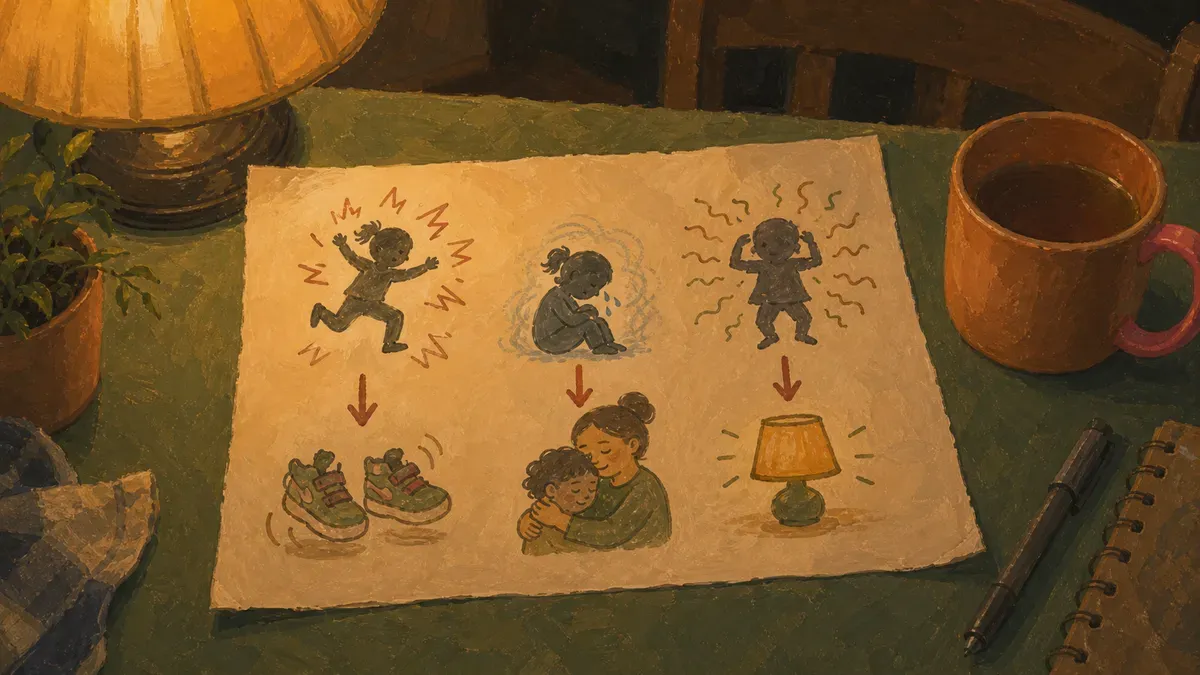
Let the body tell you which tool:
- Wound up, can’t sit, climbing the walls? Movement first. Heavy work, jumping jacks, a hallway sprint before anything else.
- Frozen, teary, shutting down? Connection. Get close, offer breathing, your steady presence is the safe space.
- Buzzy and overstimulated? A sensory reset. The bottle, dim lights, fewer words.
For a color-coded shortcut, lean on the four-color zones of regulation framework by OT Leah Kuypers, which gives kids a shared word for blue, green, yellow, and red states. Tape a self-regulation strategies pdf to the fridge so the matching becomes a routine and the tools are picked before the meltdown, not during it.
No more guessing in the moment. You read the signs, you grab the tool, you move on with your day.
Calming Strategies for ADHD, Autistic, and Big-Feelings Kids
The same tool lands differently depending on the kid in front of you, so here’s how to bend these strategies for an ADHD body, an autistic kid heading toward overload, and a big feeler at any age.
ADHD: Strategies for a Body That Won’t Stop
Asking an ADHD kid to sit still and breathe before they’ve burned off the buzz is a losing game. Move first, settle second. Ten jumping jacks, a hallway sprint, or a few minutes throwing themselves onto the crash pad, and then the breathing has somewhere to land.
What helped me with Eli was giving him a word for the speed in his body.
The Alert Program, built by occupational therapists Mary Sue Williams and Sherry Shellenberger, uses an engine metaphor: is your engine running high, low, or just right? It hands a kid the language and the tools to notice and shift gears, which is half the battle with executive function that runs ahead of the brakes.
For the deeper version, here’s guidance on supporting a dysregulated autistic or ADHD child, plus my own walkthrough of OT emotional regulation strategies for an ADHD kid whose body won’t stop.
Autism: Sensory-Safe Accommodations
With my autistic kid, the goal shifted from fixing the moment to preventing it. You don’t argue an overloaded nervous system into calm. You lower the volume on the room.
That means predictable routines so nothing ambushes him, a low-sensory safe space he can retreat to, headphones for the grocery store, dimmer lights when the day’s been long. Deep pressure helps some kids find the floor again, and a weighted lap pad across the knees gives that grounding without pinning a kid down the way a full blanket can. The 2-pound one I’d hand a nervous first-timer is an Amazon’s Choice at 4.7 stars across 1,700-plus reviews; check the current price on Amazon and start light, because 2 pounds is plenty for a lap. Knowing the difference between a meltdown and a tantrum changes what you do next. A meltdown isn’t a bid for something, it’s overload spilling over, and autism.org notes the nervous system can take 20 minutes or more to come down even after the stressor is gone.
A meltdown ends when the body resets, not when you give in, so your job is safety and quiet, not negotiation.
Adjusting by Age, From Toddler to Big Kid
One strategy, three deliveries. Here’s how it looks by age: - Toddlers: Do it with them. Breathe loud, name the feeling out loud, be the calm they borrow. - School-age kids: They can run a five-senses scan or grab a fidget on their own once they’ve practiced it enough. Buying a 4-pack (4.6 stars, 12,000-plus reviews) means the lost one is never a crisis.

- Big kids: Drop the cute label. Call it a reset, a cool-off, their spot. Same tools, repackaged for bigger emotions and more pride.
Build a Calm-Down Space and Daily Practice at Home
A label change gets the strategy in the door. What keeps it there is a physical spot and enough rehearsal that a child can find it without your help.
Set Up a Calm-Down Corner Kids Will Use
A calm-down corner doesn’t need a bean-bag budget or anything you saw on Instagram. A corner of the couch with a basket of tools is enough:
- Something soft to sit on
- One or two sensory items (a squeeze bottle, a fidget, a weighted lap pad)
- A feelings card on the wall where a child can actually see it
Position it somewhere quiet but not isolated. A kid in crisis doesn’t want to feel banished. They want to feel held.
The corner only works if your child knows it before they need it. Introduce it on a calm afternoon, let them pick the pillow, let them name the spot. Ownership matters more than aesthetics, and a space a child helped build is one they’ll actually use.
For a full walkthrough of what goes in and how to introduce it without eye-rolls, see how to build a calm down corner at home. For the research behind why a designated spot helps kids return to ready faster, the calm down corner emotional regulation guide goes deeper.

Practice Calm When Everyone Is Already Calm
Most families skip this piece: a child can’t retrieve a strategy mid-meltdown if they’ve only ever heard about it during one.
Practice dragon breathing on a Wednesday afternoon, not after a blowup on Saturday. The Kids Mental Health Foundation explains that repeated use of adaptive strategies can reshape the neural circuits tied to fight-flight-freeze reactions, meaning the practice you do during calm moments is the practice that actually shows up when big emotions hit.
Build it into existing routines rather than carving out separate time.
- Two minutes of belly breathing before books at night
- A squeeze of a stress ball during after-school snack (a 2-pack runs 4.5 stars across 4,000-plus reviews, so one can live in the car too)
- Walk through a calming scan together at bedtime, when the room is already quiet
Small repetitions on ordinary days are how a toolkit becomes something a child reaches for on their own.
Found this useful? Save it for the next rough afternoon.
Questions parents ask me about this
What emotional regulation activities actually work for kids?
The ones that match what the body needs in that moment. A wound-up kid needs movement first, a frozen or shut-down kid needs connection, and an overstimulated kid needs a quieter sensory reset. Breathing exercises, heavy work like wall pushes, cold water, grounding scans, and feelings labeling all work when you read the signal correctly. The strategy itself matters less than timing.
At what age can a child start to self-regulate emotions?
Toddlers cannot self-regulate on their own at all; they borrow your calm, which is why co-regulation comes before any strategy. School-age kids can start running simple tools themselves with enough practice during calm moments. Teenagers can label and manage their internal state, though they still need a low-judgment adult nearby on the hard days. The skill builds gradually over years, not weeks.
What is the difference between a meltdown and a tantrum?
A tantrum is a bid for something; a meltdown is the nervous system hitting its limit. A child in a tantrum is still reading the room and adjusting behavior based on your response. A child in a meltdown is in overload and cannot stop on command, no matter what you offer or take away. Treating them the same way, with consequences and negotiation, does not help a meltdown and can make the next one worse.
How do I help my child when they shut down instead of acting out?
Shutdown is the nervous system going quiet rather than loud, but it is still dysregulation. Start with connection before you try any tool: sit near them, speak softly, match their low energy rather than pulling them up. A gentle sensory input like a weighted blanket or slow deep pressure often helps more than words in that moment. Give it time before expecting a response.
What should I do after a meltdown is over?
Nothing right away. A child's body may need 20 minutes or more after the visible storm passes before they are ready to process anything. Once they are calm and regulated, a brief, low-key check-in works better than a debrief or a consequence. The teach-and-repair moment is real, but it belongs in the recovery window, not the wreckage.
When should I seek professional help for my child's emotional regulation?
If meltdowns are frequent, long, or getting worse over time instead of better; if your child is hurting themselves or others; or if the dysregulation is shutting down school, friendships, or daily routines, it is time to loop in a professional. An occupational therapist can assess sensory needs, and a child psychologist can look at the bigger picture. You do not have to wait until things are at a crisis point to ask for an evaluation.
How does my own stress affect my child's ability to calm down?
More than most parents expect. A regulated adult is the most powerful co-regulation tool in the room; an activated one makes it harder for a child to settle, because young nervous systems mirror the adults around them. Settling yourself first is not a luxury step. It is what makes every other strategy actually land.
Written by
Nora Hayes
Mom of two and a former preschool aide. I share the screen-free sensory play and calm-down ideas I test at my own kitchen table, plus what the moms in my little meet-up swear by. A parent passing on what works, not a doctor or a therapist.
More about NoraKeep going
All Calm & Big Feelings-
 Calm & Big Feelings
Calm Corner Ideas: 25 Picks Under Your Coffee Budget
Skip the $200 setups. These 25 calm corner ideas cost less than a latte and soothe big feelings. Build one your kid loves this week.
-
 Calm & Big Feelings
Cozy Corner Preschool: Calm Down Ideas for Throwers
Throwing the calm-down tools? Build a cozy corner preschool space that survives big feelings, with throw-proof tools and steps that work.
-
 Calm & Big Feelings
Calm Corner Classroom Setup for Autistic Kids
Most calm corners fail autistic kids because they skip the sensory profile. Build a calm corner classroom that works in 5 steps. Start here.
-
 Calm & Big Feelings
Zones of Regulation Red Zone: A Parent's Plan
Your kid is in the zones of regulation red zone and nothing works. Here's what to say, what to skip, and how to ride out the worst 10 minutes.