Zones of Regulation Red Zone: A Calm-Down Plan


I am a parent sharing what worked at my house, not medical advice. For anything to do with your child's development or sensory needs, talk to your OT or doctor.
Some links here are affiliate links. If you buy through one, I may earn a small commission at no extra cost to you. As an Amazon Associate I earn from qualifying purchases. I only point to things I'd actually use with my own two.
The red zone of regulation is the full-meltdown state where your kid can’t hear you, can’t problem-solve, and doesn’t need your words right now. I’m Nora Hayes, a former preschool aide and mom of an autistic seven-year-old, and I’ve spent enough 2am floor-sits to know the calm part of any calm-down plan starts with you.
This guide covers what to do in the moment, what to say (and what to skip), how to catch the storm early, and how to help your kid reset, all built around the Zones of Regulation framework now used in schools across more than 40 countries.
What the Red Zone Actually Looks Like
The red zone is a kid who has lost the wheel: too angry, too overwhelmed, or too far gone to steer themselves back. You learn to read it in the body first, then you understand why your words bounce right off.
The Body Cues That Come First
Forget what your kid says in this moment. Watch what their body does. Before the screaming peaks, you’ll usually catch the same tells: clenched fists, a flushed face, a jaw locked tight, a voice climbing louder and faster, a body that won’t hold still. Some kids pace. Some bolt. Some go stiff and red.
Those are the warning lights, and by the time you spot two or three of them stacking, you’re close to the edge.
- A racing heart your kid may not consciously notice
- A chest tightening, breath going shallow
- Heat rising through the face and neck
Why do the body cues matter so much? It comes down to interoception: the nervous system’s ability to sense its own state. Kids with weaker body awareness of those internal signals tend to swing harder and faster, because they can’t feel the storm building until it’s already on top of them. You’re reading the cues your kid can’t yet read in themselves.
If you want a side-by-side of calm, wound-up, and gone, here’s what each zone of regulation looks like at home.
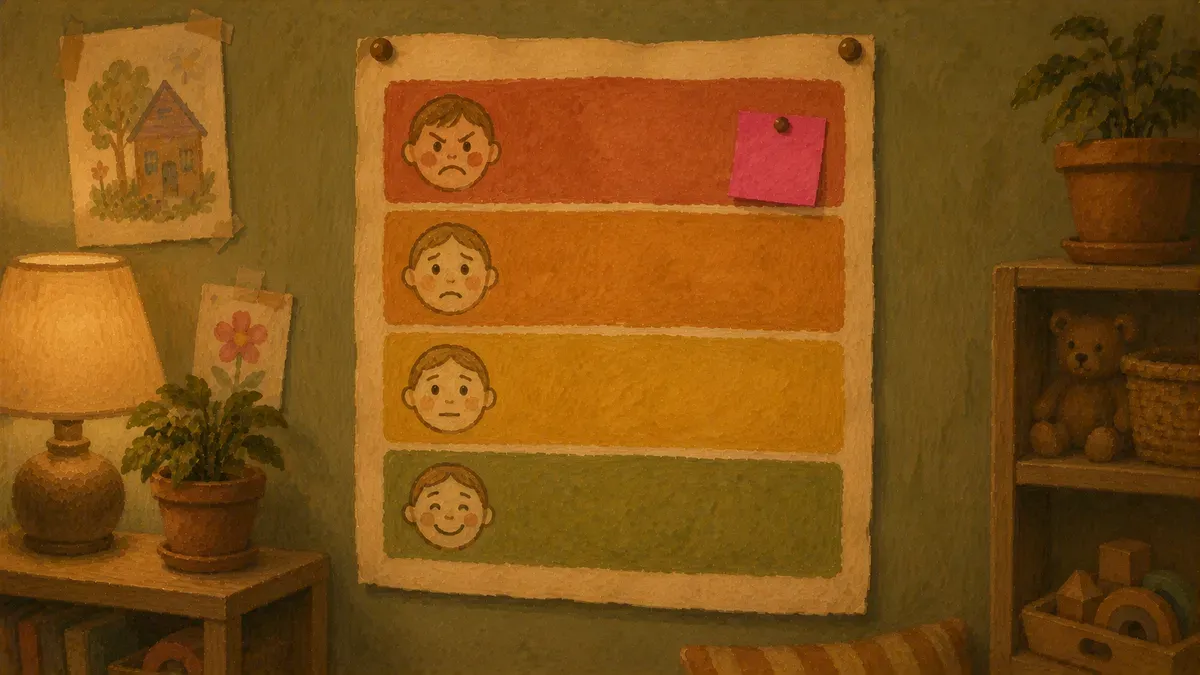
Why a Red-Zone Brain Can’t Hear You
Here is the part that saves your sanity at 6pm: in a heightened state, the thinking part of your kid’s brain has gone offline. You are talking to a brain that physically cannot use logic right now.
This has a name. - Healthline calls it an amygdala hijack: the brain’s alarm center takes over.
- The prefrontal cortex, the part that handles reasoning, empathy, and self-control, goes quiet.
- Consequences, questions, and “use your words” don’t land because there’s nobody home to receive them.
It’s not defiance and it’s not manipulation. A child’s regulating brain is still under construction, so during this kind of dysregulation the emotional system runs the show and the calm-it-down system barely gets a vote. That’s the out-of-control feeling, for them and for you.
So when your reasoning hits a wall mid-meltdown, you’re not failing. You’re just early. The words can come later, once the brain comes back online. Right now your job is to be the calm, not to be convincing.
The First 10 Minutes: What to Say and Do
The first ten minutes set the tone for everything that follows, and they break into three moves: settle your own body, say the few words that land, then hand the body a way out. None of it asks your kid to think, which is the whole point.
- Drop your shoulders and slow your breath before you do anything else.
- Say two or three words on a loop. No questions back, no explanations.
- Give the body a physical exit: pressure, movement, or somewhere quiet.
Calm Your Own Body First
Sounds backwards when a small person is screaming, I know. But your nervous system is the tool here, not your words.
A dysregulated kid borrows their calm from the nearest steady adult. That borrowing has a name, co-regulation, and it works through your body before it works through anything you say. Research on co-regulation and the stress response from ZERO TO THREE describes it as dyadic synchrony: a regulated grown-up can actually steady a child’s stress system just by being settled nearby.
Before you reach for theirs, run a quick self-check:
- Shoulders dropped or braced?
- Breath slow or held?
- Voice steady or climbing?
The fastest way to calm down a raging kid is to be the calm they can sync to, and you can’t fake that with a clenched jaw and a sharp tone.
If you need the mechanics of staying steady while they aren’t, here’s how to co regulate kid in the moment without losing your own footing.

Short Phrases That Actually Land
Now that your voice is steady, keep your words tiny. The red zone is no place for a paragraph.
A kid mid-meltdown has no spare brain to decode sentences, so any feelings talk that demands a response will bounce right off. What lands is short, repeated, and asks nothing back:
- “I’m right here.”
- “You’re safe.”
- “I’ve got you.”
- “I’m not going anywhere.”
Pick one or two and say them on a loop, slow and low. You’re not teaching emotional vocabulary right now, you’re being a heartbeat they can find in the noise. The lesson comes later.
Naming the feeling can help once the storm thins out a little. The American Psychological Association notes that talking with kids about their emotions, rather than brushing them off, builds emotional competence over time, and a line like “It looks like you’re angry because the tower fell” gives a child something to pause on. Save it for the edge of the storm, not the center. In the center, a common language of three or four safe words does more than any clever script.
Offer the Body a Way Out
Words carry a kid only so far. A raging body needs a physical exit, not a conversation.
Four exits worth keeping in rotation:
- A weighted blanket or a tight squeeze, if they like pressure
- Deep breathing you do together, slow in through the nose, longer out
- Heavy work, carrying, pushing, hauling something with weight
- A quiet retreat, dim and low on noise, until the wave passes
These are coping strategies you offer, never force. The one we keep folded over the couch arm is a 5-pounder, heavy enough to feel like a hug without pinning a small kid down, and it’s earned 4.7 stars from more than 1,700 parents. Eli has days he shoves the blanket off and just needs to run laps in the yard. That counts too. If you want a permanent landing spot for this, a stocked calm down corner emotional regulation setup means the way out is already waiting when the next red zone hits. Offer the door, then let the body walk through it on its own clock.
What Not to Say When Your Kid Is Raging
The door out matters, but so does whatever is coming out of your mouth while your kid is mid-rage. Some of the most natural things to say are the ones that pour gas on the fire, and a couple of common reactions need a plan before they happen, not after.
The Phrases That Pour Fuel on It
Here’s the hard part. The phrases that fly out of us first are usually the ones that make it worse. They feel like help. They land like a match.
- “Calm down” or “you’re fine.” Telling a dysregulated child to calm down or stop crying can actually hurt their ability to settle, compared to kids whose feelings get acknowledged. The APA flags dismissive commands as counterproductive during an episode. Your kid hears “my big feeling is wrong,” and the anger climbs.
- “If you don’t stop, then…” A threat adds another fight to a kid who is already past the point of control. It raises the stakes when your whole job is to lower them.
- “Why are you doing this? Use your words.” Asking an out-of-control kid to explain is asking the offline part of their brain to file a report. It can’t.
That last one trips up the most parents I sit with in our living-room group. We want a reason, because a reason feels like a handle. But demanding one mid-storm just adds a task to a kid who can’t even find their breath. The trigger here isn’t your child being difficult. It’s a nervous system parked well past logic.
Save the talking for after; during the red zone, fewer words win.
When Throwing and Hitting Happen
Sometimes the meltdown comes with flying shoes or swinging fists. Your first job stops being words and becomes bodies. Move the breakables, clear the little sibling, put yourself between your kid and anything that hurts, including you.
- Hold the limit without the lecture. “I won’t let you hit” while you block the swing is a full sentence.
- Stay close and keep it low-key. You’re not reasoning right now; you’re keeping everyone safe.
- If staying near makes it worse for your particular kid, give them space. That’s information, not rejection.
Some children need space to come down, and that’s information, not rejection. You’re still the calm anchor, just from three feet back. If hitting and throwing are a regular thing at your house, our walk-through on kid throws things theyre angry goes deeper than I can here.
One caution worth naming: this level of intensity can genuinely frighten a parent, and there are signs that point toward getting a professional involved. - Aggression that causes real danger, or tantrums that run past 25 minutes, are flags the American Academy of Child and Adolescent Psychiatry says are worth a call to a professional.
- A pattern that scares you counts too. Riding out a hard episode is normal. Calling for help when the pattern worries you isn’t failing; that’s parenting.
Catching the Red Zone Before It Hits
The best red-zone plan is the one you never have to use, because you caught the slide early. Two things make that possible: reading the warning signs your kid throws off before they tip into full loss of control, and knowing the handful of triggers that push your specific child over the edge.

Spotting the Yellow-Zone Warning Signs
There is almost always a yellow zone before the red. It’s the wobble before the fall, and it’s your window.
Yellow is where a quick tool still lands, before the thinking brain checks out. If you want the full picture of how the zones of regulation work, I broke it down elsewhere.
Watch for the body cues that show up early at your house:
- Goofy, too-loud energy that won’t settle
- Picking fights with a sibling over nothing
- Whining, clinging, or sudden tears over a small thing
- Bouncing off the walls when it’s almost bedtime
None of those are red yet. They’re an invitation. A snack, a few minutes of heavy work, a change of room, a hug, any of it has a real shot at nudging the dial back toward green. Wait until the screaming starts and your tools stop working. Self-regulation is a skill, and you teach it by stepping in while there’s still room to steer.
Knowing Your Kid’s Triggers
Same kid, same handful of things, over and over. Once you spot the pattern, you stop getting ambushed.
The usual suspects show up in a pattern once you know to look:
- Hunger (the 5pm spiral is almost always this)
- Overtired, running on fumes
- Too much noise and chaos with no break
- Transitions from one activity to the next
Transitions are sneaky because of how sensory processing and interoception work together: a kid often can’t feel they’re already dysregulated, so the second you say “shoes on, we’re leaving” lands like a shove instead of a request.
The other big one is the size of the problem. A snapped cracker or the wrong color cup is, to a little kid, a genuinely huge deal. Calling it small doesn’t help. Knowing it’ll hit hard does.
Keep a rough log for a week. Jot the time, what came right before, and how bad it got. Patterns surface fast: it’s always 5pm, always the leave-the-park moment, always after a loud playdate. That list is your early-warning system, and it’s worth more than any script for the storm itself.
Reconnecting After the Storm Passes
The storm always ends. What you do in the quiet after it shapes whether the next one is shorter, and it splits into two jobs: reconnect first, then, much later, build the skills together.
Repair First, Teach Later
When the crying stops and the shoulders drop, your kid isn’t ready for a lesson. They’re ready for you. The first thing they need is to know you’re still on their side, that nothing broke between you that a hug can’t fix.
So repair before anything else. - Pull them close, hand them water, sit on the floor.
- No mention of what just happened, no “we don’t throw blocks,” no review.
- That comes later, when they’re fully back in the green zone, calm and settled, sometimes the next morning over breakfast.
This is where co-regulation does its quiet work again: your steady body tells theirs the danger has passed.
CHADD puts it plainly: mid-meltdown is “usually not the best time to explain a consequence or have a long conversation,” and emotional regulation improves gradually, not in one teachable moment. When you do circle back, keep it short and curious. “That was a big feeling. What was going on?” Give them the words, the common language and emotional vocabulary, to name what swallowed them. If you want a script for it, here’s how to talk meltdown after everyone has calmed.
Building the Toolbox Together
One good repair doesn’t change much. A hundred of them do.
Every calm-after talk is a deposit. You’re not fixing today’s blowup, you’re slowly handing your kid their own toolbox, the coping strategies they’ll one day reach for without you. “Last time, squeezing the pillow helped. Want to try that next time you feel it building?” That’s regulation skills being built, one low-stakes conversation at a time.
It’s slow, and it’s supposed to be. The Zones of Regulation team’s evidence-base writeup of a University of Minnesota study across five schools reports that students’ social-emotional “Strengths” rose from 28% to 55% in four months, while classrooms without it barely moved. Repeated practice builds real, measurable self-regulation.
A steady spot helps the practice stick. Many families set up a calm corner to build a steady go-to spot for big feelings, so the tools live somewhere your kid can find them.

The red-zone moments won’t vanish. They’ll just get shorter, further apart, and a little easier to climb out of, because you’ve been building the way out together all along.
Red-Zone Plans by Age and Need
The bones of a red-zone plan stay the same at every age and for every kid. What changes is the dial: how many words, how much body, how much space. Here is how to tune it for the kid in front of you.
Toddlers, Big Kids, and Preteens
A two-year-old in the red zone is not a small ten-year-old. Tantrums peak early, then fade as language grows in, and the Potegal temper-tantrum research shows exactly why the plan has to shift. They found 85 to 90% of kids between 18 and 36 months have tantrums, against only about 10% of four- and five-year-olds.
So with toddlers, lean almost entirely on your body.
- Keep words to a minimum; they are not ready to process sentences yet.
- Co-regulate with your body: a steady arm, a calm face, close presence.
- Hold off on talking until they are through the worst of it. Asking for explanations gets you nothing.
Big kids in the four-to-seven range can start to share a common language with you. This is where naming a zone and pointing to a calm-down spot begins to land, once they are out of the worst of it.
Preteens need something toddlers never do: privacy. A ten-year-old hates an audience.
- Step back and say “I’m right here when you’re ready,” then mean it.
- Offer two choices instead of one direction; at this age, a little control is what actually calms them down.
Neurodivergent and Sensory Needs
For a neurodivergent kid, the red zone often is not a tantrum at all.
| Tantrum | Meltdown | |
|---|---|---|
| Driver | A goal (it stops once the goal is met) | System overload with no off switch |
| Response | Setting a limit works | Talking and redirecting make it worse |
Sensory triggers are usually the engine. Sensory processing challenges show up in 5 to 15% of children overall but climb to between 20 and 95% in kids with neurodevelopmental conditions, per a 2020 Cogent Medicine study. That gap is exactly why the standard talk-it-out script falls flat here.
Interoception is the other piece. A 2025 review found about 50% of autistic individuals struggle to identify their own emotions, tied to weak interoceptive signals, so the body hits red before the kid ever feels it coming.
That means sensory-friendly tools, not lectures.
- Deep pressure: a weighted lap pad, a firm squeeze, heavy-work input
- A dim corner with minimal visual noise
- Noise-cancelling headphones sized for kids to cut sound
- A chew necklace for oral input
None of these cost much. The lap pad we keep in the car is a 2-pounder that drapes over the knees while a kid waits, an Amazon’s Choice with more than 4,500 ratings behind it. Headphones I’d buy first. At 18,000-plus reviews and 4.6 stars, they give a sound-sensitive kid a quiet bubble in a loud gym without shutting the world out. The chew necklaces come six to a pack of food-grade silicone, rated 4.6 across 1,800-plus reviews, which matters when they get gnawed to nubs and left at grandma’s. Skip the fancy single chewy and check the current price on Amazon.
The Zones team makes the same point in their guidance on childhood meltdowns and sensory processing: pare it down and co-regulate first. Offer the tool, never force it, and let their body lead the way out.
Found this useful? Save it for the next rough afternoon.
Questions parents ask me about this
What do you do when a child is in the zones of regulation red zone?
Settle your own body first, then get close and use as few words as possible. The thinking brain is offline during a meltdown, so calm instructions land as noise. Stay near, keep it to short phrases like "I'm right here" or "you're safe," and give their body a way out, whether that's a room change, heavy work, or just space to move.
How long does a red zone meltdown usually last?
Most meltdowns burn out on their own once the child isn't being further escalated. Staying close, keeping things quiet, and not demanding anything shortens it. If a meltdown stretches past 25 minutes, that's a signal to loop in a professional.
Is the red zone a bad zone or a normal feeling?
It's a normal feeling, not a bad one. Everyone lands in the red zone; kids and adults alike. The goal of naming zones isn't to eliminate big emotions but to help children recognize where they are so they can learn, over time, to move through it. Rage, panic, and overwhelm are real. The red zone is just a word for when those feelings are running the show.
Should you give consequences for red zone behavior?
Not during the meltdown itself. Mid-episode is the worst time because the child has lost access to the reasoning brain that makes a consequence meaningful. Protect bodies, hold a calm limit without a lecture, and wait. Once your child is back in the green zone, a short and low-key check-in is far more useful than a consequence delivered in the heat of the moment.
How is a meltdown in the red zone different from a tantrum?
A tantrum usually has a goal and a stopping point the child controls. A meltdown doesn't. There's no negotiating out of it, no clear off switch, no audience behavior. The child isn't making a choice; their nervous system has taken over. For many neurodivergent kids especially, a meltdown looks like loss of control because it is, not defiance.
When should you get professional help for frequent red zone episodes?
If red-zone episodes are happening daily, causing injury, or lasting much longer than you'd expect, start with your pediatrician and ask for a referral to an OT or child therapist. Aggression that puts someone at risk, or an episode that runs past 25 minutes, are both clear flags. Frequent dysregulation can have sensory, neurological, or emotional roots that a professional is trained to identify.
Can a calm-down corner actually help during the red zone?
Not usually in the middle of it. A calm-down corner is most useful in the yellow zone, that early window before things tip over, when the body can still respond to an invitation to settle. During a full red-zone episode, leading a child to a corner doesn't help and can escalate things. Set it up and practice it when things are calm so your child knows it's a safe spot, not a consequence.
Written by
Nora Hayes
Mom of two and a former preschool aide. I share the screen-free sensory play and calm-down ideas I test at my own kitchen table, plus what the moms in my little meet-up swear by. A parent passing on what works, not a doctor or a therapist.
More about NoraKeep going
All Calm & Big Feelings-
 Calm & Big Feelings
Emotional Regulation Activities for Kids That Work
Most calming tricks fail mid-meltdown. These emotional regulation activities for kids work when nothing else does. Find the one that fits your child.
-
 Calm & Big Feelings
Calm Corner Ideas: 25 Picks Under Your Coffee Budget
Skip the $200 setups. These 25 calm corner ideas cost less than a latte and soothe big feelings. Build one your kid loves this week.
-
 Calm & Big Feelings
Cozy Corner Preschool: Calm Down Ideas for Throwers
Throwing the calm-down tools? Build a cozy corner preschool space that survives big feelings, with throw-proof tools and steps that work.
-
 Calm & Big Feelings
Calm Corner Classroom Setup for Autistic Kids
Most calm corners fail autistic kids because they skip the sensory profile. Build a calm corner classroom that works in 5 steps. Start here.