Social and Emotional Learning Curriculum and the IEP


I am a parent sharing what worked at my house, not medical advice. For anything to do with your child's development or sensory needs, talk to your OT or doctor.
If your child’s school already runs a social and emotional learning curriculum, you have more leverage than you think to get a calm-down corner written into their IEP or 504 plan as a real accommodation, not a favor the teacher might remember on a good day.
That matters because a strategy on paper survives a substitute, a new classroom, and a rough October, while a verbal “sure, we can try that” usually does not.
I’m Nora Hayes, a former preschool aide raising an autistic 7-year-old, and this guide covers what these programs actually teach, why the IEP is where you ask, and the exact words to use when you do.
What a Social and Emotional Learning Curriculum Actually Teaches
Strip away the jargon and a good program teaches one thing: how a kid handles big feelings and other people. CASEL, the group most schools build their lessons on, breaks that into five named skills, and one of them sits right under any calm-down corner.

The Five Competencies Behind Every SEL Program
When a teacher says their classroom uses SEL, they almost always mean a version of the five core SEL competencies framework that CASEL spells out. Knowing the five by name is what lets you sit in a meeting and ask for the right one instead of nodding along.
Here is what each one is supposed to deliver, in CASEL’s own words:
- Self-awareness: understand one’s own emotions, thoughts, and values
- Self-management: manage one’s emotions, thoughts, and behaviors effectively
- Social awareness: understand the perspectives of and empathize with others
- Relationship skills: establish and maintain healthy and supportive relationships
- Responsible decision-making: make caring and constructive choices about personal behavior
That’s the whole map. Naming a feeling is self-awareness. Calming down before the marker gets thrown is self-management. Reading the room and noticing a friend is upset is social awareness. The last two, relationship skills and responsible decision-making, are the longer game, the stuff that shows up on the playground and in group work.
Why Self-Regulation Sits at the Center of the Framework
Of those five, self-management is doing the heaviest lifting when your kid is melting down at their desk.
That is exactly the skill a calm-down corner is built to grow. The framework hands a child a goal, regulate yourself before you boil over, and the corner gives them a physical place and a routine to practice it. One is the why, the other is the where.
- Emotional regulation is not soft or separate from learning. It is the foundation of it.
- A meta-analysis of 213 school programs covering more than 270,000 students found an 11-point academic achievement gain for participants, per CASEL’s research summary.
- Calmer kids also show better behavior and well-being, which is why self-management is the competency worth pointing at in a meeting.
How a Calming Corner Turns the Curriculum Into Something a Child Can Use
Self-management on a worksheet is just a word. In the corner of a classroom it becomes a place a kid can walk to, which is where the curriculum stops being abstract and starts being something your child can actually do.
What Belongs in a Classroom Calming Corner
A calm down corner in a classroom is mostly stuff you’d recognize from a sensory bin, arranged so a wound-up kid can reach it without having to ask. Start with seating that signals slow down: a floor cushion, a beanbag, or a low chair tucked away from the busy center of the room.
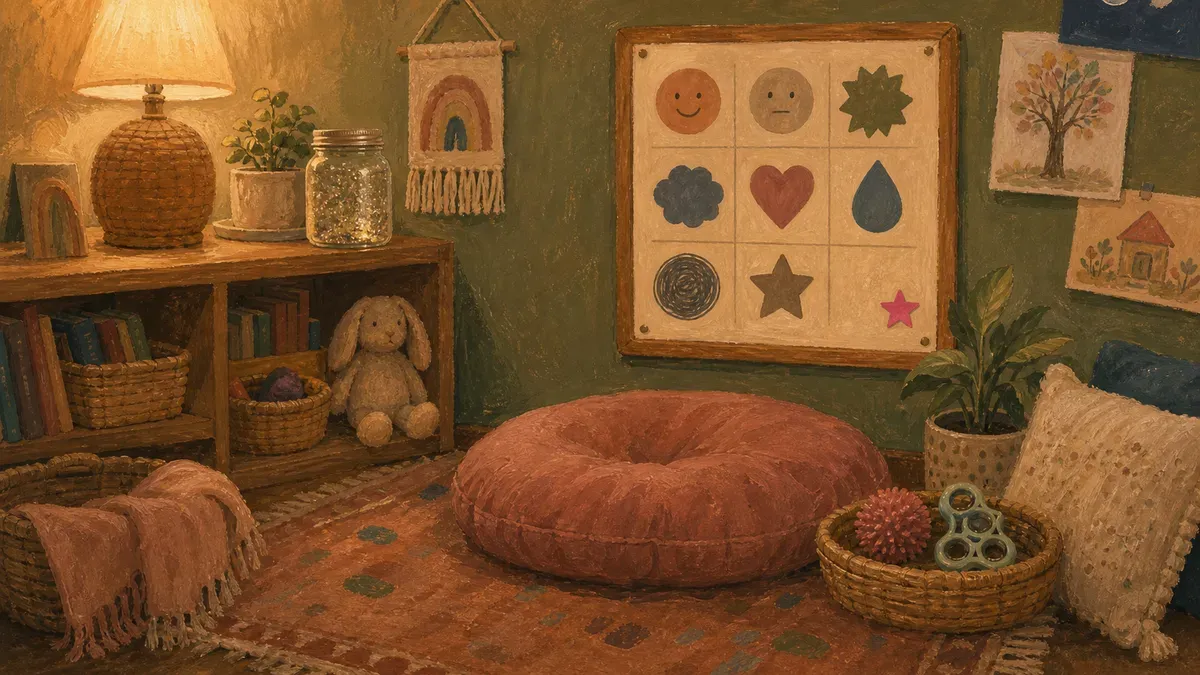
Then the sensory tools. A 2021-2022 study across elementary and middle schools, described by Mental Health Center Kids, stocked these corners with stress balls, slime, playdough, and fidgets, and first graders showed measurable gains in coping and personal control. Those are the working parts of emotional regulation, not decoration.
The last two pieces are what make the SEL skills usable in the actual moment:
- A feelings chart, so a kid who can’t find the words can point instead
- A breathing prompt, a simple card or poster that walks them through it
That’s the whole behavioral intervention. Put all four pieces in place and the corner stops being a nice idea on a checklist. It becomes a working system a child can actually navigate on a hard day.
How the Corner Reinforces Skills the Curriculum Names
Here’s the part most schools get wrong. The corner only works when going there is a choice, not a sentence.
Restorative-practice educators draw a hard line between a calming corner and a time-out: access should never be restricted as a form of punishment, and the real goal is a child who eventually walks over on their own. That self-initiated visit is self-management happening in real time. A kid feels the storm coming, decides to step away, and uses the tools. That is the exact decision-making the curriculum keeps naming.
| How it’s used | What it teaches |
|---|---|
| Child chooses to go | Regulation skill that sticks |
| Sent there as punishment | Resistance, not relief |
Want to see a calm corner in a classroom up close? Here’s what a calm corner classroom looks like in practice for one autistic kid. That picture is also exactly what you’ll point at in the meeting where you ask the school to put it in writing.
Why the IEP or 504 Plan Is Where You Ask for It
A teacher can love a calming corner and still lose it the year your kid changes classrooms. The two subsections below sort out where a calm-down corner belongs on paper, and why tying it to the program your school already runs is the fastest yes you’ll get.
Accommodation vs. Goal: Where a Calm-Down Corner Fits
There are two ways a calm-down corner can show up in your kid’s plan, and they do different jobs.
An accommodation is a thing the school provides, like access to a quiet space with sensory tools when your child feels overwhelmed. A goal is something your child works toward, measured over time, like “will use a calming strategy when frustrated in four of five chances.” One is a support. The other is a skill being built and tracked.
Where each lands depends on the document. Per federal guidance on IEP and 504 accommodations from Understood, an IEP requires annual goals that are measurable, while a 504 plan provides accommodations without requiring measurable goals.
So here’s how it shakes out:
- In a 504 plan, write the corner as an accommodation. Access to the space, plain and simple.
- In an IEP, you can do both: list the corner as an accommodation and attach a self-management goal that uses it, with assessment built in.
The accommodation is the floor every team should agree on. The measurable goal is what turns a nice idea into something the team actually revisits. The support is owed, not granted as a favor.
Tying the Request to the School’s Existing SEL Program
Here’s the move that makes the meeting easier. You’re not asking for something new. You’re asking the school to apply a tool it already paid for.
Most teams already operate inside an SEL framework. CASEL reports that 83 percent of U.S. school principals said they used an SEL curriculum in 2023-24.
- That stat is your anchor.
- A calm-down corner isn’t an add-on. It’s how their self-regulation curriculum gets practiced in real time.
- Frame the request as integration, not a special favor.
“Your curriculum teaches self-management. This is where my kid practices it.” When the request lines up with state standards the district already follows, the team has far less reason to push back, and school districts that bought into SEL have a paper trail that backs you.
If you want the language to point at, our guide to calm down corner emotional regulation breaks down what goes in the space. Bring that picture to the table, and the ask answers itself.

Exact Language to Put in the IEP or 504
A clear picture of the space is half the battle; the other half is words specific enough that nobody can argue with them later. Here is the phrasing to hand over, and how to make it tight enough to actually track.
Sample Accommodation Wording You Can Bring to the Meeting
Don’t walk in with a vibe. Walk in with a sentence you’d be happy to see typed into the accommodations table. Something like:
“Student has access to a designated calm corner (or sensory space) for self-regulation breaks, available on request by the student or as offered by staff, for up to 5 minutes per break.”
That single line does the heavy lifting. It names the space, it makes the break a right rather than a favor, and it says who decides and how long. A common version of 504 accommodation wording phrases it as access to a quiet space for breaks, with a note to clarify when and how those breaks are requested so there’s no confusion mid-meltdown.

While you’re at it, list the calm corner ideas for classroom use you want the space to actually hold. The plan can spell out:
- Soft seating (a beanbag, a floor cushion)
- A feelings chart for naming the emotion
- A breathing prompt card or visual
- One or two quiet sensory tools (a fidget, a weighted lap pad)
Write it down and those calming corner ideas for classroom support stop being optional decor and start being part of the accommodation. That’s the difference between a behavioral intervention on paper and a pile of stuff a substitute might pack away.
Defining Triggers, Tools, and an Exit Signal
Vague language is where good plans go to die. “Breaks as needed” sounds fine until you realize nobody can measure it, and special education guidance is blunt about this: an IEP accommodation table should identify each support with its frequency, location, and duration spelled out. So spell them out.
Three pieces make it trackable:
- The trigger. What sends the kid to the corner. Rising voice, balled fists, the warning signs you and the teacher both recognize before things tip over.
- The tools. The exact items they reach for, so it reads as a regulation step and not a hideout.
- The exit signal. How the child shows they’re ready to rejoin, a thumbs-up, a card flipped to green, a quiet word to the aide.
Name all three and the corner becomes an emotional regulation skill the team can watch grow, not a vague allowance. For practice runs at home, our emotional regulation activities for kids cover the same calm-down moves your kid can rehearse before they ever need them at school.
Making the Calm-Down Strategy Work at Home Too
A skill the corner builds at school sticks faster when your kid practices the same moves on your couch. Here is how to copy the setup and the words your child already hears in class, so home and school stop feeling like two different worlds.
Mirroring the Classroom Cozy Corner in Your House
You do not need a whole room. A corner of the playroom, a beanbag wedged behind the couch, a basket of the same tools the teacher uses. That is the win: when the home spot mirrors the classroom cozy corner your kid already knows, they walk in and the rules are obvious, because they are the rules they practice every day.

Match what you can. The same feelings chart, the same breathing card, a calming jar like the cozy corner in their classroom has. Emotional-regulation educators recommend that home and school calming spaces share the same name, visuals, and procedures so the skill carries across both.
- Same feelings chart, not a different version you printed
- Same name for the spot (whatever school calls it)
- Same sequence: go in, pick a tool, check in before coming out
The self-awareness and self-management your kid is building do not switch off at the school door. These cozy corner ideas from the classroom translate directly at home: one setup your kid already knows, practiced in two places instead of one. If you want a step-by-step, our full guide to building a calm-down routine walks you through it, and it shows you how to set up a calm down corner at home without buying a thing.
Using the Zones Language Everyone Already Knows
Here is where most home corners quietly fail: the tools match, but the words do not.
Pick the one the school already uses and use it at the kitchen table too. If their class runs the zones of regulation, then “what zone are you in?” should sound the same on a Tuesday night as it does in second period.
- School: “you’re in the yellow zone, what would help?”
- Home, same question on a Tuesday night
- Same check-in, same exit, one less thing your kid has to translate while already upset
Zones of Regulation’s own evidence summary reports that families who carry that vocabulary home gain more shared language for talking about feelings, and educators see kids check in more often and recover with fewer blowups. That is the real point of integration. One emotional-regulation system, named the same way everywhere, so your kid practices self-management instead of learning two separate scripts and mastering neither.
Found this useful? Save it for the next rough afternoon.
Questions parents ask me about this
How does social and emotional learning curriculum support calm-down strategies?
SEL curriculum teaches children that managing strong feelings is a learnable skill, not just a personality trait. The calm-down corner is where that lesson becomes practice: the child learns the concept in the curriculum, then uses the corner to actually do the thing when feelings run hot. Without the curriculum giving the strategy a name and a framework, the corner is just a cozy chair. Together, they form one system.
Can a calm-down corner be written into a 504 plan instead of an IEP?
Yes. A 504 plan covers it as an accommodation, which means the school provides the corner and the access without tying it to a measurable goal. That is a lower bar to clear than an IEP goal and is appropriate when the child needs the support but does not require specialized instruction. The written language still needs to be specific enough that a substitute teacher can follow it.
Is a calming corner the same as a time-out?
No, and the difference matters. A time-out is something done to a child; a calming corner is something a child uses. The corner is available before or during a big feeling, and the child is never locked out of it as a consequence. The hard part is saying it right: 'You're not in trouble, and you get to choose when to use this spot.' That phrasing keeps the corner feeling like a resource.
What do I say if the teacher pushes back on a classroom calming corner?
If the district has adopted an SEL curriculum, the calm-down corner is already an implementation of what the school teaches, not an add-on. Address the practical concerns directly: where the corner will sit, how large it needs to be, whether it disrupts the class if a child gets up to use it. Most teachers' real worry is space and classroom flow, not the idea itself. Offering to help stock the corner, and keeping the ask simple, usually moves the conversation forward.
How do I make the accommodation measurable so the IEP team approves it?
The plan needs a trigger, the specific tools available, how long the break lasts, and an exit signal the child uses to rejoin the group. Vague language like "breaks as needed" gives the team nothing to track. Spelling out a five-minute limit, the signal the student uses when ready, and where in the room the corner sits turns a soft request into something the IEP team can write data toward.
Does my child's school have to provide SEL tools if they aren't in the budget?
Schools are required to provide accommodations written into an IEP or 504 plan, and budget is not a legal excuse for removing a required support. That said, the tools for a calming corner are genuinely low-cost: soft seating, a printed feelings chart, a basic breathing prompt card. Keeping the list simple and affordable makes approval easier and removes the budget objection before it comes up.
What should I put in a calm-down corner for a child with autism or ADHD?
Start with soft seating, a feelings chart, a breathing visual, and one or two sensory tools matched to how your child actually seeks or avoids input. A sensory-seeker might want a fidget or a stress ball; a child who gets overwhelmed easily might want noise-canceling headphones or a weighted lap pad. The corner works best when the tools reflect how that specific kid regulates, not a generic list. Match what you know, adjust as you go.
Written by
Nora Hayes
Mom of two and a former preschool aide. I share the screen-free sensory play and calm-down ideas I test at my own kitchen table, plus what the moms in my little meet-up swear by. A parent passing on what works, not a doctor or a therapist.
More about NoraKeep going
All Calm & Big Feelings-
 Calm & Big Feelings
Emotional Regulation Activities for Kids That Work
Most calming tricks fail mid-meltdown. These emotional regulation activities for kids work when nothing else does. Find the one that fits your child.
-
 Calm & Big Feelings
Calm Corner Ideas: 25 Picks Under Your Coffee Budget
Skip the $200 setups. These 25 calm corner ideas cost less than a latte and soothe big feelings. Build one your kid loves this week.
-
 Calm & Big Feelings
Cozy Corner Preschool: Calm Down Ideas for Throwers
Throwing the calm-down tools? Build a cozy corner preschool space that survives big feelings, with throw-proof tools and steps that work.
-
 Calm & Big Feelings
Calm Corner Classroom Setup for Autistic Kids
Most calm corners fail autistic kids because they skip the sensory profile. Build a calm corner classroom that works in 5 steps. Start here.