Sensorial Montessori Activities to Calm a Toddler


Sensorial Montessori activities are simple, hands-on tasks that give a kid one clear thing to feel, sort, or pour, and that single focus is what settles a wound-up toddler before the wheels come off. I’m Nora Hayes, a former preschool aide and mom to a sensory-seeking 7-year-old, and I’ve watched a bin of warm water or a stack of rough-and-smooth tiles pull my son back from the edge more times than I can count.
Below, I’ll walk you through what montessori sensory play actually is, why it calms a sensory-seeker instead of winding them up, and ten activities you can set up tonight with stuff already in your house.
What Sensorial Montessori Work Is and Why It Calms
It’s hands-on, yes, but it has rules: specific materials, a defined structure, and one clear job per activity. Two things set it apart: what the materials do and how they’re presented.
How Isolating One Quality Settles a Busy Mind
Every piece of sensorial material is built around one property: size, weight, color, texture, or sound. That’s it. The Pink Tower is only about size. The Color Tablets are only about color. Nothing else competes for the child’s attention.
This is the isolation of quality at work. Dr. Montessori wrote that removing distracting factors allows a child to engage in “an inner and external analysis that can help him acquire an orderly mind.” The International Montessori Association explains the principles behind Montessori sensorial education in detail. For a sensory-seeking toddler whose nervous system is already pulling in six directions, one clear input is a relief, not a limitation.
The controlled materials are also self-correcting. The stair only fits together one way. If the blocks are wrong, the child can see it without anyone telling them. That built-in feedback keeps them anchored to the task.
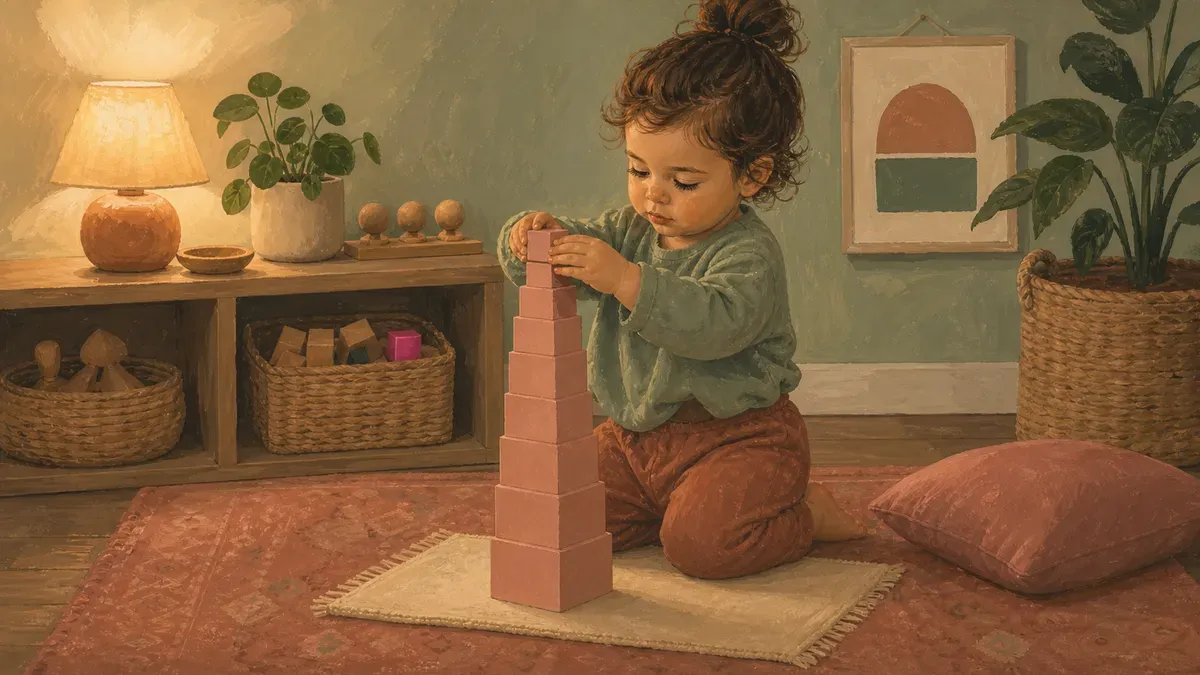
Sensorial Work vs. Ordinary Sensory Play
Open-ended sensory play (rice bins, shaving cream, water tables) is great. Free-form, exploratory, kids love it. But for an overwhelmed toddler, all that open choice can add to the noise.
Montessori sensory work flips it: ordered presentation, a defined start and end, one clear job. The child knows what the activity is asking of them. That structure is what does the calming. Montessori understood that a young child’s absorbent mind soaks up the environment constantly, and the toddler years are a sensitive period for sensory refinement. Channeling that absorption into one manageable focus gives the nervous system somewhere to land.
If you want setups that follow this structure without starting from scratch, browse our montessori activities printables for low-prep options a toddler can use independently.
Reading the Signs of a Sensory-Seeking Toddler
Before you can offer the right activity, you need to read what your kid’s body is already telling you. Here’s how to spot the seeker versus the avoider, and catch the moment before things unravel.
Sensory-Seeking vs. Sensory-Avoiding Behavior
A sensory-seeker is hard to miss. They crash into the couch on purpose, spin until they fall, mouth everything, squeeze the cat. As guidance on sensory processing in young children explains, these kids are in constant motion, craving deep pressure and heavy input. Their nervous systems are asking for more.
A sensory-avoider looks completely different. Loud noises send them under the table. They gag at certain textures, refuse to walk barefoot on grass, melt down when a shirt tag rubs wrong.

Some kids are both, depending on the day. Their tactile sense may crave sensory exploration while their auditory system has already hit its limit. Knowing which mode your child is in right now matters more than any label. It determines whether you reach for the heavy-work bin or the quiet corner during that sensitive period of the afternoon. Wondering is montessori good for an active child? The movement-friendly structure tends to suit seekers well.
Catching the Pre-Meltdown Window
The meltdown isn’t where the problem starts. By the time your toddler is on the floor, the window for easy intervention has already closed.
- Volume creeping up for no clear reason
- Losing interest in an activity they liked two minutes ago
- Rocking, pacing, or bouncing in place
- Clinging or crashing into you repeatedly
That short stretch between “getting wound up” and a full meltdown is exactly when a sensorial activity lands best. Sensory refinement in early childhood is still developing, and an overwhelmed nervous system needs something concrete to anchor to. Catch it early, and ten minutes of structured play can reset the whole afternoon.
10 Sensorial Montessori Activities That Calm Before a Meltdown
Catch that restless window and you need something to hand your kid right now, not a project you have to set up first. Here are ten that work, grouped by what they pull on: eyes and hands, then ears and nose and weight, then pure blind touch.
- Pink Tower: grading by size
- Color Tablets: matching and grading by shade
- Touch Boards: rough-to-smooth texture strips
- Fabric pairing: texture matching by feel
- Sound Boxes: paired cylinders, sorted by sound
- Smelling Bottles: paired scent jars, sorted by nose
- Baric Tablets: sorted by which feels heavier
- Mystery Bag: object recognition by touch alone
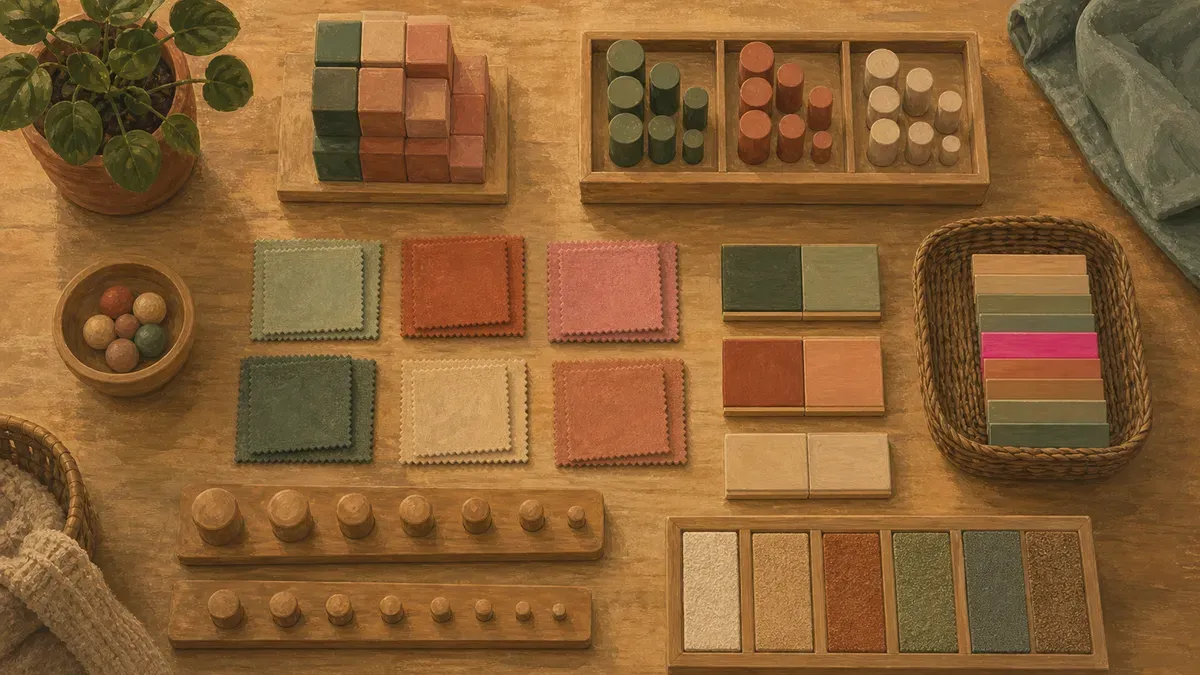
Visual and Tactile Grading Activities
When a toddler’s hands won’t stop, give them something to line up. Grading work, putting things in order from biggest to smallest or darkest to lightest, hands busy fingers a job with a clear endpoint.
Ten solid beechwood cubes, per Kid Advance, vary only in size from 1 cm³ up to 10 cm³, all the same pink, so the only thing to sort by is dimension. A kid who builds it, knocks it, and builds it again is doing real visual discrimination work without knowing it.
Color Tablets are pairs your child matches by shade, then later grades from palest to deepest.
Fabric pairing is the no-buy version. Cut two squares each of velvet, burlap, fleece, and silk, and have them find the matches by feel.
These sensorial games turn fidgety hands into focused ones, which is the whole point right before a meltdown.
Sound, Smell, and Weight Activities
Quieter senses pull a wound-up kid down a gear. Where stacking burns energy, these ask for slow, careful attention, and that shift is often what settles things.
- Sound Boxes: paired cylinders, shaken and matched from loud to soft
- Smelling Bottles: two sets of scent jars, sorted through the nose
- Baric Tablets: small weighted pieces, sorted by which feels heavier
Trillium Montessori describes all three as pairing work that sharpens one kind of sensory discrimination at a time.
The magic is the pairing itself. Matching two soft sounds, or two faint smells, forces the kind of deliberate focus that’s almost impossible to manage and stay frantic at the same time.
None of these need the official set. Dried lavender, coffee, and a citrus peel in matching jars cover smell. Rice and dried beans in identical containers give you sound boxes for the price of pantry scraps.
These sensorial activities trade big movement for narrow attention, and a narrowed kid is a calmer kid.
Stereognostic and Mystery Bag Activities
The last group is my favorite for a kid who needs deep input, because it shuts off sight and makes the hands do all the work. The stereognostic sense, per Reach for Montessori, is the ability to know an object by its shape and texture through touch alone, no looking.
The Mystery Bag is the whole activity in one drawstring pouch. That same site notes the bag is usually first presented with paired Geometric Solids, a sphere, a cube, a cone, around age three.
- Start with three familiar objects: a spoon, a pinecone, a small wooden block
- Reaching and squeezing inside the bag without peeking is the calming part
- Two minutes of focus still counts; run it again tomorrow if they walk away
The tactile sense gets fed, the eyes get a rest, and the guessing keeps the brain just busy enough.
These sensorial games sit right alongside the pour-and-scoop jobs in our roundup of montessori practical life toys for toddlers who won’t sit.
DIY Sensorial Activities You Can Make at Home for Almost Nothing
You do not need a Montessori supply catalog to do any of this. The classic materials have cheap, effective stand-ins in your kitchen and backyard right now.

Kitchen and Recycled-Material Swaps
For smelling jars, grab six small spice jars or film canisters and fill them in matched pairs: a cotton ball soaked in vanilla in two, a pinch of dried lavender in two, a little cinnamon in two. Your kid closes their eyes and pairs them by scent. Same isolation of quality as a purchased smelling set, zero dollars spent.
Weighted bottles come together in three minutes. Fill two identical plastic water bottles with dry rice, two with sand, two with dried beans. Cap and tape the lids. The baric work is right there.
Glue one strip to each card, make two of each fabric, and you have a matching game. Wooden materials are lovely, but cardboard works the same way for a three-year-old’s fingers.
- Fabric touch cards: cardboard, fabric scraps, glue
If you want the full picture on montessori tiny budget setup, that guide covers shelf setup and material sourcing without spending much.
Nature-Based Sensorial Activities Outdoors
Outdoor sensorial work costs nothing and delivers real heavy-work input. Lifting rocks, hauling a bucket of dirt, climbing over a log. Occupational therapists describe that kind of proprioceptive input as calming and regulating for kids who need deep pressure.
For sensory exploration that builds grading and sensory refinement, try a size sort with sticks or stones. Gather a handful and line them up from smallest to largest. Same grading skill as any classic sensorial sequence, different materials.
A scent walk is even simpler. Stop at five things to smell: a crushed leaf, a flower, wet soil, cut grass, a pine cone. One clear scent focus at a time. The slowly changing outdoor rhythm gives an overwhelmed kid room to settle without any setup at all.
No cleanup, and fresh air usually does half the work on its own.
Turning Sensorial Work Into Everyday Emotional Regulation
Outdoor time helps, but you can’t count on the weather. What you can count on is a shelf your kid already knows. This section covers how to build that shelf and, more importantly, how to use it before you actually need it.
Setting Up a Calm-Down Shelf
Pick a low shelf your toddler can reach without asking. Two or three materials on it, not eight. Rotate weekly so it stays fresh, but keep the structure the same. That’s the whole point of ordered presentation in home implementation: predictability is calming before a word is spoken.
What goes on it depends on your kid. A fabric-matching set, a small sound jar, a mystery bag with a few smooth wooden pieces. Each gives one clear sensory focus and a defined endpoint. They finish it, they feel it. No adult scaffolding required.

This kind of sensorial education at home doesn’t need a Montessori classroom. It needs two or three intentional choices on a shelf the child can reach on their own.
Building the Habit Before the Storm
The shelf only works if it’s not introduced mid-meltdown for the first time. At that point, your kid doesn’t trust it, doesn’t know what to do with it, and will probably throw it.
Offer the activities during calm moments. - After lunch when the house is still
- Before a tricky transition
- On a random Tuesday afternoon when nothing is wrong yet You’re building an association: this is where I go to feel settled. That’s the developmental benefit that compounds over weeks.
Research on emotional regulation in early childhood found meaningful gains in self-regulation and attention among preschoolers in Montessori programs compared to a control group. Those gains came from repeated, calm practice with purposeful materials. The same logic applies at home.
Repetition during calm builds the fine motor and sensorial education habits that carry into harder moments. By the time a rough transition hits, reaching for that shelf is already familiar ground. Browse our full library of Montessori activity printables or start with montessori self care activities to find materials they’ll actually want to return to.
Found this useful? Save it for the next rough afternoon.
Questions parents ask me about this
What are Montessori sensorial activities for young children?
These hands-on materials isolate one quality (size, texture, sound, weight, or scent) so a child can explore it fully without distraction. Each has a built-in right answer the child discovers on their own, with no adult correction needed. Each material has only one variable to figure out, so there is nothing to overwhelm and nothing to fail at. The child self-corrects, closes the loop, and moves on satisfied.
At what age can a toddler start sensorial Montessori activities?
Most toddlers are ready for simple pairing and matching work between 18 months and 2 years old. Autistic and ADHD kids tend to click with sensorial work because there is one right answer and no adult waiting to grade them. - **18 months to 2 years:** simple pairing and matching (fabrics, scent jars, sound cylinders) - **Around age 3:** grading work (ordering by size, weight, or roughness) - **Sensory seekers:** do well with heavier materials and rougher textures - **Sensory avoiders:** tend to prefer shorter sessions and smoother materials Start with whatever your child reaches for on their own, let them repeat it as many times as they want, and loop in their OT if you have one.
Can sensorial activities actually stop a toddler meltdown?
Not once the meltdown is already rolling. The window that matters is before things escalate: restlessness, loud play, scattered focus. A familiar sensorial activity introduced during calm moments often catches kids in that pre-meltdown window because reaching for it is already a habit. The strategy is repetition during calm, not rescue during crisis.
Are sensorial Montessori activities good for an autistic or ADHD child?
Many autistic and ADHD children find this kind of work calming precisely because the structure is predictable and the outcome is clear. There is no guessing, no wrong way to try, and no waiting for an adult to tell them if they got it right. Follow your child's cues and loop in their OT if you have one. They know your kid's sensory profile better than any article can.
What is the difference between sensorial work and regular sensory play?
The short version: one is open-ended exploration, the other has a built-in aim the child works toward. The earlier section covers the distinction in full.
Do I need to buy expensive wooden materials to start?
No. The principles work with what you have. Fabric scraps in two or three textures pair the same way a commercial Touch Board does. Small containers filled with rice, dried beans, or sand become sound-matching jars. Cotton balls dabbed in vanilla, cinnamon, and coffee cover olfactory pairing. The wooden classroom sets are beautiful and durable, but pantry-and-fabric-bin versions do the same job at home.
How long should a sensorial activity session last for a toddler?
Let the child lead. A toddler who is focused might repeat an activity for ten or fifteen minutes; a new or dysregulated child might stay two. Both are wins. The point is not duration. Quality of attention while it lasts is what matters. When your child walks away, the session is done. Calling them back rarely works, and forced sitting is the opposite of what makes this approach effective.
Written by
Nora Hayes
Mom of two and a former preschool aide. I share the screen-free sensory play and calm-down ideas I test at my own kitchen table, plus what the moms in my little meet-up swear by. A parent passing on what works, not a doctor or a therapist.
More about NoraKeep going
All Montessori-
 Montessori
Montessori Activities for 3 Year Olds That Build Skills
At 3, kids crave real work, not toys. These Montessori activities for 3 year olds build focus, coordination, and independence. Start one today.
-
 Montessori
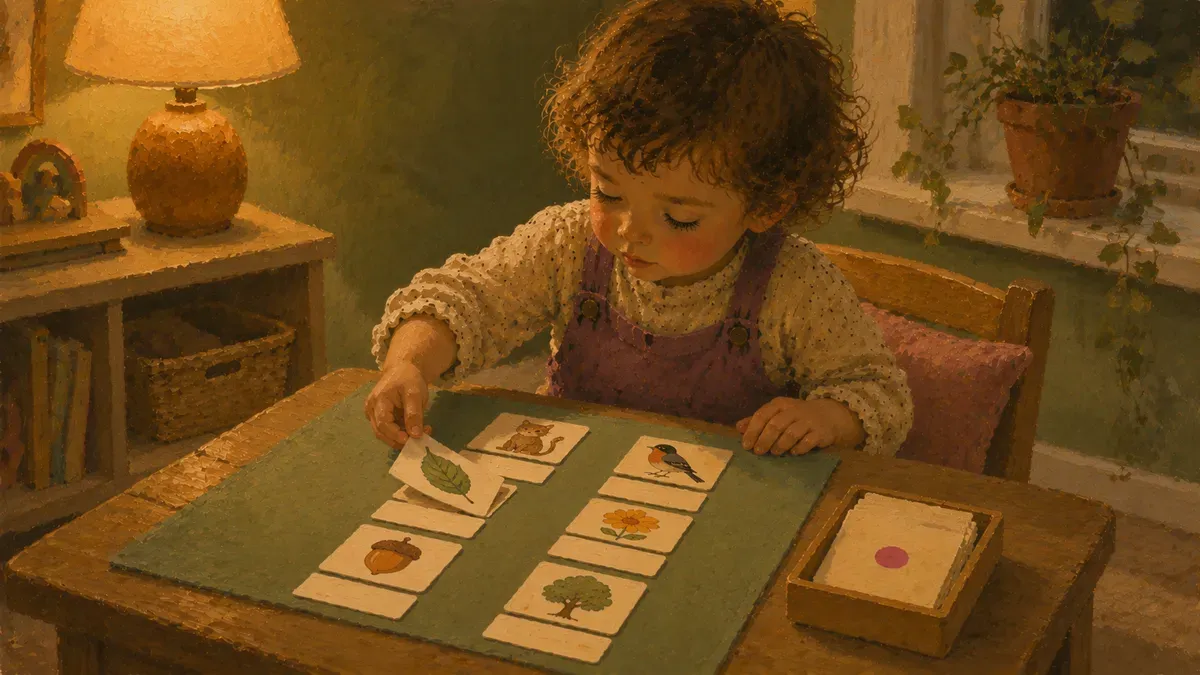
Step by Step Montessori 3-Part Cards Walkthrough
Confused by 3-part cards? This step by step Montessori walkthrough shows the exact order to present them so your child matches and self-corrects.
-
 Montessori
Practical Life Montessori: 20 Kitchen Activities
Practical life Montessori starts in your kitchen. Get 20 no-buy activities using spoons, jars, and bowls you own. Set up a tray today.
-
 Montessori
Montessori Activities for 2 Year Olds: 30 Ideas
30 Montessori activities for 2 year olds, sorted by mess level. Pick a no-mess tray or a sensory bin and set it up tonight.