Age Appropriate Chores, Toddlers to Teens


Some links here are affiliate links. If you buy through one, I may earn a small commission at no extra cost to you. As an Amazon Associate I earn from qualifying purchases. I only point to things I'd actually use with my own two.
Three-year-olds can handle real age-appropriate chores: matching socks, carrying their plate to the sink, wiping up spills, and feeding a pet. Starting small builds the habit before they’re old enough to resist, and it cuts the daily load on you by just enough to matter. I’m Nora Hayes, a former preschool aide and mom of two, and this covers which jobs actually fit each stage from toddler all the way up to a 13-year-old running laundry start to finish.
Why Chores Matter More Than a Tidy House
Before we get into the stage-by-stage list, it’s worth understanding what chores are actually doing for your kid, because it’s a lot more than a cleaner floor.

The Skills Hiding Inside Everyday Tasks
A three-year-old wiping up a spill is not helping you. Not really. But she is practicing something she’ll use every day for the rest of her life: noticing a problem, doing something about it, finishing the job.
That’s responsibility. It grows one small task at a time, long before a child does anything perfectly. The habit of pitching in, built early, becomes automatic. Life skills like following a sequence, tolerating frustration, and seeing a task through don’t come from instruction. They come from repetition.
Research on the long-term benefits of childhood chores published in the Australian Occupational Therapy Journal found that children who did more household chores showed stronger working memory and better impulse control. Not because chores are magic. Because doing real things in the real world is how kids build independence, and that only happens by actually doing them.
Personal Chores Versus Family Chores
Not all chores look the same, and the distinction matters.
The American Academy of Child and Adolescent Psychiatry (AACAP) separates two categories in its age-by-age guidance: tasks a child does for themselves (getting dressed, putting their shoes away, clearing their own plate) and tasks they do for the household (feeding the dog, wiping the table, putting groceries on the low shelf).
Both belong on the list. Personal chores build self-sufficiency. Family chores teach teamwork and the understanding that this household runs because everyone pitches in. See our complete guide to chore and reward systems if you want a structure that holds both kinds together. A kid who only ever does things for themselves never learns that second part. And the second part is the one that shows up in friendships, classrooms, and eventually jobs.
Age-Appropriate Chores by Developmental Stage
The trick isn’t deciding whether your kid can help, it’s matching the job to where they actually are. Here’s what works at each stage, from a toddler who wants to do everything to a teen who’d rather do nothing.
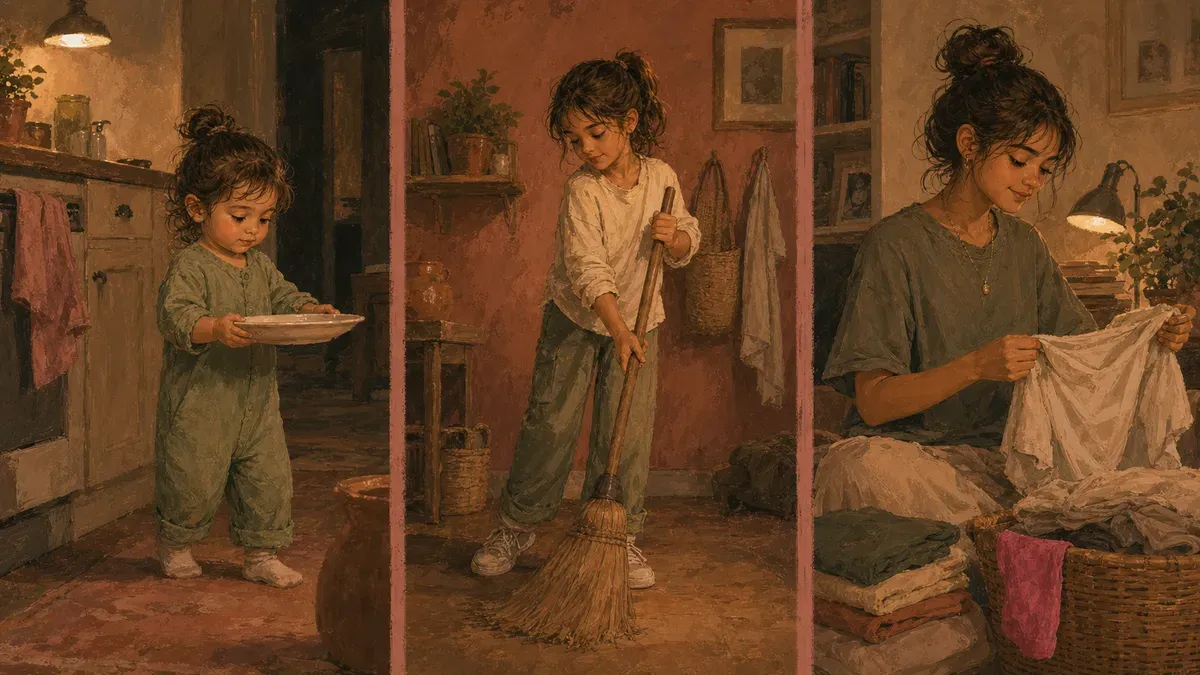
Toddlers and Preschoolers (Ages 2 to 4)
People hear “toddler chores” and picture putting blocks in a bin. That’s the floor, not the ceiling. A 3 year old can do a lot more if you set it up to match their hands and their attention span, which is short.
At this age the win is the participation, not the result. The bed will be lumpy. The spill will get smeared, not wiped. That’s fine, you’re building the habit. The CDC tells parents of 3-to-5-year-olds to let their preschooler help with simple chores as a way to grow independence.
Real jobs that work for chores for 3 year olds:
- Feeding the pet with a pre-scooped cup (you measure, they pour)
- Wiping a spill or the table with a damp cloth
- Sorting clean laundry into piles by color
- Carrying their plate to the sink
- Putting groceries on a low shelf
Sorting laundry is the sneaky-good one. Hand a toddler a three-bin laundry hamper and “darks in the middle, whites on the left” turns a fuzzy color lesson into a game they can win before they can count. It’s an Amazon’s Choice pick, 22,000+ parents rating it 4.6 stars, and it rolls on wheels so she can push it back to the closet when the piles are done.
Putting groceries away is on the official list from child and adolescent psychiatry guidelines, which says 2-to-3-year-olds can put toys and groceries away and dress themselves with a little help. If you want it written down where they can see it, a simple picture-based chore chart for kids does more than any reminder you’ll repeat fourteen times.
School-Age Kids (Ages 5 to 11)
Somewhere around kindergarten, the attention span stretches and the chore list can grow with it. Now they can follow two or three steps, remember a job from yesterday, and take a little pride in doing it right.
This is the stretch where household tasks start to look like contributions, not just supervised practice. The breakdown by age: sweeping floors and sorting laundry lands in the 5-to-7 window, loading the dishwasher and meal prep by 7 to 9, and by 10 to 11 they can handle their own bedsheets, a bathroom scrub-down, and basic yard work.
A solid set of responsibilities for this age:
- Making the bed (it’ll look made-ish, and that counts)
- Setting and clearing the table
- Sweeping and loading the dishwasher
- Basic meal prep, like washing veggies or stirring
- Sorting and folding laundry
The shift you’ll notice is ownership. A 5 year old wants you watching every move; a 9 year old wants you to leave so they can prove they don’t need you. Lean into that. Loosen the reins, raise the expectations a notch, and resist re-doing their work in front of them. This is also the age where money starts to motivate, so it’s worth understanding how an allowance chore chart works for little kids before you tie chores to a few coins.
Tweens and Teens (Ages 12 to 15)
By the tween years, chores stop being about practice and start being about running an actual household someday. A 12 year old who can’t do laundry becomes an 18 year old who can’t do laundry. The goal now is independence, plain and simple.
The American Academy of Child and Adolescent Psychiatry lists washing the car, helping with younger siblings, running errands, and grocery shopping as fair game for kids 12 and up. Build from there.
Good independence-builders for 12, 13, and 14 to 15 year olds on chores:
- Doing their own laundry, start to finish
- Cooking a simple meal for the family once a week
- Mowing the lawn and basic yard work
- Grocery shopping from a list you hand them
- Watching a younger sibling for short stretches
The move with teenagers is to hand over a whole job, not a step. Not “help with dinner,” but “Thursday dinner is yours.” Pair it with a clear standard and, if your family does it, an allowance that scales with the work. Resistance is normal at this age, and a real teen will test every boundary you set. The skill is what sticks, long after the eye-rolling stops.
Introducing a 3-Year-Old to Their First Chore
Starting small is the whole strategy. The first chore doesn’t need to be impressive, it needs to be repeatable. That means picking the right task and tying it to the right moment in the day.
Picking the First Task and Time of Day
Three-year-olds aren’t reliable on demand, but they’re surprisingly reliable when something is always what happens next. Anchor the chore to a fixed point in their daily rhythm and it starts to run itself.
Some kids follow a picture better than they follow your voice, especially when language is still catching up. A visual schedule board with picture cards lays the sequence out where they can see it: breakfast, then feed the dog, then play. Parents raising autistic and speech-delayed kids reach for these constantly, and this felt one comes with 109 picture-and-word cards, over 2,000 reviews averaging 4.7 stars. You don’t need it to start. But if spoken reminders keep sliding off your kid, seeing the steps is often what makes it click.
Good first tasks are physical, fast, and obvious. Putting their cup in the sink works because there’s a clear before and after: cup on the table, cup in the sink, done. Clear start, clear finish.
The time-of-day piece matters more than parents expect. A task right after breakfast becomes part of what breakfast is. A Journal of Family Theory & Review systematic review found that consistent daily routines anchored to fixed points like meals support toddlers’ emotional regulation and ease anxiety around transitions. You’re not just building habit, you’re reducing friction in the whole morning.
Pick one chore. Not three.
- Pick one physical, fast, obvious task.
- Anchor it right after a meal or another fixed daily moment.
- Work through it together for the first week, side by side.
- Name the effort out loud when you praise them.
- Leave the imperfect result alone and let them repeat it tomorrow.
Modeling, Praising, and Lowering the Bar

Do the chore alongside them the first week. Not watching. Together. Toddlers learn from imitation far more than instruction.
Aim praise at the effort, not the outcome. Praising the effort, not the result, is the move pediatric guidance consistently lands on. There’s hard data behind it too: a peer-reviewed study (PMC6176062) found effort-praised children improved performance significantly more after setbacks and stayed on task longer than ability-praised children.
“Great job feeding Chester” beats “You’re so helpful” every time. It names the action, which is what you want repeated.
Accept imperfect. Kibble on the floor, a lopsided fold, streaky counters: all fine. Correcting the result teaches them they did it wrong. Focusing on participation teaches them to try again tomorrow. You can make reward chart toddler cant wait to keep that motivation going through the early, imperfect weeks.
When Kids Refuse: Handling Resistance and Chore Battles
Even a three-year-old who loved helping last week can dig in their heels today. Here’s how to read what the pushback actually means, and how to hold the line without it becoming a daily standoff.
Why Resistance Happens
Not every refusal is defiance. Sometimes a child is hungry, overtired, or mid-play and the transition itself is the problem, not the chore. Bad timing produces most chore battles before temperament even enters the picture.
That said, temperament matters. Child psychology guidance on managing defiance found that children with resistant temperament show stronger links to behavioral issues in families with low parental structure, which means fuzzy expectations make pushback worse, not better. If your child never knows what’s expected or when, refusal is a predictable result.
The fix is usually simpler than it sounds: clear expectations at a predictable moment. “After dinner, you carry your plate” leaves no room for negotiation, because the rule isn’t new every night.

Consequences Without the Power Struggle
The goal isn’t compliance through pressure. It’s teaching that skipping a responsibility has a connected result.
The Parent Encouragement Program describes logical consequences as parent-presented options directly tied to the behavior: skipping a chore means an extra one later, not a punishment designed to sting. The distinction matters: you’re not retaliating, you’re showing how the world works.
- Keep your tone flat and your words short.
- Give the connected consequence, not a lecture: “The dog wasn’t fed, so that’s your first job before the tablet.”
- Say it once, follow through.
Positive reinforcement still belongs here. Catch them doing it without being asked and name it out loud. Encouragement after a completed chore builds the motivation to repeat it far more reliably than pressure before one. If the reward chart is losing steam, check the childrens reward chart guide before scrapping it entirely.
Building Chores Into Your Family Routine
Positive reinforcement gets a chore done once. A routine gets it done every Tuesday for the next three years. Both matter, but the routine is the thing that sticks.
Charts, Checklists, and Visual Cues
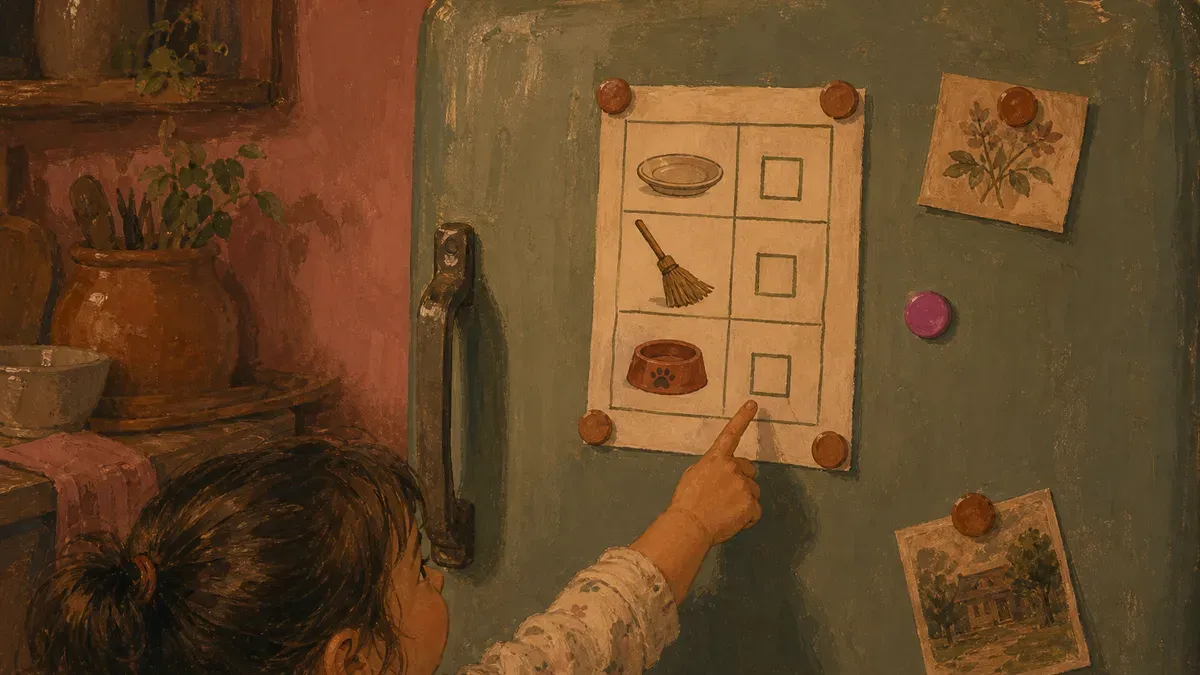
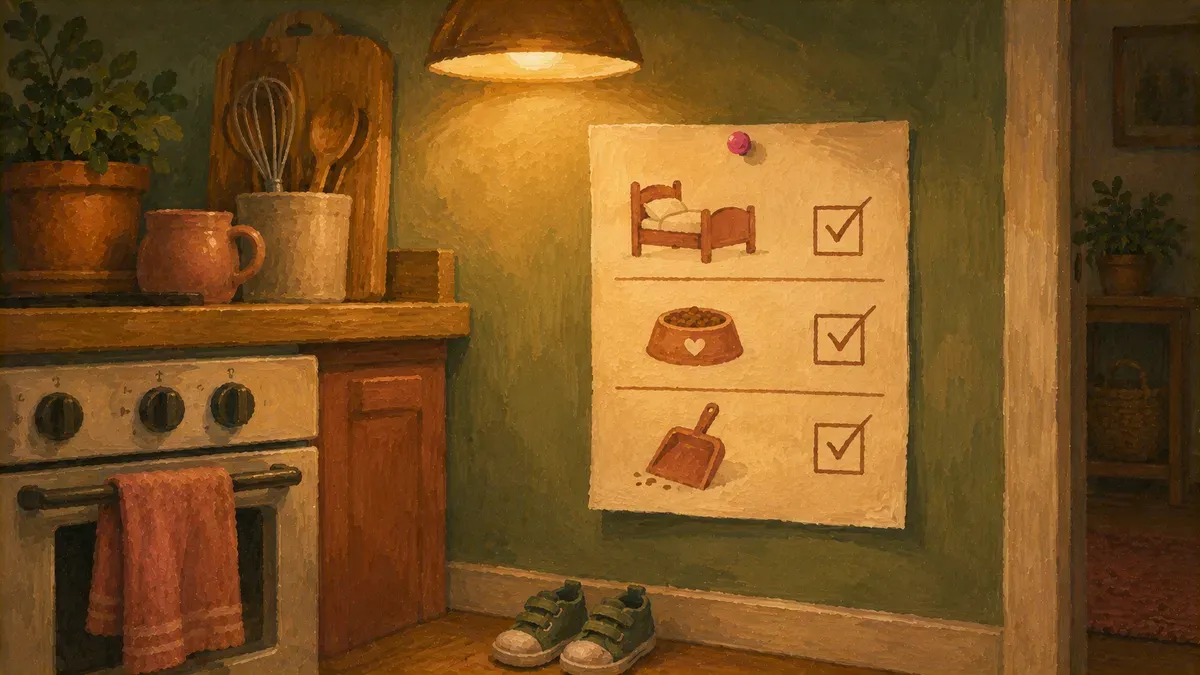
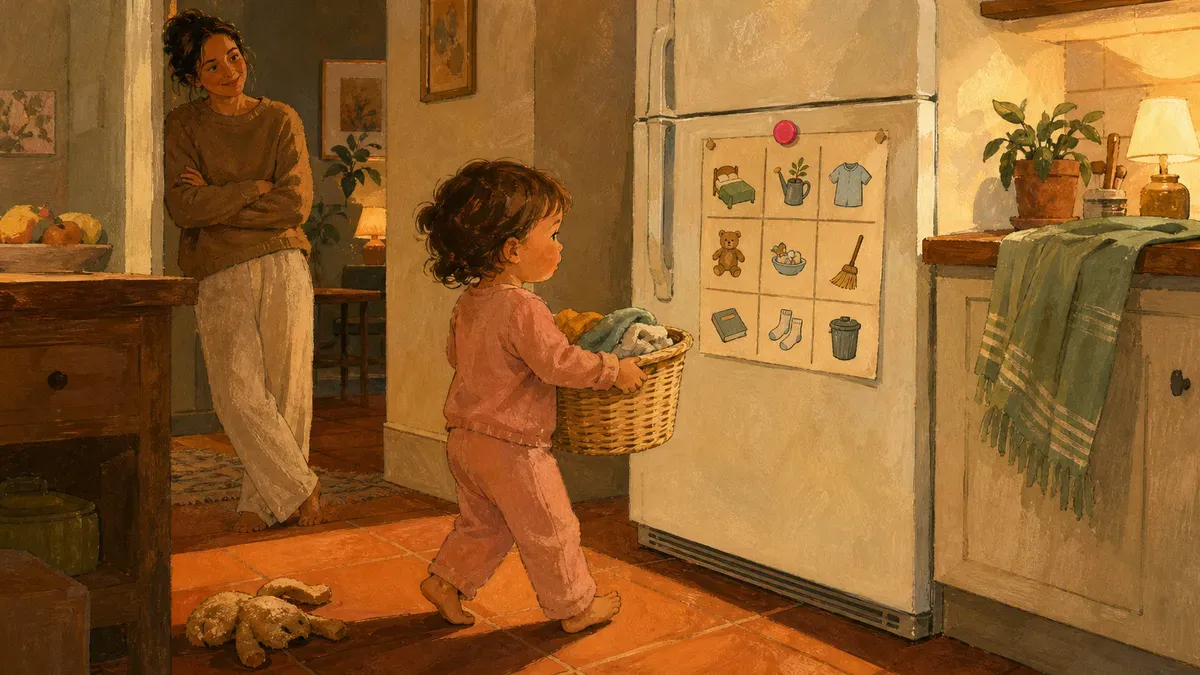
A three-year-old cannot read, but they can scan a picture and know exactly what comes next. Hang it at their eye level and use photos of your actual child doing the tasks if you can swing it.
A few things make these charts actually stick, whether you’re using a simple picture schedule or one of the reward chore charts that add stickers or stamps:
- Images over words. One task per picture, kept simple, so a non-reader can scan and go.
- Short sequence. Two or three tasks. That’s the whole list.
- Photos of your kid help. Seeing themselves in the chart beats a stock illustration every time.
- Dry-erase checklist. A marker swipe across a completed box gives a small hit of satisfaction that outlasts any sticker.
If you’d rather not reprint a chart every week, a magnetic dry-erase chore chart wipes clean and resets every morning. This one sticks to the fridge, comes with its own fine-tip markers so you’re not hunting for a dried-out one at 7am, and has earned Amazon’s Choice with 2,400+ ratings at 4.7 stars.
If you’re weighing the options, figuring out which chore chart fits your family first saves you from cycling through three different systems before landing on one that holds up past week two.
Making It a Team Effort, Not a Job List
The difference between a chore your kid dreads and one they just do is often how it’s framed. “It’s your job to set the table” lands differently than “we’re all getting dinner ready together.”
Building that kind of family culture around pitching in is exactly what Harvard’s Making Caring Common project points to: children who contribute to family chores develop empathy, responsibility, and confidence because helping meets their intrinsic needs for belonging and competence. That’s not developmental theory, that’s just why a toddler lights up when you hand them a job.
When your three-year-old carries their cup to the sink and you say “thank you for helping our family,” something clicks. It’s not about the cup. It’s about them being someone who contributes. Keep the teamwork language going and the chores stop feeling like a job list pretty quickly.
Found this useful? Save it for the next rough afternoon.
Questions parents ask me about this
What are age-appropriate chores for toddlers and young kids?
Two- and three-year-olds can put toys away, carry their plate to the sink, sort laundry by color, wipe up small spills, or help feed a pet. The key is physical and fast: tasks with an obvious result they can see in the same minute they finish. By preschool age, kids can fold washcloths, help set the table, and sort groceries into low cabinets. Match the task to what their hands and attention span can actually do, not to what would be convenient for you.
At what age should kids start doing chores?
Two to three years old is genuinely not too early. Kids that age are already imitating everything you do, and a simple task channels that energy into something real. Habits built in toddlerhood tend to carry forward; by school age, kids are ready for more complex tasks because the baseline was already there. Starting early means the expectation is already woven in by the time they're old enough to resist it.
Should I pay my child an allowance for doing chores?
That's a family call, and both approaches work if they're consistent. Some families keep family chores separate from allowance entirely, because contributing to the household is just what the family does. Others tie a small allowance to a separate set of optional tasks. What tends to backfire is paying for every single chore, because it teaches kids to expect payment before they help, and family chores stop feeling like shared responsibility.
How many chores is too many for a young child?
For a three-year-old, one chore is plenty. One task they do every day, anchored to the same moment in the routine, builds more genuine habit than a long checklist ever will. Adding more before the first chore is solid. Splitting focus too early makes everything feel optional. Once a task runs on autopilot, add another one.
How do I adapt chores for a neurodivergent or special needs child?
Break it into fewer steps and make the sequence visual. A simple picture card showing the three steps to feed the dog works better than a verbal list for a lot of kids, including kids who process language differently. Let the child do the physical parts they can manage and skip the ones that are genuinely hard right now. A sensory-seeker who needs to move might love carrying the laundry basket; a kid with fine motor challenges might need the fork placement step skipped entirely. Follow what your child can do today and build from there.
Should toddlers be rewarded with stickers for doing chores?
A sticker chart can help in the early weeks when the habit is brand new, but the goal is to phase it out. Praise the effort in the moment, say thank you the way you would to anyone who helped, and let that be enough over time. When every chore needs a sticker to happen, the sticker becomes the whole point, and the habit doesn't actually stick. Use it as a launch tool, not a permanent system.
Written by
Nora Hayes
Mom of two and a former preschool aide. I share the screen-free sensory play and calm-down ideas I test at my own kitchen table, plus what the moms in my little meet-up swear by. A parent passing on what works, not a doctor or a therapist.
More about NoraKeep going
All Reward & Chore Charts-
 Reward & Chore Charts
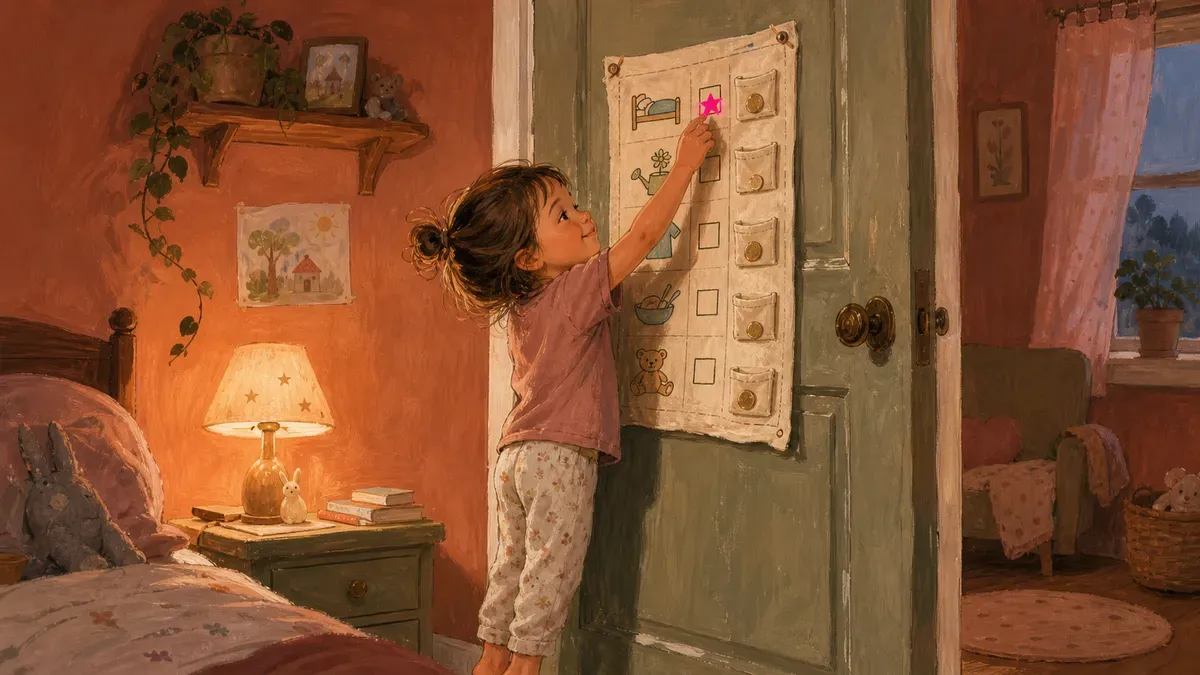
Allowance Chore Chart: How to Start With Little Kids
Set up an allowance chore chart that ties money to effort: paid-vs-unpaid rules, prices by age, 100 chore ideas, and the best charts. Start today.
-
 Reward & Chore Charts
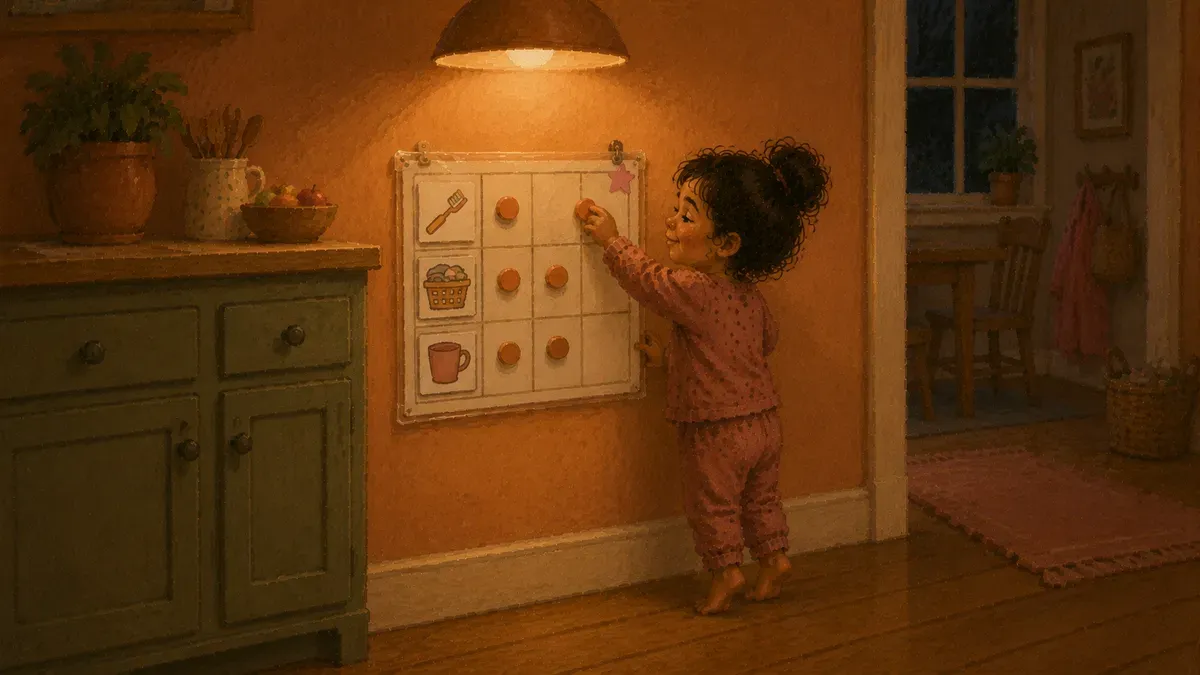
Childrens Chore Chart Printable with Pictures
Pre-readers can't follow word lists, but they can follow pictures. Free printable chore chart for toddlers and preschoolers, ready to laminate.
-
 Reward & Chore Charts
Chore Chart vs Reward Chart: Which One Your Kid Needs
Chore chart, reward chart, or responsibility chart? Find out which fits your child's age, build one in 5 steps, and snag a free template.
-
 Reward & Chore Charts
Chore Chart for Kids by Age: What Each Age Can Do
A 2-year-old can really help. See what a chore chart for kids should include at every age, plus charts that stick. Start today.