Make a Chore Chart for a Can't-Wait Toddler

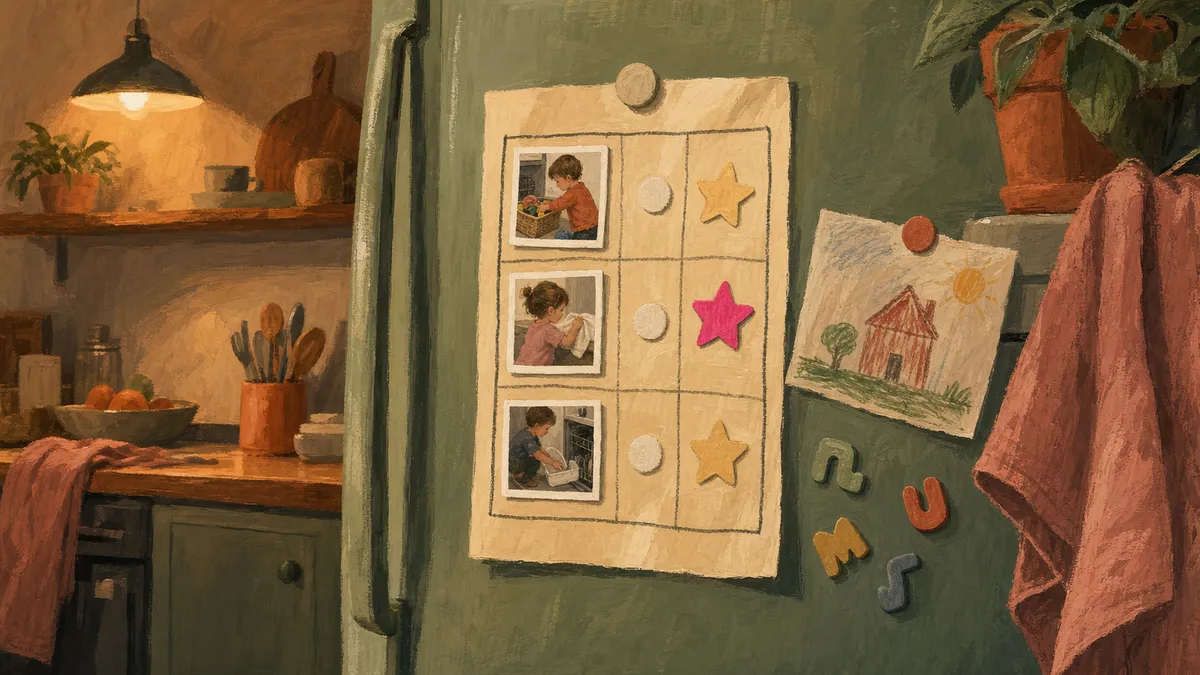
To make a chore chart that actually sticks with a toddler whose patience evaporates in five minutes, pair three picture tasks they already half-do with a reward that lands the second they finish, not at the end of some far-off week. I’m Nora Hayes, a former preschool aide raising a sensory-seeker and a busy three-year-old, and every chart that worked for us shared that one trick: the payoff has to come now.
Below you’ll build the chart in six steps, pick rewards that hit in the moment, make it feel like your kid’s own, and keep it alive past the two-week slump.
The plan in brief:
- Pick 3 picture-based tasks your toddler already half-does
- Reward each finished task within 30 seconds, not at week’s end
- Run the same routine at the same times every single day
Why Standard Charts Flop With a Toddler Who Can’t Wait
The Five-Minute Patience Ceiling
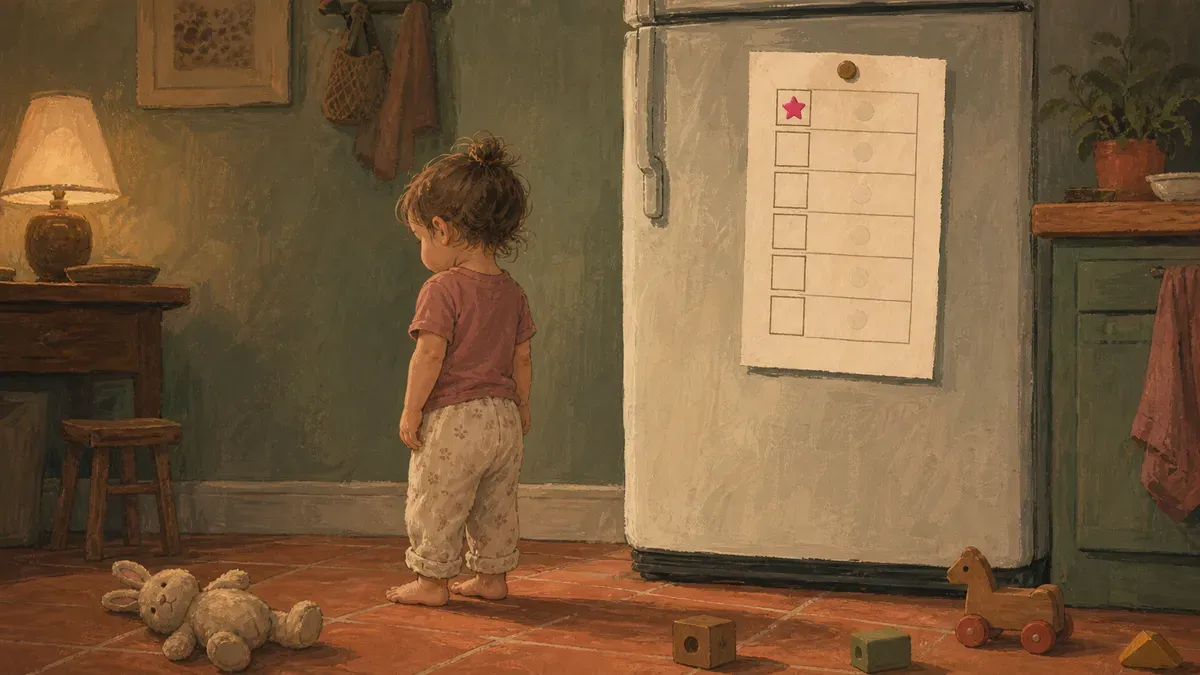
A toddler under four is not being stubborn when she ignores the reward chart. She literally cannot connect a sticker she earns right now to a prize she gets on Saturday. According to research on delayed gratification in young children, a delay above 5 minutes is difficult for a 3-year-old, while older children can hold out for more than 20 minutes. That gap is enormous. A sticker on Monday might as well be a rumor about next year.
This is why any reward system built on waiting falls apart fast. The chart looks great on the fridge. The consistency is there. But your toddler’s brain simply isn’t wired to trade today’s effort for a future payoff she can’t picture.
Why Weekly Goals Backfire at This Age
- Saved-up stars are an adult abstraction. A 3-year-old can’t hold “five more stickers” as a motivating idea across four days.
- The mental thread snaps by Tuesday morning, and pointing at the chart won’t rebuild it.
- Weekly charts remove every concrete prompt by design.
A 2024 study found that without an external cue like an hourglass, 3-year-olds completed a time-based memory task successfully only 55.55% of the time. Take away the concrete prompt, and the goal evaporates.
Buy-in also collapses at this scale. Responsibility feels real when the loop closes fast: task done, something good happens, done. Stretch that loop to a week and you’ve lost her. The reward chore charts that actually work for this age pay off the same day, often the same minute. If yours stopped landing, the culprit is almost always the gap between action and payoff, and you can fix a childrens reward chart that stopped working before it kills the routine entirely.
Make a Chore Chart in Six Steps
Here is the build, start to finish. Three steps to set it up, three to make it stick, and you can have the whole thing on the fridge before nap is over.
- Pick three tasks your toddler already half-does.
- Add a real photo of each task so a pre-reader can follow along.
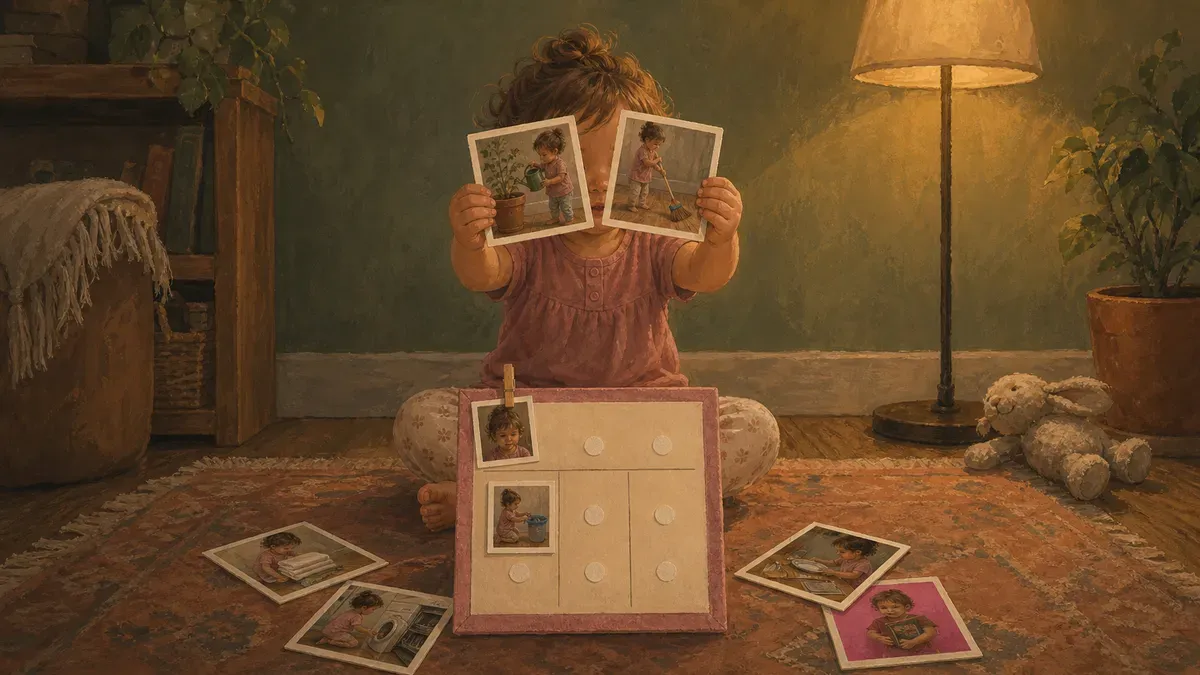
- Build the board with a cookie sheet, velcro dots, and laminated cards.
- Set up two columns: to-do on the left, done on the right.
- Give one instant reward the moment each card moves to done.
- Close the loop every time. No gap between finishing and the reward.
Pick Three Tiny Tasks and Add Pictures
Start with what your kid already half-does. The American Academy of Child and Adolescent Psychiatry puts putting toys away and getting dressed with help squarely in reach for a 2- or 3-year-old, so your task assignment isn’t a stretch, it’s a job they can already nearly pull off. Three is the number. More than that and a toddler’s eyes glaze.
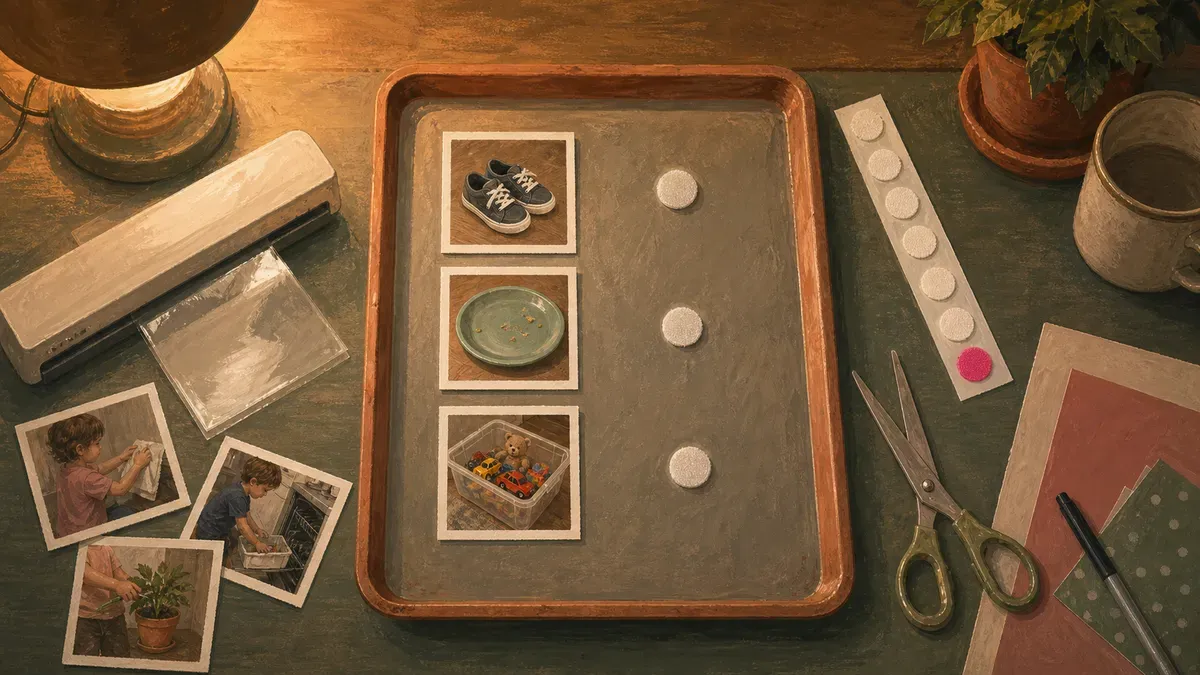
For a 3-year-old, my go-to chore list is toys in the basket, plate to the sink, shoes by the door. Pick yours from what already happens daily, and lean on a list of age appropriate chores if you’re blanking.
The part that makes a DIY chores chart work for a pre-reader is a picture for each task.
- Snap a photo of your kid’s actual basket, plate, or shoes.
- Skip the clipart. A photo of their real sneakers clicks instantly; a cartoon broom means nothing.
Build the Board With Cheap Supplies
How do I make a chore chart a toddler can run themselves? You make the finished part visible. A picture sitting in a “done” spot is the whole trick.
Grab a cookie sheet, a strip of velcro dots, and laminated picture cards, and you’ve got a chore chart maker for under ten bucks.
Set it up like this:
- Stick the hook side of the velcro on the back of each card, loop side in two columns on the cookie sheet.
- Left column to-do, right column done.
- Magnets work the same way if you skip the velcro.
When a household task gets finished, your kid peels the card off the left and slaps it on the right. That motion, the moving, is half of what they’re after. Picture-based schedules like this foster independent task completion in little kids, with 8 of the 23 studies in one 2011 review showing more task initiation and follow-through.
Attach an Instant Reward to Each Task
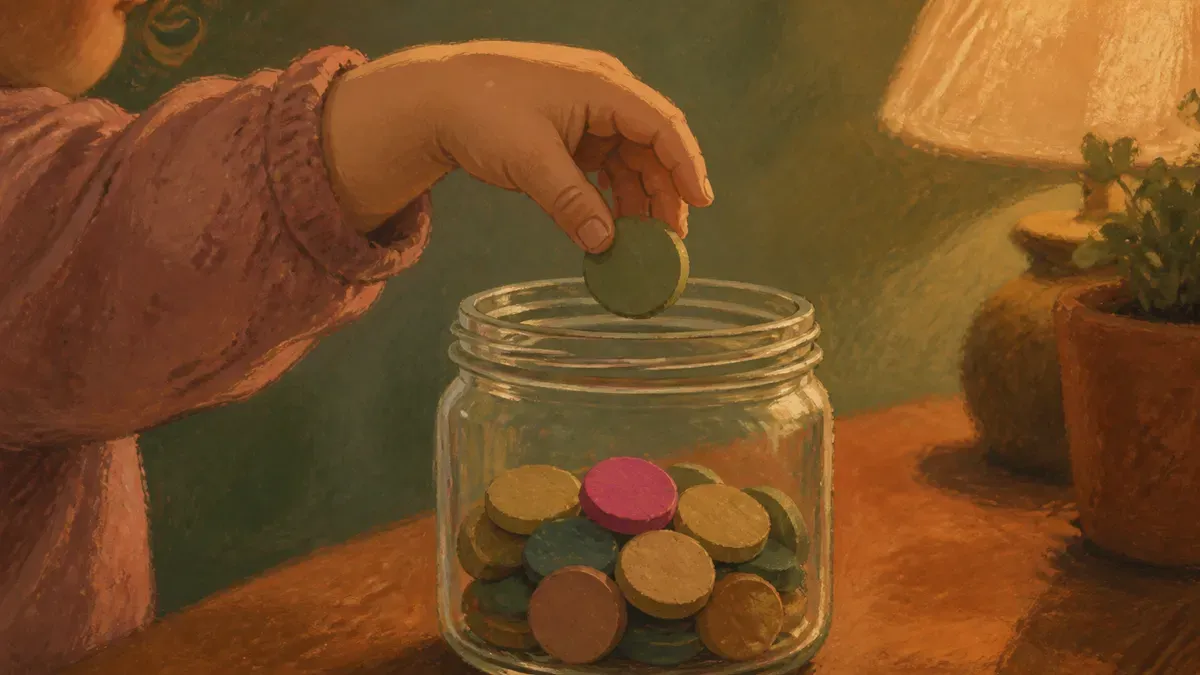
Every card that moves to done earns something, right then. Not at bedtime, not Sunday. The second the plate hits the sink, a token drops in their jar.
A token economy works on toddlers precisely because the payoff is immediate. That clear, instant link is what lets a small child connect the doing to the getting, the reason token reinforcement is so effective at shaping behavior in children. Your reward system can be a pom-pom in a jar, a sticker on the back of their hand, ten seconds of being swung upside down. Whatever your kid lights up for.
The rule that ties the whole task assignment together: one finished card, one reward, no gap. Skip the gap and the chart goes quiet. Close it every time and they’ll start dragging you over to do the next one.
Reward Systems That Land in the Moment
The reward you choose and how long you stretch it determines whether the chart keeps working.
Tokens, Stickers, and Tiny Privileges
Not all rewards are equal for a toddler who lives entirely in right now. Here’s how they stack up for household tasks:
- Sticker on the card: fastest, zero prep, works for kids who love a visible mark. The sticker is the reward, not a ticket to something else.
- Token in a jar: a marble, a pom-pom, a chip. Dropping it in feels satisfying on its own. When the jar fills (five tokens, not fifty), they trade it for one small thing.
- Tiny privilege: pick the next song, choose which cup, sit in the special chair at lunch. Zero cost, lands in under a minute.
For a kid who can’t wait, that third option sometimes wins on hard days because there’s nothing to accumulate and nothing to lose.
Guidance on praise and reward for young children points to the token approach specifically. The conditioned reinforcer landing right after the behavior is what makes the reward system click for preschool-aged kids.
Fading the Reward as the Habit Sticks
The chart is a bridge, not permanent furniture. Once your toddler is moving her card without a reminder three or four mornings in a row, the routine is taking hold.
That’s when you start stretching, slowly. Applied behavior analysis practice recommends moving from rewarding every single response to rewarding after a few, so the behavior builds resistance to dropping off. Read the full sequence in how to phase sticker chart once habit sticks. In practice: praise every task this week, a token every two tasks next week, then every three.
Don’t pull the reward cold. That’s how charts die in week two. Fading gradually holds consistency and builds the buy-in that turns responsibility into something your toddler owns, not a system you’re running for them.
Personalize the Chart So Your Toddler Owns It
Ownership doesn’t arrive on its own once the habit forms; you build it into the chart from day one. Two things drive it: making the chart feel like theirs, and picking a format you’ll actually maintain.
Use Their Photos, Colors, and Favorite Characters
The fastest shortcut to buy-in is letting your toddler help make the thing.
Print a photo of them putting toys in the bin. Cut out a sticker of their favorite character for the header. Let them pick the color of the velcro dots. These feel like small moves, but APA research on personalized learning shows that when children have structured, meaningful choices over how they engage with tasks, they develop intrinsic motivation. They do the thing because it feels like theirs, not because you’re watching.
A personalized chore chart doesn’t need to be beautiful. It needs to be recognizable to a three-year-old who can’t read. Their face, their stuff, their world is what makes the chart feel like it belongs to them.
Printable vs Make-Your-Own Boards
The right format comes down to one thing: what you’ll actually keep up with.
A printable chore chart is the faster start. Download, print, laminate if you have time, tape it to the fridge. Done. A good editable chore chart template lets you swap in your kid’s task names and photos before you print, so you’re not stuck with generic clip art. Take a look at our childrens chore chart printable for pre-readers for a version built around real photos and a moveable done column.
The DIY job chart (a cookie sheet, index cards, velcro) costs almost nothing and you can rework it on a Tuesday night when your toddler decides they hate the fish card. Both work. The printable gets you started faster; the DIY version is easier to change on the fly.
Keep the Chart Working Past Week Two
Getting the chart up is the easy part. Keeping it alive past the novelty is where most parents quietly give up. Two things prevent that: tying tasks to moments your toddler already knows, and knowing how to refresh the system without burning it down.

Anchor Tasks to Daily Routines
The chart doesn’t run on your reminders. It runs on your routine. Tie each task to a fixed moment (shoes after breakfast, toys in the bin before bath) and the routine becomes the cue, not you. The more you repeat the same sequence, the less you have to say. One day your toddler just does it, because that’s what always comes next.
Pick moments that already have momentum. After breakfast, before lunch, before bed. Each slot gets one or two tasks, not five. For what’s actually right at your child’s age, a chore chart for kids by age is a useful calibration check. A Journal of Family Theory & Review meta-analysis of 170 studies found that children with regular routines around age 3 tend to show stronger problem-solving and language skills by age 5. The routine is doing something. The chart is just the scaffolding.
Reset Without Starting From Scratch
Interest will dip. Usually around day ten. That’s not failure. That’s how toddlers work.
When engagement drops, swap one element instead of scrapping the whole chart. Change one photo, add a new reward, let your toddler pick a replacement task at a quick family meeting. That single swap restores ownership without discarding the habits already forming. Responsibility builds in layers; the life skills come from the chart staying in play, not from it being perfect.
A weekly rotation of one task keeps things feeling current without overwhelming a kid who finally has the routine down. Browse our full library of reward chore charts when you’re ready to add a new picture or try a fresh format. One small change buys another two weeks.
Found this useful? Save it for the next rough afternoon.
Questions parents ask me about this
What age can a toddler start using a chore chart?
Most kids are ready around age two, once they can follow a simple one-step direction. At that stage, tasks like putting toys away or helping with dressing are genuinely within reach. Starting with one or two picture tasks keeps the chart useful rather than overwhelming.
How many chores should a toddler chart have?
Three is the sweet spot for toddlers and young preschoolers. More than three tasks in a row pushes past most kids' working memory, and the chart stops feeling doable. Pick three things your child already half-does on good days, then build from there.
Should I give my toddler a reward every time, or save it up?
Reward every task, every time, at least at the start. Toddlers under four cannot connect a sticker today to a prize at the end of the week, so saving rewards up means the link between the action and the payoff never forms. Aim to hand over that sticker or token within thirty seconds of the task being done, because that quick handoff is the whole mechanism.
What chores can a 2 or 3 year old actually do?
At two and three, realistic tasks include putting toys in a bin, dropping dirty clothes in a hamper, carrying their plate to the sink, and helping wipe a low surface. These are things most kids can complete start-to-finish without adult help once they know the routine. Anything requiring fine motor precision or more than one step is better saved for four and up.
How do I keep my toddler from losing interest in the chart?
Swap one element before you assume the chart has run its course. A single small swap, like a new photo, a different reward, or a fresh task picked at a quick family meeting, usually resets the novelty for another couple of weeks. Anchoring tasks to fixed daily moments helps the routine do the reminding so you are not the one asking every time.
Are stickers or tokens better for a toddler reward chart?
Both work, but the speed of the payoff matters more than the format. Stickers are immediate and tangible, which makes them a strong fit for kids under three. Tokens in a jar work well once a child grasps that the jar filling up means something good is coming, usually around age three and a half to four. If you are just starting out, stickers are the simpler path.
Is a printable chore chart or a digital app better for toddlers?
A physical chart wins for this age group. Toddlers need something they can touch and move, like sliding a card to a done column or placing a sticker, to make the reward loop feel real. A screen-based app adds distance between the action and the payoff and removes the hands-on element that helps the routine stick. Print it, laminate it, and hang it at their eye level.
Written by
Nora Hayes
Mom of two and a former preschool aide. I share the screen-free sensory play and calm-down ideas I test at my own kitchen table, plus what the moms in my little meet-up swear by. A parent passing on what works, not a doctor or a therapist.
More about NoraKeep going
All Reward & Chore Charts-
 Reward & Chore Charts
Age Appropriate Chores by Age (Toddler to Teen)
Most kids handle real chores younger than you think. Get age appropriate chores by age, from 3-year-olds to teens, and start building habits today.
-
 Reward & Chore Charts
Allowance Chore Chart: How to Start With Little Kids
Set up an allowance chore chart that ties money to effort: paid-vs-unpaid rules, prices by age, 100 chore ideas, and the best charts. Start today.
-
 Reward & Chore Charts
Childrens Chore Chart Printable with Pictures
Pre-readers can't follow word lists, but they can follow pictures. Free printable chore chart for toddlers and preschoolers, ready to laminate.
-
 Reward & Chore Charts
Chore Chart vs Reward Chart: Which One Your Kid Needs
Chore chart, reward chart, or responsibility chart? Find out which fits your child's age, build one in 5 steps, and snag a free template.