Visual Schedules for ADHD vs. Autism: Why One Fails

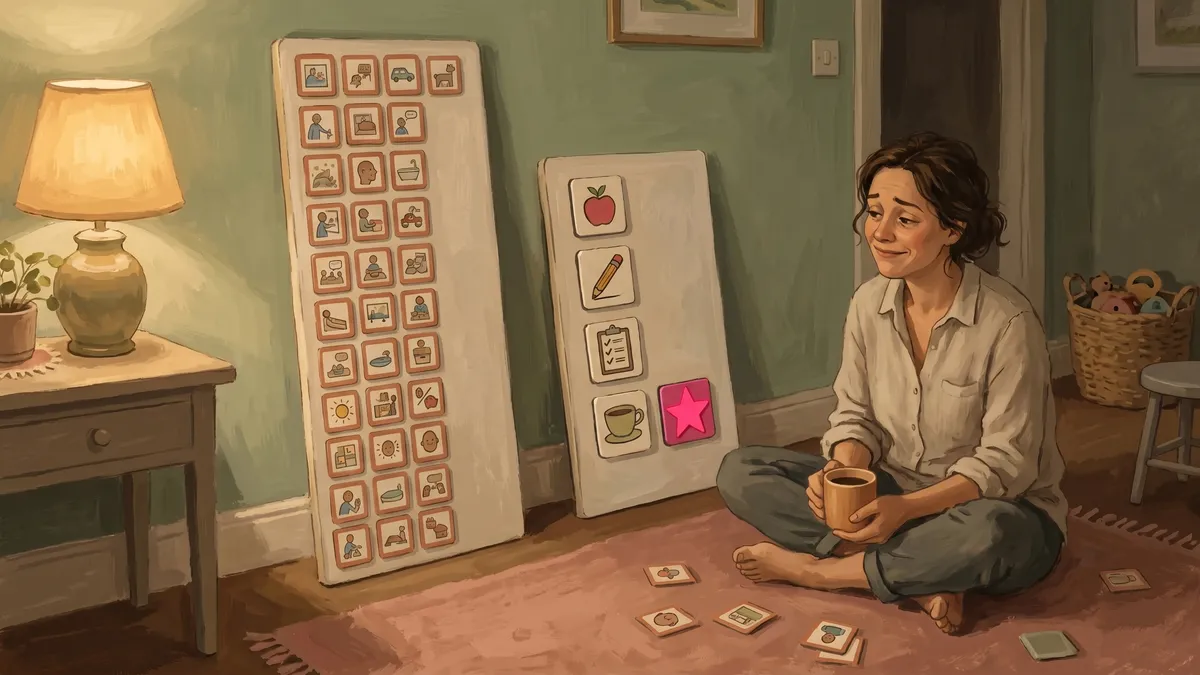
One visual schedule cannot serve both your autistic kid and your kid with ADHD, because the two are solving opposite problems: an autistic child needs the whole day made predictable, while a child with ADHD needs help starting the next thing. I’m Nora Hayes, a former preschool aide raising one autistic kid and one neurotypical toddler, and I’ve watched the same board calm one of them and bore the other into a meltdown.
Here is what each kid actually needs, the four steps to build a board for each, and how to adapt one when a child has both.
The plan in brief:
- Lead an ADHD board with the reward at the end; lead an autism board with the full, fixed sequence.
- Cap an ADHD chart at 3 to 5 steps; show the whole routine, start to finish, for an autistic child.
- Make ADHD steps movable and check-off-able; keep autism steps identical day to day.
ADHD and Autism Use the Same Tool for Different Reasons
Same laminated cards, same velcro strip, completely different reasons they work. Read our beginner’s guide to visual schedules to see the basics; here is where the two diagnoses split.
What an ADHD brain needs from the board
When a child with ADHD stands in the hallway doing nothing, it is usually not defiance. Task initiation is genuinely hard when working memory is unreliable. The board replaces that internal sequence with an external one: the next step, right there, no effort required to recall it.
Motivation is the other piece. The NCAEP evidence-based practices list for autism names visual supports as a tier-1 practice; for ADHD kids, the reward system matters just as much. A good ADHD board makes the payoff visible. A star, a check mark, something to cross off. That small hit of completion pulls a child into self-regulation when their attention span would otherwise wander. Cap it at three to five steps; more and the board itself becomes the overwhelm.
What an autistic child needs from the board
For an autistic child the board removes uncertainty. A 2020 meta-analysis by Jenkinson et al. found an effect size of r = 0.62 between intolerance of uncertainty and anxiety in autistic individuals across nine of ten studies. That is why transitions hit so hard: when the next moment is unknown, anxiety fills it.
The answer is predictability baked in. A mismatch between the board and what actually happens lands harder on an autistic child than no schedule at all. Consistency is the whole point. Cognitive flexibility is already a stretch for many autistic kids; the board should not add to that load.
Build a Schedule That Fits Each Kid in 4 Steps
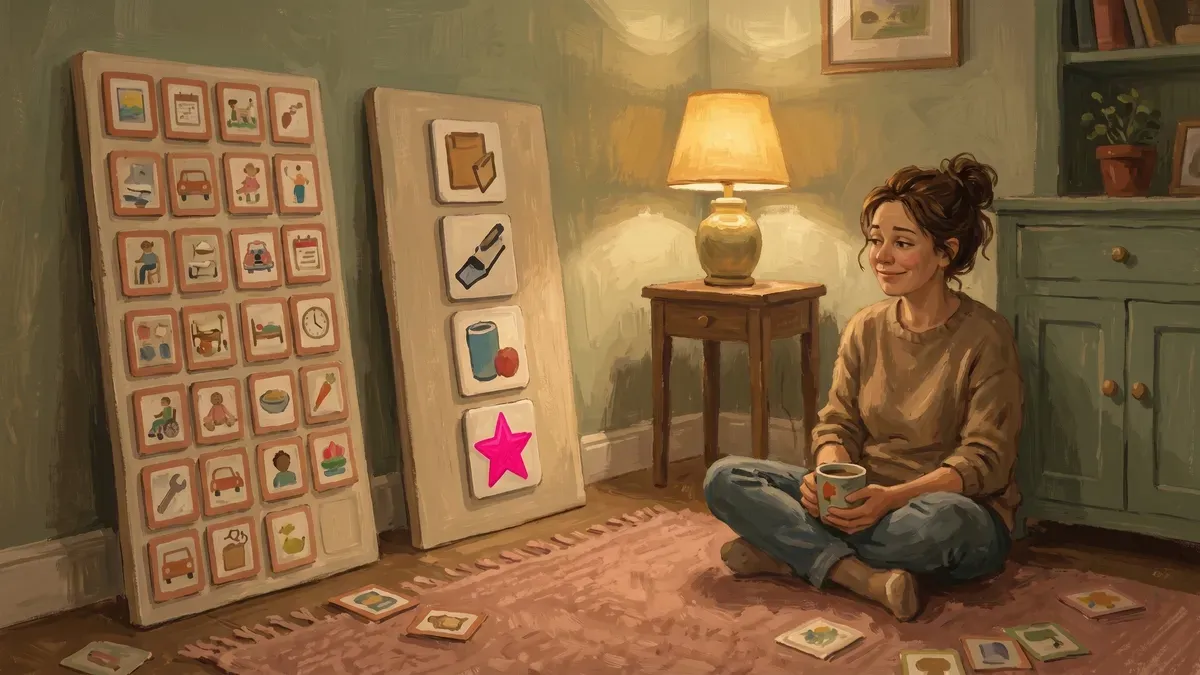
The first decision you make (how much to show) determines whether the board helps or overwhelms. Here is how the length, the pictures, and the layout each shift depending on which kid is standing in front of it.
- Decide how many steps to show and what lands at the end of them.
- Match the image style to how your kid actually reads a board.
- Settle whether tiles move or stay put every single day.

Choose the length and the payoff
Start by deciding how much to show. For your ADHD kid, cap it at three to five steps and end on something they actually want: snack, screen, the trampoline. That last tile is the motivation that drags them through the boring middle. A short first-then schedule (“first shoes, then park”) does the same job and gives you scaffolding for one transition at a time.
For your autistic kid, do the opposite. Show the whole sequence, every step, in the order it really happens. The reward is not a finish-line treat; the predictability is the payoff.
A blank visual schedule template is the easiest place to start, since you can pull the same tiles in or out depending on the kid. Print one, laminate it, and you have a reusable checklist for task completion that fits either child.
Pick the right pictures and labels
The picture has to match how each kid reads the board. For an ADHD kid, photos or clean icons paired with a word label keep the next step obvious and fast to scan, so the representation jogs the attention instead of testing it. Real shots of your own bathroom or backpack often beat a generic clip-art set here.
For your autistic kid, comprehension leans on consistency. Use the same symbol for “brush teeth” every single time, never a fresh picture each week. Many autism classrooms lean on Picture Communication Symbols, a standardized icon library kids learn to read fast precisely because the pictures never change. A clean, reusable set is exactly why a free printable visual schedule for the classroom, saved as a PDF, gets used year after year. That stable representation is its own quiet scaffolding.
Make it movable or make it fixed
The last call is whether the board moves. For ADHD, make it hands-on. Velcro tiles they peel off, or a checklist they tick, hand them a tiny hit of done-it satisfaction at each step, and that little burst feeds self-regulation and keeps them moving through the transitions. Over time it builds the independence to run the routine without you hovering.
For your autistic kid, lock it down. Same layout, same spots, identical every day, because the fixedness is what anchors them. Moving tiles around is a feature for one child and a stressor for the other. Pick the version that matches the kid in front of you, and let the board do its one job.
Side-by-Side: How the Two Boards Differ
Want the whole comparison on one screen? Here it is. If you’ve read how an autism visual schedule works, you already know that board is built to remove surprises, while the ADHD version is built to get a stalled kid moving. Seeing them side by side makes the design logic click faster than any explanation.
This table lines up the two boards across the choices you actually make when you build one:

| Design choice | ADHD board | Autism board |
|---|---|---|
| Main job | Beat task initiation, spark motivation | Deliver predictability, kill uncertainty |
| Schedule type | First-then or a short individual schedule | Full individual schedule, sometimes within-task |
| What’s shown | The next move plus a payoff | Every step, start to finish |
| Tiles | Movable, check-off-able | Fixed, same spot daily |
| The win | ”I started" | "I knew what was coming” |
So when you’re staring at a blank board, ask one question: is my kid stuck because they can’t start, or anxious because they don’t know what’s next? Those two problems don’t move with the same picture. The answer tells you which column you’re building.
When a Child Has Both ADHD and Autism
Both profiles in one kid is more common than most parents expect. A meta-analysis of 63 studies found that 38.5% of autistic individuals also meet criteria for ADHD, and DSM-5 now officially allows a dual diagnosis.
So you built two columns in your head, and your child is in both. That’s the reality for a lot of families.
The schedule itself can still work. What changes is the order of priorities. For a child who needs both predictability and help with task initiation, start with the autism side: keep the same sequence every day, same symbols, same layout. That fixed structure handles the anxiety. Then borrow from the ADHD column by making each step’s strip removable, so there’s a visible “done” moment after each task. That check-off action gives the dopamine nudge without disrupting the routine.

Where it gets harder is cognitive flexibility and sensory processing. An unexpected change can hit a dual-diagnosis kid from two directions at once: the routine disruption triggers anxiety, and the attention snap makes it harder to re-engage. Build in one planned variation per week so the board teaches some adaptability through scaffolding, not surprise.
For the full setup, creating a visual schedule autism setup at home walks through the physical build step by step.
If it gets messy, simplify. One anchor routine matters more than a perfect system.
How to Adapt a Visual Schedule for Home and the Classroom
Any schedule — hand-drawn cards, index cards, a printed grid — is a starting point, not a finished product. Here’s how to shape one for home and for the classroom.
Home routines: morning and bedtime
For a child with ADHD, a daily routine chart works best cut down to five cards max. Morning and bedtime routines are prime failure points because they run on low motivation at the exact moments when attention is thinnest. Put the steps that cause friction on the chart, skip the ones your kid already does on autopilot, and add a reward tile at the end. That’s the engine.
For an autistic child, sequence matters more than length. Keep the routine the same every morning, same pictures in the same spots. If a schedule change swaps one card out, walk them through the new version the night before. Predictability is the point. A 2024 literature review in the International Journal of Developmental Disabilities found strong evidence that visual schedules increase on-task behavior in students with autism, and the same principle carries into home routines.

Classroom and special-education boards
A whole-class visual schedule posts the day’s blocks so everyone knows what’s coming. A kindergarten classroom daily schedule typically runs eight to ten picture cards across the top of the board, matching the rhythm of transitions.
Individual schedules in a special education setting sit at the student’s workspace or on a binder ring. Teachers adapt special education schedule cards the same way parents do: students with ADHD get a shorter checklist with a moveable marker, while autistic students get a fixed sequence with consistent symbols.
- Reading Rockets notes that visual prompts increase student independence and reduce the need for adult support, benefiting both individual and whole-class implementation.
The behavior management payoff comes from keeping each student’s version predictable to them, even as the class moves through different activities.
What to Do When the Schedule Stops Working
Even a board that ran smoothly for months can hit a wall. The kid stops checking it. Meltdowns come back. You wonder if you did something wrong. You probably didn’t.
Start with the simplest explanation first: something changed. A new baby, a moved-around bedroom, a different after-school routine. Autistic kids feel those shifts before you name them. If the schedule hasn’t changed but behavior has, look at what else did.
- Pictures outdated. Your kid grew up. A cartoon toothbrush card for a six-year-old can feel babyish. Swap in a photo of their actual brush.
- Too many steps. Compliance creeps when the board gets padded over time. Strip it back. Five steps instead of eight is a proactive fix, not a failure.
- The reward tile vanished. For an ADHD kid especially, self-regulation fades when there’s nothing to work toward. Put the reward back at the end.
For autistic kids, a board that stopped working often means the gap between the board and reality widened. Maybe breakfast takes longer now, or the bus comes earlier. The fix is resetting the sequence so it matches the actual morning again, not pushing through the mismatch.
Don’t scrap the whole system at the first rough week. Try this instead:
- Tweak one thing (a photo, a step count, a reward tile).
- Give it a few days before deciding if it worked.
- If it’s still not clicking after three or four attempts, loop in the OT. They can spot what’s hard to see from inside it.
You’ll also find replacement templates in our complete library of routine guides whenever you’re ready to rebuild.
Found this useful? Save it for the next rough afternoon.
Questions parents ask me about this
What are the best visual schedules for kids with ADHD?
The best visual schedule for a child with ADHD is short, movable, and ends with a reward. Three to five picture cards with a motivating tile at the end outperforms a long laminated list every time, because the brain that struggles with working memory needs a clear, achievable finish line in view. Anything you can physically move or check off works better than static print, because each completed card makes the finish line visible and the remaining steps countable.
How many steps should a visual schedule have for a child with ADHD?
Start with three to five steps, maximum. ADHD strains working memory, so a long sequence blurs into noise before the second card is flipped. Once your child moves through a short board without prompting for a week or two, you can add one step at a time, but most kids stay in that three-to-five range and do fine there.
At what age can a child start using a visual schedule?
Most kids are ready for a simple two- or three-picture schedule around age two to three, when they can point to pictures and follow a short sequence. For a child with ADHD or autism, starting earlier rather than later usually pays off because the routine becomes automatic before the challenges of preschool and kindergarten hit. A first-then board (just two cards) is a good entry point for toddlers.
Should I laminate or use velcro for a visual schedule?
For a child with ADHD, velcro wins because the physical act of moving each card keeps attention engaged and gives a sense of progress. For an autistic child whose board needs to stay identical every single day, lamination with a consistent layout holds the sequence in place without introducing variation. Many parents do both: laminate the base board and velcro the picture cards so the order stays flexible without looking different each morning.
What do I do if my child refuses to use the visual schedule?
Check what changed first, because refusal is almost always triggered by something: new pictures, a step that got longer, a reward tile that disappeared. Try stripping the board back to two or three familiar steps and reintroduce it without pressure. If the board has worked before and suddenly stops, the schedule probably drifted out of sync with the actual routine rather than the routine outgrowing the tool.
Can the same visual schedule work for siblings with different needs?
The same board rarely works for both, but you can run two boards side by side with less effort than it sounds. An autistic child needs the same pictures in the same fixed order every day; an ADHD child needs a shorter, movable checklist with a reward at the end. Setting up two versions takes about ten minutes at the start of the week and avoids the daily negotiation of whose board this actually is.
Do visual schedules actually have research behind them?
Yes. The research is solid: a 2024 review in the International Journal of Developmental Disabilities found consistent support for visual schedules, and Reading Rockets data shows visual prompts cut how often kids need adult reminders to finish routines. The evidence base is strongest for autistic children but extends to kids with ADHD and mixed needs. Real-world results still depend on setup: the right length, pictures the child understands, and consistent daily use matter more than the material the board is printed on.
Written by
Nora Hayes
Mom of two and a former preschool aide. I share the screen-free sensory play and calm-down ideas I test at my own kitchen table, plus what the moms in my little meet-up swear by. A parent passing on what works, not a doctor or a therapist.
More about NoraKeep going
All Visual Schedules-
 Visual Schedules
Visual Schedule Printable: 20 Picture Cards + Free PDF
Visual schedule printable with the 20 picture cards every toddler home needs. Free PDF to download, print, and start using tonight.
-
 Visual Schedules
Visual Schedules: A Beginner's Guide for Parents
Most visual schedules fail before day three. Learn how they work and build your first board in 5 steps your child will actually follow. Start today.
-
 Visual Schedules
Toddler Schedule: Build One With Picture Cards
Your 2-year-old can't read a clock yet. Build a toddler schedule with picture cards in 5 steps that stop nap fights and meltdowns. Start today.
-
 Visual Schedules
Free Printable Daily Routine Chart Kids Will Follow
Grab a free printable daily routine chart your child will actually follow, plus picture cards and tips to make any routine stick. Download now.