Visual Schedules: The Beginner's Guide I Wish I Had

Some links here are affiliate links. If you buy through one, I may earn a small commission at no extra cost to you. As an Amazon Associate I earn from qualifying purchases. I only point to things I'd actually use with my own two.
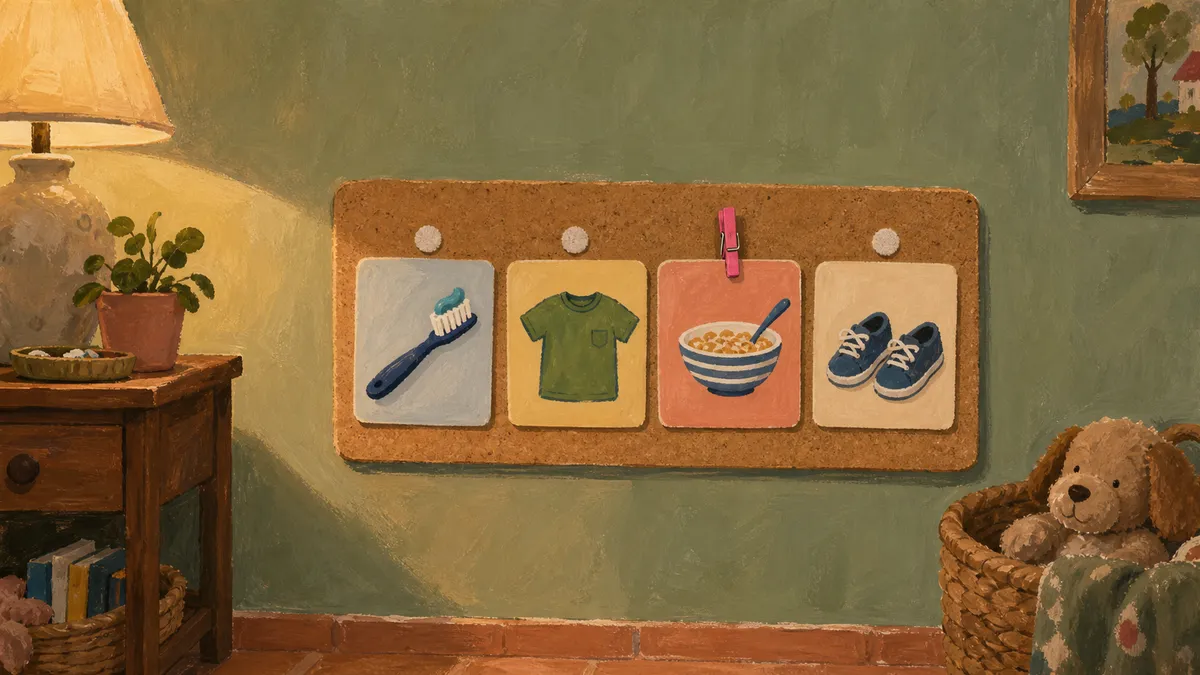
A visual schedule is a row of pictures that shows your kid what happens next, so the day stops being a fight over every transition. I’m Nora Hayes, a former preschool aide raising an autistic, sensory-seeking 7-year-old, and the fastest way to start is to pick one routine, lay out a few picture cards in order, and hang the board where your child can see it.
Below I’ll walk you through what these boards actually are, the 5 steps to build your first one tonight, real examples, the cheap materials that hold up, and what to do when your kid ignores it.
The plan in brief:
- Pick one routine to start (morning or bedtime), never the whole day.
- Choose 4-6 picture cards for that routine, in the order they happen.
- Hang the board at your child’s eye level and walk it with them for the first week.
What a Visual Schedule Actually Is
Strip away the jargon and a visual schedule is just a row of pictures that answers the question every kid is silently asking: what happens next? Here’s how that visual schedule does its job, and why it earns a spot in homes that have nothing to do with a diagnosis.
How a Picture-Based Routine Works
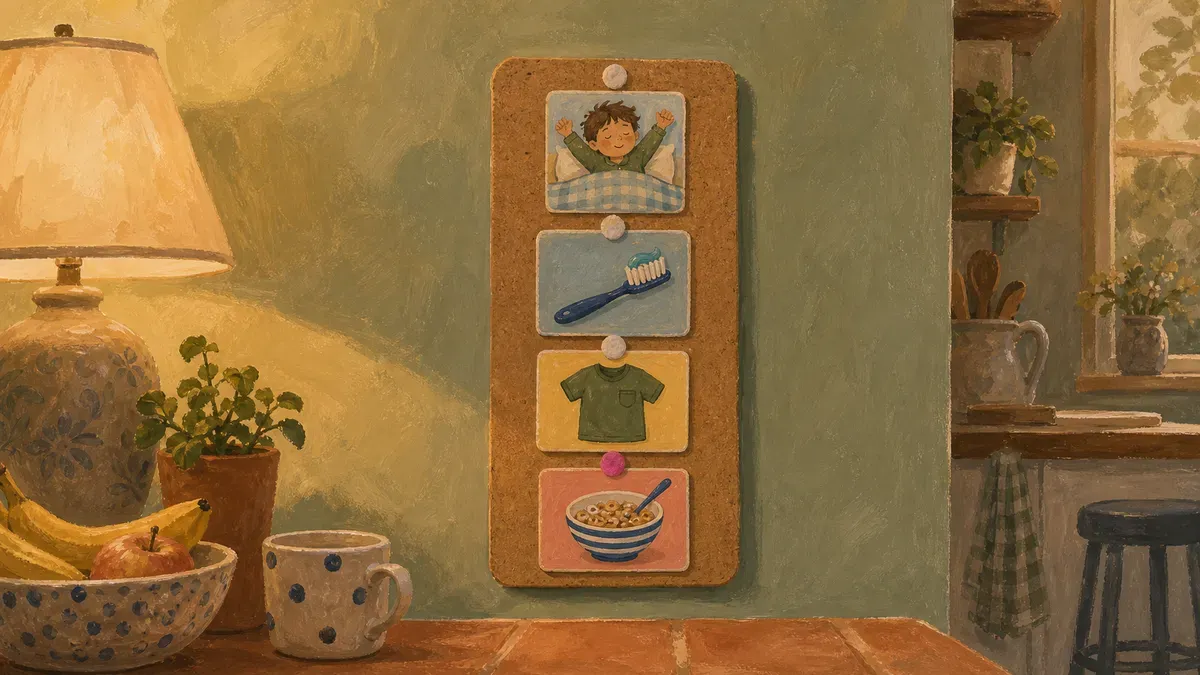
Your kid can’t hold a five-step morning in their head. “Get dressed, eat, brush teeth, shoes, backpack” is an abstract list to you and a fog to them. A picture-based routine pulls that fog into something they can see and touch.
Researchers describe a visual activity schedule as a series of images, photos, or line drawings that depict a sequence of events and prompt a child to follow the tasks on their own, per a definition from the ERIC education database. In plain terms: each picture card is one step, the cards sit in order, and your child works down the row one step at a time.
- Look at the next card and point to where they are in the sequence
- Finish that step
- Move the card over or check it off, then start the next
A simple first-then board is the baby version of this, two cards: first this, then that.
Who Benefits Most (and Why It’s Not Just for Autism)
A predictable order lowers the daily friction for every kid, and the gains run deepest for neurodivergent ones:
- Autism spectrum: visual structure is often how these kids make sense of the day, not a workaround but a genuine fit
- Sensory processing differences: spoken instructions can overwhelm a kid who is already maxed out; a board they can see stays put
- ADHD: the CDC reports that 11.4% of U.S. children ages 3 to 17 carry this diagnosis, and a visible board does a lot of the remembering the brain struggles to hold mid-task
They gain independence, and your child starts owning routine activities instead of waiting to be told. If you want ready-made setups by routine, my visual schedules routines guides walk through each one.
How to Build Your First Visual Schedule in 5 Steps
Here’s the short version before we get into the how:
- Target the one routine that breaks down most.
- Assign a picture to each step, laid out in real order.
- Mount the board where your child can see and reach it.
- Guide them through it every day for a week.
- Hand off control and let them lead.
Choose One Routine and the Right Number of Steps
Don’t try to schedule the whole day. Pick the one routine that goes sideways most often, usually the morning rush or bedtime, and build a visual schedule for kids around that single stretch.
Then keep it short. Occupational therapy guidance for ADHD routines recommends breaking a routine into 3 to 6 concrete steps, since the board’s whole job is to externalize the sequence so your kid isn’t holding it all in their head.
Four to six cards is the sweet spot for most toddlers and preschoolers. Match the count to your child’s developmental level, not their age on paper. A morning routine might be wake up, potty, get dressed, shoes, breakfast.
A board your kid can finish builds the habit. A board with twelve steps just teaches them to ignore it.
If each step still feels like a fight, you’ve got too many. Cut it back until task completion feels easy, then add a card later.
Pick and Arrange Your Picture Cards
Now give every step a picture. Photos of your own kid doing the thing work best, but clear clip-art or icons work fine too.
When you arrange the cards, a few things matter:
- Order them in the exact sequence the routine happens, top to bottom or left to right.
- Use your real-life order, not what looks tidy online. Shoes before coat if that’s how your morning actually runs.
- The sequence is the whole point: a board in the wrong order just creates confusion.
Staring at a blank board with no idea where to start? Work from a sample visual schedule first and swap in your own steps. You can follow our visual schedule template and personalize it card by card.
For kids brand new to this, start even smaller. The UConn parent training program calls the two-step first-then board the simplest place to begin, and their guidance on picture-based communication systems walks through it. Get two cards working, then grow the row.
Place the Board and Walk It Together
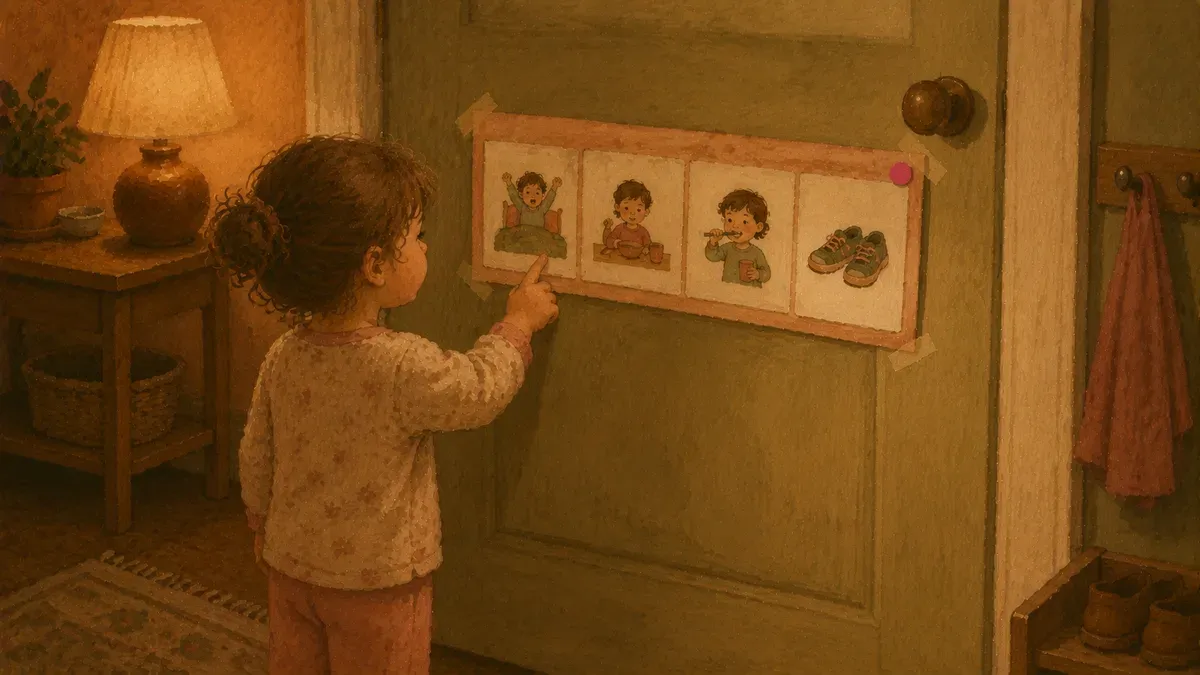
Hang the finished schedule where your kid can see and reach it, at their eye level, not yours. Bathroom door for bedtime, kitchen wall for morning. A board taped up at adult height is a board nobody uses.
The first week, you’re the guide. Walk through each transition together, point to the card, name it, then move it or check it off when it’s done. This is the part most parents skip, and it’s the part that makes the structured environment stick.
Keep your reinforcement plain and immediate. “You did dressed, what’s next? Shoes, you found it.” You’re not running a reward system, you’re a caregiver pointing at a row until the row starts pointing for you.
By the end of the week, ease off. Let them check the next card before you say anything. That small handoff is the whole point.
Visual Schedule Examples for Everyday Routines
The quickest way to understand this is to steal a board that already works. Here are the two routines most families start with, plus a weekly version for when your kid outgrows the one-day view.
Morning and Bedtime Routine Boards
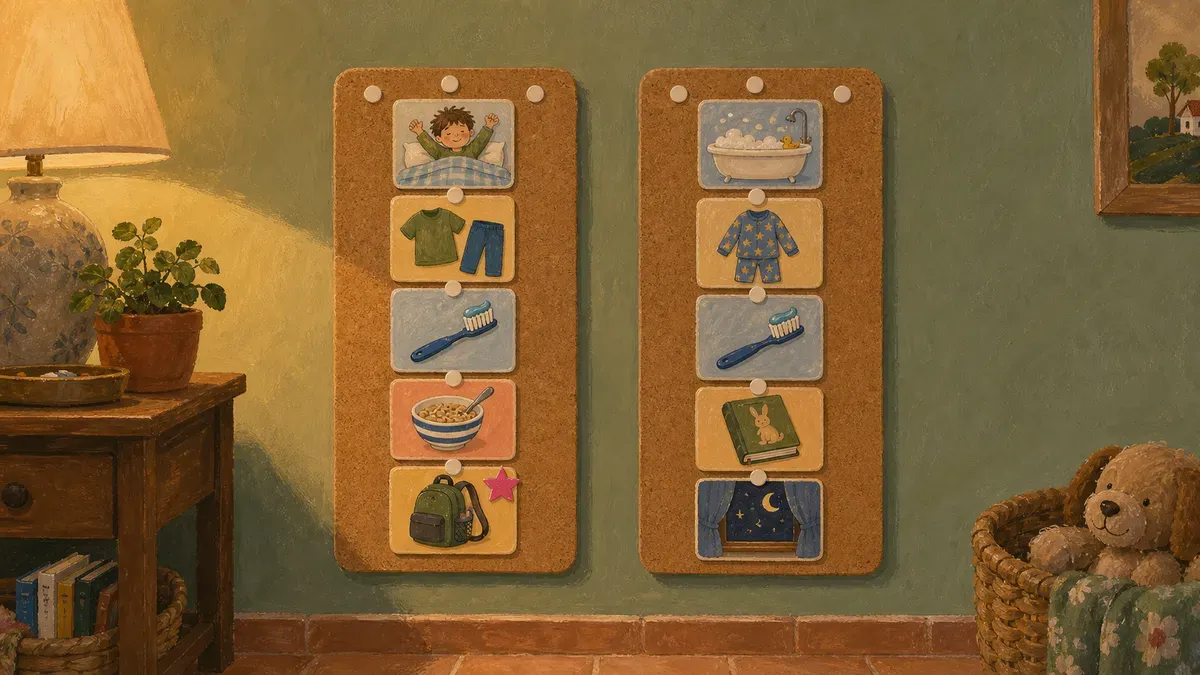
Mornings are where most of us start, because that’s where the meltdowns live. A solid morning board runs in the order the day actually happens: wake up, potty or diaper, get dressed, brush hair, eat breakfast, pack the bag. That’s six picture cards your kid can work down without you narrating every step.
Want a ready-made one to copy? A printable children’s morning routine chart saves you the cutting and laminating.
Bedtime gets its own board, and it’s shorter on purpose. A wound-down kid handles fewer steps better. Bedtime runs five steps, always in the same order:
- Bath
- Pajamas
- Brush teeth
- Book
- Lights out
Keep both as plain photo cards in the real order of your routine. The board carries the daily routine so you’re not the one repeating “and then we…” forty times before 8 a.m. These are the visual schedule examples that earn their keep, because the transitions they smooth are the ones that wreck a morning.
Weekly and Days-of-the-Week Boards
A daily board answers “what’s next.” Once your kid stops asking that and starts asking “is it the swimming day,” they’re ready for a wider view. A days of the week visual lays out the whole week in a row so they can see Tuesday coming instead of waking up to a surprise.
This is when the structured environment stretches from today to the whole week. Kids in the UK typically meet the days of the week around reception or year 1, ages 4 to 6, per Twinkl’s parenting guide, so that’s a fair window to introduce one.
Mark the special stuff. A swim icon on Wednesday, grandma on Saturday, the no-school weekend boxes shaded a different color. That predictability is the roadmap a kid uses to settle into the week instead of fighting it one morning at a time.
Materials, Lamination, and Velcro vs. Dry-Erase
You don’t need much. The board itself costs less than a lunch out.
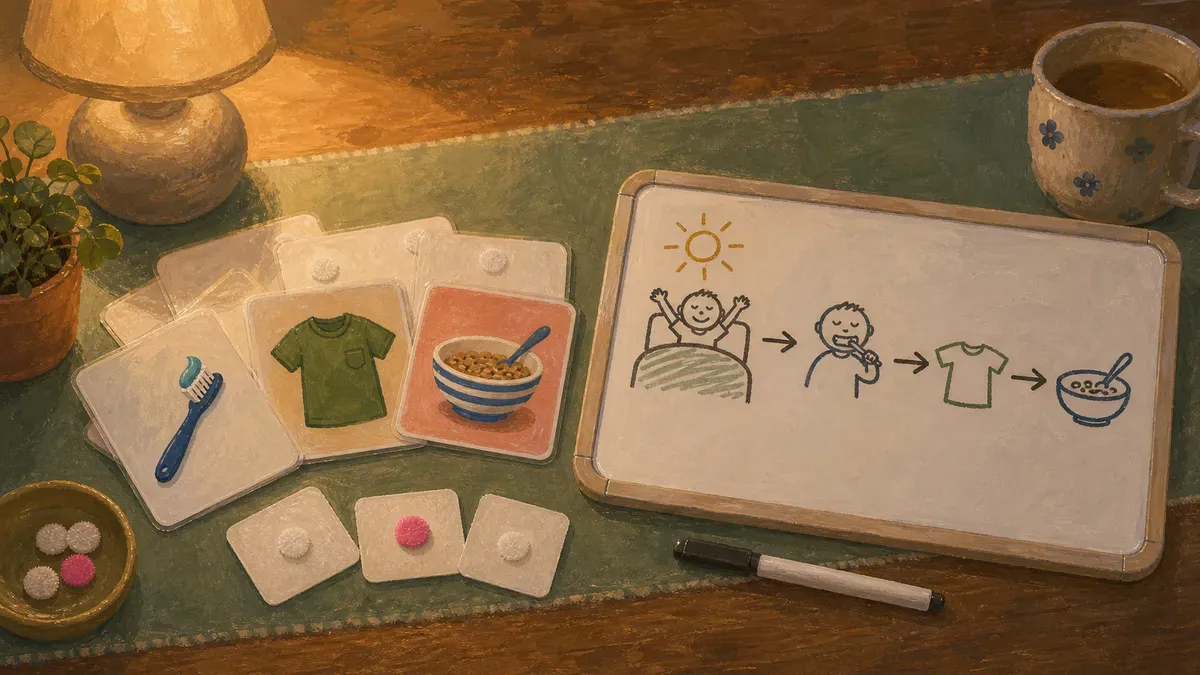
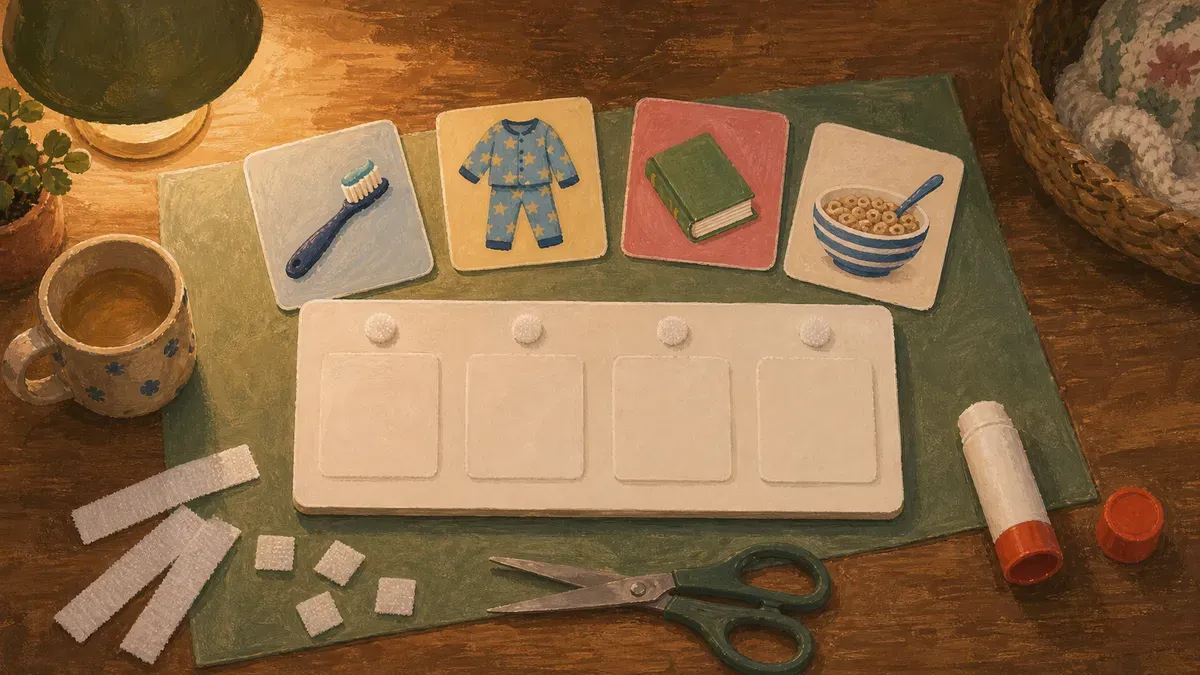
Start with our printable blank visual schedule template and print it on regular paper. That’s it for day one. No laminating yet, because you’ll likely shuffle cards around before the layout settles into something that actually sticks.
Once the card order stops changing, laminate. A basic home laminator warms up in about four minutes and comes with a few starter pouches, enough to seal a whole morning’s worth of cards in one sitting. It pays for itself the first time a card survives a yogurt spill. Check the current price on Amazon; the one I point parents to sits at 4.6 stars across 3,300-plus reviews, which for a cheap gadget is a lot of tired people agreeing it just works. Laminated cards shrug off a three-year-old’s breakfast, a backpack floor, and whatever happens between 7 and 9 AM.
Then the real question: how do the cards actually move? Here’s how the three setups I’ve used stack up.
| Setup | How it works | Parents’ rating |
|---|---|---|
| Hook-and-loop dot set | 35 washable dots; your kid peels each card to “done” and presses it back tomorrow | 4.4★, 290+ reviews |
| Dry-erase routine board | Magnetic board with a morning side and a bedtime side, wipe and reset each night, nothing to lose under the couch | 4.3★, 580+ reviews, Amazon’s Choice |
| Pocket chart | 8 fabric pockets, 23 activity cards plus 4 blanks to fill in, sliding in and out with no adhesive | 4.6★, 260+ reviews, Amazon’s Choice |
The dot set wins for sensory-seekers. That physical peel-and-stick “finished” moment lands harder than checking a box, and it keeps the personalized schedule flexible when a step needs to move. The dry-erase board is faster on a chaotic night. The pocket chart is the one I’d hand a family whose routine shifts by the day, since you can rebuild the structured environment in ten seconds without peeling a thing.
For most families starting out, hook-and-loop dots on a foam board is the simplest move. Low-cost, forgiving when the order changes, and your kid gets to own the process of flipping each card.
When Your Child Won’t Follow the Schedule
Getting the board up is the easy part. The real work is making it feel like theirs, not another thing you’re making them do, and knowing when the setup itself is what’s broken.
Introduce It Without a Power Struggle
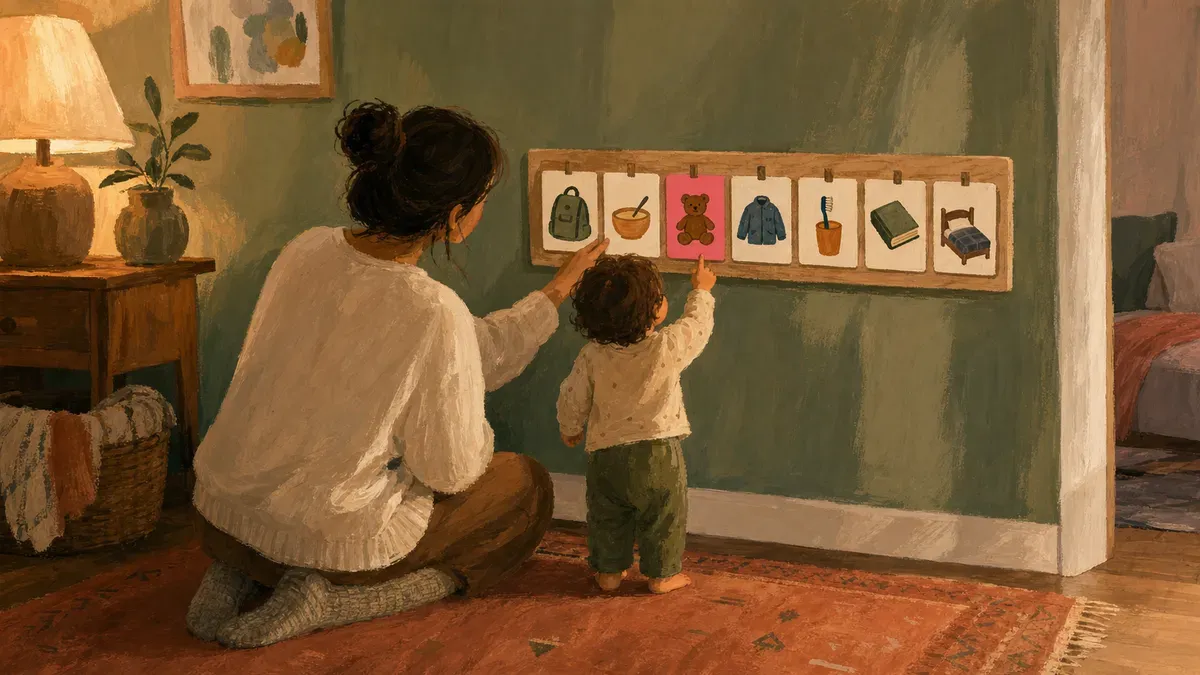
Don’t roll it out as a new rule. Bring your child in while you’re building it. Let them pick their own picture card for “breakfast,” help tape the header, decide which corner of the wall it lives on. Small ownership signals kill resistance before it starts.
The first week, walk every transition with them. “Okay, what does the schedule say comes next?” Point together, let them flip the card. Occupational therapy advice on routines and transitions from NAPA Center recommends having kids physically move the completed card to a “done” pocket or bin. Moving the completed card gives them a clear signal the step is done as caregiver control gradually loosens.
Skip the behavioral expectations talk. Just do the routine, follow the board, stay calm. Reinforcement here is simple: name the win. “You checked the schedule yourself. That’s big.”
Fix the Most Common Beginner Mistakes
Most schedules stall for one of three reasons: too many steps, wrong placement, or no follow-through.
- Cut the step count until your child can follow it without shutting down.
- Keep the same cards in the same order for at least two weeks before changing anything.
- Use the board every single time, not just on the hard mornings.
- Too many steps. If your child shuts down at card four, pull back to three. Match the step count to their developmental level, not where you wish they were.
- Changing the cards too soon. Swapping out picture cards before your child has learned the sequence resets their progress. Give the same setup at least two full weeks before you adjust anything.
- No follow-through. The board only builds a structured environment when you use it every single time, not just on the rough mornings. Task completion needs the routine to be consistent.
If nothing’s clicking after two solid weeks, browse our complete library of routine guides or dig into what to do when a toddler wont follow visual schedule 9. Sometimes the problem is the routine itself, not the board.
Found this useful? Save it for the next rough afternoon.
Questions parents ask me about this
How do I get started with visual schedules for kids?
Pick one routine your child does every day, pull four to six pictures for it, and put the board at their eye level. That's it. You don't need a perfect system on day one. Start with morning or bedtime and walk through it together for the first week until it clicks.
How many pictures should I put on a toddler's visual schedule?
For most toddlers and preschoolers, four to six pictures hits the sweet spot. If your child keeps skipping steps or seems confused, that's usually a sign there are too many, not too few. Fewer than four and the board loses its usefulness; more than six and you've outpaced what most young kids can track at once. Match the step count to where your child is developmentally, not to their age on paper.
At what age can a child start using a visual schedule?
Most kids are ready somewhere around two to three, though younger toddlers can start even earlier with a simple two-step first-then board. If your child can follow a point or understands "first this, then that," they're ready to try. Begin with two pictures, then grow the board as they get it.
Do I need to laminate a visual schedule?
No, not right away. Print on plain paper, test the routine for a week or two, and laminate once you're sure the sequence is staying. A home laminator is cheap if you decide you want one, but a working unlaminated schedule beats a perfect laminated one you haven't made yet.
What if my child ignores the visual schedule completely?
First, check placement: the board needs to be at their eye level, not yours. Then go back to basics: physically walk through each card with them at transition time instead of pointing from across the room. Letting your child help build or choose the pictures also makes a real difference; kids who had a hand in making the board are much more likely to use it.
Are there free apps for visual schedules?
Yes, several apps let you build picture-based schedules on a tablet or phone at no cost, with paid upgrades for larger symbol libraries. Digital schedules work well for kids who are already comfortable with a device and for families who need to update the routine often. That said, a physical board is usually easier for very young kids and sensory-seekers who benefit from touching and moving the cards.
How do I match a home schedule with daycare or school?
Ask the teacher or daycare provider what their routine looks like and use the same picture symbols at home that they use in the classroom. Consistent images across settings help your child transfer the skill instead of learning it twice. Even a rough match (same general sequence, similar card style) is enough to smooth the gap between home and school.
Written by
Nora Hayes
Mom of two and a former preschool aide. I share the screen-free sensory play and calm-down ideas I test at my own kitchen table, plus what the moms in my little meet-up swear by. A parent passing on what works, not a doctor or a therapist.
More about NoraKeep going
All Visual Schedules-
 Visual Schedules
Visual Schedule Printable: 20 Picture Cards + Free PDF
Visual schedule printable with the 20 picture cards every toddler home needs. Free PDF to download, print, and start using tonight.
-
 Visual Schedules
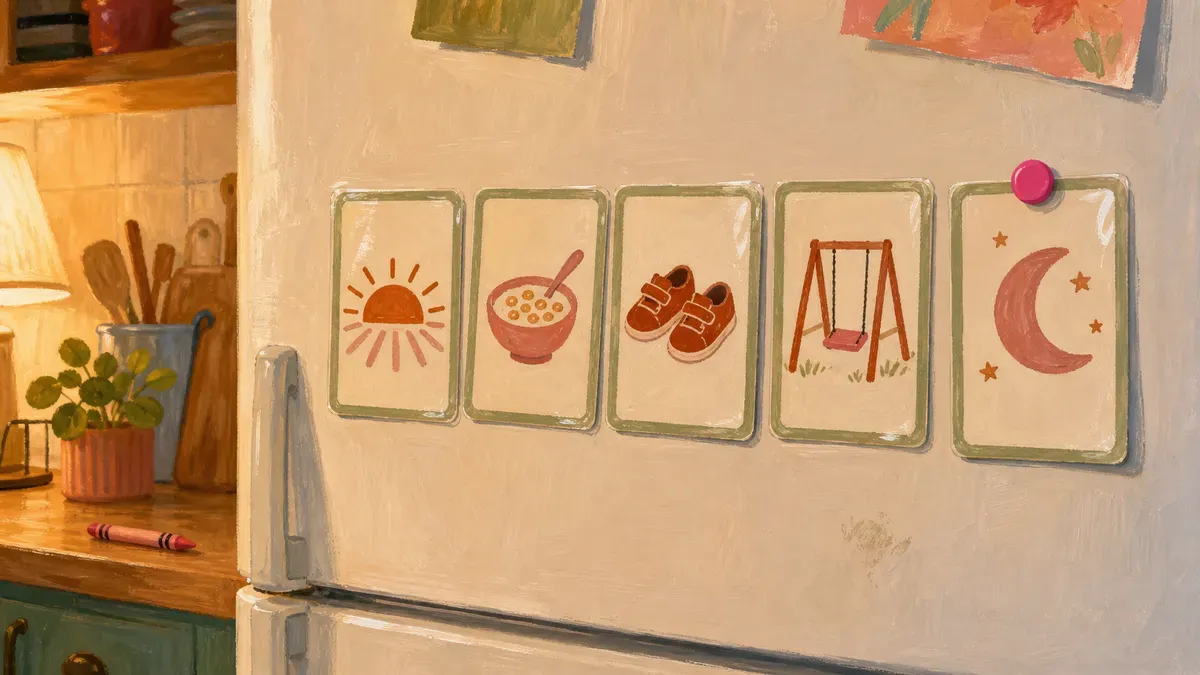
Toddler Schedule: Build One With Picture Cards
Your 2-year-old can't read a clock yet. Build a toddler schedule with picture cards in 5 steps that stop nap fights and meltdowns. Start today.
-
 Visual Schedules
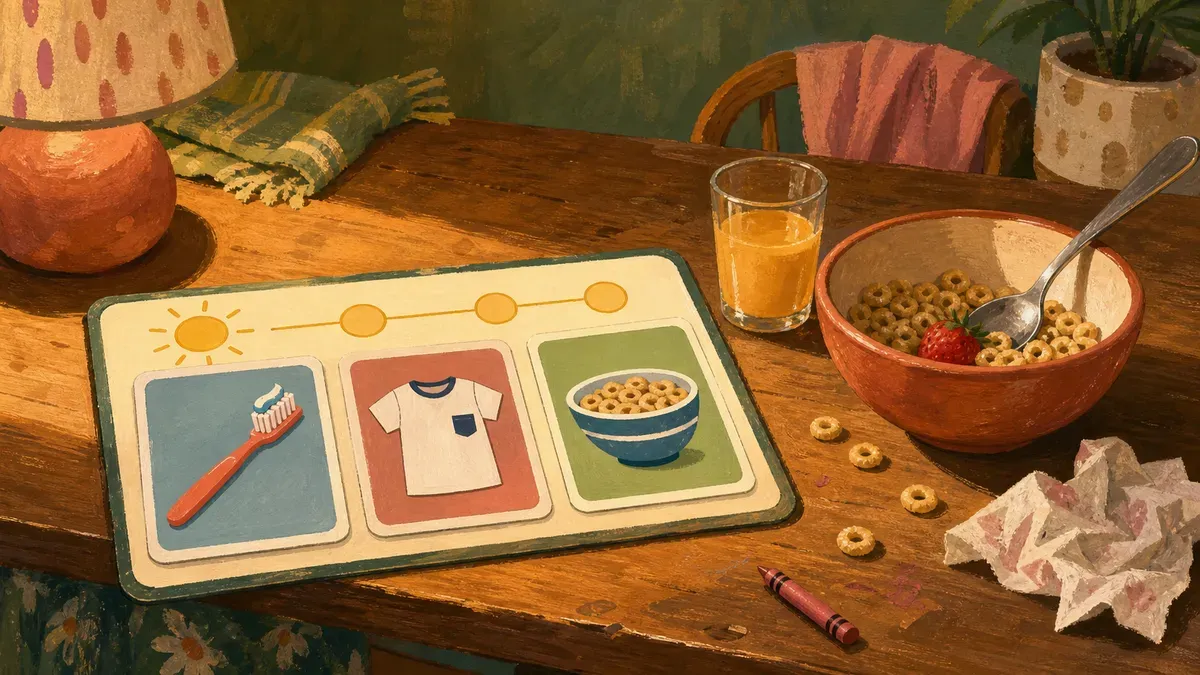
Free Printable Daily Routine Chart Kids Will Follow
Grab a free printable daily routine chart your child will actually follow, plus picture cards and tips to make any routine stick. Download now.
-
 Visual Schedules
Morning Routine Printable: Make One Kids Follow
Stop the morning yelling. This morning routine printable gets kids out the door on their own in 15 minutes. Grab the free chart and build it today.