Toddler Schedule for 2-Year-Olds Who Can't Read Yet

Some links here are affiliate links. If you buy through one, I may earn a small commission at no extra cost to you. As an Amazon Associate I earn from qualifying purchases. I only point to things I'd actually use with my own two.
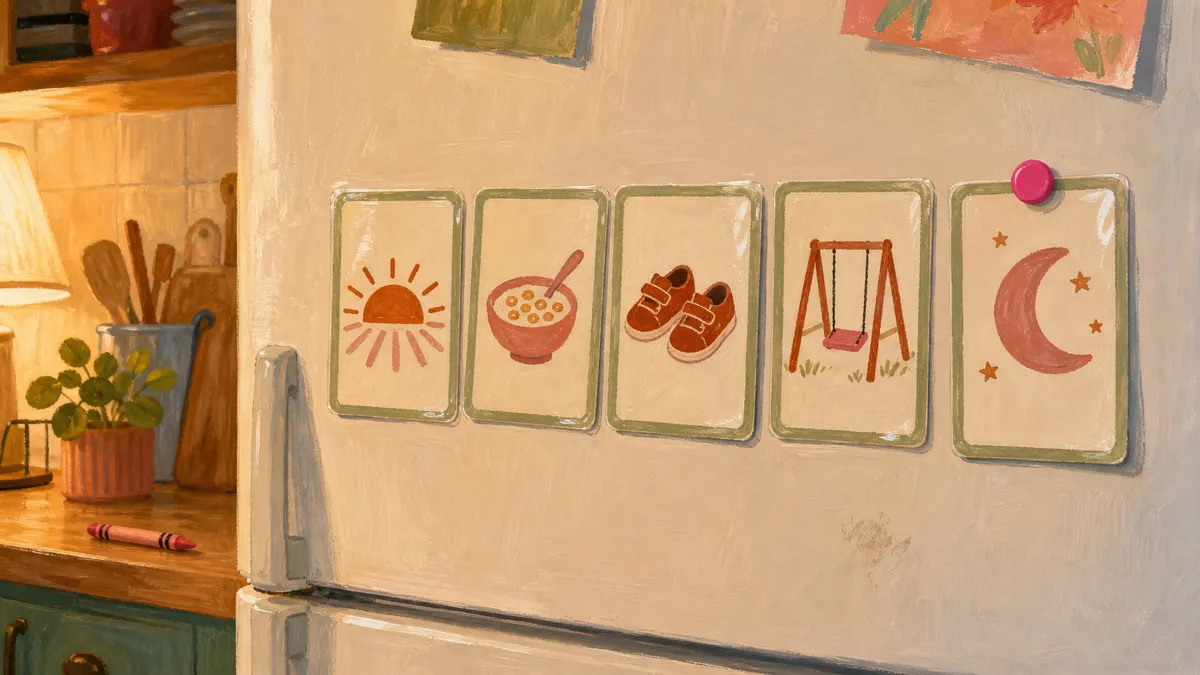
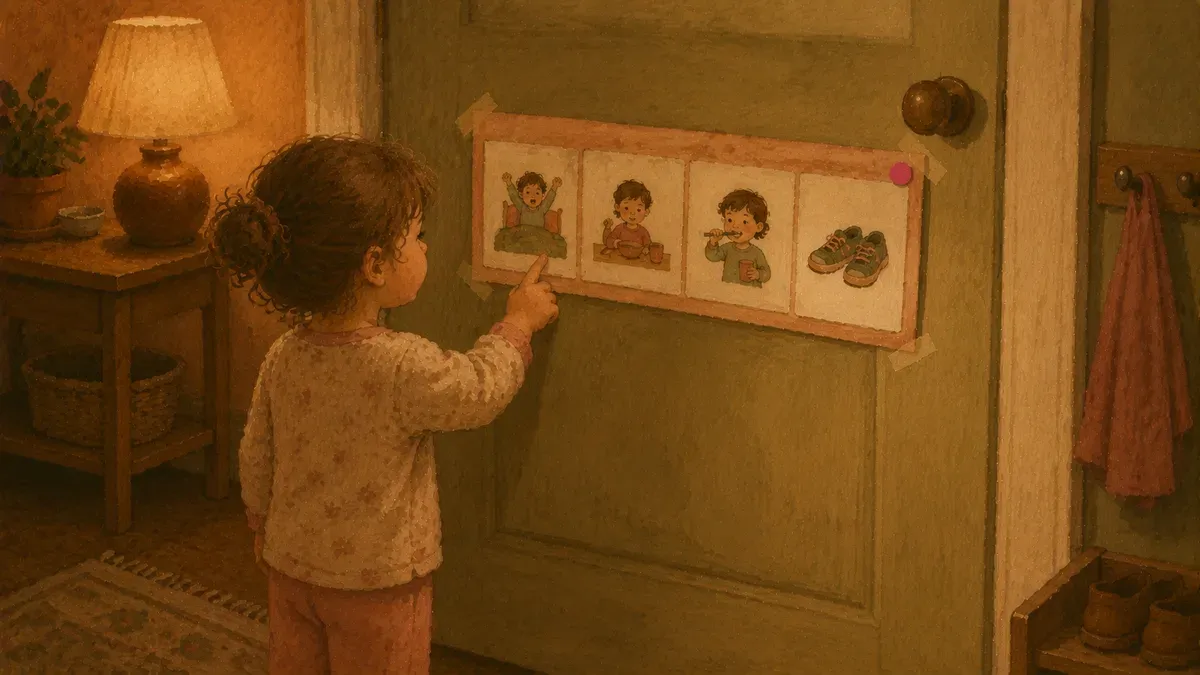
Daily routine cards for 2-year-olds swap clock times for pictures, giving your toddler a visual schedule they can actually follow. At two, abstract time means nothing, but a card row with a predictable shape cuts the “what now?” meltdowns. I’m Nora Hayes, former preschool aide and mom to two, and this covers how to build your row, a sample day you can copy, and what to do when the routine falls apart.
The plan in brief:
- Lay out 6 to 8 picture cards in the order the day actually happens, from wake-up to bedtime.
- Anchor the day around the same nap window (roughly 12:30 to 2:30 PM) and a fixed bedtime.
- Walk through the cards together every morning and flip or remove each one as it’s done.
Why a 2-Year-Old Needs Pictures, Not Clock Times
A two-year-old has no idea what 8:45 means. What she does understand is “breakfast picture, then shoes picture, then park picture.” That sequence is the whole schedule.
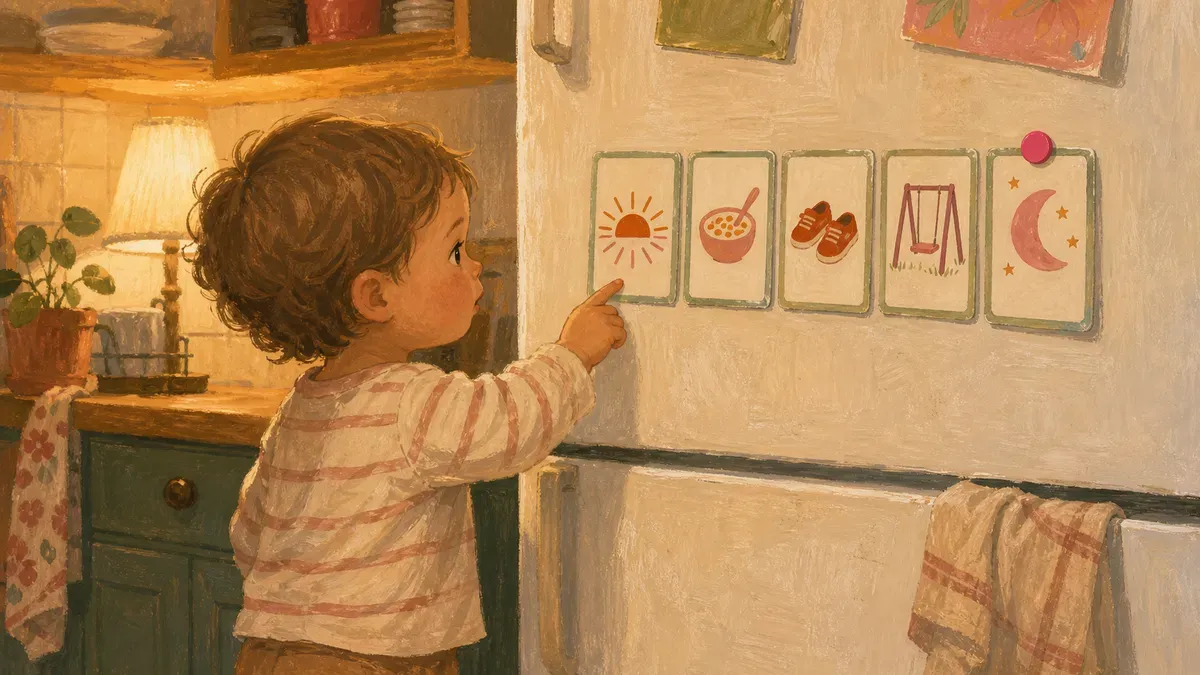
Clock times create anxiety because the clock is invisible to a pre-reader. A picture card is something she can touch, point to, and anticipate. That predictability is what calms the hour, not the clock. Research on routines and child development backs this up: a 2024 systematic review in the Journal of Family Theory & Review found that 16 of 18 studies on family routines linked consistent routines to stronger self-regulation and executive function in children.
- Transitions are where most toddler meltdowns live
- The shift from one activity to the next hits hard when she can’t see it coming
- A picture card makes “what’s next” concrete before you’ve said the words
- That removes the negotiation and cuts the emotional crash that follows a surprise
For language development, the routine also gives you the same words in the same order every morning. “Now shoes. Now coat. Now car.” That repetition is vocabulary practice in disguise.
Visual schedules routines work for the same reason: the visual carries the message before the words get there.
How to Build the Schedule in 3 Steps
Before you cut a single card, the daily schedule has to match the day you actually live with your 2-year-old. Here’s how I build one from scratch, in three moves: map your anchors, make the cards, then hand it over to your kid.
- Identify the fixed events that anchor every day.
- Create picture cards from those moments and laminate them.
- Hand the routine over so your toddler moves the cards themselves.
List the Anchors of Your Day
Start with the parts of the day that don’t move. Wake time, breakfast, nap time, dinner, bath, bedtime. Write them down in order on a scrap of paper before you go near a printer.
These are your structure, the bones everything else hangs on. The snack, the playground, the cleanup song all slot in between them, but the anchors stay put.
Do this in pencil for a few days first. Watch when your kid actually gets sleepy, actually gets hungry, and pin the nap and meals to the real rhythm, not the one you wish you had.
Map the day you have, not the day on the parenting blog.
Print and Prep the Cards
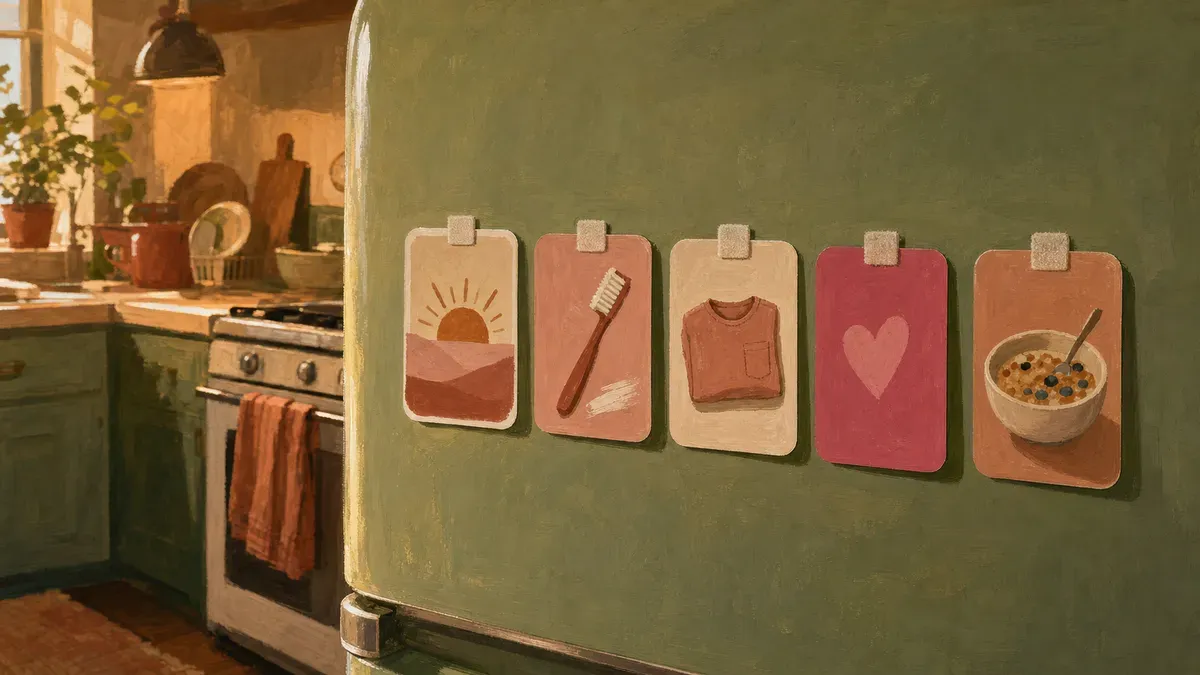
Now turn those anchors into pictures. Print 6 to 8 simple icons, one per moment, on cardstock so they survive a toddler’s grip. Printer paper goes limp by day three. The 65lb version holds up when small hands maul it, and the 100-sheet pack I reach for has 480-plus parents behind it at 4.8 stars. You can draw the icons yourself, snap photos of your own kid doing each thing, or grab a ready-made visual schedule template and skip the art project.
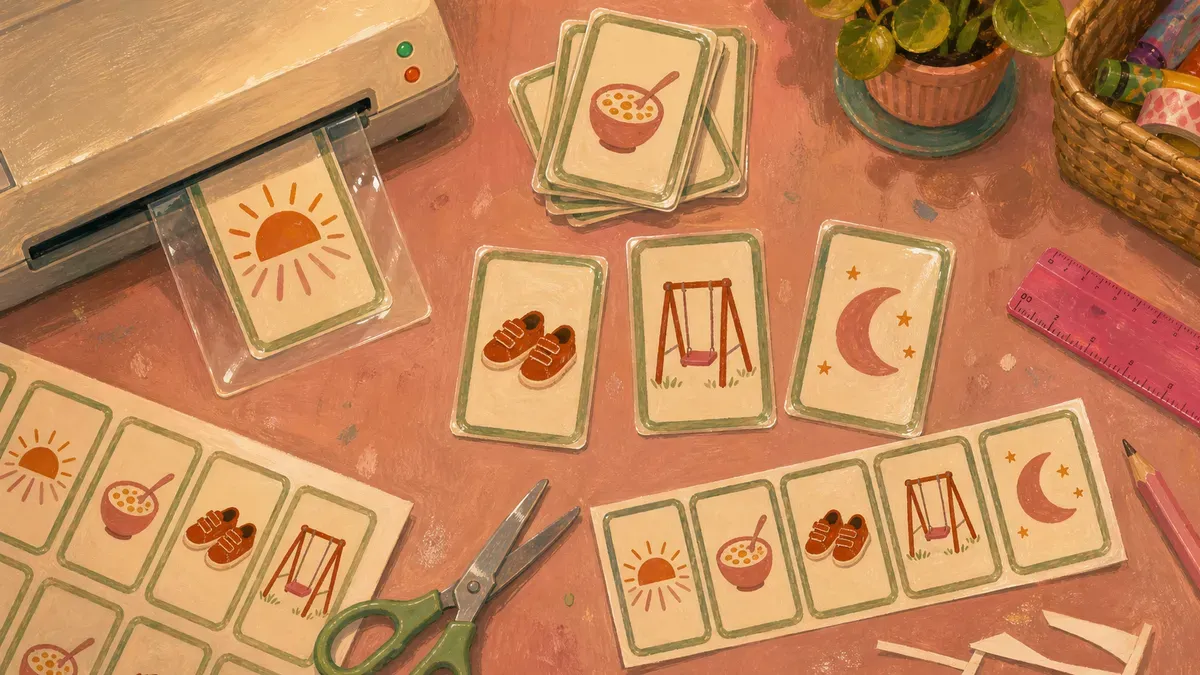
Laminate every card. A picture schedule lives on the fridge, gets dropped, chewed, and crammed in a backpack, and thin lamination folds and creases fast. Step up to the 5 mil pouches instead and the set survives the year. They’re an Amazon’s Choice pick sitting on 13,000-plus reviews at 4.9 stars, which is about as sure a bet as laminate gets.
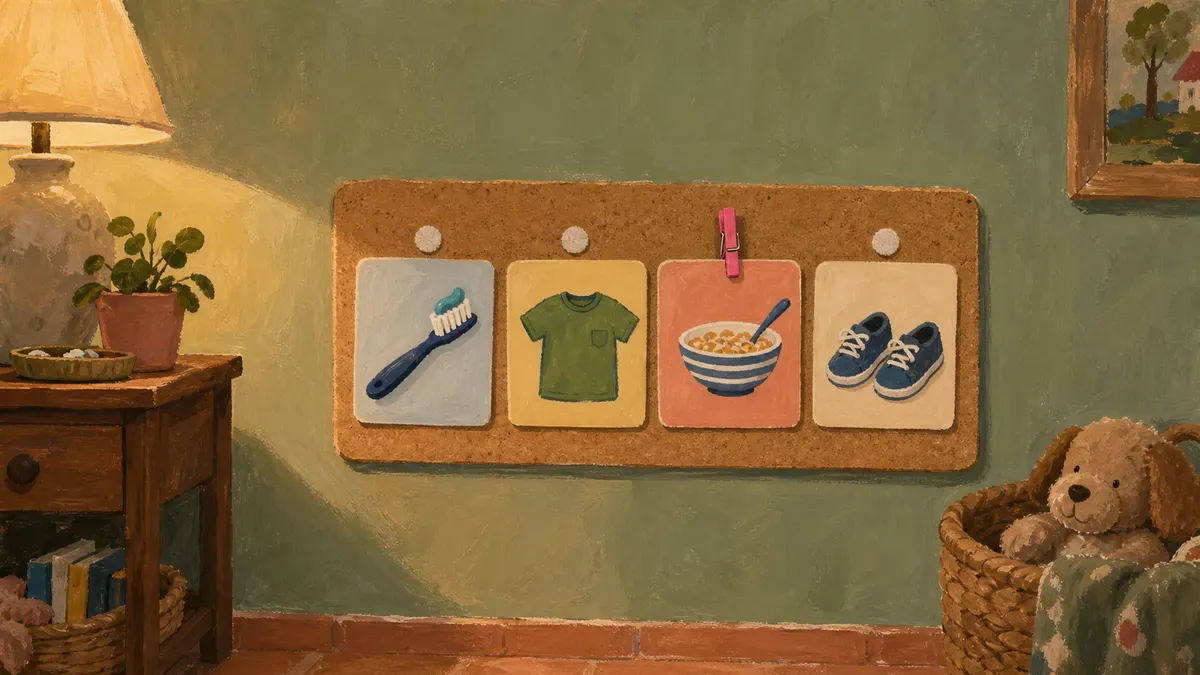
Then add Velcro dots or a magnet strip so the icons become movable. One 200-pack of 3/4-inch dots, with over 8,000 reviews behind it, outlasts every set of cards you’ll ever cut. That one detail is the whole point: a pre-reader can grab a card and physically move it when the activity is done.
Introduce It Without a Power Struggle
Don’t hang the cards and bark orders at them. For the first few days, walk through the routine together, card by card, like you’re reading a story about the day.
Then step back and let your toddler do the moving. They flip the breakfast card, they pull the nap card off the wall. NAEYC points out that letting children carry out each step themselves builds independence and heads off the struggles and tantrums that come from surprises, and you can read their full take in their guide to growing toddler independence.
That hand-off is what keeps transitions calm. With consistency, the routine cards stop feeling like a command and start feeling like their job, something they get to do, not something done to them. That shift is where the behavior management actually happens.
Sample Daily Routine for a 2-Year-Old
Here is what a practical schedule looks like when it runs on toddler biology instead of a clock on a wall.
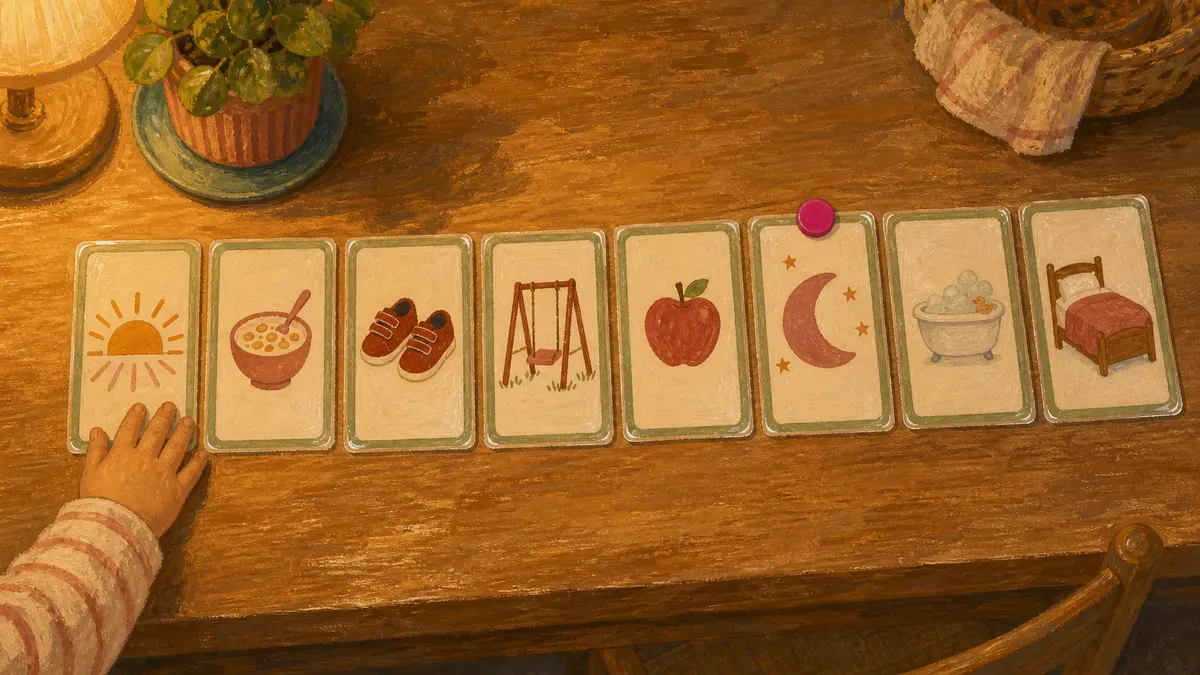
Wake time, meals, nap, and bedtime are the fixed anchors. Everything between them can flex.
- Wake + breakfast (~7:00 AM): start the morning routine right away, cards go up
- Morning play (~7:30-9:30): free play first, when energy is highest
- Snack + outside (~9:30-10:30): movement before any sit-down activity
- Independent playtime (~10:30-11:30): quiet time in a contained space, start with 10 minutes
- Lunch (~11:30)
- Nap time (~12:30-2:30): non-negotiable at this age
- Afternoon play + snack (~2:30-4:30)
- Family dinner (~5:00-5:30)
- Bath, books, bedtime (~6:30-7:00)
This works as a schedule for a 2 year old or a 20 month old, almost exactly. At 20 months, nap runs a little longer and independent playtime is shorter, maybe 5 minutes before they want you back. The bones are the same. Only the proportions shift as they grow.
The times are guidelines. What actually matters is the order. If breakfast lands at 8 instead of 7, everything slides an hour and the day still holds because the sequence is what’s in their body, not the numbers.
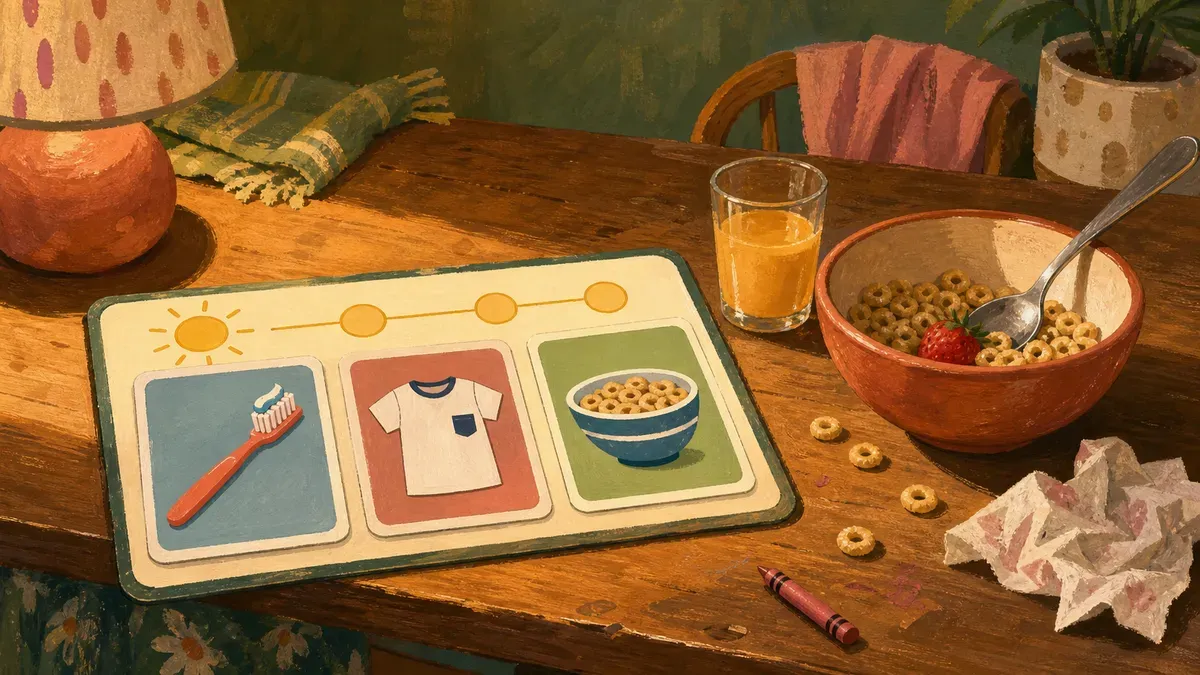
You can pair this with a children’s morning routine chart for the first block of the day if that piece needs more detail than the general schedule covers.
Print this shape. Adjust the times to your household. Once the order is familiar, the routine runs itself.
Adjusting the Routine by Age and Stage
That printed shape isn’t forever. The same cards that run your 2-year-old’s morning would baffle a 10-month-old and feel babyish to a 3-year-old, so here’s how the routine bends as your kid grows.
Babies Through 18 Months
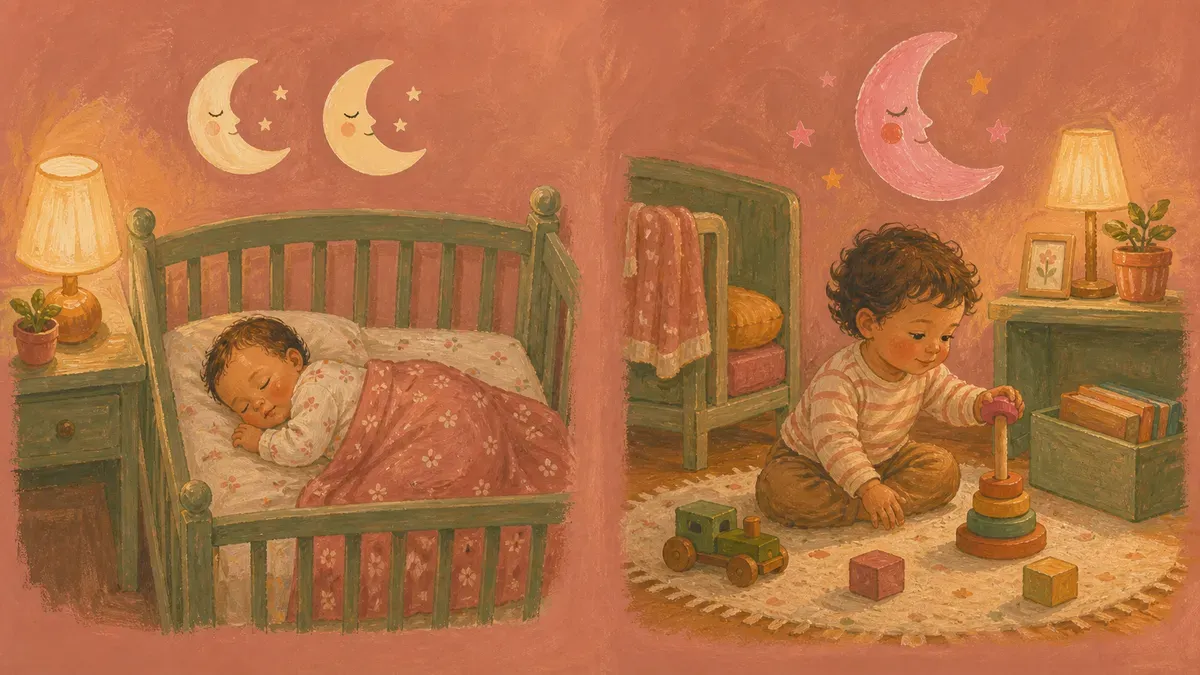
Don’t bother with picture cards yet. A 2-month-old daily routine, a 10-month-old’s day, a 13-month-old’s, a 15-month-old’s, a 16-month-old’s, right up to an 18-month-old schedule, still runs on sleep and food, not visuals. Your baby can’t read a card and doesn’t need to.
At these ages the day is built around two naps and feeding windows. Wake, eat, play a little, sleep, repeat. The recommended sleep amounts for toddlers land at 11 to 14 hours per 24 hours for the 1-to-2 crowd, naps included.
Most kids drop from two naps to one somewhere between 13 and 18 months, with 14 to 15 months the usual tipping point, per Huckleberry. So a one year old schedule still leans on two sleeps and a steady rhythm of wake time, feeding, and nap time. The cards come later.
What Changes at Two and Beyond
The switch flips around the one-nap mark. Once your toddler consolidates to a single nap, Huckleberry notes those wake windows stretch to four to six hours, and suddenly there’s a long, alert stretch of morning to fill.
That gap is exactly where picture cards earn their keep. A 2-year-old has the attention and the developmental milestones to follow a sequence, anticipate what’s next, and handle transitions without a card-flip surprise. Longer awake stretches mean more to organize, which is why visuals click now and didn’t at one.
If you’re sorting out how many cards to show, my guide on how many pictures should toddlers visual schedule include walks through it. Keep building toward three, where quiet time replaces the second nap and the routine grows up with your kid.
Handling Naps, Screen Time, and Daycare Days
Three things wreck a smooth-looking schedule faster than anything else: a nap that drifts, a tablet that won’t turn off, and a daycare day that runs on different rules. Here’s how the cards handle each one.
Protecting the Nap Window
Guard the nap like it’s the load-bearing wall of your day, because it is. Start rest time early in the afternoon and keep it consistent, somewhere in that 12:30 to 2:30 PM block. The Sleep Foundation points to a nap start window of 12:30 to 1:00 p.m. for 2-year-olds, and there’s a reason to keep it from sliding late: a study of 1.5-year-olds found that naps ending later in the afternoon were linked to shorter nighttime sleep.
A nap that creeps to 3:00 doesn’t just shorten quiet time, it steals from bedtime. When the rest card lands in the same spot every day, the whole afternoon settles around it, and you protect the night before it even starts.
Where Screen Time Fits
Screen time isn’t the enemy. The fight is the enemy, that scream when the show ends out of nowhere. So give it a card.
Put a tablet or TV icon in one fixed afternoon slot, usually after nap, with a real card on each side of it: snack, then screen, then the next thing. Now the screen has edges.
Your toddler can see what comes before and after, so the end of a show becomes just the next card, not an ambush.
That predictable hand-off is what shrinks the transition meltdowns, and it keeps screen time from becoming a nightly power struggle. The AAP’s screen time guidance for young children recommends no more than 1 hour a day of high-quality programming for ages 2 to 5, and a single fixed slot makes that limit run itself.
Keeping Daycare and Home in Sync

A toddler living by two different rulebooks works twice as hard. The fix is making home and daycare feel like one continuous day.
Ask your provider for their rough order: arrival, snack, play, lunch, nap, pickup. Then mirror it on your home cards using the same icons and the same words, so “snack” looks and sounds identical in both places. That shared structure means the predictability doesn’t stop at the daycare door, and the transitions between worlds get a whole lot softer.
- Use matching icons for the steps both places share
- Run a quick card walk-through before you leave each morning
- Keep a tiny travel set in the bag for the ride and pickup
My guide on building a daycare schedule for toddlers walks through matching the two side by side. When both worlds run on the same cards, the toughest transition of the day, the drop-off, stops feeling like a different planet.
Staying Flexible When the Day Falls Apart
Some days the schedule survives intact. Most days it doesn’t.
Three things reliably wreck a day:
- A late wake-up
- A tantrum that ate 40 minutes
- A nap that refused to start
That’s not a failure of the routine. It’s just Tuesday.
The picture schedule is a guide, not a rulebook. When the day goes sideways, you don’t abandon the cards; you skip to wherever you actually are. If lunch happened late, move straight to nap prep. Your two-year-old still gets the visual cue of what comes next, and that predictability keeps the wheels from coming off even when the timing is wrecked.
Meltdowns are where this flexibility matters most.
- A toddler mid-tantrum can’t absorb an explanation of why lunch is late.
- One card, one cue: “Here’s what’s next.” That’s enough.
The goal isn’t a perfectly timed day; it’s a kid who knows the shape of what’s coming.
The sequence is what steadies the day, not the hour hand.
Found this useful? Save it for the next rough afternoon.
Questions parents ask me about this
How do I create a toddler daily schedule that actually works?
Start with the four fixed anchors your day already has: wake time, meals, nap, and bedtime. Fill the gaps with activities in a consistent order rather than assigning clock times to every slot. Put the routine on picture cards your toddler can see and touch, and walk through them together for a few days until the order sticks.
What time should a 2-year-old wake up and go to bed?
Most 2-year-olds wake somewhere between 6:00 and 7:30 AM and do best with a bedtime between 7:00 and 8:00 PM. The exact times matter less than keeping them consistent day to day. What anchors the schedule is the gap between wake time and nap, and between nap and bedtime, not the numbers on the clock.
How many hours of sleep does a 2-year-old need per day?
Two-year-olds need 11 to 14 hours of sleep across the full day, nap included. Most of that comes overnight, with a single midday nap making up the rest. If your child is on the shorter end of that range but waking rested and in a good mood, they are probably fine.
What do I do when my toddler refuses to follow the schedule?
Skip to wherever you actually are in the day and keep going from the current card. Fighting to get back on track step by step usually makes things worse. During a meltdown, one card at a time is enough: hold up the next picture, name it, wait. The routine is a tool, not a contract, and a partial day still counts.
How many picture cards should a 2-year-old's schedule have?
Six to eight cards covers a full day without overwhelming a toddler who is still learning what a schedule even is. Too many icons and the board becomes noise. Stick to the biggest transitions and the most consistent parts of the day, and you can always add a card later once the habit is solid.
Should I use clock times or just the order of activities?
Use the order, not the clock. A two-year-old cannot read a clock and the concept of "10:15 AM" is meaningless to them. Sequence is what they can track: this, then this, then this. Clock times stress you out when things run late and tell your toddler nothing useful. Order holds even when the day shifts.
How do I keep the routine going on weekends and travel days?
Keep the same sequence of activities even if the timing drifts. A separate small set of travel cards helps on the road: pack the same icons your toddler sees at home so the order feels familiar even in a different place. Protecting the nap window and bedtime matters more than hitting every activity in between.
Written by
Nora Hayes
Mom of two and a former preschool aide. I share the screen-free sensory play and calm-down ideas I test at my own kitchen table, plus what the moms in my little meet-up swear by. A parent passing on what works, not a doctor or a therapist.
More about NoraKeep going
All Visual Schedules-
 Visual Schedules
Visual Schedule Printable: 20 Picture Cards + Free PDF
Visual schedule printable with the 20 picture cards every toddler home needs. Free PDF to download, print, and start using tonight.
-
 Visual Schedules
Visual Schedules: A Beginner's Guide for Parents
Most visual schedules fail before day three. Learn how they work and build your first board in 5 steps your child will actually follow. Start today.
-
 Visual Schedules
Free Printable Daily Routine Chart Kids Will Follow
Grab a free printable daily routine chart your child will actually follow, plus picture cards and tips to make any routine stick. Download now.
-
 Visual Schedules
Morning Routine Printable: Make One Kids Follow
Stop the morning yelling. This morning routine printable gets kids out the door on their own in 15 minutes. Grab the free chart and build it today.