Reflection Rules vs Time-Out: Which Builds the Skill?


I am a parent sharing what worked at my house, not medical advice. For anything to do with your child's development or sensory needs, talk to your OT or doctor.
Reflection rules are the short, calm-it-down steps a kid walks through when big feelings hit, so they learn to name what’s happening and settle themselves instead of just sitting still until a timer beeps. That difference is the whole thing: a time out in the corner buys you a few quiet minutes but really teaches compliance, while walking a kid through what set them off is how they build the skill to handle the next blowup.
I’m Nora Hayes, a former preschool aide raising an autistic seven-year-old, and below I’ll cover what reflection rules actually mean, how they differ from time-out, the brain science underneath, how it plays out at school versus home, and how to start tonight.
What Reflection Rules Actually Mean
Reflection rules are a short, guided routine your kid follows after a big feeling has cooled, where they name what they felt and pick a way to calm their body. Two pieces make it click: the why behind reflecting instead of punishing, and the actual corner where it lives.
The Idea Behind Reflecting Instead of Punishing
A reflection rule is not a script your kid recites while they’re still screaming. It runs after the storm passes, when the nervous system has settled enough to think.
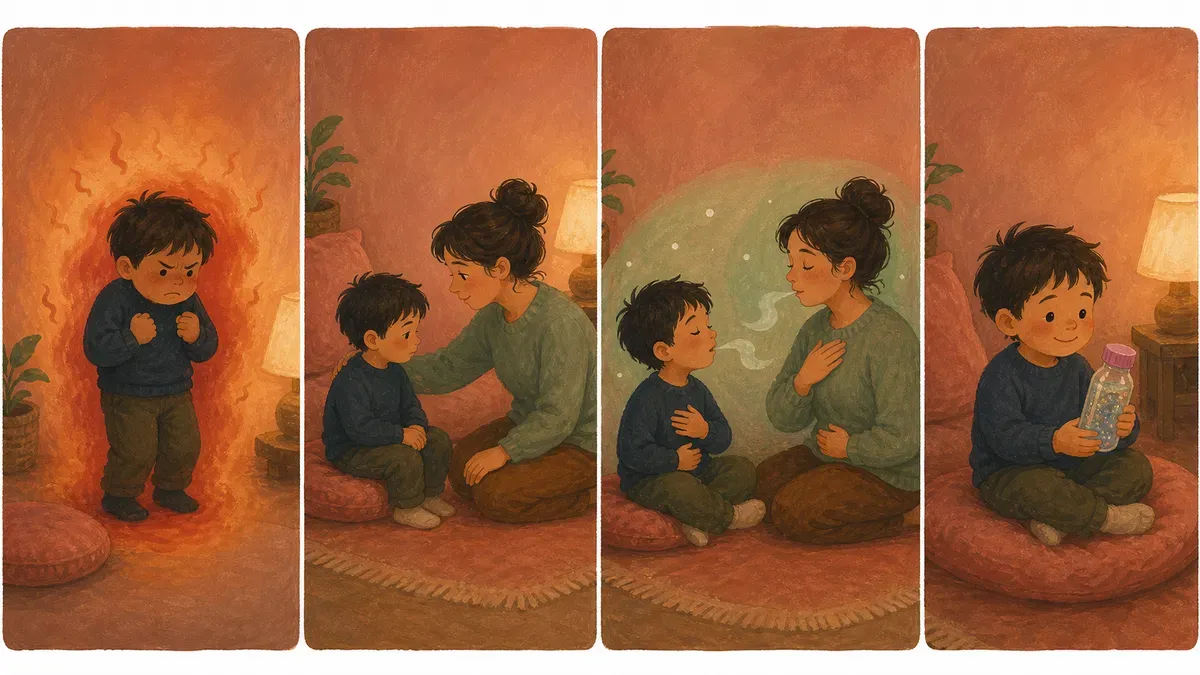
The routine is tiny. Name the feeling (“I was mad”), notice what the body did (“my hands got tight”), pick one coping tool, try it. That’s it. You’re not lecturing, you’re walking them through the same handful of steps until the steps become theirs.
The shift is the whole point. A kid sent to think about what they did gets a punishment. A kid guided through naming big feelings and choosing a calming tool gets a rep at emotional regulation. Same corner, opposite job.
The corner works because it turns a reaction into a practice, rep by rep.
Done enough times, the routine stops needing you. That hand-off, from your voice to their own, is what self-regulation actually is. Coping skills aren’t taught in one big talk. They’re built in small, boring repetitions.
How a Calm Down Corner Carries These Rules
Reflection rules need a home, or they evaporate the second a meltdown hits. A calm down corner emotional regulation spot gives them one.
Keep it simple. A pillow or beanbag, a couple of sensory items (a squishy, a glitter bottle, a chewy), and a plain poster with the steps in pictures. The poster is doing real work here, it carries the routine so a flooded kid doesn’t have to remember it from scratch.

Why the same spot every time? Because a dysregulated brain doesn’t want novelty, it wants safe and familiar. Going to the same cozy corner becomes its own cue: this is where my body slows down.
Early on you sit there too. That’s co-regulation, your calm lending them calm until they can find it solo. The corner gives reflection rules a body, so emotional safety stops being a lecture and becomes a place.
How Time-Out in the Corner Differs
Swap that warm corner for the version most of us grew up with and the whole thing flips. Here is what changes when the goal becomes quiet instead of calm, plus a quick side-by-side so the gap is easy to see.
Why a Time-Out in the Corner Stops at Compliance
A classic time out in the corner does one job: it sends your kid away to be quiet. Stand here, face the wall, think about what you did. The room goes still, the misbehavior stops, and for a frazzled minute that feels like a win.
But nothing got taught. The Child Mind Institute, in its guidance on effective discipline approaches, describes the isolating version of time-out as a tool that works by pulling attention away to shut a behavior down, not by showing a kid what to do next time. It runs on disapproval, not on skill.
So the lesson a child actually walks away with is thin. Big feelings get you sent off alone. That framing can tip a hard moment into a power struggle, the punitive stand-off where you are the warden and they are serving time.
Quiet in the moment is not the same as a kid who knows what to do with the storm.
Next time the wave hits, you are right back at square one, because the isolation ended the outburst without leaving anything behind.
Reflection Rules vs Time-Out at a Glance
The two corners can look almost identical from across the room. What each one is trying to do, and what your kid is left holding afterward, is where they split.
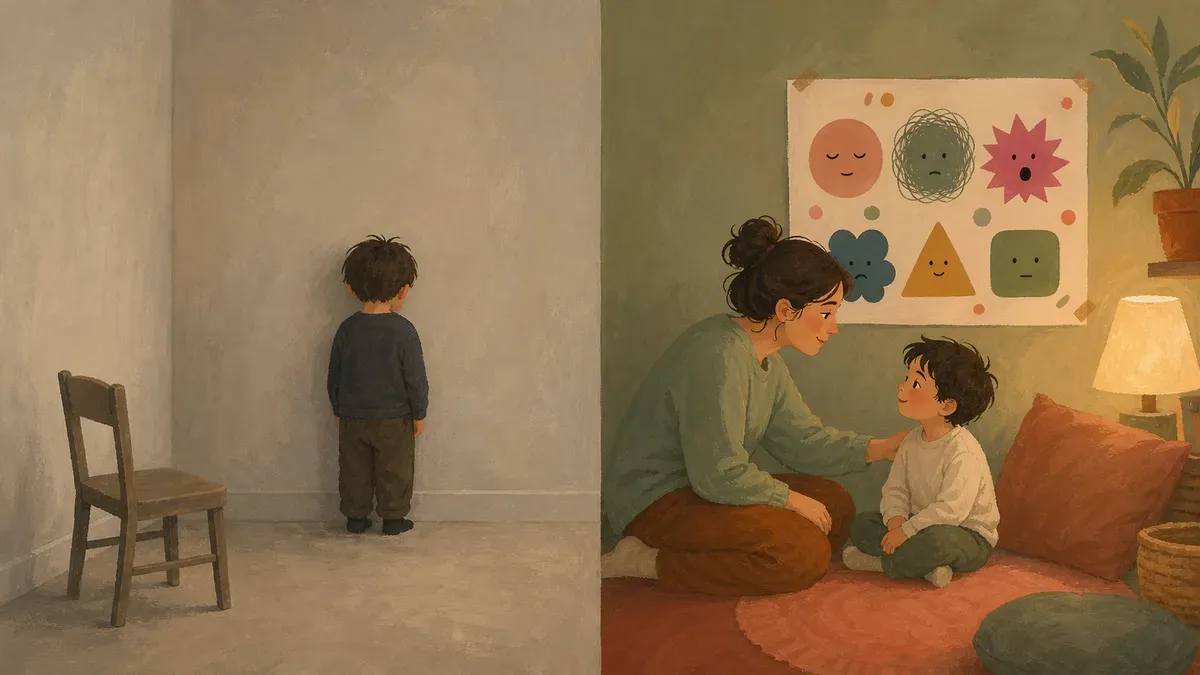
Here is the same kid, the same meltdown, run through both approaches:
| Reflection rules (time-in) | Time-out in the corner | |
|---|---|---|
| Goal | Help the child calm and reset | Stop the behavior, signal disapproval |
| What they learn | Name it, feel it, pick a coping tool | That feelings get them sent away |
| The relationship | Connection, you stay near | Distance, discipline through isolation |
| Long-term | A skill they carry on their own | Same blowup, same fix, next time |
Think of it as the difference between teaching and stopping. One ends today’s storm. The other slowly hands your kid the umbrella, so the next storm is theirs to weather.
The Brain Science Behind Why It Matters
There is a reason a punished kid rarely learns the lesson you think you are teaching, and it lives in the brain. Below is what is happening under the hood during a meltdown, and why naming the storm changes what your kid keeps from it.

A Dysregulated Brain Cannot Learn From Punishment
When a kid is mid-meltdown, the thinking part of the brain has gone offline. Their nervous system has flipped into survival mode, and the part that handles logic and choices is not running the show anymore.
This is why isolation backfires. Sending a flooded kid away alone reads as more threat, not less, and it stacks stress on a brain that is already maxed out.
- Nationwide Children’s Hospital explains that under extreme stress, the brain focuses only on immediate survival, not on decision-making or communication.
- Reasoning with a flooded brain does not land; the survival response has shut that door.
Connection is what brings the thinking brain back online. The Encyclopedia on Early Childhood Development notes that a child’s access to supportive, sensitive adult care buffers the stress system and protects the developing brain. That is co-regulation in plain terms: a regulated adult nervous system is what pulls a dysregulated child back down. That is attachment theory in practice, and during early brain development it is the only thing that actually lands.
A kid in survival mode can’t learn a lesson; they can only feel safe enough to come back, and that has to happen first.
Naming Zones to Build Lasting Skills
Once the thinking brain is back, naming what just happened is where the real growth lives. This is where reflection rules and a simple feelings vocabulary work together.
Many families borrow color-coded language to do this. The zones of regulation framework gives a kid four colors to label their state, then a strategy that matches it. - Green: calm.
- Red: the volcano. Naming the color turns a fuzzy storm into something a child can point at and work with.
That naming is what closes lagging skills over time. A neurodivergent kid often is not refusing to self-regulate, they just have not built the coping skills yet, and labeling the state is the first rep. Created by OT Leah Kuypers, the Zones curriculum reports reaching all 50 states and more than 40 countries, and the program says schools see drops in office referrals after rolling it out. One calm-down becomes a repeatable habit, and repeatable habits are how resilience gets built.
Reflection Rules at School vs at Home
The steps look almost identical in a classroom and a kitchen, but the setting changes the tools. Here is what reflection rules look like at school, then how you mirror them at home so your kid meets the same routine in both places.
Classroom Reflection Routines and Debrief Sheets
A teacher has 20-some kids and no floor time to sit cross-legged for ten minutes. So the school version adds a piece of paper.
PBIS World lays out the version a lot of positive-behavior-support classrooms run, and it’s a clean three-step loop.
- Teacher points the child to the reflection center and names the rule that got broken, in one sentence.
- Child completes the sheet (or draws the feeling, or tells it out loud if they can’t write yet).
- Teacher and child review it together once the child can actually think again.
That last step is the whole point. Done with warmth instead of a lecture, it doubles as positive reinforcement and keeps the child’s emotional safety intact, so the reflection grows self-regulation instead of just logging the behavior. If you want the deeper version, here is how a calm corner classroom works.

Keeping the Same Rules Consistent at Home
You don’t need the worksheet at home. You need the same shape. A peer-reviewed study on social and emotional learning standards found that consistent routines across settings predicted stronger language, social skills, and fewer behavior problems, while a mismatch between home and school just confuses a kid and makes self-regulation harder to learn.
So run the kitchen-table version. Same calm-down spot, same three beats.
- Name the feeling.
- Notice what your body did.
- Pick a tool for next time.
The home swap is your voice. Instead of a sheet, you sit beside your kid and talk it through, lending a little calm until they can hold it themselves.
Keep the script short and warm. “That was a big feeling. What did your body do? What helps next time?” That connection is positive parenting doing its quiet work, and it is what lets the skill travel from the classroom to your living room. If you’re starting from scratch, here’s how to set up a calm down corner at home for a caregiver who’s never done it. Same rules, two rooms, and the kid stops having to relearn them every time the address changes.
Putting Reflection Rules Into Practice
Knowing the why is one thing. Saying the right words while your kid is on the floor and you’re running on three hours of sleep is another. Here’s the script I lean on, plus what to try when the corner just isn’t landing.
A Simple Reflection Script to Introduce It
Most guides tell you to “guide your child to the calming corner” and stop there. They never hand you the actual words. Here they are.
Walk over with them, low and warm, and try this:
- “Your body looks really big right now. Let’s go to our spot.”
- “I’m going to sit right here with you. You’re not in trouble.”
- “When you’re ready, we’ll squeeze the pillow and breathe slow together.”
- “Once you feel a little calmer, we’ll talk about what happened.”
Notice what that does. You name the body, you offer connection, and you preview the after-calm chat without forcing it. That fourth line is the reflection part, and it waits until the storm passes.
The corner isn’t a place you send a kid to feel bad; it’s a place you sit with them until they can think again.
Keep your voice flat and kind. The point of this co-regulation is emotional safety, not a lecture. For the full setup, posters and tool list included, see our complete calm down corner guide. It’s the same positive parenting move every time, which is exactly why a flooded kid eventually trusts it.
What to Do When the Corner Isn’t Working
Sometimes the kid refuses to go, or goes and stays escalated for twenty minutes. Don’t scrap the whole thing. Check three things first.
- Does it feel like punishment? If your tone tightens, the corner turns into a time-out in disguise and the dysregulation gets worse. Soften the voice.
- Are you co-regulating, or hovering? A flooded kid usually can’t self-soothe yet. Sit closer, breathe slower, lend them your calm.
- Do the tools match the kid? A sensory-seeker needs weight and squeeze; an avoider needs quiet. Swap the sensory items until something clicks.
Refusal is data, not failure. It usually means the moment moved too fast, not that your child lacks the coping skills. Build them one calm exit at a time, and the resilience follows. If you need fresh tools to test, this list of emotional regulation activities for kids is where I’d start. Some days you’ll dodge the power struggles, some days you won’t. Both count.
Found this useful? Save it for the next rough afternoon.
Questions parents ask me about this
What are reflection rules for calming down at school?
Reflection rules are the small, repeatable steps a child follows after a big feeling: name what you're feeling, notice what's happening in your body, then pick a tool that helps you settle. At school, they usually live in a calm-down or reflection center and often include a short written sheet the child completes once they're ready to talk. The point is building a skill the child can reach for on their own over time, not processing the incident in the middle of the storm.
Is a time-out ever appropriate, or should I always use a calm down corner?
Time-out can stop a behavior in the moment by withdrawing attention, and some families find it useful in specific situations. What it does not do is teach the child what to do instead. A calm-down corner fills that gap by giving the child a place to practice settling and a routine to repeat, so the skill actually builds. For most families managing big feelings regularly, especially with a neurodivergent child, the corner paired with a short reflection routine will get you further than a time-out alone.
At what age can a child start using reflection rules on their own?
Most children begin to use a short, simple version independently sometime in the early school years, but it varies a lot by child. Toddlers and preschoolers need a caregiver alongside them every time; the adult is doing the regulating at first, which is exactly the point. Starting the routine early still makes sense, because the repetition over months is what eventually hands the skill off to the child.
How long should a child stay in the calm down corner?
Long enough to actually calm down, not a set number of minutes. A flooded nervous system does not run on a clock, and some kids are ready in two minutes while others need ten. The cue to come out is a body that has settled: breathing slower, muscles less tense, able to make eye contact and hold a short conversation. Keeping a child in the corner after they've regulated defeats the purpose and can start to feel punitive.
What do I put in a reflection sheet for after a child has calmed down?
A simple reflection sheet asks three things: what feeling did you have, what did you notice in your body, and what tool did you try. For younger or pre-reading children, pictures work better than words. The sheet isn't a confession record; it's a way to name the experience while it's still fresh, which builds the vocabulary the child needs to recognize the same feeling earlier next time. Keep it short enough that the child can finish it in a few minutes while still feeling connected to the adult sitting with them.
Do reflection rules work for neurodivergent or autistic children?
Yes, often very well, though the setup usually needs to fit the child more closely. Sensory seekers and sensory avoiders need different tools in the corner, and the reflection routine may need to be more visual, more physical, or slower-paced than a typical classroom default. The three-step structure works well for kids who rely on predictable routines because it is concrete and consistent. Adjust the tools and the pacing to your child, and loop in their occupational therapist if you have access to one.
What if my child refuses to go to the calm down corner?
Refusal is almost always information: the corner feels like a punishment, the tools don't match what the child actually needs, or the child is too flooded to make any decision at all. Start by going with them rather than sending them, so the space stays connected to safety rather than isolation. Check that the tools match their sensory profile. And lower your expectations for the first few weeks; a child who spends thirty seconds in the corner and then finishes calming down next to you is still practicing the idea that big feelings have a place and a routine.
Written by
Nora Hayes
Mom of two and a former preschool aide. I share the screen-free sensory play and calm-down ideas I test at my own kitchen table, plus what the moms in my little meet-up swear by. A parent passing on what works, not a doctor or a therapist.
More about NoraKeep going
All Calm & Big Feelings-
 Calm & Big Feelings
Emotional Regulation Activities for Kids That Work
Most calming tricks fail mid-meltdown. These emotional regulation activities for kids work when nothing else does. Find the one that fits your child.
-
 Calm & Big Feelings
Calm Corner Ideas: 25 Picks Under Your Coffee Budget
Skip the $200 setups. These 25 calm corner ideas cost less than a latte and soothe big feelings. Build one your kid loves this week.
-
 Calm & Big Feelings
Cozy Corner Preschool: Calm Down Ideas for Throwers
Throwing the calm-down tools? Build a cozy corner preschool space that survives big feelings, with throw-proof tools and steps that work.
-
 Calm & Big Feelings
Calm Corner Classroom Setup for Autistic Kids
Most calm corners fail autistic kids because they skip the sensory profile. Build a calm corner classroom that works in 5 steps. Start here.