Learner Zone for a 3-Year-Old: A Plain-Language Guide

I am a parent sharing what worked at my house, not medical advice. For anything to do with your child's development or sensory needs, talk to your OT or doctor.
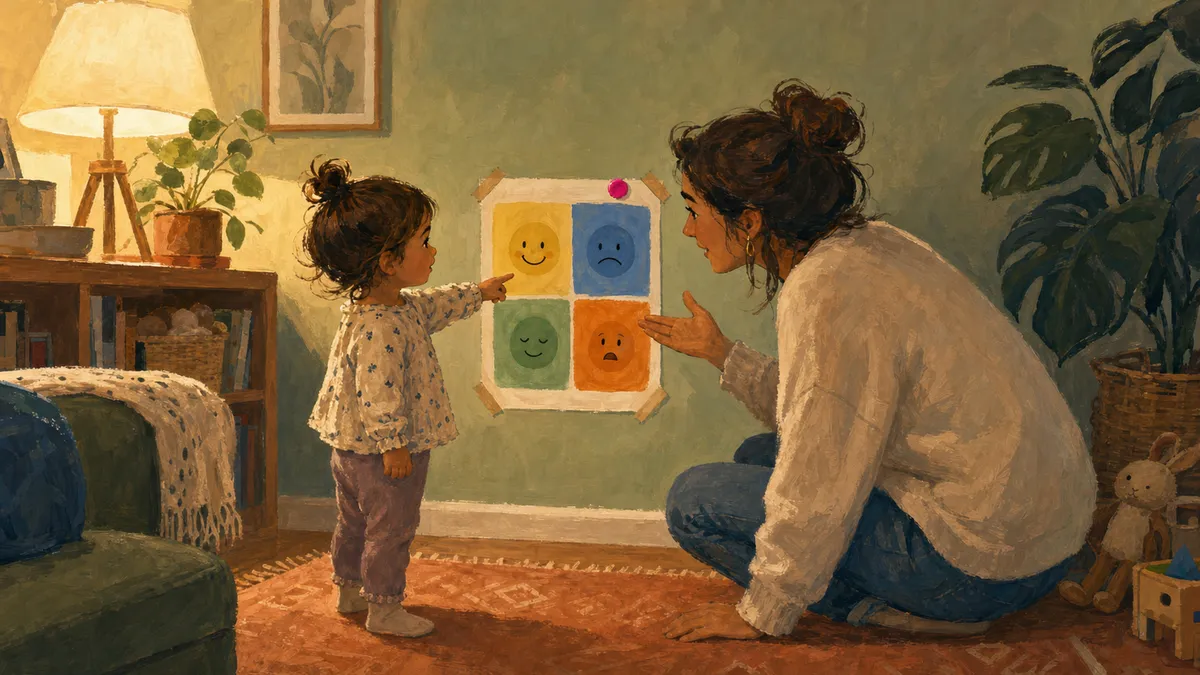
The learner zone is just the calm, ready-to-go feeling your toddler has when they can listen, play, and roll with the day, and you teach it by naming the color, pointing to a body cue they can feel, and keeping it short. I’m Nora Hayes, a former preschool aide raising a sensory-seeker, and this is the version I’d hand a tired parent at 2am instead of a worksheet.
Below you’ll find toddler-sized words for each zone, picture cues that actually stick, and tiny everyday moments where this clicks for a 3-year-old.
The plan in brief:
- Co-regulate first: stay calm beside them and name the feeling out loud, “You look red and angry.”
- Pair each color to one body cue a toddler can feel: green hands soft, red fists tight.
- Practice one one-minute calming move per day until they reach for it on their own.
Teaching the Zones to a 3-Year-Old, Step by Step
Forget the lesson plan. A 3-year-old learns this the way they learn everything else, by living it with you in the messy middle of a real feeling, so we’ll start with colors, move to body signals, then lock in one calm-down move.
- Say the color out loud while she’s living the feeling.
- Anchor each color to something her body does so she can sense it from the inside.
- Run one breath or movement reset once a day, no crisis needed.

Start With Colors During Real Feelings
Don’t sit your toddler down for a feelings class. Catch the moment instead. When she’s happy and settled at the breakfast table, you say, “You’re calm and ready, that’s green.” That’s it. One color, named out loud, while she’s actually in it.
The HHS Child Care Technical Assistance Network makes this point for early childhood: you grow a child’s feelings vocabulary by labeling feelings during real emotional moments throughout the day, not in a scheduled sit-down. As you supply the names, the words start to stick.
- Start with green. It’s the calm, focused, ready-to-go feeling, and toddlers spend more time there than anywhere else.
- Stick with one color for ten days before you introduce another.
When you make zones of regulation a normal part of preschool-age daily life, emotion identification stops being abstract. It becomes “oh, this feeling has a name.” You’re not teaching a chart. You’re handing her words for what’s already happening in her body.
Link Each Color to a Body Signal
Color alone is too floaty for a 3-year-old. She needs to feel it. So pair every color with one concrete thing her body does, because noticing those inside signals is what actually builds regulation.
This is interoception, the skill of sensing what’s going on inside. A scoping review in the Journal of Occupational Therapy, Schools, & Early Intervention found that interoception plays a critical role in a child’s emotional awareness, and that helping kids notice body sensations boosted that awareness. Tiny bodies feel the storm before they can name it.
Give each zone one signal she can physically catch:
- Green: soft belly, easy breathing, ready to play
- Yellow: wiggly legs, a buzzy or silly feeling, hard to sit still
- Red: tight fists, hot face, big and loud
- Blue: heavy arms, a yawn, slow and tired
When her arousal level climbs and the fists clench, you name it together: “Tight hands. That’s red.” The red zone now has an anchor she can feel from the inside, not just a card you’re holding up. Same on a droopy afternoon, when the blue zone shows up as a yawn she can actually point to.
Practice One Calm-Down Move a Day
Here’s the part most parents skip. You can’t teach a calming strategy mid-meltdown, when nobody’s listening. You rehearse it when she’s calm, so it’s already loaded when she needs it.
Pick one move and do it once a day during a quiet stretch. The simplest is deep breathing. A Stanford field experiment found that guiding kids through just four slow deep breaths over one minute measurably lowered their physical arousal, with the calming effect building in the second half. Four breaths. One minute. That’s a coping strategy a 3-year-old can actually do.
- Make it a game: smell the flower, blow out the candle.
- Do it after lunch every day, calm moment, no meltdown required.
An occupational therapy resource on self-regulation notes that direct instruction for 3-to-5-year-olds should run only three to six minutes, because short and often sticks far better than a single long sit-down.
Building these little calming strategies into zones of regulation for kids is what gives her something to reach for later. Once the move lives in her body, that’s when you teach toddler use calm down corner as the space she goes to practice it.
Do this for two to three weeks and you’ll watch her reach for the breath on her own one day, mid-wobble, before the red hits. That’s the whole goal. One color, one body cue, one move she owns.
What the Learner Zone Means in Toddler Terms
Naming the four zones is where this whole thing starts, because a kid can’t use a map she’s never seen. So here’s the four-color map in words a three-year-old actually holds onto, and why one of them gets a special job.
The Four Colors and the Feeling Behind Each
Think of the zones of regulation as four feeling-buckets, each one a color. Your toddler doesn’t need the textbook version. She needs one feeling word per color, the kind she already uses.
- Blue zone is the sad, tired, slow word. “I’m low.” Sleepy, droopy, want-a-cuddle.
- Green zone is the just-right word. “I’m good.” Calm, happy, ready.
- Yellow zone is the wiggly, getting-silly word. “I’m bouncy.” Also worried or frustrated.
- Red zone is the big, loud, too-much word. “I’m done.” Mad, scared, melting down.
Keep it to those four for now. The one thing she has to swallow is that every bucket is okay to land in.
- Sad is fine.
- Bouncy is fine.
- Even a red, fist-clenched, floor-flop afternoon is a normal place to be at three.
The CDC’s positive parenting guidance for toddlers leans hard on this: name the feeling with words, don’t shush it away. A picture of regulation, in toddler terms, isn’t four good colors and one bad one. It’s four real feelings, all allowed, that we just gave names to.
Want the body-cue and behavior version of each color? I broke down what each zone of regulation looks like at home so you can spot them in the wild.
Why It Is Called a Learner Zone
Green gets a nickname, and it earns it. Green is the learner zone, the one place where a small body is settled enough to actually take something in.
Picture her in green:
- Shoulders loose
- Eyes on you
- Ready to play, ready to listen
That’s not luck of the mood. That’s the arousal level where self-regulation is doing its job and her brain has room for a new word, a game, a turn-taking moment. The preschool years are when this clicks fast, because growing language lets a child start using words to steer feelings, as an occupational therapy review of self-regulation in 3-to-5-year-olds puts it.
Calling it the learner zone gives her a goal she can picture.
You’re not asking her to “calm down,” which means nothing to her. You’re asking her to get back to green, the spot where the fun and the listening happen. That framing turns social-emotional learning into something concrete: a color she returns to, not a behavior she’s nagged into.
Toddler-Friendly Visuals That Actually Work
A color she returns to needs something she can actually see and reach, which is where the right visual earns its keep. Two things make or break it: the visual itself, and the tiny daily habit you build around it.
Pick Visuals Sized for a 3-Year-Old
Most zones of regulation images and visuals you find online were made for a classroom of 8-year-olds. They’re a wall of small print, a feelings thermometer with twelve labeled rungs, a busy bulletin board nobody under five can decode. Hand that to a 3-year-old and you’ve lost her before you start.
A good zone chart for this age hits three marks:
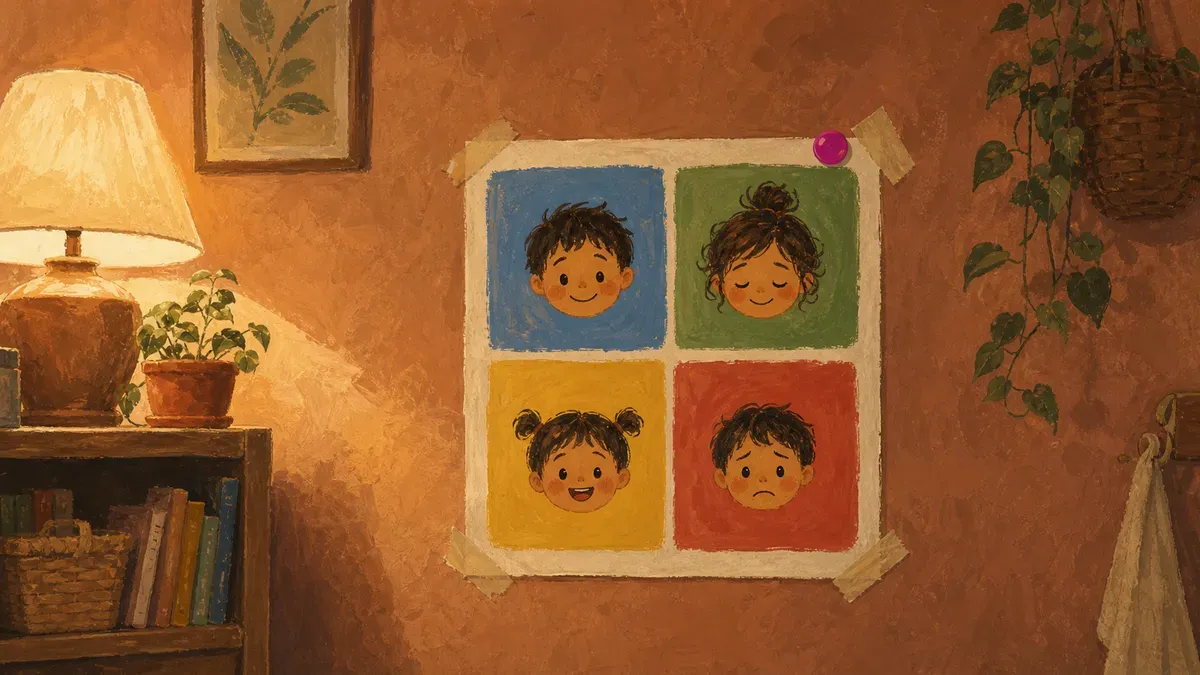
- Four large color blocks so she can see them from across the room
- One clear face per color, in real photos, not cartoons (a toddler maps faces to people she already knows)
- Barely any words, because she can’t read them anyway
Then hang it where she lives, not where you’d hang art. The Texas Education Agency’s guidance on classroom physical arrangement notes that when displays were lowered to the eye level of 3- and 4-year-olds, the kids showed more interest and started asking about the words on them. Same logic at home: a zones of regulation visual at her height gets looked at, one at yours gets ignored.
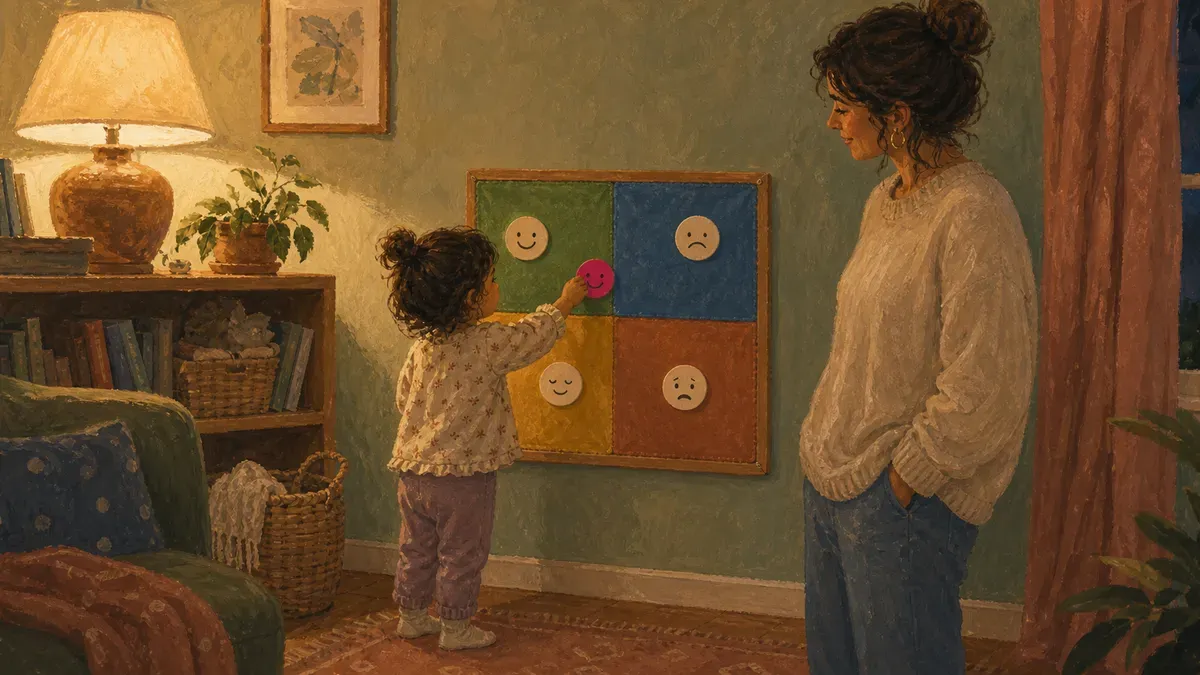
If you’d rather not piece this together, I keep a feelings chart with feelings zones at June’s height by the back door, where we land after preschool pickup.
Turn the Visual Into a Daily Check-In
A chart on the wall does nothing until you use it out loud. The move is small: at the same predictable moments each day, you point and ask, “Where are you right now?” That’s the whole check-in.
Pick moments that already exist so you are not inventing a new chore. Good anchor points:
- Right after waking
- Before lunch
- At pickup
- Before bed
The Selman 2024 review of routines and child development found that consistent routines support self-regulation and that knowing what comes next lowers a kid’s anxiety, which is exactly what a same-time-every-day check-in gives her.
Keep it light. She points to a color, you name it back, you move on. No quiz, no “are you sure?”, no making her defend it. If she picks the loud color while looking perfectly calm, let her. Naming beats accuracy at three.
This is where the zones of regulation preschool routine quietly takes hold. Once the habit is set, she starts doing the emotion identification herself before you ask, and the visual stops being your prompt and becomes her habit.
Simple Zones Activities for Preschoolers
The chart on the wall does the slow work. These little games do the fun part, splitting into two kinds: ones that teach a color through play, and ones that move a wound-up kid back toward calm.
Color-Matching Games That Teach Feelings
A 3-year-old learns a feeling faster by sorting it than by hearing about it. These zones of regulation activities turn the abstract into something she can pick up and put in a pile.
- Color sort. Dump a bin of pom-poms in blue, green, yellow, and red, and have her drop each one into a matching cup. While she sorts, narrate one feeling per color. No quizzing, just talking.
- Feeling-face match. Print two sets of simple face cards, lay them face up, and let her find the pairs. When she flips a grumpy face, say “that’s a red one, all done and big.” She finds the match herself, and that’s what makes the label stick.
- Puppet version. A sock puppet “feels” yellow and wiggly, she sorts him a calming card from her little emotional toolbox, and the role-play does what a worksheet never could.
That play-based emotion work isn’t just cute, either. A 2023 study on social-emotional development in preschoolers found kids in a play-based group grew in emotion comprehension and showed fewer aggressive responses than peers who didn’t play it out.
Calming Activities for the Red and Yellow Zones
Matching games teach the names. These activities for zones of regulation give her a body-based way out when she’s already past names and into a yellow or red zone.
Start with bubble breathing, because it’s deep breathing she can actually see. Hand her a wand, ask for one slow bubble, and the long exhale settles her without you saying the word “breathe.”
- Bear hugs. A big squeeze, hers or yours, gives the deep pressure that helps a tight body let go.
- Bookworm rolls. Wrap her snug in a blanket and roll her out, slow and giggly.
- Heavy work. Carrying a stack of books, pushing the laundry basket, helping shove a chair in.
That last one matters most. Occupational therapists describe proprioceptive ‘heavy work,’ the pushing and carrying against resistance, as deep-pressure input that calms and organizes the nervous system. It’s why a kid who hauls the recycling bin out often comes back steadier than they left, and it’s one of the most reliable calming strategies you’ll have.

For more ways to build these into a cozy spot, here’s our full guide to emotional regulation at home. Pick two she likes and keep them on rotation. The goal isn’t a perfect drill, it’s a body that remembers the way back to green.
Using the Zones During Everyday Routines
All the drills in the world won’t stick if they live in a special “lesson” slot. The zones land when they ride along with the meals, the leaving-the-house scramble, and the wind-down you already do, and it starts with you being the calm one in the room.
Co-Regulate Before You Name a Zone
A 3-year-old can’t reach for calm on their own yet. They borrow yours. According to research on co-regulation in early childhood, toddlers are only just building the neural wiring for self-regulation, so they lean hard on a caregiver to steady both their body and their feelings. Zero to Three ties that early co-regulation to how well a kid later handles their own big stuff.
In plain mom terms: if you’re tight-jawed and rushing, naming a color does nothing. Your kid reads your nervous system before they read your words.
So before you say anything about yellow or red, drop your own shoulders. Slow your voice. Get down low. Then name it.
Your calm is the tool. The color word only works once your body has done the borrowing for them.
When the meltdown is already loud, that’s not the teaching moment. You ride out the dysregulation together first. For the full play-by-play, the piece on co regulate kid walks through what to do when the meltdown is already loud.
Weave Zones Into Meals, Transitions, and Bedtime
You don’t need a curriculum. You need three or four anchor moments you already hit every single day in early childhood, and you hang a quick check-in on them.

Routines aren’t just cozy, they measurably steady a kid. A BMC Psychiatry study of children around 34 months old found that kids whose parents kept routines a lot or completely scored 5.0 points lower on emotional and behavioral difficulty scales than kids with no routine at all. The everyday anchor is doing the heavy lifting here, not the worksheet.
Pick your moments:
- Meals. “What color are you while we eat?” One word back, no quizzing.
- Transitions. Shoes-on, car seat, leaving the park. Name your own color out loud so they hear a caregiver model it.
- Bedtime. A blue-zone wind-down by the calm-down corner: dim light, one breath, soft voice.
Keep it short and keep it the same. A ten-second daily check-in builds the habit that a one-time feelings lesson never can. Stack it onto what already happens, and the framework just becomes how your house talks.
Found this useful? Save it for the next rough afternoon.
Questions parents ask me about this
How do you explain learner zones to a 3 year old?
Tell them the green zone means their body feels just right, and that's the learner zone where they can play and listen and do things. Skip the word "regulate" and use their words instead: "Your body feels good. That's the green zone." A simple color plus one body feeling is all a 3-year-old needs to start making sense of it.
Is a 3-year-old too young for the Zones of Regulation?
Three is early, but it's not too early for the groundwork. At this age, the goal isn't mastering all four zones on demand. It's building a color vocabulary for feelings one zone at a time, starting with green. The full picture comes together gradually, usually closer to four or five, as they spend more time hearing the language in real moments.
When does zones language usually start to stick for toddlers?
Most kids need months of low-pressure exposure before they use the language on their own. Daily one-second check-ins (you name the color during a real feeling, they hear it again and again) build the connection far faster than any one lesson. The first sign it's sticking is usually when they point to a chart unprompted, or use a color word when they're upset.
Can I teach the zones without buying the official curriculum?
Yes. A homemade chart with four colors, a few face photos or drawings, and a habit of naming feelings in the moment is enough to get started with a toddler. The formal curriculum is designed for classrooms and older kids; at home with a 3-year-old, daily repetition and a posted visual do most of the work.
What do I do when my toddler is already in the red zone?
Don't try to name or teach the zone mid-meltdown. Ride it out first. Your job in that moment is to stay calm, because toddlers borrow regulation from the adult in the room before they can manage it themselves. Once the storm passes and they're back to green, that's your window to reconnect and, if the moment is right, briefly name what happened.
Are all four zones okay for a young child to feel?
All four zones are normal and allowed, including red and blue. The goal is never to stay green at all times; it's to have words for every feeling and to know what helps the body shift when needed. Naming a zone without shushing it teaches kids that all feelings make sense, even the hard ones.
How is a calm-down corner different from teaching the zones?
A calm-down corner is a physical space with tools (a pillow, a sensory bottle, something to squeeze) that helps a child's body settle. The Zones of Regulation is the language and framework that explains why the body needs to settle in the first place. They work well together: the corner gives your child somewhere to go, and the zones give them words for what's happening when they get there.
Written by
Nora Hayes
Mom of two and a former preschool aide. I share the screen-free sensory play and calm-down ideas I test at my own kitchen table, plus what the moms in my little meet-up swear by. A parent passing on what works, not a doctor or a therapist.
More about NoraKeep going
All Calm & Big Feelings-
 Calm & Big Feelings
Emotional Regulation Activities for Kids That Work
Most calming tricks fail mid-meltdown. These emotional regulation activities for kids work when nothing else does. Find the one that fits your child.
-
 Calm & Big Feelings
Calm Corner Ideas: 25 Picks Under Your Coffee Budget
Skip the $200 setups. These 25 calm corner ideas cost less than a latte and soothe big feelings. Build one your kid loves this week.
-
 Calm & Big Feelings
Cozy Corner Preschool: Calm Down Ideas for Throwers
Throwing the calm-down tools? Build a cozy corner preschool space that survives big feelings, with throw-proof tools and steps that work.
-
 Calm & Big Feelings
Calm Corner Classroom Setup for Autistic Kids
Most calm corners fail autistic kids because they skip the sensory profile. Build a calm corner classroom that works in 5 steps. Start here.