Maria Montessori Theory, Explained for Real Homes

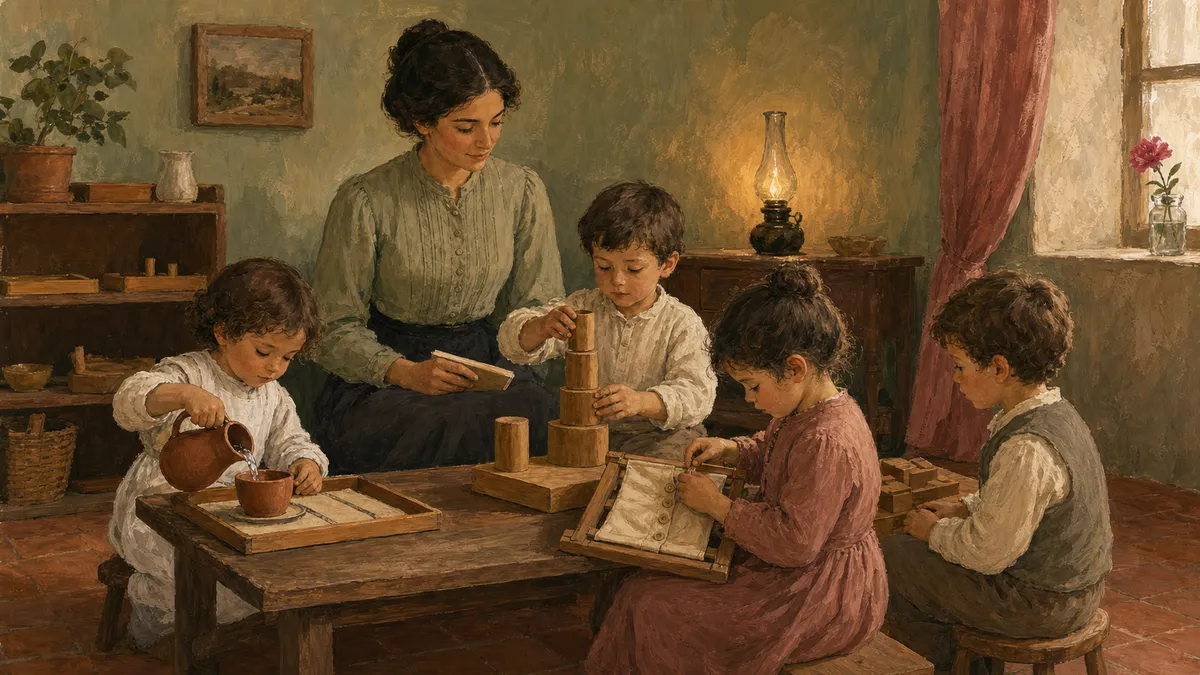
Maria Montessori theory says kids learn best by doing real things with their own hands, at their own pace, in a space set up so they can manage on their own. That matters because “follow the child” isn’t a parenting slogan, it’s the whole idea: when your kid wants to dump bins for the fortieth time today, that repetition is the work, not a phase to redirect.
I’m Nora Hayes, a former preschool aide and mom of an autistic kid, and in this guide I’ll cover Montessori’s biography, her core principles, how children actually develop, and what any of it looks like in a real kitchen with no special furniture.
Who Maria Montessori Was and Where Her Ideas Began
Before the chalk dust settled in Rome’s San Lorenzo slums, there was a physician who studied children the way she’d once studied disease. Here’s how a physician ended up rewriting how we think about learning, and the messy Rome classroom where it all clicked.
From Physician to Education Pioneer
She was a doctor first. She earned her medical degree from the University of Rome in 1896, one of the first women to attend medical school in Italy, per Maria Montessori’s biography and historical record. It cost her. She faced such open hostility from male classmates and professors that she was forced to do her dissections alone, after hours, when no one would share a room with her.
That medical training is the whole point. That training mattered. A scientist stepped into a classroom, and those are two different ways of looking at a child. She didn’t start with a teaching philosophy and then hunt for kids to fit it. She started by watching.
Her method grew out of observation, the same patient, note-taking observation a doctor uses on a patient.
- What a child reached for, and what she walked past
- How long she stayed with one task before drifting
- When the work was holding her, and when it had lost her
The result was an approach to child development built on empirical research instead of “this is how we’ve always done school.” That distinction still holds up. She trusted what the kids actually did over what adults assumed they needed.
The First Casa dei Bambini in Rome
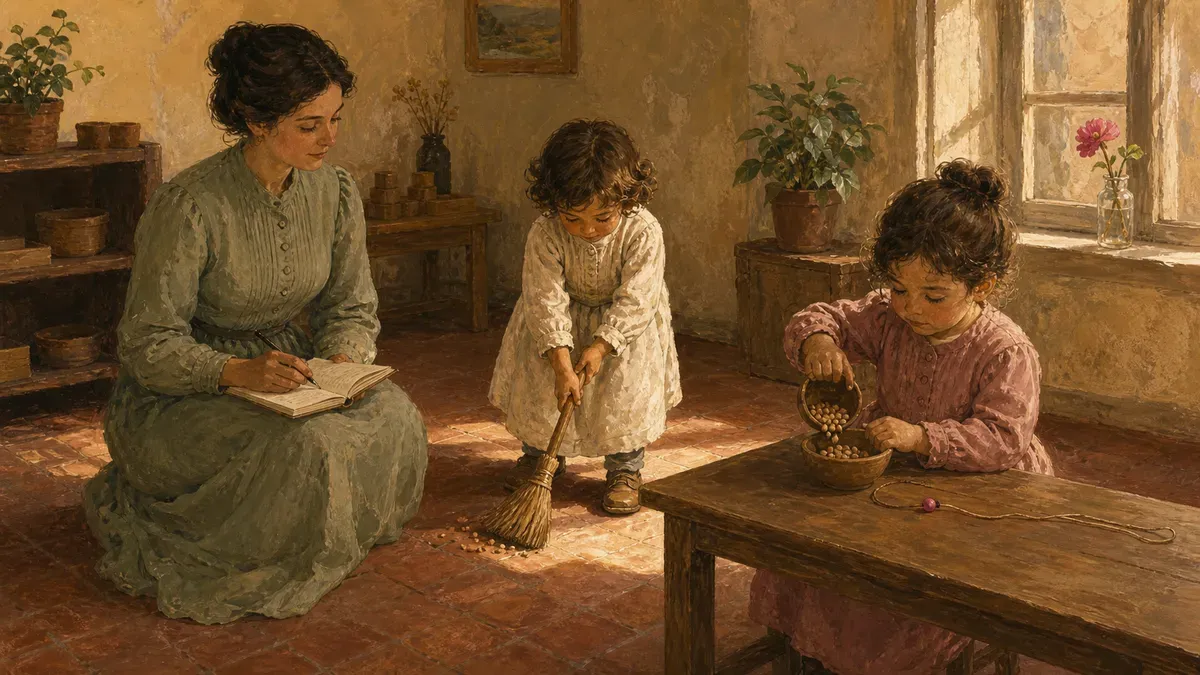
The theory stopped being theory on January 6, 1907. That’s when the first Casa dei Bambini opened in San Lorenzo, a Rome district so poor it was called “the shame of Italy,” enrolling around 50 children aged 2 to 6 from desperately struggling families, according to Montessori Australia.
This was her live experiment, and it sits at the heart of the history of Montessori education. She gave these kids real, purposeful tasks.
- Pouring water without spilling
- Sweeping the floor
- Buttoning a coat
- Scrubbing a table until it was actually clean
She also gave them toys. And here’s the part that surprised everyone, including her. The children kept choosing the real work over the toys.
That single observation is the Montessori origin story in a sentence. A 3-year-old would rather wash a table than play with a doll, if you let her do it for real and don’t rush her. Watching that pattern repeat is where the whole theory crystallized.
The Casa dei Bambini wasn’t a school built to prove a point. It was a room where she got out of the way and let natural development show itself. Everything that came after, the whole history of Montessori, traces back to what those kids in San Lorenzo did when nobody was managing them.
The Core Principles Behind Montessori Theory
Strip away the philosophy labels and the specialized rooms, and what’s left is a handful of ideas that explain why any of it works. Three do most of the heavy lifting: real freedom inside firm limits, a child’s own drive to get good at something, and a room set up so it teaches without anyone talking.
Independence and Freedom Within Limits
Freedom in Montessori beliefs doesn’t mean a free-for-all. It means a child gets to choose what to work on, how long to stay with it, and when to move on, but inside boundaries that don’t bend. Choose any tray on the shelf, yes. Throw the tray, no.
That balance is the whole point. In The Absorbent Mind, Montessori wrote that to let a child do as he likes before he’s built any self-control “is to betray the idea of freedom.” Freedom isn’t the absence of limits. It’s what grows inside them.
- Pick her own work and stick with it long enough, and she builds a focus nobody handed her.
- The adult’s job is to set up real choices and then step back.
The shift is small but it changes everything: the child does the correcting, not the grown-up.
These Montessori principles around freedom of choice are why a Montessori room can look so calm. The order isn’t imposed from outside. It’s what a child builds when she’s trusted with a real decision and a clear edge she can’t cross.
Intrinsic Motivation Over Rewards
No stickers. No star charts. No “good job” every thirty seconds. That absence trips up a lot of first-time visitors, and it’s deliberate.
Montessori theory holds that the real engine of learning is a child’s own pull toward mastering a task, not a prize waiting at the end. A toddler will pour water from one jug to another forty times in a row, soaking the table, perfectly content. Nobody’s paying him. The pouring is the point.
This is why the materials are built to carry their own control of error.
- Knobbed cylinders: one hole per cylinder, wrong peg simply does not go in.
- Pink tower: stack it off-order and it wobbles before you finish.
According to the Montessori Foundation’s overview of the philosophy, the materials are autodidactic, meaning a child can see and fix her own mistake without an adult stepping in to judge it. The feedback comes from the work itself.
That’s what protects the inner drive. A reward shifts the focus to pleasing the grown-up. A self-correcting material keeps it on the task, which is exactly where Montessori education theory wants it. It’s the engine behind what she called self-construction, the slow build of a competent person from the inside out.
The Prepared Environment as Silent Teacher
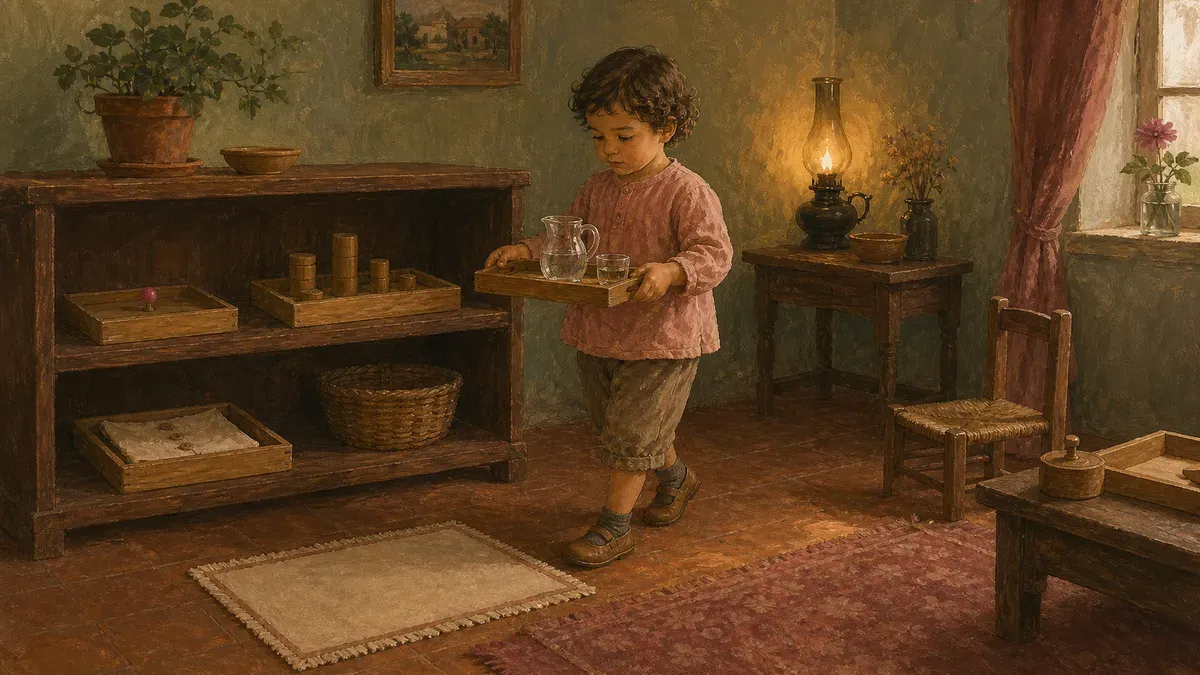
The room itself does a surprising amount of the teaching. That’s the idea behind the prepared environment, and it’s why this approach puts so much weight on furniture, shelf height, and where the scissors live.
Everything is sized for the child:
The prepared environment is Maria Montessori’s most practical idea, built on theories about how space teaches when it is arranged for the child.
- Shelves at her height, not yours.
- Real glass, because breakable things teach care.
- A pitcher she can actually lift. That’s self-directed learning in its plainest form.
The American Montessori Society lists the multi-age classroom, the Montessori materials, child-directed work, and uninterrupted work periods among the recognized Montessori principles and standards, and every one of those is really a feature of the environment. Order it well and the classroom environment does the quiet work a teacher used to do.
This is the heart of il metodo, the metodo Montessori in its original Italian: arrange the space so the space does the teaching. You don’t have to build a whole classroom to use it at home. Start small, one accessible shelf, and you can pull a few setups from our full library of Montessori activities and printables to see what “prepared” looks like on a kitchen floor.
How Children Actually Develop: Planes and Sensitive Periods
A prepared shelf only works if it matches the kid standing in front of it, and Montessori had a map for that. She split childhood into stages, then noticed certain skills come roaring in at certain ages, which explains a lot of toddler behavior that looks like pure chaos.
The Absorbent Mind and Four Planes of Development
Montessori didn’t see one long stretch of growing up. She saw four distinct chapters, each with its own job. The American Montessori Society lays out her four planes of development, running from birth all the way to age 24: First Plane (0 to 6), Second Plane (6 to 12), Third Plane (12 to 18), and Fourth Plane (18 to 24).
The first one is the wild one. Montessori called it the absorbent mind, and the name is literal. A baby or toddler soaks up language, movement, and the rhythm of the home with no effort at all, the way a sponge takes on water.
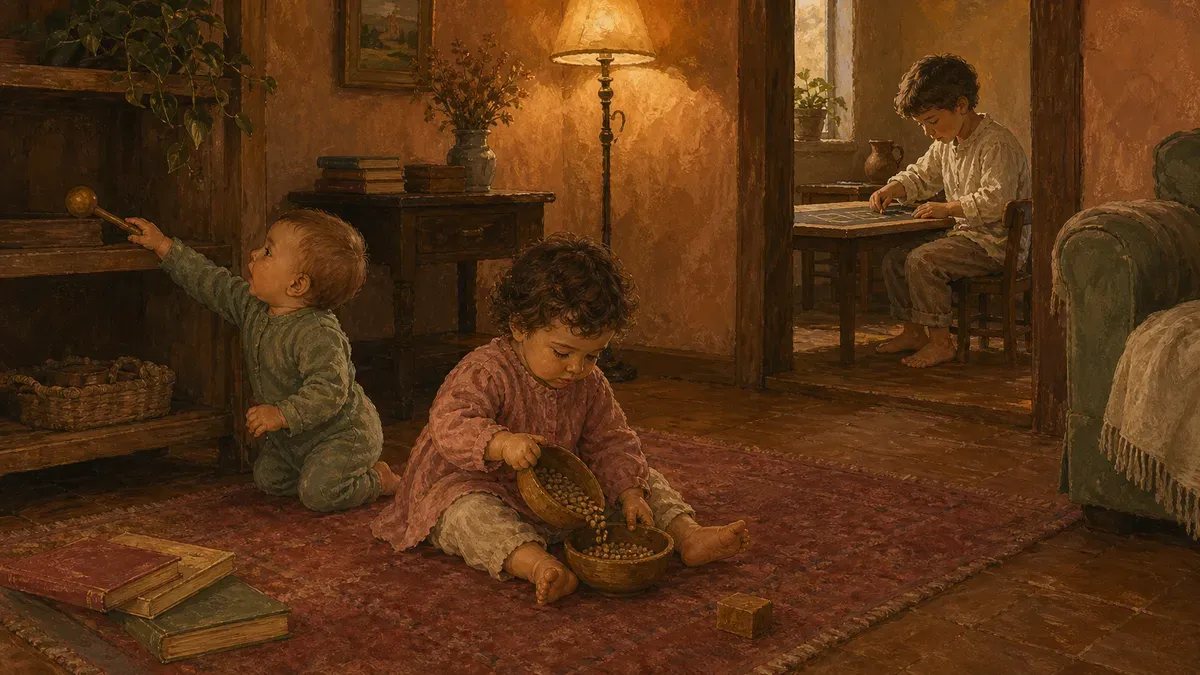
This is why your two-year-old picks up a phrase you’d rather they hadn’t, instantly, while you’re still working on “please.” That effortless soaking-up is self-construction in action: the child is literally building who they’ll become out of whatever surrounds them.
The takeaway for Montessori education at home is simple: at this age, the environment teaches more than you do.
It’s the backbone of the whole Montessori philosophy. Set up the room so what your kid absorbs is worth absorbing, because they’ll absorb it whether you planned it or not.
Sensitive Periods and the Drive to Repeat
Inside those planes are shorter windows Montessori called sensitive periods, stretches when a child is biologically primed to nail a specific skill. Hit the window and the learning feels easy. Miss it and the same skill takes real grinding later.
The AMS flags two sensitive periods that explain a ton of toddler life:
-
Order: starts at birth, peaks in the second year, runs through age 5. This is why your toddler melts down when the blue cup shows up instead of the red one.
-
Movement: two phases, birth to 2.5, then refinement from 2.5 to 4.5.
Here’s the part that saves your sanity. When your kid insists on lining up the shoes in exactly the same order every single time, or climbs the same step over and over until you want to scream, that is not stubbornness. Montessori called this repetition the road to normalization, the settling into calm, focused work that the método and enfoque of the pédagogie are quietly aiming for.
In this educación, built on the Montessori filosofia, the answer is always to feed the drive, not fight it. The core of the Montessori filosofia, and really the whole point, is to feed that drive instead of fighting it. A few sensorial montessori activities for calm, sensory-seeking kids give that repeat-loop somewhere productive to land.
So when natural development looks like obsessive bin-dumping, trust it. The kid isn’t being unproductive. They’re right on schedule.
What ‘Follow the Child’ Really Means at Home
Knowing the dumping is on schedule is one thing. Knowing what to do while you’re standing there with a sticky floor and zero patience is another. Following the child at home comes down to two small habits: reading the drive behind the behavior, then watching before you step in.
Reading the Repetitive ‘Dump Bins’ Behavior
Your kid grabs a small pitcher and starts pouring dry beans from one cup into another. They pour it back. Then again. This is the part where most of us want to redirect them to something that looks more like learning.
Here’s the shift the montessori way asks for: that emptying and filling isn’t chaos, it’s a drive. Moving things from one spot to another, dumping and hauling and refilling, is one of the recognized core play schemas in child development, and it lines up with the window when a toddler is wired to master movement. The kid is practicing. Loudly.
So following the child means feeding that drive instead of fighting it. Don’t take the bin away, give it somewhere to go.
- A basket of pinecones to carry to a bowl across the room
- Pom-poms and a muffin tin to sort, then dump, then sort again
- A small pitcher of dry beans to pour between two cups
You took the exact behavior and gave it a job, which is what montessori parenting looks like in a real home. Same drive, now it’s practical life skills. The mess gets a job.
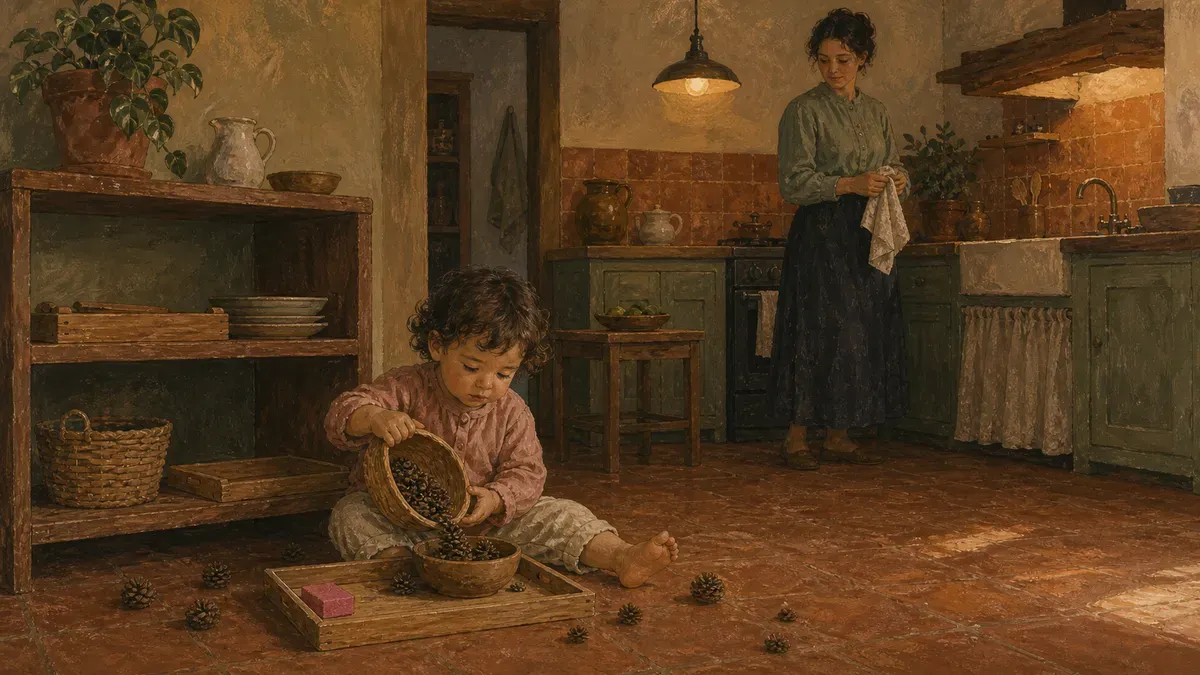
Observation Before Intervention
The harder habit isn’t setting up the activity. It’s shutting up long enough to see what your kid is actually drawn to.
We’re wired to jump in, and the small corrections pile up fast.
- They pick up the spoon wrong, we fix it
- They stack the blocks sideways, we straighten them
- They take too long on a step, we take over
Following the child flips that order: you watch first, then you build the environment around what you saw. The principle is almost uncomfortable. Once a child locks into concentration, the adult should act as if the child does not exist, which is a fancy way of saying don’t interrupt a kid who’s busy.
Observation is the whole point of why montessori education works the way it does. It tells you where the genuine interest is, the spark you can’t fake or assign. You’re not picking the activity off a list and hoping it lands. You’re noticing what they reach for on their own, then giving them the freedom of choice to go deeper.
That’s the philosophy at the heart of the montessori approach: the drive is already there.
And if you’re wondering whether is montessori good for every child, that question gets a lot easier once you’ve watched your own kid lead for a week.
Montessori Theory Versus Traditional Education
Watch a kid lead for a week and you start noticing every place school does the opposite. Two differences do most of the heavy lifting: who the adult is in the room, and how the day gets carved up.
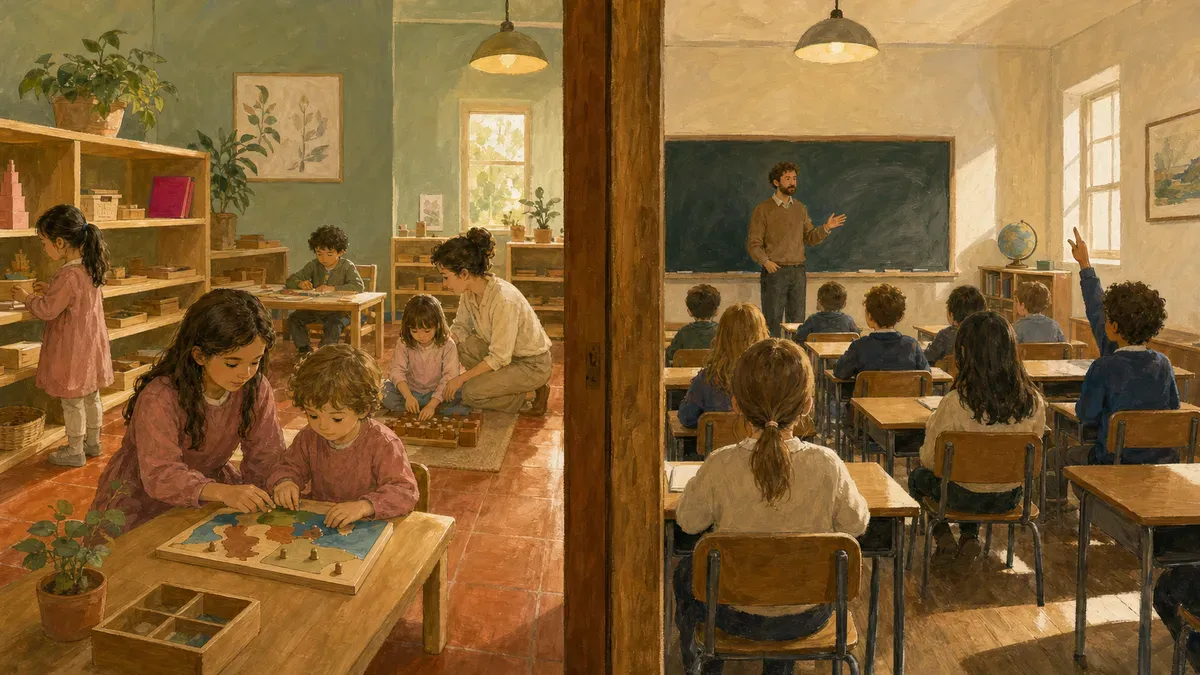
The Teacher as Guide, Not Lecturer
In a traditional room, one adult stands up front and pours the same lesson into thirty kids at once. The Montessori teaching philosophy flips that. The adult mostly watches, then quietly connects one child to the next thing that child is ready for. Teacher as guide, not the voice everyone has to face.
The tool for that hand-off is the three-period lesson, and the meaning of Montessori education lives in how careful its three steps are.
- Naming: “This is rough. This is smooth.”
- Recognition: “Show me the rough one.”
- Recall: “What is this one?”
The teacher only moves to that last step when she’s pretty sure the child will get it right. Montessori Services explains it’s done that way on purpose, to protect a child’s confidence instead of catching them out. No red pen, no being put on the spot. That’s the whole Montessori teaching style in one small exchange.
Mixed-Age Classrooms and the Uninterrupted Work Cycle
| Traditional | Montessori | |
|---|---|---|
| Grouping | Single grade | Mixed-age, ~3 years |
| Schedule | Short bell-driven periods | Long uninterrupted work cycle |
| Who teaches | One adult, front of room | Guide plus older peers |
The gap is built into the standards. AMS accreditation sets a 2- to 3-hour uninterrupted work cycle, four days a week, as the floor, with a 3-hour cycle five days a week as the goal. Deep focus needs room to show up.
None of this makes Montessori the right fit for every family. If you want the honest version, read the parents who tried it and stepped back on why we left montessori. Worth knowing before you commit.
Putting Montessori Theory Into Practice Without a Classroom
You don’t need a classroom, matching wooden trays, or a Pinterest-perfect playroom to use any of this. Two things get you started: real work your kid can do, and a shelf they can actually reach.
Start Small With Practical Life
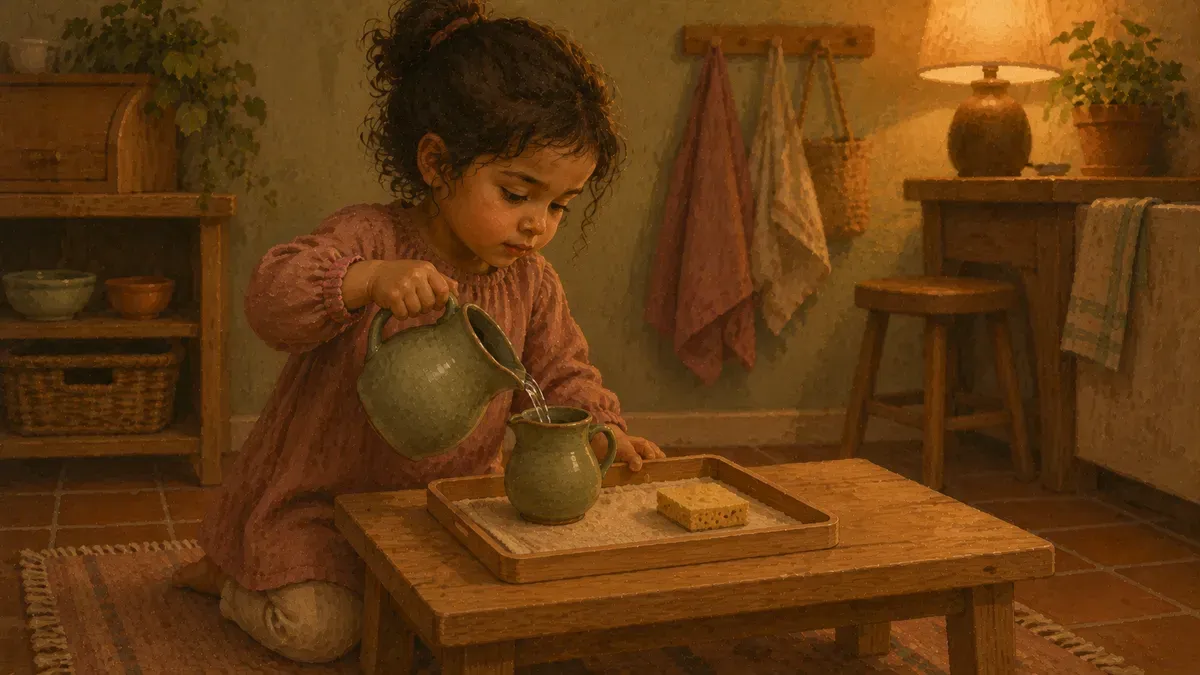
The cheapest door into the whole theory is sitting in your kitchen right now. - Pouring water from a small pitcher into a cup.
- Spooning beans from one bowl to another.
- Wiping up the spill with a little sponge.
This is practical life work, and it’s where I’d tell any tired parent to begin. According to the hidden power of practical life skills, exercises like pouring, spooning, and table washing build fine motor skills, hand-eye coordination, and concentration, no specialized materials required.
That last part matters. You can skip the catalog entirely and still get the benefit.
What the child gets back is bigger than a clean motor skill. They’re doing a real job, start to finish, on their own. That’s where independence and self-directed learning actually come from, not from a toy that lights up and does the work for them.
Keep the portions tiny so spills stay small. Expect a mess the first few tries, and let it ride. If you want a starting list sorted by age, here’s a fuller guide to montessori practical life activities by age you can work through.
Prepare the Space, Then Step Back
Now give that work a home. A prepared environment sounds grand, but at this age it’s a low shelf, a few trays your child can carry, and learning materials they can reach without asking.
Put out three or four things, not twenty. A full shelf overwhelms a toddler and they freeze. Rotate something new in when the old activity goes stale, and tuck the tired one away for later.
Then the hard part: step back. Set the space up, then let them choose. Following the child means watching what they reach for again and again, and trusting that the repetition is the point.
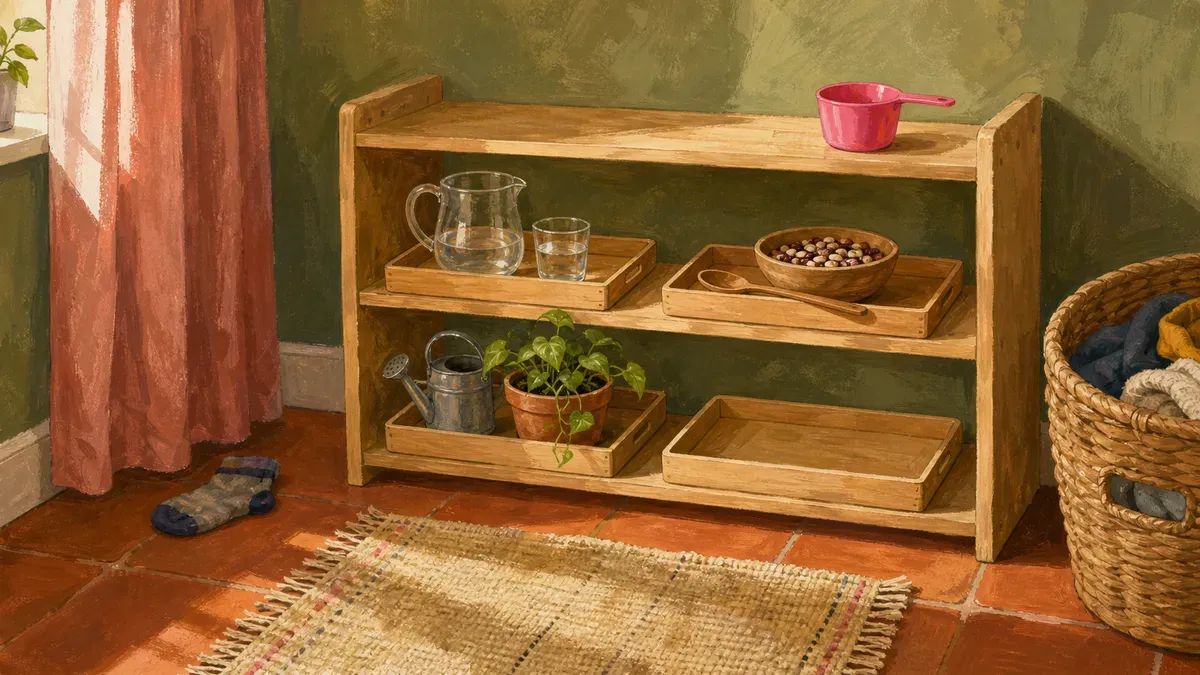
If building trays from scratch feels like one more job you don’t have time for, a set of ready-to-print montessori activities printables can stock that shelf in an afternoon. The prepared environment does the work either way. The materials just need to be there, at their level, ready to reach.
Found this useful? Save it for the next rough afternoon.
Questions parents ask me about this
What is Maria Montessori's theory of child development?
Montessori theory holds that children are natural learners who build themselves from the inside out, driven by an inner need to master their environment rather than by adult instruction. Development unfolds in four broad stages, each with its own logic, pace, and set of skills the child is biologically primed to absorb. The adult's job is to prepare a space that fits where the child actually is, then get out of the way. The learning follows.
What are the four planes of development in Montessori theory?
Montessori described four planes: birth to six, six to twelve, twelve to eighteen, and eighteen to twenty-four. Each plane has a distinct way of learning and a different emotional and physical profile. The first plane is the most intensive. The child absorbs language, movement, and order almost without effort. Later planes build on what earlier ones laid down.
What is the absorbent mind in Montessori theory?
The absorbent mind is Montessori's term for the way very young children soak up everything in their environment without trying. Language, routines, emotions, the texture of daily life: all of it goes in. This happens automatically in the first six years, which is why the prepared environment matters so much at that age. After six, this effortless absorption gives way to a more deliberate, reasoning kind of learning.
Is Montessori theory good for children with ADHD or autism?
Many families raising autistic or ADHD kids find that Montessori principles fit their child well: uninterrupted work time, freedom to move, hands-on materials, and an environment built around the child's actual pace rather than a group schedule. That said, Montessori is not a therapy or clinical approach. If your child has specific support needs, run any educational framework past their therapist or specialist to see what fits.
Why does my toddler throw or dump Montessori materials instead of using them?
Dumping and transporting are legitimate stages of development, not misbehavior. A toddler in the movement sensitive period is doing real developmental work when they carry a heavy basket from one end of the room to the other, then carry it back. Over and over. That repetitive hauling is not aimless; it is the exact work their body is asking for right now. The fix is not redirecting them away from dumping but giving them materials with a clear beginning and end so the mess has a boundary. A basket with a few objects to move between two spots feeds the drive and keeps cleanup honest.
Can you follow Montessori theory at home on a tiny budget?
Yes. The philosophy centers on a prepared environment and real, purposeful work, both of which cost next to nothing. A low shelf you already own, a few kitchen items, and a mat on the floor is enough to start. Rotate three or four activities rather than setting out twenty at once; the materials are a vehicle, the approach is the point.
What is the difference between Montessori and traditional education?
The biggest differences are who leads, how age is grouped, and how time is structured. In a traditional classroom a teacher paces the group, children are sorted by same age, and the day runs on fixed blocks. In a Montessori environment the child chooses their own work within a prepared space. Age groups span about three years so older children mentor younger ones, and the work cycle runs two to three uninterrupted hours. Both approaches teach; they just disagree about who should be doing most of the choosing.
Written by
Nora Hayes
Mom of two and a former preschool aide. I share the screen-free sensory play and calm-down ideas I test at my own kitchen table, plus what the moms in my little meet-up swear by. A parent passing on what works, not a doctor or a therapist.
More about NoraKeep going
All Montessori-
 Montessori
Montessori Activities for 3 Year Olds That Build Skills
At 3, kids crave real work, not toys. These Montessori activities for 3 year olds build focus, coordination, and independence. Start one today.
-
 Montessori
Step by Step Montessori 3-Part Cards Walkthrough
Confused by 3-part cards? This step by step Montessori walkthrough shows the exact order to present them so your child matches and self-corrects.
-
 Montessori
Sensorial Montessori Activities That Calm Toddlers
Sensory-seeking toddler heading for a meltdown? These 10 sensorial Montessori activities calm and refocus little hands fast.
-
 Montessori
Practical Life Montessori: 20 Kitchen Activities
Practical life Montessori starts in your kitchen. Get 20 no-buy activities using spoons, jars, and bowls you own. Set up a tray today.