3 Day Potty Training Method, the Honest Version

Some links here are affiliate links. If you buy through one, I may earn a small commission at no extra cost to you. As an Amazon Associate I earn from qualifying purchases. I only point to things I'd actually use with my own two.
The 3 day potty training method means you clear three days at home, ditch the diaper, and keep your kid bare-bottomed while you prompt the potty, push fluids, and cheer every success until self-initiation clicks. I’m Nora Hayes, former preschool aide, and I’ve run this with my own June and several friends’ toddlers, and after three days, your kid is started, not finished. Here’s what each day looks like and how to adjust when your toddler isn’t following the script.
The plan in brief:
- Clear your calendar for three days at home and take the diaper off, bare bottom, no pull-ups, all day.
- Push fluids and prompt the potty every 20 minutes or so, cheering every success and staying calm at every accident.
- Expect Day 2 to feel worse than Day 1, then watch self-initiation start to click by Day 3.
Is Your Toddler Actually Ready for This?
Skip readiness, and three days at home turn into three days of mopping with nothing to show for it. The method works when the body and the brain show up together. Not a day before.
You don’t need a milestone chart for this part. You need a kid who can stay dry a couple of hours, follow a two-step ask, and pull their own pants up and down. The American Academy of Pediatrics points to that same short list, plus walking and sitting steadily, as the green light, and notes most kids land there between 18 and 30 months, per pediatric guidance on signs of potty training readiness.
Here’s what I look for before we go diaper-free for a long weekend:
- Dry stretches. Two hours dry, or waking up dry from a nap, means the bladder is starting to hold.
- Body signals you can see. Pausing mid-play, grabbing the diaper, hiding to poop. They feel it happening.
- Following simple directions. “Go grab your shoes” lands without a fight.
- Some independence with pants. Up, down, and willing to try.
- Plain old interest. Watching you, asking, wanting the big-kid underwear.
The not-ready list is just as loud once you stop hoping. No dry stretches at all. Zero interest, or a hard “no” every time the potty comes up. Can’t sit still for two minutes. Fighting you on every small ask that day. Those are the signs your child is not ready for potty training, and we hit that exact wall with June at two and a half.
Age is the worst predictor here. June was ready at three; I’ve watched a friend’s barely-two-year-old beat her to it. Readiness is a checklist, not a birthday. Wait for the body signals, and the three days do the heavy lifting for you.
The 3-Day Method, Step by Step
Once the readiness boxes are checked, the method itself is almost dumb-simple: clear your calendar for three days, ditch the diaper, and prompt, prompt, prompt until your kid starts catching the signal on their own. The shape of those three days isn’t the same, though, and that’s where most people get blindsided.
Some parents call it potty boot camp for good reason. The toilet goes from zero to constant presence over 72 hours, by design.
Day 1 is bare bottoms and a potty timer that never stops. Day 2 is the one nobody warns you about, the day it feels like nothing is sticking. Day 3 is where you finally leave the house for a short test run.
Here’s how the three days actually break down:
- Clear your calendar and pull the diaper off on morning one.
- Day 1: bare bottom, push fluids, and prompt to the potty every 20 minutes.
- Day 2: hold the same rhythm even when accidents come roaring back.
- Day 3: bank an early catch, then test the skill with one short outing in real underwear.
Day 1: Bare Bottom and Constant Prompting
Wake up, pull the diaper off, and don’t put another one on until bedtime. That’s the whole shape of potty training day 1: bare bottom, a full water cup, and you glued to a timer. The naked method works because there’s no diaper to catch the accident. Your kid feels the pee run down their leg and starts wiring that warm surprise to the seat you keep walking them to.
Push fluids all morning. Water, milk, a splash of juice, a popsicle, whatever keeps them sipping. More going in means more chances to practice, and Day 1 is all about reps.
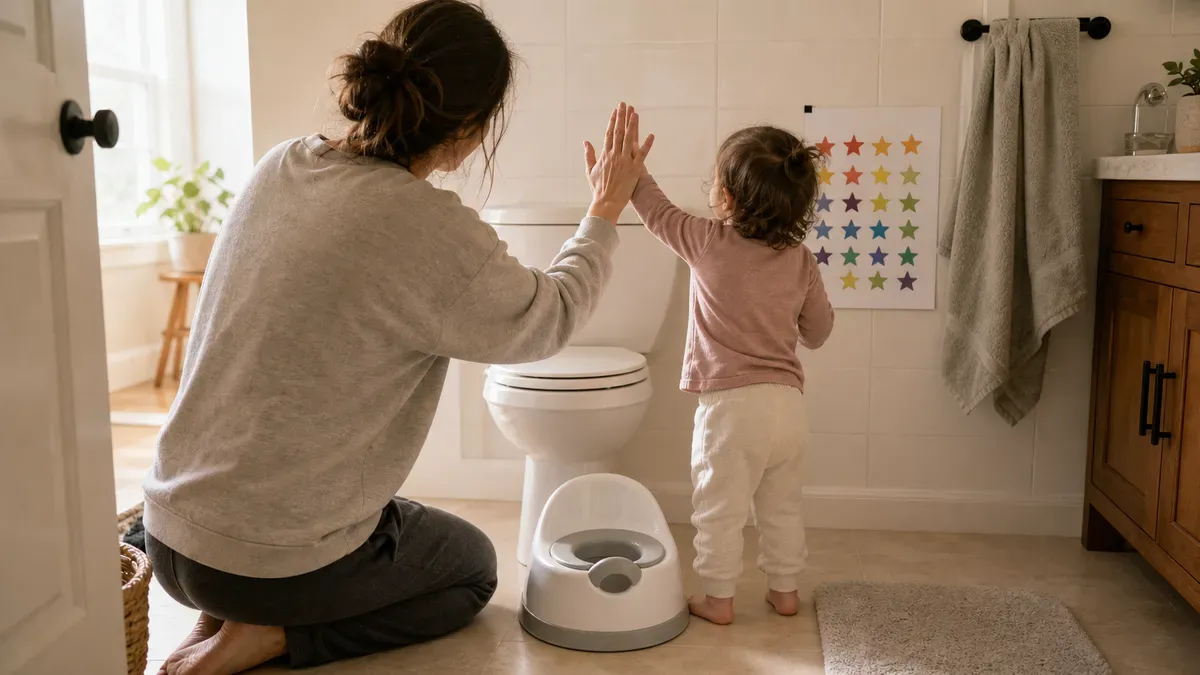
Then set a timer and prompt, prompt, prompt. Cleveland Clinic suggests a sit every 20 minutes or so, two to three minutes a try, stretching the gap toward an hour once your child actually goes. I keep it loose. A timer on the counter, a goofy “potty time” sing-song, and we head over together every time it buzzes.
Most of Day 1 is misses, and that’s fine. June peed on the rug twice before lunch, and I just wiped it up, said “pee goes in the potty,” and reset the timer. No big reaction. The accidents are the lesson, not the failure.
- When something lands in the bowl, lose your mind a little. Clap, dance, sticker on the chart, call grandma.
- Toddlers chase a reaction, so make a catch feel like the best thing that’s happened all day.
By dinner you’ll be wiped and the floor will need a once-over. That’s a normal first day of potty training, not a sign it isn’t working.
Day 2: The Day Nobody Warns You About
Day 1 felt like the start of something. Day 2 is where half of parents quietly wonder if they broke their kid.
The accidents come roaring back. Sometimes more of them than the day before, often the bigger kind, and the cheerful self-starter from yesterday now wants nothing to do with the potty. You did everything the same. It feels like going backward.
It isn’t. The novelty wore off, the body is still learning, and a tired toddler holds it longer and misses bigger. A puddle is information, not a verdict on the whole thing.
The biggest Day 2 mistake is changing the plan because it stopped feeling like it was working.
This is the day to do less, not more. Keep the prompts steady, keep the bottom bare, keep the fluids going. Same rhythm, same words, same calm. Consistency is the whole job today, and it’s boring, and boring is exactly right.
A few things that get you through:
- Drop the disappointment in your voice. Accidents get a flat “let’s get to the potty,” nothing more. Big feelings about misses teach them to hide it.
- Save the real celebration for catches. A success still gets the dance, the high-five, the genuine “you did it.” That positive reinforcement is doing more than any sticker chart.
- Expect the poop to lag. Pee usually clicks first. A kid who’s nailing pee can still hold their bowels for days or hunt for a corner, and that’s its own normal.
- Scale back the sit timer if they’re fighting it. A toddler clamped on a cold seat in tears learns nothing.
When June hit Day 2, she had three accidents before nine in the morning and I was ready to call it. I didn’t change a thing, just kept prompting. By that afternoon she caught one on her own, and the doubt lifted.
Day 2 is the dip, not the dead end. Push through it without rewriting the plan, and Day 3 has somewhere to go.
Day 3: Adding Short Outings
By now the catching starts to outpace the missing. Day 3 is where you test whether the skill travels, because a kid who only pees at home isn’t trained yet. They’ve learned the bathroom. The job now is teaching the body to hold the signal anywhere.
- Keep the bare bottom for the morning. Once you’ve banked a catch or two, slide on real underwear.
- Plan one short outing: a loop around the block or a quick run to the corner store, 20 minutes tops.
- Force a potty trip right before walking out the door.
The outing isn’t about staying dry the whole time. It’s about practicing the urge in a new place and proving the seat exists outside your bathroom.
Pack a spare set of clothes and a towel in the car, and go in assuming the first outing ends in a puddle.
- Watch for the wiggle, the freeze, or the sudden hand-to-crotch grab. That’s self-initiation trying to happen.
- When your kid says “potty” before you prompt, cheer it like they scored. That’s the whole goal.
Don’t drop the prompts or the rewards yet. Consistency is still the job on Day 3, same as Day 1. Keep the timer running between outings and keep the stickers (or the dance, or the cookie) coming for every catch.
And give the follow-up time. In Emily Oster’s survey of around 6,000 parents, 70% nailed pee and poop together, but 16% needed about a month more for bowel training and 14% needed longer. Three days starts the skill. The rest of it shows up over the weeks after.
What to Have Ready Before You Start
Skip the shopping spree. Most of what gets sold as potty-training gear is stuff you already own or don’t need, and a fried brain on a Friday night does not need one more decision. You need less than the registry lists swear you do.
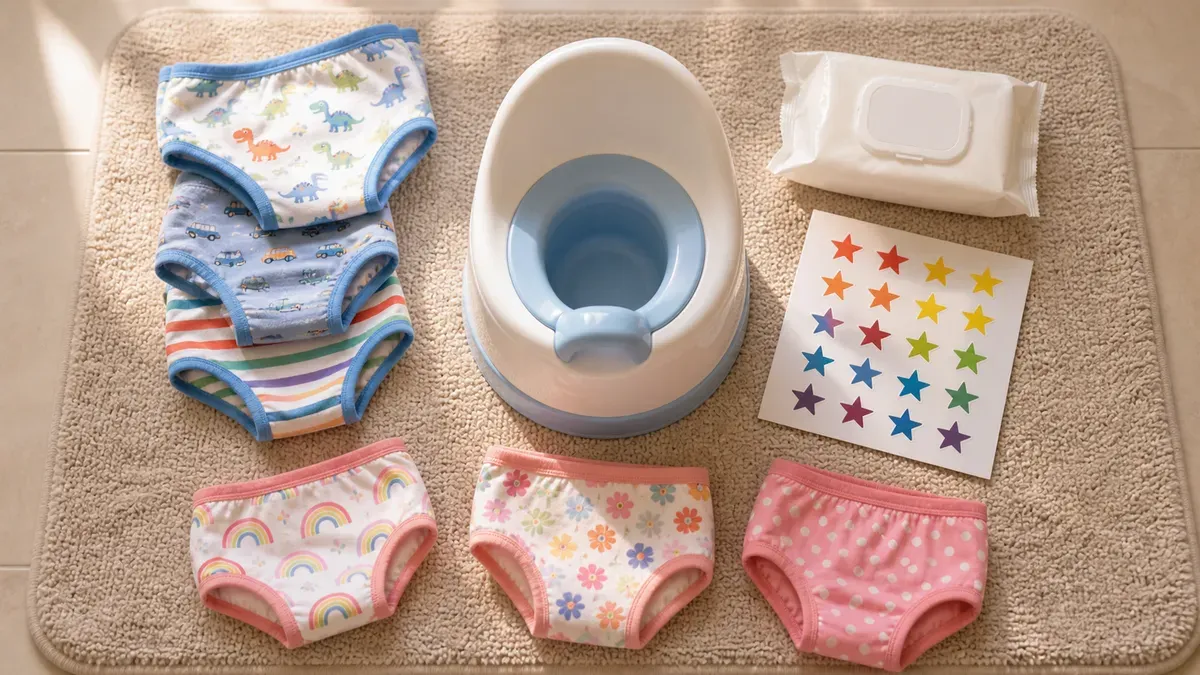
Here’s the short list that actually earns its spot:
- Underwear, and more of it than feels sane. A big cotton multipack like the MooMoo Baby eight-pack is what I’d grab, sized 2T on up and sitting on 17,000-plus reviews at 4.5 stars as a #1 best seller. Cheap, fun, character-covered. You’ll burn through them on Day 1, so overbuy on purpose.
- A potty chair that sits on the bathroom floor. Low, no climbing, no waiting for the big toilet. The BabyBjörn one is an Amazon’s Choice pick with 4,000-plus reviews at 4.8 stars, and it’s light enough that a toddler can haul it to whatever room you’re in. Some kids do better on a seat reducer, but the floor potty usually wins for speed.
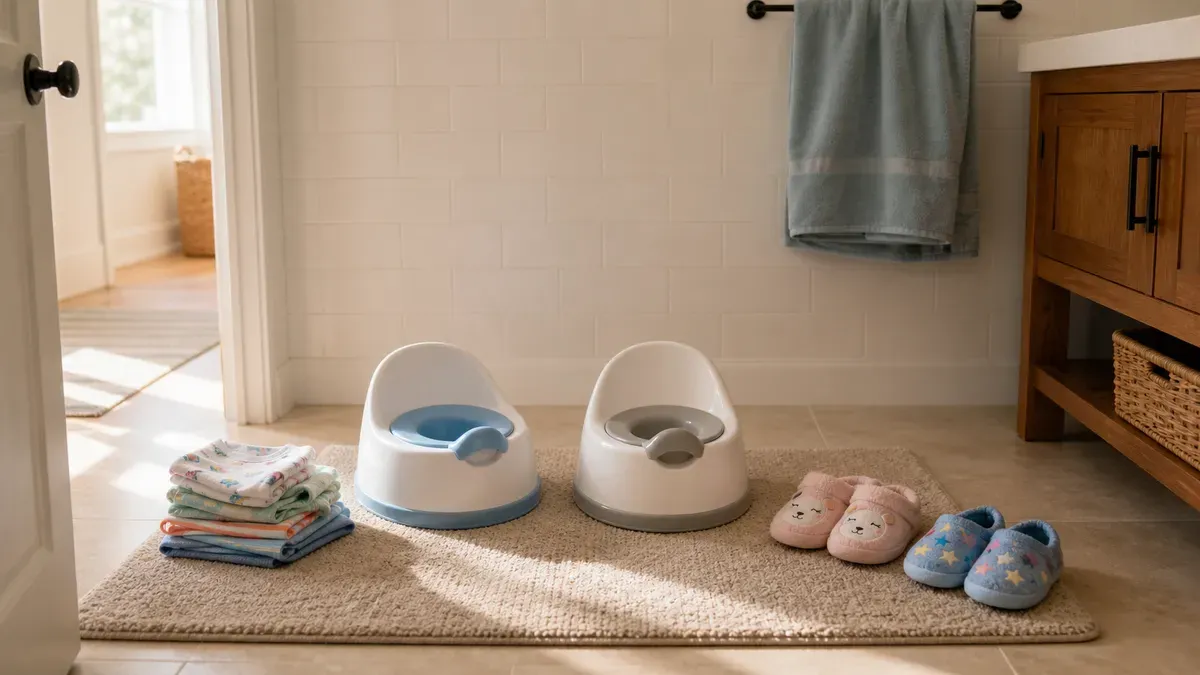
- Wipes and a bucket for the cleanup you know is coming. Old towels, a spray bottle, whatever saves you a trip down the hall mid-accident.
- Spare clothes within reach. Stash a pile by the bathroom so a miss doesn’t turn into a scavenger hunt.
- A reward ready to hand out. A potty training sticker chart on the wall, or a jar of something small. The point is to celebrate the catch the second it happens.
Notice what’s missing: pull-ups and a fancy musical potty. Training pants feel like progress, but they catch the pee the same way a diaper does, which is exactly the signal you’re trying to let your kid feel.
Want a method to read alongside this plan? The most-recommended potty training in 3 days book is Jamie Glowacki’s “Oh Crap!”, 300-some pages that 14,000-plus parents have rated 4.5 stars. The oh crap potty training method lines up closely with the bare-bottom approach here, and her Oh Crap! starting window lands at 20 to 30 months, right when most kids are eager to please.
Have it all out the night before. Setup is the easy part, and it’s one less thing to scramble for tomorrow.
How Long Potty Training Really Takes
So where does “three days” leave you in the real timeline? Three days starts the skill. Full daytime dryness, the kind where you stop packing a spare outfit everywhere, usually lands weeks later. Anyone selling you toilet training in less than a day is selling a clickbait dream, not a toddler.
The later you start, the faster it tends to go. Per Emily Oster’s ParentData survey of about 6,000 families, kids who start between ages 3 and 3.5 average around nine days of active training, while families who begin before 18 months average about 12 weeks. A younger body just needs longer to feel the signal. That gap is the whole argument for not rushing it.
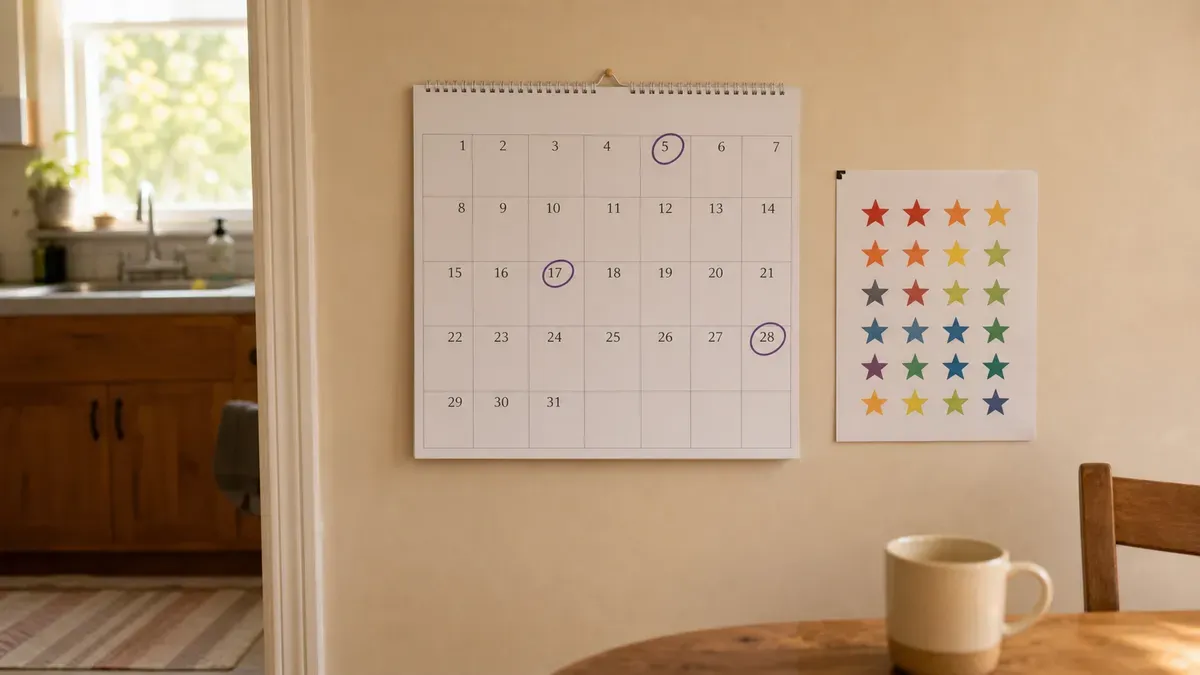
When people ask me how long it takes to potty train a toddler, my honest answer is one good week of effort, then a tail of accidents that stretches for a while. Plan for roughly six weeks before you call it done. With June, pee clicked in days. The leftover misses (the distracted, too-busy-playing kind) dragged on past a month, and that was normal, not failure.
Regression is part of the timeline, not a detour off it. When a kid who was catching every pee starts having accidents again, it usually traces back to one of these:
- A cold or illness
- A new sibling or big life change
- A trip away from home
None of it is lost progress. The fix is the same consistency you ran on Day 1: no punishment, no restart.
For the long-game numbers, the AAFP’s clinical review puts it plainly: most kids land in their own time. Picking the right potty book, like the right train potty book for a kid who isn’t even two yet, matters less than staying steady through the messy middle.
Here’s the timeline I give every nervous parent in my group:
- Days 1 to 3: the skill switches on at home
- Weeks 1 to 6: shrinking accidents, the occasional bad day
- Beyond that: dry days are the norm, with a slip when life gets loud
Night dryness is its own beast on its own clock, often months or years behind daytime, and chasing it early just burns you out. The follow-up after those first three days is where this actually gets won. Slow, unglamorous, and completely normal.
Adjusting the Method for Your Kid
The plan I’ve laid out is one plan, and your kid is not a generic kid. Some of the friction parents hit isn’t the best method failing, it’s the method needing a small tweak for the child in front of them. Below I’ll cover where boys and girls actually differ (less than the internet wants you to believe), and what to do when the sticker chart your toddler loved on Day 1 stops moving the needle.
Boys vs. Girls
The big secret about boys and girls? In a 3-day setup, you train them almost exactly the same. Everybody sits first. A boy learning to pee standing while he’s also learning to recognize the urge is two skills at once, and that’s a recipe for a soaked wall. Sit now, stand later.
The differences are real but small. In one Pediatrics study tracking when these milestones show up, girls hit daytime dryness a couple of months ahead of boys on average, with interest and that two-hour-dry window landing earlier too. Helpful to know. Not a reason to wait, and not a reason to panic if your son trails his cousin.
The core setup is the same for both:
- No diaper from morning on
- Push fluids all day
- Prompt on the timer every 20 minutes or so
- Big, immediate reward for every catch
With June I just needed consistency. With a sensory-seeker like my son Eli, the wiggle-and-go energy needed more movement built in before sitting.
If you want the standing-up, aim-game stuff once the sitting clicks, I broke it all down in how to potty train a boy start to finish. For the three days themselves, treat your toddler as a toddler first. Same plan, same patience.
When the Reward System Isn’t Landing
Stickers lose their shine fast. A chart that had your kid sprinting to the potty on Day 1 gets a shrug by the third afternoon, and suddenly your reward system is doing nothing. That’s not your kid quitting. It’s a toddler getting bored, which is the most toddler thing there is.
First fix: shrink the gap. A sticker earned now and cashed in “later” means nothing to a three-year-old who lives in this exact minute. Hand over the reward the second they catch a pee, while they’re still on the seat. Immediate beats big every time.
A few swaps worth trying:
- Prize box (a shoebox of dollar-store finds): the surprise does the heavy lifting
- Fruit snack on the seat: edible, instant, gone before they stand up
- Extra TV time: useful if you’re already using screens as leverage
Cheap, instant, renewable.
If building your own feels like one more chore this week, a ready-made potty training prize box does the assembly for you: a reusable chart, a wad of stickers, a couple of paper crowns, and a finish-line certificate in one kit. It’s carrying 6,000-plus reviews at 4.6 stars, which tells you how many worn-out parents just outsourced this exact step.
Praise outlasts any prize.
Treats can actually distract more than they motivate. The American Academy of Pediatrics leans on naming the win: “You felt it coming and you got there!” beats a generic “good job.” Whatever currency you land on, keep the words real and keep the consistency. The reward changes. The cheering doesn’t.
After the Three Days: Did It Actually Work?
Three days in, here’s the honest scorecard: your kid is catching most pees on the seat, telling you sometimes, and still soaking the occasional pair of underwear. That’s a pass. “It worked” doesn’t mean dry forever by day four. It means the switch flipped, and the rest is reps.
So what does the next stretch actually look like?
Accidents keep happening, and they should. A diaper-free kid who’s been at this less than a week is still learning to read a half-full bladder while distracted by a cartoon. The misses shrink week over week. Some days they vanish, then a rough afternoon brings three. Boring consistency is what closes the gap, the same prompting and cheering you ran on day one.
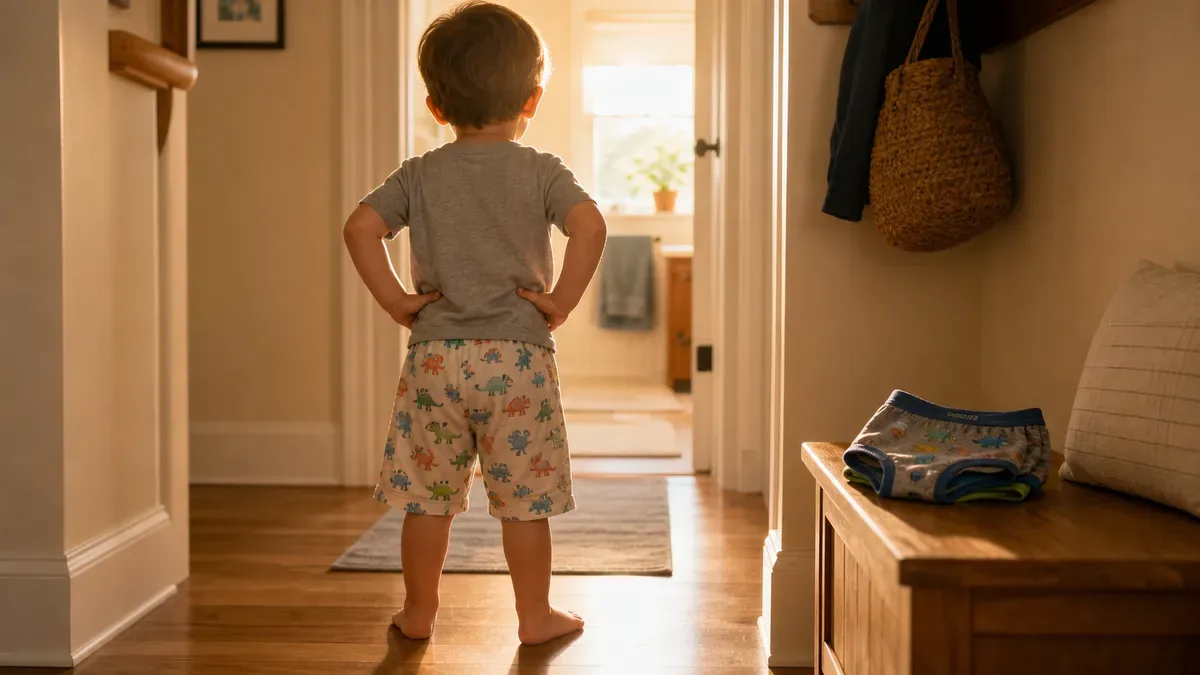
Then, weeks in, your trained kid suddenly forgets everything. This is the part nobody warns you about, and it’s normal. A backslide around now, sometimes called potty training regression age 3, usually has a reason behind it.
Common triggers include a new baby, a move, a change in childcare, family stress, or physical issues like constipation or a UTI. The AAP notes it “usually doesn’t last very long,” with most kids back on track within a few days or weeks.
- Regression isn’t a sign the three days failed, and it’s not a reason to start over.
- Skip the restart, skip the punishment.
- Go back to basics: prompt a bit more, lower the pressure, and let it pass.
If a UTI or constipation could be in play, that’s a quick call to your pediatrician, not a discipline problem.
Here’s the bar I’d actually hold the method to.
By the six-week mark: accidents are rare, your kid is initiating more than you prompt, and a wet pair is the exception, not the rule.
Hit that, and it worked. Slower than that with steady progress still counts.
Want the longer view, including nights and travel? Walk through our complete potty training guide. The three days were the hard part. You already did it.
Found this useful? Save it for the next rough afternoon.
Questions parents ask me about this
Does the 3-day potty training method really work?
It works the way the name doesn't promise. Three days is enough for the skill to switch on at home: bare bottom, push fluids, prompt the potty, and cheer every catch until your toddler starts feeling the urge and heading over on their own. What it won't do is hand you a kid who's bone-dry forever by Sunday night. After the three days you've got a started kid, not a finished one, and the accidents shrink over the following weeks.
What's the difference between a 3 day method and a potty training boot camp?
Not much, honestly. A potty training boot camp is the same idea with a more intense name: clear your calendar, stay home, go diaper-free, and prompt all day until it clicks. Some boot camp versions add stricter timers or no breaks, but the engine is identical to the three day method. Pick whichever wording makes you feel less terrified and run the same plan.
Is there a 3 day potty training book or PDF I should read first?
You don't need one to start, but reading a 3 day potty training book the night before can settle your nerves and give you a script. The most-recommended one walks through the same bare-bottom approach this method uses, so it'll feel familiar rather than contradictory. A short PDF guide does the same job in less time if you're starting tomorrow. Read it, then trust the plan over your own urge to improvise on Day 2.
Can you really potty train in less than a day instead of three?
No, and the claim sells better than it works. Toilet training in less than a day is a marketing hook, not a real timeline for most toddlers, because the body needs repetition to connect the urge to the seat. You might get a few lucky catches in an afternoon, but that's a head start, not a trained kid. Plan for three days at home and weeks of follow-up, and you'll be working with reality instead of against it.
Do I still use diapers or pull-ups at night during the 3 days?
Yes, nights stay in diapers, and that's not cheating. Nighttime dryness runs on its own clock, often months or years behind daytime, because it depends on body signals your toddler can't control yet. Chasing dry nights during these three days just burns you both out for nothing. Keep a diaper on at bedtime and naps, and tackle nights as a separate project much later.
What do I do about poop if my child will only pee on the potty?
This is normal, so don't panic or treat it as failure. Poop almost always lags behind pee, and a kid who's nailing the pee can still hold their bowels for days or weeks. Keep prompting, keep the bare-bottom routine, and stay flat and calm when they withhold rather than making it a battle. Most kids close the gap on their own; if you see signs of constipation or real pain, that's a call to the pediatrician, not a discipline problem.
How do I keep my toddler entertained while stuck home for three days?
Keep it close to the bathroom and low-key, because a wound-up kid misses more. Floor activities work best: a sensory bin, water play, stickers, books, anything they can drop the second you say potty. Skip long shows or anything that pulls them into a trance and makes them ignore the urge. The boredom is part of the deal, so plan a few easy setups ahead of time and rotate them across the three days.
Written by
Nora Hayes
Mom of two and a former preschool aide. I share the screen-free sensory play and calm-down ideas I test at my own kitchen table, plus what the moms in my little meet-up swear by. A parent passing on what works, not a doctor or a therapist.
More about NoraKeep going
All Potty Training-
 Potty Training
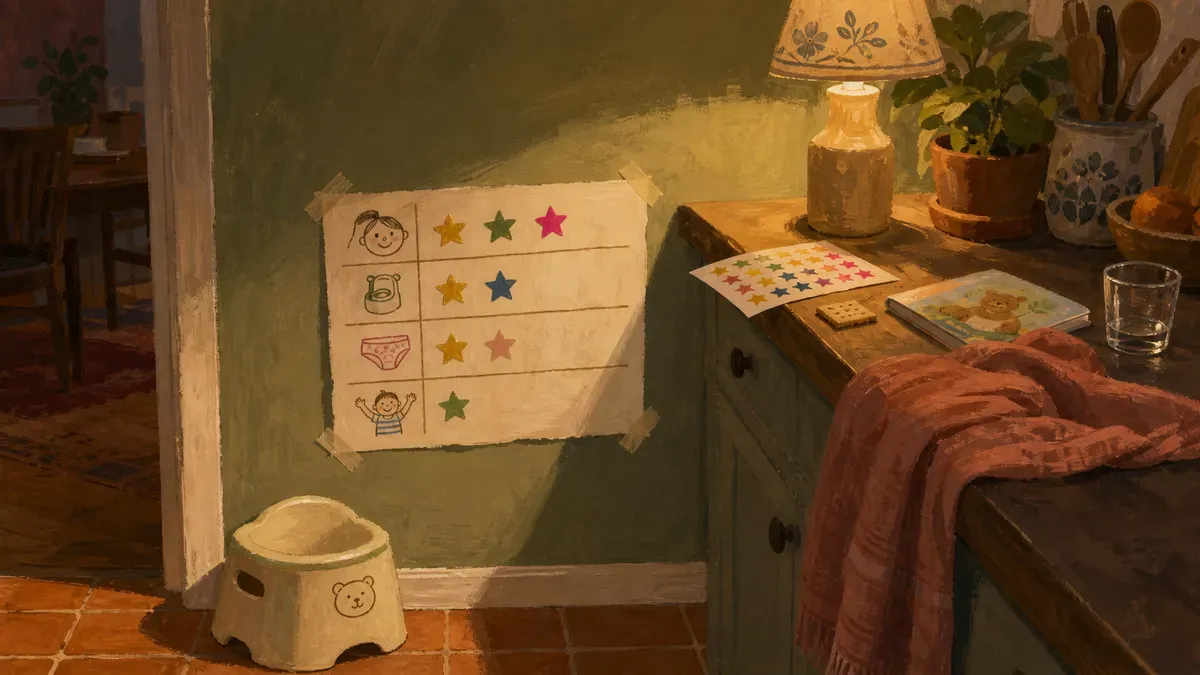
Potty Training Reward Chart: 20 Ideas Under $3
Skip the toy aisle: build a potty training reward chart with 20 ideas under $3 you already own. Grab the plan that motivates a stubborn toddler.
-
 Potty Training
How to Potty Train a Boy (and How a Girl Differs)
How to potty train a boy in 3 to 6 months: the readiness signs, the step-by-step method, and the small things that differ for girls.
-
 Potty Training
Potty Training Sticker Chart Printable (Free Download)
Free potty training sticker chart printable that survives travel and routine resets. Print, sticker, reward, reuse anywhere. Download now.
-
 Potty Training
Potty Training Certificate: A Just-Do-This Guide
Charts skip the finish line. Make a potty training certificate that gets your toddler over the line for real. Print yours tonight.