Potty Training Visual Schedule for a Nonverbal Toddler

Some links here are affiliate links. If you buy through one, I may earn a small commission at no extra cost to you. As an Amazon Associate I earn from qualifying purchases. I only point to things I'd actually use with my own two.
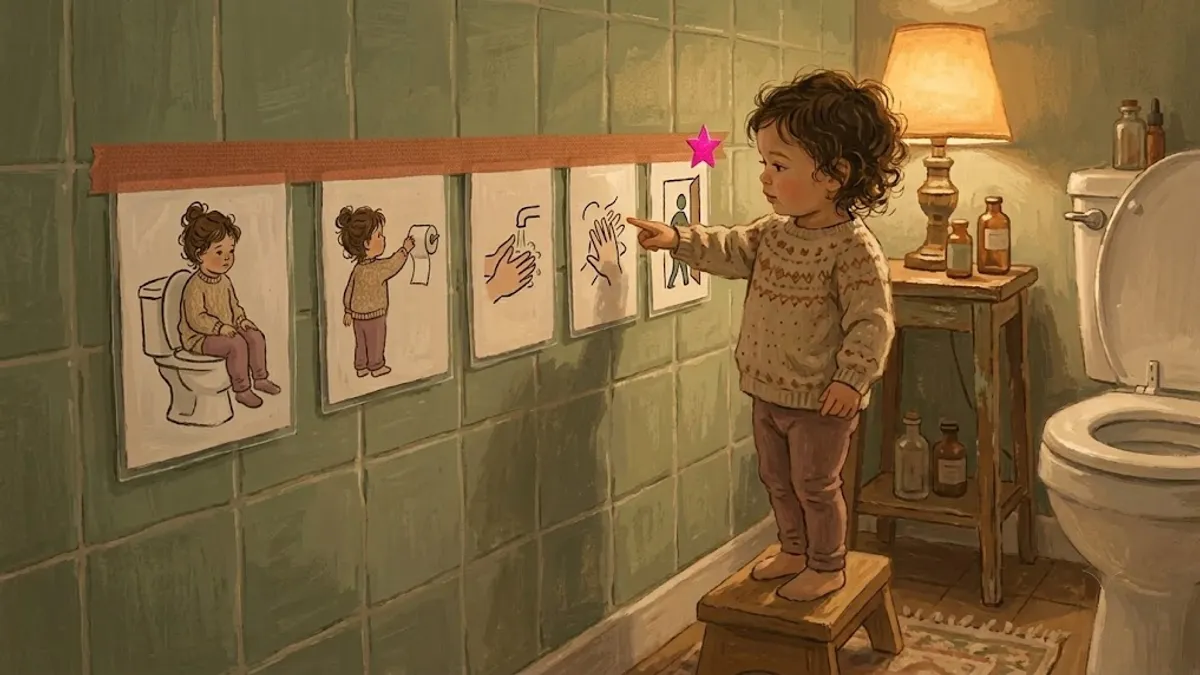
A visual schedule is the core tool for potty training a nonverbal toddler: a photo-card sequence for each step, a First-Then board, and a request card your child can hand you. If your toddler can’t say “potty,” show the routine, don’t explain it. I’m Nora Hayes, a former preschool aide raising an autistic sensory-seeker, and here you’ll get the printable sequence, how to run it at every sit, backup communication tools, and how to adapt for autism, Down syndrome, and sensory needs.
The plan in brief:
- Print a 4-to-6 picture card sequence: walk in, pants down, sit, wipe, flush, wash.
- Run the same card sequence at every scheduled sit, every 60 to 90 minutes.
- Pair one sign or picture-exchange card with each step so your child can request the potty back.
Why a Visual Schedule Works When Words Don’t
Before you print a single card, it helps to know why pictures land where talking doesn’t. Two things are going on: the cue itself is the problem, and a fixed picture order fixes it.
The Communication Gap Behind Toileting Refusal
When a toddler digs in their heels at the bathroom door, the easy read is “not ready.” Often it’s the opposite. They’re plenty ready to go, they just can’t unpack the word “potty” on demand.
“Potty” is abstract.
- A place
- A feeling
- An action
- A whole sequence of steps
For nonverbal kids and late talkers, that verbal cue is noise, and noise the moment they’re already on edge breeds anxiety, and anxiety reads as refusal.
This tracks with how communication develops. Plenty of toddlers in the potty training window are still sorting out speech sounds, so leaning on a spoken command asks for the one skill they haven’t built yet. Developmental readiness for the body and readiness for the word don’t arrive together.
That’s the gap a picture closes. A photo card, like the symbols on any AAC board, hands the child the message without making them produce or decode language first.
How Pictures Make the Routine Predictable
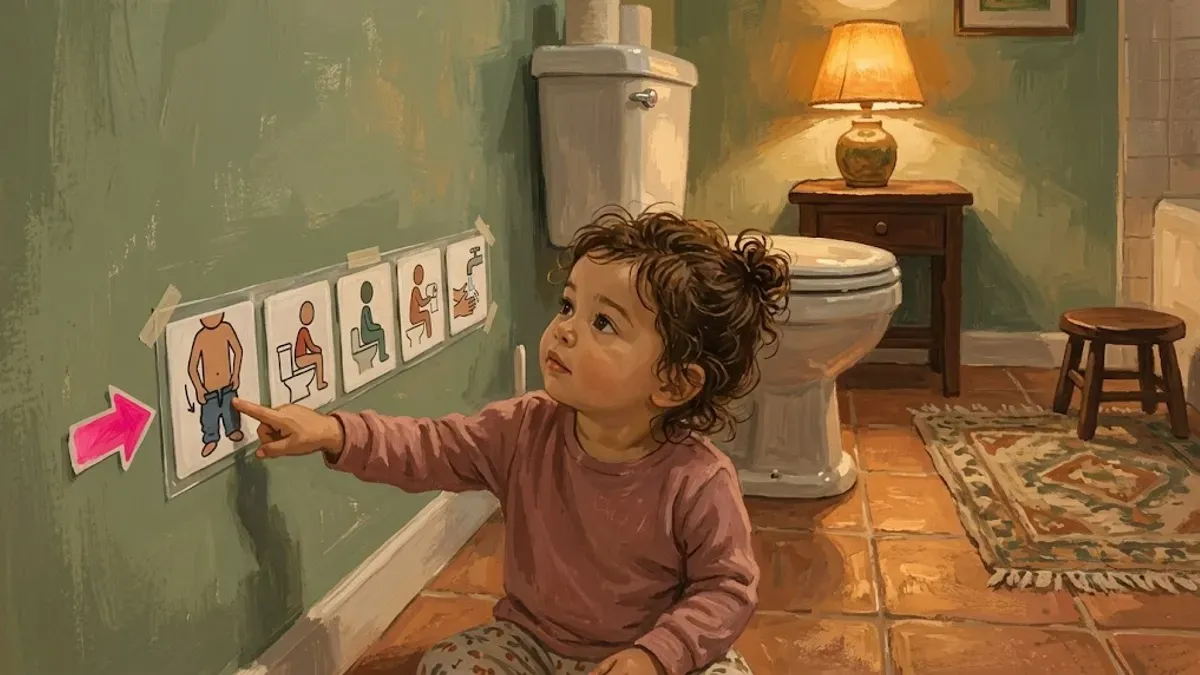
Kids resist what they can’t see coming. “Go potty” is a demand that lands out of nowhere; a fixed strip of pictures turns it into an order of operations they can read top to bottom.
That’s the quiet power of potty training visuals. Every sit follows the same order:
- Pull pants down
- Sit
- Wipe
- Flush
- Wash hands
The child stops guessing what the bathroom wants from them and starts anticipating the next step.
Consistency is the whole mechanism. A 2023 systematic review of visual schedules for toileting called them a potential intervention for building independent toileting skills in children with mild autism, pointing right at this everyday living routine.
Picture-based instructions also outlast your patience on a rough day. The strip says the same thing whether you’re calm or fried, and that visual support is what makes the routine stick.
How to Build and Use the Visual Schedule Step by Step
Here’s the build, start to finish: choose the cards, set up the board, then run the same strip on a clock. Three small jobs, and you can have it taped to the wall before naptime.
- Choose four to six photo cards covering each bathroom step
- Pair those cards with a First-Then board and a timed sit schedule
- Waterproof the cards and hang them at your child’s eye level by the toilet
Pick the Right Pictures and First-Then Board
Start with four to six cards, one per step. Walk in, pants down, sit, wipe, flush, wash hands. That’s it. Resist the urge to add more, because a long strip just gives a wound-up kid more to scan and more to skip.
Clear beats cute. A plain photo of your own toilet reads faster than a cartoon, and these potty training visual aids only work if the picture matches what the child actually sees. Real bathroom, real sink, real soap.
Then set up the First-Then board next to the strip. Two slots: “first” holds the potty card, “then” holds the reward, and the child sees the demand and the payoff in one glance. No surprise at the end, no mystery about what they’re working toward.
You can rig one from cardboard and two velcro dots, or skip the craft hour: a ready-made First-Then board arrives laminated with a fat stack of picture symbols already cut. The one I steer friends toward is an Amazon Overall Pick at 4.6 stars across 900+ reviews, and it wipes clean the first time a wet hand grabs it.
Keep the First-Then board dead simple: one thing to do, one thing they get.
If you’re using a token board for stickers or stamps, park it right there too. Those visual supports stack: the picture-based instructions say what, the First-Then board says why bother. That’s your whole reward system on one wall.
Run the Sequence on a Timed Sit Schedule
A visual schedule for potty training only earns its keep when you actually run it, and the easiest trigger is the clock, not your kid asking. Most toddlers won’t ask. So you go to them.
Sit them every 60 to 90 minutes. Watch a few days first and you’ll spot the elimination timing, the rough window after drinks or meals when they tend to go, and you can tighten the gap there.
A community-based school study using a timed voiding protocol started kids at trips every 30 minutes with short 3-minute sits, then stretched the gap once they stayed dry, reaching mastery in about three months on average. You don’t need a stopwatch that strict at home. The takeaway: short, frequent, predictable.
Each sit, run the full routine. Point to the first card, do that step, point to the next, down the strip every single time:
- Walk in, point, pants down
- Sit (a small timer helps if waiting is hard)
- Wipe, flush, wash
- Flip the First-Then card to the reward
Don’t skip cards on the easy days. The consistency is the whole point of toilet training this way, because the same order every time is what turns a chaotic ask into a sequence the child runs half on their own. Boring and identical is exactly what you want.
Free Printable Cards You Can Start With Today
You don’t need to buy anything to start tonight. Milestones Autism Resources offers a free toilet training toolkit with visual schedule guidance, and there are plenty of free printables floating around if you’d rather grab a ready set than make your own.
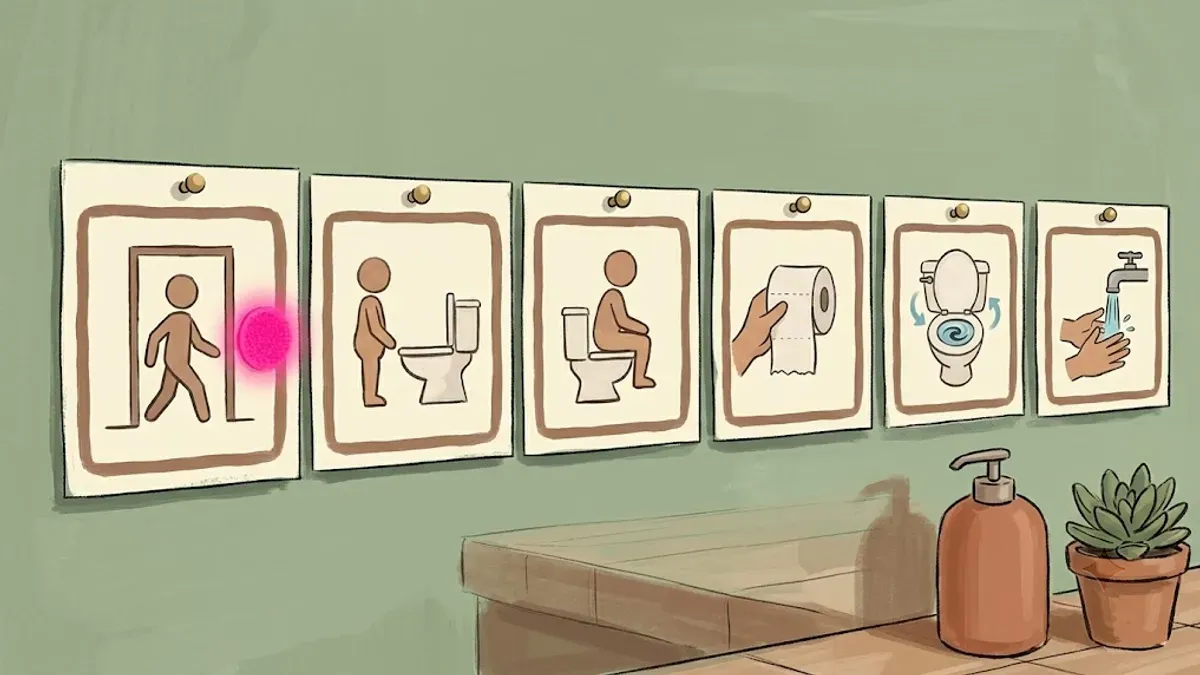
Print, then laminate. A laminator is ideal, but clear packing tape over cardstock survives wet hands just fine. These potty training visual aids live in a splash zone, so waterproof them or you’ll be reprinting by Thursday.
Arrange the cards in order, top to bottom or left to right, right at the child’s eye level by the toilet. Velcro dots let them pull each card as they finish a step. Tape works too. The picture-based instructions just need to be visible from the seat, every time.
Communication Tools That Replace the Word ‘Potty’
The cards on the wall handle the order of operations, but they don’t give your child a way to say “I need to go right now.” That’s the gap these three tools close, each one a different on-ramp to the same request.
Teaching the Sign for Potty
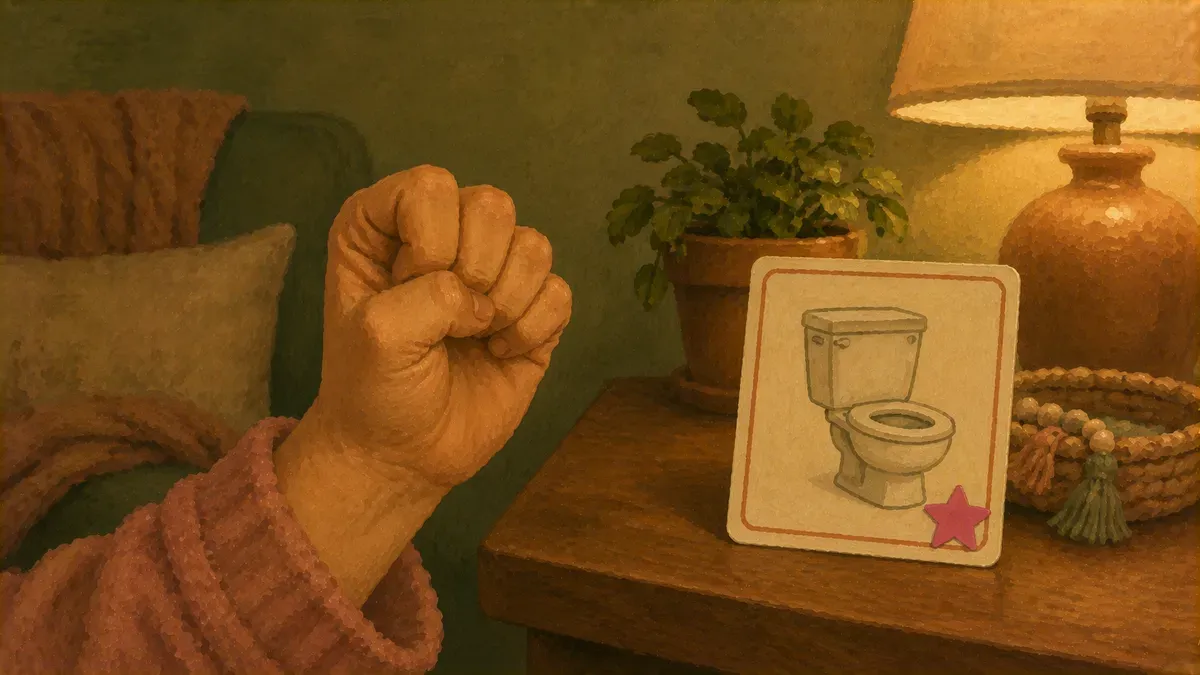
One sign your child can flick on their own beats a hundred reminders from you. The ASL sign for toilet is easy: curl your fingers into your palm with your thumb poking up between your index and middle fingers so your hand makes the letter T, then shake it side to side a couple of times, like you’re jiggling a toilet handle. That’s the whole motion, and Signing Time shows it as part of a toilet training toolkit for nonverbal children.
Model it at every single sit. You make the sign, you say the word once, then you walk to the bathroom. Do it the same way each time and the sign becomes the cue, no spoken language to decode.
Hand-over-hand the sign for the first week, then let them do it solo the moment they reach for it.
Sign language for potty training works because it’s portable. It travels to grandma’s house, the car, the park, anywhere the cards aren’t. Sign language is one small piece of augmentative and alternative communication your child carries in their own two hands.
Using PECS to Let Your Child Request the Toilet
Some kids take to a sign fast. Others do better handing you something. That’s where the Picture Exchange Communication System earns its place. In how the Picture Exchange Communication System works, Phase 1 has one move: the child picks up a picture card and places it directly in your hand, with no verbal prompts.
- Make one toilet picture card and keep it somewhere your child can reach it.
- The setup works best with two adults: one receives the card and heads to the bathroom right away, the other gives gentle physical guidance to complete the handoff.
The second your child puts that card in your hand, you go. No waiting, no “in a minute.” The whole point of these picture-based instructions is that the request gets answered instantly, so your kid learns the card is power. That immediate payoff is what turns a passed picture into real, child-led communication.
Writing a Potty Social Story Your Toddler Understands
A potty training social story rehearses the whole routine before your child ever has to live it. You’re not teaching a new skill here, you’re lowering the anxiety around one.
Keep it short, first-person, one simple line per page with a picture:
- “Sometimes my body needs to go potty.”
- “I walk to the bathroom.”
- “I pull down my pants and sit on the toilet.”
- “I am all done. I wash my hands.”
- “Mom is happy. I did a good job.”
Read it before sits, at bedtime, in the calm moments, not mid-meltdown. The repetition is the desensitization. By the time the real trip happens the order already feels familiar.
One honest caveat. The Association for Science in Autism Treatment calls the research on Social Stories mixed and cautions they carry limited support used on their own. So lean on it as one rehearsal tool alongside your cards and your sign, never the only thing. Used together, these three give a nonverbal kid real ways to ask, which is the heart of potty training autism spectrum when the word itself never comes.
Pairing Rewards With the Visual System
The sign and the cards tell a child what to do. The token board tells them why it’s worth doing again. These two subsections show how to wire reinforcement directly into the visual routine and keep it consistent across everyone who cares for your child.
Token Boards and Immediate Reinforcement
A token board is a simple strip with five or six empty circles and a picture of the reward at the end. Each time your child completes a step on the picture sequence or sits for the agreed time, a token goes in the next circle:
- Right when the step is done
- Not after cleanup
- Not after washing hands
For a nonverbal child who can’t hold an abstract “good job earlier” in mind, the token is the bridge between the action and the reward. It makes positive reinforcement visible and concrete, something they can watch fill up.
A drawn-on index card does the job, but the magnetic star token boards are cheap and hold up better: eight chunky stars a toddler can grab and slap on, dry-erase so a reset takes one wipe. More than 2,200 parents give it 4.7 stars, which is about how it went at our house too.
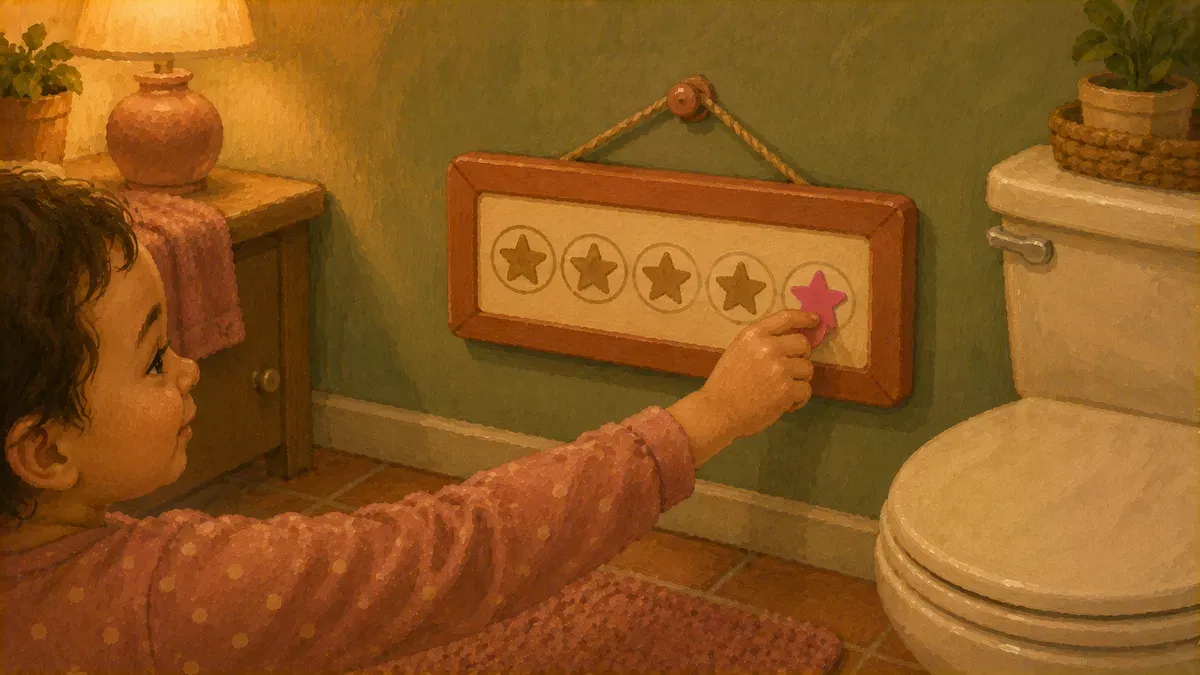
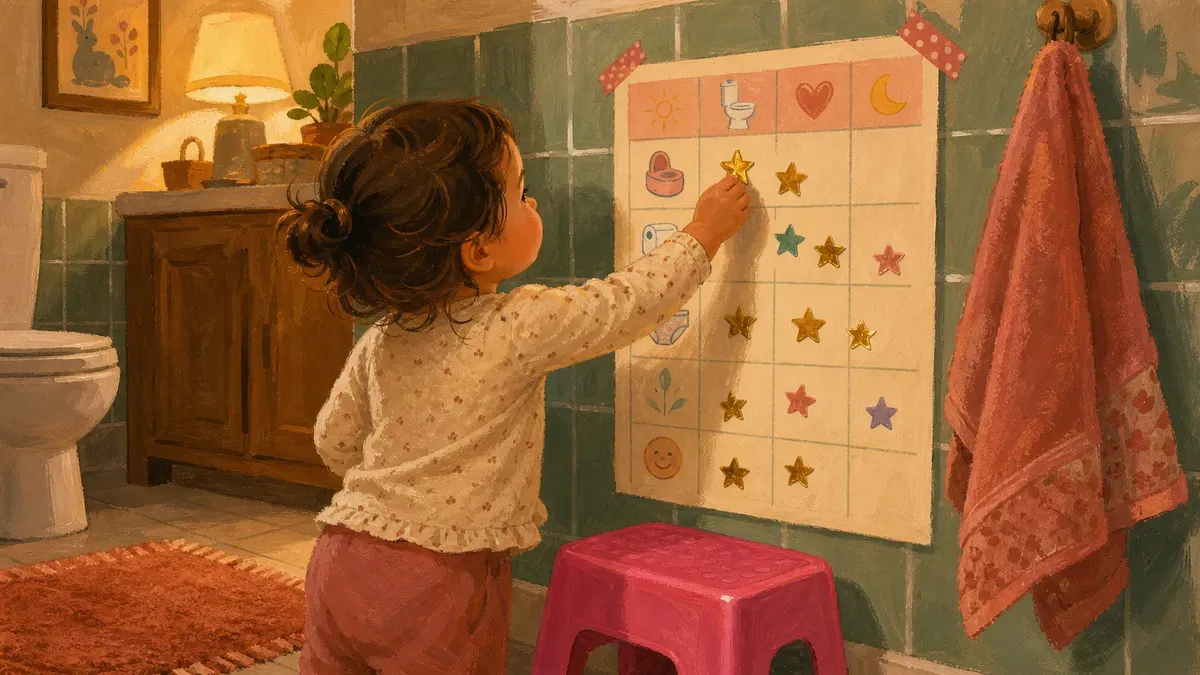
You can pair the token board with your potty training sticker chart if your child responds to both visual layers. Some kids do fine with just one system; watch what lights your child up. A token board slots naturally into a First-Then board too: First finish the sequence, Then earn the reward, with the token strip showing the path between them. The clearer the path, the less protest at the start.
Keeping Motivation Consistent Across Caregivers
This is where most plans quietly fall apart: dad does it differently, grandma skips the token, daycare uses a different card.
A classroom-based toilet training study found that keeping the toilet picture card and teacher directive consistent across varied restroom locations and staff was a key mechanism for skill transfer across settings:
- Same card at every location
- Same language from every adult
- Same sequence, no shortcuts
Print your exact cards and send a set to daycare. Walk grandma through the token sequence before her first solo babysit. The reward at the end of the token strip should be the same reward they get at home, not a substitute picked on the fly.
For rewards that travel and stay motivating across caregivers, the potty training reward chart guide has options that work at grandma’s house as well as yours. The goal is a system simple enough that every adult in the loop can run it without a briefing every time.
Adapting the Schedule for Autism, Down Syndrome, and Sensory Needs
The same three-part system carries over to most kids, but two groups need a few tweaks before it clicks: kids with Down syndrome who reach readiness on a slower clock, and sensory-sensitive kids who can’t tolerate the bathroom long enough to sit. Here is what to change for each.
Down Syndrome and Slower Developmental Readiness
Kids with Down syndrome usually get there. They just get there later, and pushing before the body is ready only drags it out. The National Down Syndrome Society suggests waiting until after the third birthday to start, because beginning before readiness signs appear tends to lengthen training and stir up problem behaviors.
The gap is real, not a hunch. In a case-control study on developmental readiness for toilet training, children with Down syndrome finished at a mean age of 56.2 months versus 27.1 months for typically developing kids. So plan for a longer runway and don’t read slow progress as failure.
- The visual schedule order stays the same, but pace it differently.
- Break the cards into smaller picture steps and stretch the desensitization phase over weeks.
- Sit in the bathroom fully clothed long before you expect anything to happen.
For these neurodiverse kids, the predictable order is the part that does the heavy lifting once readiness arrives.
Easing Sensory Triggers in the Bathroom
Sometimes the holdup isn’t the schedule at all. It’s the room. Sensory issues run high here: a review of sensory disturbance in autism notes parent-rated questionnaires estimating 45 to 95% of autistic individuals show some sensory disturbance, with flushing noise and seat texture coming up constantly as toileting challenges.
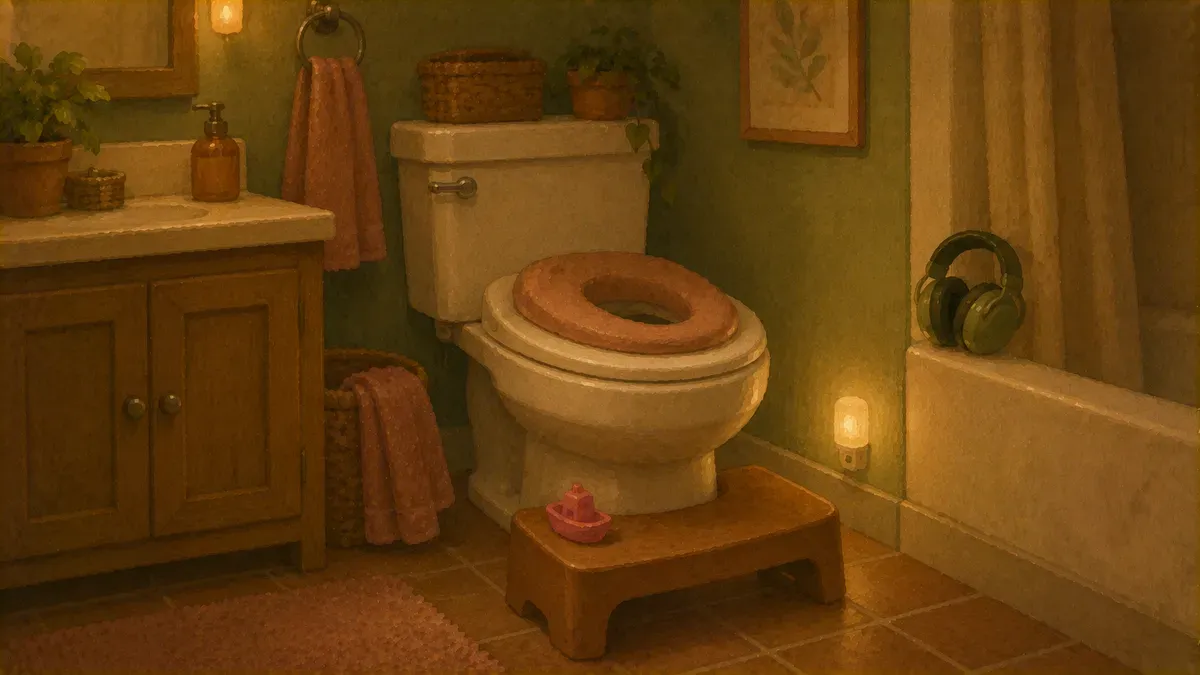
Fix the room before you blame the kid. A few changes that work at our house:
- A padded seat insert so cold porcelain stops being the dealbreaker. The cushioned one I use is an Amazon’s Choice at 4.4 stars, soft enough that sitting stops being a fight.
- Kids’ noise-cancelling headphones for the flush, or just flush after they’ve left the room the first few weeks. The pair we own cuts about 27 decibels and has more than 9,000 parents behind it.
- A dimmer bulb or a warm nightlight instead of the harsh overhead glare.
- A sturdy step stool so dangling feet have something to push against. It doubles as the boost up to the sink, shrugs off a grown adult’s weight, and has racked up more reviews (10,000-plus) than anything else in this bathroom.
Roll these in slowly as part of the same desensitization you’re already doing. For more on managing focus and impulse alongside the routine, adhd and potty training covers that angle, and our complete potty training guide ties the whole system together. Quiet the anxiety the room creates, and the cards finally have a chance to work.
Found this useful? Save it for the next rough afternoon.
Questions parents ask me about this
How do you use a visual schedule for potty training nonverbal toddlers?
Print four to six clear photo cards showing each step of the toilet routine in order, then run timed sits every 60 to 90 minutes rather than waiting for your child to request. Point to each card as you go through it, same sequence every time. The predictable order is what teaches the routine, not the explanation.
At what age should I start potty training a nonverbal or autistic toddler?
Chronological age matters less than readiness signs. Most children with Down syndrome reach readiness later than typical peers, and many autistic kids show readiness on their own timeline that doesn't match the chart on the pediatrician's wall. Watch for consistent elimination timing patterns, some awareness of being wet or soiled, and the physical ability to sit independently. When those pieces line up, start regardless of age.
What signs show my nonverbal child is ready for potty training?
Look for a predictable elimination pattern you can set a timer around, physical ability to sit on the toilet for a minute or two, and any behavioral sign they notice wetness, even squirming or going still right before. They don't need to tell you they have to go. Body readiness and speech readiness arrive separately, and the visual schedule does the communicating for them.
How do I handle accidents when my toddler can't tell me they need to go?
Keep the reaction neutral and cleanup matter-of-fact. No frustration, no drawn-out explanation, just change and move on. Shorten the interval between sits if accidents are clustering in a particular window, and track the times so you can spot the pattern. The schedule handles the communication gap; your job is to stay consistent, not to figure out how to make them ask.
My child pees on the potty but refuses to poop, what should I do?
Poop refusal is one of the most common sticking points, and it usually comes down to sensory discomfort or anxiety about the physical sensation. Check the bathroom environment first: seat insert, foot stool for posture, dimmer light, headphones for flush sounds. Run desensitization gradually, the same way you would for any sensory trigger. Don't rush this piece; most kids take longer with poop than with pee, and the success you already have is real progress worth building on.
How long does potty training take for a nonverbal toddler?
Plan for months, not weeks. Research on timed voiding schedules suggests mastery typically lands around three months when the schedule runs consistently, but that's an average across many children, not a deadline. Some kids click faster; some take longer. Consistent daily practice matters far more than speed, and a slower timeline is not a failure.
Should I use sign language or picture cards if my child uses an AAC device?
You don't have to choose. Layer all three. The picture card sequence runs the routine at the toilet. The sign gives your child a portable way to request anywhere, no device needed. The AAC device carries the request when the sign isn't being recognized yet or the device is already in hand. Each system backs up the others, and more communication pathways means more chances for your child to get the message across.
Written by
Nora Hayes
Mom of two and a former preschool aide. I share the screen-free sensory play and calm-down ideas I test at my own kitchen table, plus what the moms in my little meet-up swear by. A parent passing on what works, not a doctor or a therapist.
More about NoraKeep going
All Potty Training-
 Potty Training
Potty Training Reward Chart: 20 Ideas Under $3
Skip the toy aisle: build a potty training reward chart with 20 ideas under $3 you already own. Grab the plan that motivates a stubborn toddler.
-
 Potty Training
How to Potty Train a Boy (and How a Girl Differs)
How to potty train a boy in 3 to 6 months: the readiness signs, the step-by-step method, and the small things that differ for girls.
-
 Potty Training
Potty Training Sticker Chart Printable (Free Download)
Free potty training sticker chart printable that survives travel and routine resets. Print, sticker, reward, reuse anywhere. Download now.
-
 Potty Training
Potty Training Certificate: A Just-Do-This Guide
Charts skip the finish line. Make a potty training certificate that gets your toddler over the line for real. Print yours tonight.