Summer Potty Training Toilet: The Warm-Weather Advantage

Some links here are affiliate links. If you buy through one, I may earn a small commission at no extra cost to you. As an Amazon Associate I earn from qualifying purchases. I only point to things I'd actually use with my own two.
Summer potty training is simply ditching the pants for a few days while warm weather cuts the mess and the stress. A relaxed kid learns faster, and fewer wet pants means fewer meltdowns for everyone. I’m Nora Hayes, a mom of two and former preschool aide, and this guide covers when to start, what to have on hand, and how to get through the first week without losing your mind.
Why Summer Makes Potty Training Easier
Summer hands you three things that matter: less clothing between your child and the potty, a clear window to spot readiness, and uninterrupted time when potty training clicks best.
Fewer Clothes, Faster Learning
When it’s 80 degrees and sunny, your toddler can run around in just a T-shirt. No pants to undo, no diaper to wrestle off in that three-second window between need and action.
Without a diaper, your child feels wetness the instant it happens. Accidents stop being abstract, and that immediate feedback is the fastest teacher in potty training. Fewer layers mean you spot readiness signs faster.

Is Your Child Ready? Signs It’s the Right Season
Summer helps, but it can’t manufacture readiness.
The AAP readiness checklist names the signals: staying dry at least 2 hours, physical cues like grunting or squatting, walking to the bathroom, following simple instructions, and asking to use the potty.
Hit most of these? Go. Missing a few? Summer buys you time to wait. Signs your child isn’t ready: fighting the potty, zero interest, or accidents minutes after sitting. Age matters less than the whole picture.
Using Vacation Time for an Intensive Training Push
Pediatrician Dr. Shannon Thompson of Cleveland Clinic recommends clearing your schedule for three consecutive days with one caregiver home and no visitors for the 3-day potty training method. Summer vacation hands you that block without rearranging life.
The backyard becomes your training zone. Accidents hit the grass, not the rug. Cleanup is a hose-down. That alone keeps stress low enough to stay consistent.
The Naked Method and Diaper-Free Training in Summer
The outdoor hose-down cleanup makes accidents low-stakes, which is exactly the headspace the nude potty training method needs. Bare-bottom, potty within sprinting distance, parent watching for the squirm. I’ll walk through why this approach clicks in warm weather and what three days of committed training actually looks like hour by hour.
What the Naked Method Is and Why It Works
Your toddler goes without a diaper, underwear, or pants for hours at a stretch.
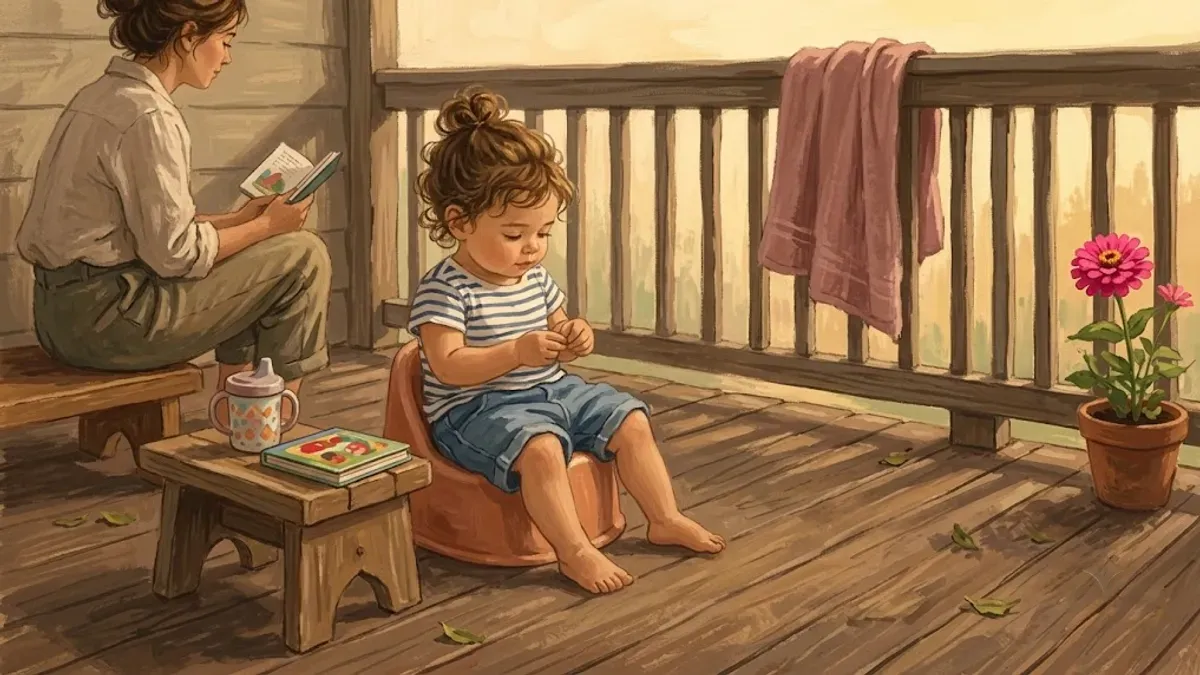
A diaper masks the wet sensation, so a toddler never connects the feeling with peeing. Going pantless removes that buffer. Dr. Shannon Thompson, writing about intensive potty training methods, puts it plainly: “Without anything on, they feel when they need to pee.” That body awareness is the whole engine.
Summer makes it practical. Bare-bottom time in a warm house, or out on a deck, means fewer puddles and faster cleanup.
A Day-by-Day Guide to Three-Day Naked Training
Day 1 is the most hands-on. Set a timer for every 20 minutes and have your child sit, per the Cleveland Clinic’s 3-day method. Watch for the wiggle or a pause in play and rush them to the potty. Push liquids all morning.
Day 2 stretches the timer out. Your child starts heading to the potty on their own while you step back.
Day 3 adds loose shorts or a dress. Skip underwear (it feels too much like a diaper). Poop takes longer than peeing, so do not panic.
Keeping It Positive: Praise, Rewards, and Staying Encouraged
Praise the effort, not just the outcome. A toddler who sat for ten seconds and stood up dry counts. “Great job sitting on the potty!” works better than generic praise.
Small rewards keep momentum. A NICE systematic review found reward systems achieved 97.4% success versus 72.2% for alarms; penalties are discouraged. Accidents are learning, not defiance. Stay calm, say nothing negative, and reset.
Supplies, Setup, and Your Summer Potty Routine
At my house, the BabyBjörn Potty Chair lived on the back deck for all of July. June picked the green one herself. That buy-in mattered more than I expected.
Choosing Between a Potty Chair and a Toilet Seat
A standalone potty chair sits on the floor at your child’s level and is less intimidating to reach fast. A seat insert clips onto the real toilet and skips the floor-to-big-toilet transition.
| Product | Best for | Parents’ rating |
|---|---|---|
| BabyBjörn Potty Chair | Floor training, backyard use | 4.8★, 4,300+ reviews |
| BabyBjörn Smart Potty | Travel, small spaces | 4.7★, 7,800+ reviews |
| BabyBjörn Toilet Training Seat | Big toilet transition | 4.8★, 5,500+ reviews |
All three are Amazon’s Choice picks, so you’re not gambling on a no-name. The floor Potty Chair is where most families start. The Smart Potty is the barely-there one at just over a pound for the diaper bag, the park, or a grandparent’s house, and once your child asks for the big toilet, the Toilet Training Seat clips on top. Pair that seat with a step stool so their feet plant flat instead of dangling, the little thing that makes pushing a poop out doable. The stool is its own quiet workhorse: an Amazon’s Choice with 10,000-plus reviews and a 175-pound rating that outlasts potty training by years.
Setting Up Your Summer Potty Station
Pick a permanent spot and don’t move it. A BabyBjörn Potty Chair beside a basket with wipes, spare shorts, and a quiet toy means everything is arm’s reach when the timer goes off.
Building a Potty Schedule That Sticks
Same anchor times every day: waking, after meals, before and after outdoor play, nap, bedtime. CHKD recommends scheduling around these natural transitions. Summer heat means more thirst, more practice. For the nap and bedtime end of that list, a waterproof mattress cover turns a soaked bed into a laundry load instead of a 2am mattress rescue. The machine-washable one I keep on hand has 3,000-plus reviews and an Amazon’s Choice badge to match.
Handling Accidents, Poop Training, and Common Setbacks
Even with a perfect potty setup and routine, accidents happen. That’s not failure. It’s how they learn. The trickier part is poop, which almost always lags behind pee, and knowing when to pause.
Why Accidents Happen and How to Respond
Bladder control develops unevenly. By age 3, only 52% stay dry during the day and 21% lack bladder sensation entirely, per data on constipation management during toilet training.
“Pee goes in the potty. Let’s try again next time.” That’s the whole script.
Poop Training: When It Lags Behind Pee Training
Poop training takes longer than pee training. A kid who pees on the potty may still demand a diaper to poop, hide behind furniture, or hold it. The release feels strange, and tensing up leads to withholding, then constipation, then more fear. One 2025 study found 23.6% of children refused to poop in the toilet, per published data.
Watch for poop timing. If your child always goes after breakfast, that’s your cue. Blow bubbles on the potty to relax those muscles. A book buys time. Some kids need privacy.
Signs You Should Pause and Try Again Later
If potty time is a daily power struggle with crying, hiding, or clamping legs together when the potty comes out, your child is telling you something real. The AAP puts it plainly: set the potty aside when it would be a relief to your child.
Other red flags include holding pee or poop for hours, sudden regression, or fear of the potty itself.
Try again in a few weeks.
Daycare, Travel, and Potty Training Away From Home
Having the right potty is half the battle. The other half is using it outside your own bathroom: a different daycare routine, a highway rest stop, a public stall with a loud auto-flush.
Coordinating Potty Training With Daycare or Preschool
Ask your daycare or preschool about their potty training routine before you start at home. Agree on the same words, the same anchor times, and a quick daily check-in about what worked. Pack two full changes of clothes in a labeled bag that lives at school.
Travel Potty Training: Road Trips and Hotel Stays
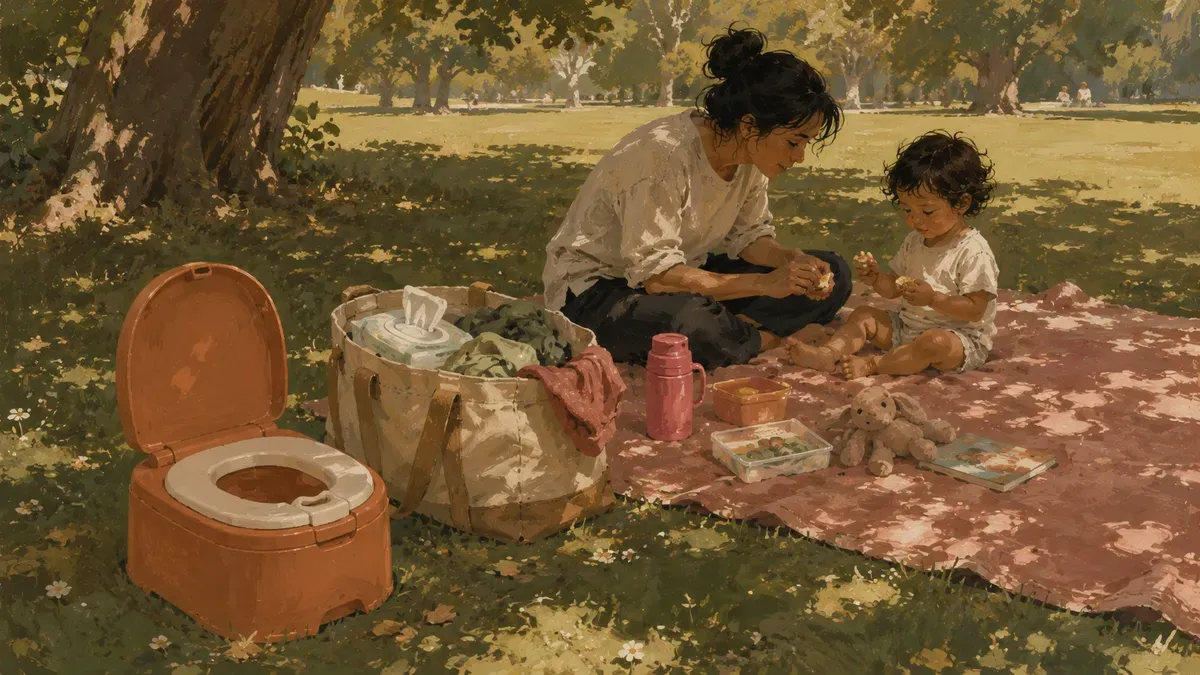
A road trip doesn’t have to undo weeks of progress. Plan rest stops every 60-90 minutes, the interval Today’s Parent recommends to avoid car-seat accidents. Bring the potty your child already knows so it feels familiar, not foreign. Set up the travel potty in the hotel bathroom the moment you arrive.
Public Restroom Fears and Auto-Flush Toilets
A public restroom echoes and the auto-flush goes off without warning, which is a lot for a newly trained toddler. Cleveland Clinic recommends three fixes: cover the auto-flush sensor with a Post-it, use a folding seat reducer, and let your child step out before you flush. The noise is less scary from a few feet back. Control over the flush builds confidence.
Found this useful? Save it for the next rough afternoon.
Questions parents ask me about this
Is summer the best time to start potty training?
Summer gives you practical advantages: fewer layers for your child to wrestle with, bare-bottom time outdoors that saves your floors, and often a block of vacation days to commit. But the season alone won't train your child. Readiness trumps weather every time. If your toddler shows the signs (staying dry for stretches, noticing when they're wet, following simple instructions), summer is the easiest window. If they're not ready, pushing through the nicest July won't help.
What age is best to start potty training?
Most children show readiness somewhere between 18 months and 3 years, with a big cluster landing around age 2 to 2 and a half. Watch for the constellation of signs instead: your child can walk to the bathroom, pull down their own pants, stay dry for two hours, and communicate when they need to go. A 22-month-old who checks every box is more ready than a 3-year-old who checks none. Start when they show you, not when the calendar says so.
How do I potty train boys versus girls?
The mechanics differ less than people think. Start both sitting down. A boy sitting on the potty empties his bladder more completely than he does standing, and it keeps aiming off the table while he's learning the basics. Once he's consistent, you can introduce standing (a few Cheerios in the bowl as targets is a classic for a reason). Girls learn to wipe front to back from the start. The same method works for both, though boys sometimes take a little longer to get fully consistent.
Can I potty train twins or multiple children at the same time?
You can, but treat them as individuals, not a unit. Give each child their own potty chair. Sharing one during the high-stakes moment of "I need to go now" rarely ends well. Stagger your expectations. One twin might pick it up in three days while the other takes three weeks, and that's normal. If you're solo, train one child first and let the other watch before starting. Seeing a sibling succeed is powerful preparation.
What if my child was doing well but now refuses the potty?
Take the pressure off entirely. Potty refusal after a good start is common and almost never about defiance. A new sibling, a change in routine, a painful poop, or simply getting bored with the novelty can all trigger it. Put the diapers or pull-ups back on for a week or two without comment, then try again with one thing changed: a new sticker chart, a different potty location, a special "potty only" toy. The skill isn't lost. It's just on pause.
Should I use pull-ups during potty training or go straight to underwear?
Go bare-bottom or straight to underwear during awake training hours. Pull-ups feel like a diaper to your child, and they mask the wet sensation that creates the cause-and-effect learning. Kids figure out fast that a pull-up catches everything, and it's easier than stopping play to find the potty. Save pull-ups for naps and nighttime, when staying dry is developmental rather than behavioral. For daytime, underwear or nothing at all teaches more in a week than pull-ups teach in a month.
How do I handle nighttime potty training during the summer?
Nighttime dryness is not something you can teach. It's hormonal. The hormone that slows urine output overnight develops at different ages (some as late as 7 or 8). You can support the process by limiting drinks an hour before bed, making a bathroom trip part of the bedtime routine, and using a waterproof mattress cover. Let your child wear pull-ups to bed until they wake dry consistently for a week or two. Waking a child at midnight to pee trains the parent, not the child.
Written by
Nora Hayes
Mom of two and a former preschool aide. I share the screen-free sensory play and calm-down ideas I test at my own kitchen table, plus what the moms in my little meet-up swear by. A parent passing on what works, not a doctor or a therapist.
More about NoraKeep going
All Potty Training-
 Potty Training
Potty Training Reward Chart: 20 Ideas Under $3
Skip the toy aisle: build a potty training reward chart with 20 ideas under $3 you already own. Grab the plan that motivates a stubborn toddler.
-
 Potty Training
How to Potty Train a Boy (and How a Girl Differs)
How to potty train a boy in 3 to 6 months: the readiness signs, the step-by-step method, and the small things that differ for girls.
-
 Potty Training
Potty Training Sticker Chart Printable (Free Download)
Free potty training sticker chart printable that survives travel and routine resets. Print, sticker, reward, reuse anywhere. Download now.
-
 Potty Training
Potty Training Certificate: A Just-Do-This Guide
Charts skip the finish line. Make a potty training certificate that gets your toddler over the line for real. Print yours tonight.