Potty Training Autism Spectrum: When Stickers Don't Work

Some links here are affiliate links. If you buy through one, I may earn a small commission at no extra cost to you. As an Amazon Associate I earn from qualifying purchases. I only point to things I'd actually use with my own two.
Potty training a child on the autism spectrum clicks into place when you fix the sensory triggers first, run timed sits with a data sheet instead of guessing, and swap the sticker chart for one reward your kid actually wants. It matters because the bathroom is a sensory minefield (loud flush, cold seat, dangling feet), and no reward chart in the world works until that part feels safe.
I’m Nora Hayes, a former preschool aide and mom to an autistic 7-year-old, and below I’ll walk you through the exact plan we use, step by step.
The plan in brief:
- Strip the bathroom of sensory triggers first: add an insert seat, footstool, and noise-cancelling headphones before day one.
- Set a visual timer and do scheduled sits every 30 minutes, logging each result on a potty data sheet.
- Reward every success within 3 seconds using one real motivator (a favorite app or snack), not a sticker.
How to Know Your Autistic Child Is Ready
Age is the least useful piece of information here. What actually predicts success is a cluster of physical and behavioral signs your child is already showing you.

Readiness signs that matter more than age
The single most reliable sign is dry stretches. According to SPARK for Autism, staying dry for at least 1-2 hours is a key physiological prerequisite. It tells you the bladder has enough capacity to hold between scheduled sits. Watch for that before you start anything.
The other behavioral precursor signs to look for:
- Goes somewhere private to poop, or hides behind the couch
- Shows any interest in the bathroom, even just following you in
- Has a consistent, readable way to signal discomfort (a gesture, a word, a behavior pattern)
You don’t need all three. One solid sign plus dry stretches is enough to try. If you’re seeing none of them yet, check our guide to signs your child is not ready for potty training before you start.
When your child is 3, 4, or older
Delayed potty training is common for autistic kids with ASD, far more common than most parenting books admit. A 5- or 6-year-old with no daytime bladder control is not behind because of a failure. Their developmental milestones run on a different timeline, full stop.
What changes at older ages isn’t the plan. It’s the data. A 4-year-old not yet potty trained needs the same timed sits and sensory setup, but denser tracking: more data points, a longer baseline, closer attention to motor skills like getting pants up and down independently. An individualized plan beats any age-based checklist. Shame has no place in any version of this, regardless of where neurotypical peers are at the same age.
How to Potty Train an Autistic Child Step by Step
Here is the whole method in one line: put your child on the toilet on a fixed clock, write down what happens, then slowly hand the job over to them. The three steps below build on each other, so work them in order and don’t skip the tracking.
- Clock before cues: pick an interval, track every sit, find the voiding window.
- Drop the pull-ups, lock in a script: real underwear, same words every trip.
- Bend the 3-day method: front-load the prep, clear the calendar, redefine what done looks like.
Step 1: Set a toileting schedule and track every sit
Start with the clock, not the kid. Scheduled toileting means you pick an interval and stick to it, no waiting for a signal that may never come. The general toilet training guidance from the Association for Science in Autism Treatment recommends scheduled sits every 30 minutes, with your child sitting and trying for one minute each time, run across at least 6 to 8 hours of the day.
Set a visual timer they can watch counting down, the kind with a colored disc that shrinks as the minute runs out, so the wait is something they see instead of something you keep announcing. When it goes off, you go, every time, no debate. The one I point parents to is an Amazon’s Choice with 1,100-plus reviews, and it runs silent on purpose, because a loud tick is just one more noise a sound-sensitive kid doesn’t need.
Then write it down. A simple potty data sheet, one row per sit, turns guesswork into a pattern you can actually read.
Log three things on every trip:
- The time you sat
- Wet, dry, or BM
- Whether they were already wet before the sit
After a few days of honest tracking, their natural voiding window jumps off the page. Most kids go at fairly predictable times, and the data sheet is how you find theirs.
Step 2: Move from pull-ups to the toilet
Once the schedule is humming, the pull-ups have to go during the day. Knowing how to potty train an autistic child past this point is mostly about removing the safety net, because a pull-up feels like a diaper and tells the body nothing has changed. Switch to real underwear or bare-bottom at home.
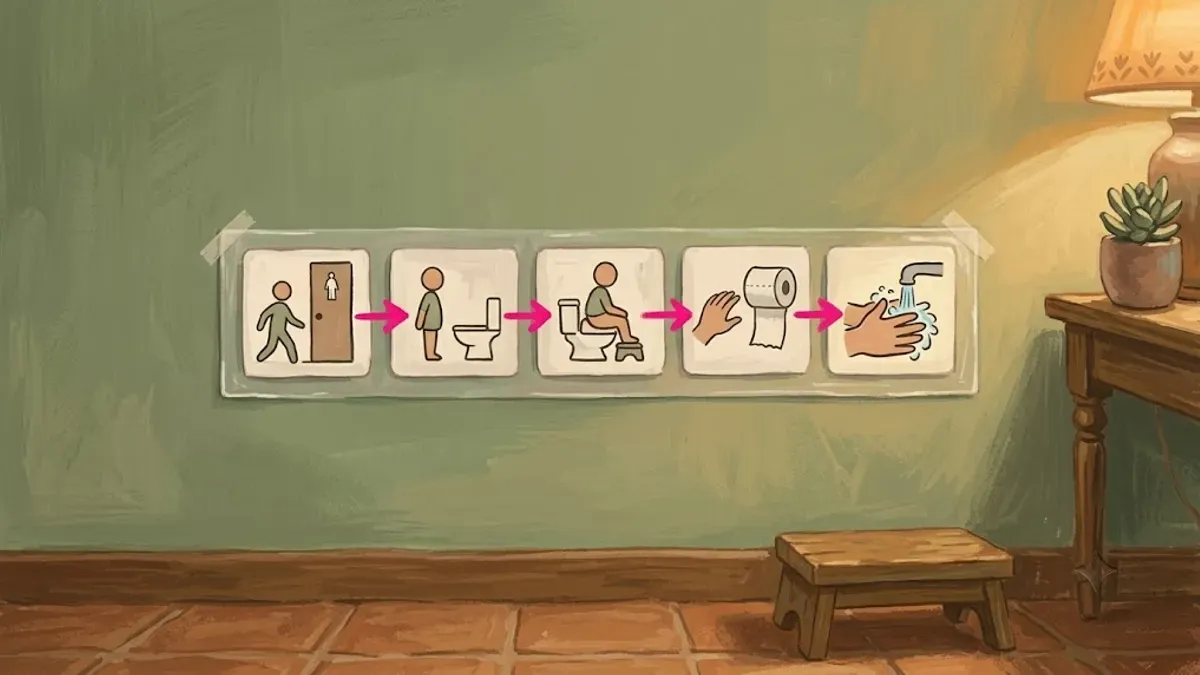
Now the part that does the heavy lifting: say the exact same thing every single trip. “Pants down, sit, try, wipe, flush, wash.” Same words, same order, same voice. The script becomes the routine, and a predictable routine is what makes scheduled toileting stick for an autistic kid who lives or dies by sameness.
Step 3: Adapting the 3-day method for autism
The compressed 3 day potty training method can work for a child on the autism spectrum, but only if you bend it. The standard version assumes a kid who reads body cues fast, and many of ours don’t.
Front-load the week before: pre-teach each step from your script and desensitize around the bathroom before day one arrives.
- Introduce the toilet seat without any pressure to use it
- Practice the flush from a distance, then up close
- Walk through pants-down and sit-down as separate dry runs
- Rehearse the full script so it’s familiar before it has to count
Clear your calendar: no errands, no visitors for three days of close watching.
Reliable sits on schedule with zero accidents is a real win. Independence on their own initiative may follow weeks later, and that’s the plan working.
If you want the full breakdown of the compressed approach, our potty training walkthrough lays out each day in detail. Run these three steps in order, lean on the data, and let the timeline be theirs.
Setting Up a Sensory-Friendly Bathroom
The timed sits only work if the room itself stops fighting you, so before the next session, fix the three things that make a bathroom feel like a trap: the seat, the noise, and the clothes. Each one is a small swap you can do tonight.

Most of that comes down to gear, and it’s cheaper than the internet wants you to believe. Here’s what earns a spot by the toilet:
| Gear | What it fixes | Parents’ rating | Reach for it when |
|---|---|---|---|
| Toilet seat insert | Shrinks the seat so nobody can fall in; folds flat into a travel bag | 4.8★, 5,000+ reviews | Your kid white-knuckles the edge of the big toilet |
| Footstool | Gives feet something solid to push against, knees up over the hips | 4.7★, 10,000+ reviews | Dangling feet set off the fear of falling |
| Noise-cancelling headphones | Takes the roar off the flush and the hand dryer | 4.7★, 2,700+ reviews | The flush is the thing that ends every trip |
The seat insert wears the #1 best-seller badge, and the stool under it is the piece most families add without thinking twice. They travel as a pair for a reason.
Potty chair vs. toilet insert for sensory needs
Reach for a stable insert seat and a footstool first, not the open potty chair on the floor. A potty chair leaves your kid perched mid-air with nothing under their feet, and that wobble is exactly what sets off the fear of falling in. Cleveland Clinic’s toilet training guidance for autistic children notes that most autistic kids need a seat insert plus a footstool, and that unsteadiness and fear of falling are common barriers.
Grounded feet change everything for sensory processing. When the footstool gives them something solid to push against, the body relaxes and the motor skills for actually pushing kick in. Match the stool height so the knees sit a little above the hips. These two adaptive supports, often recommended in occupational therapy, do more than any pep talk.
Calming sound, light, and flush triggers
The flush is usually the real villain. That sudden roar in a tiled echo chamber is a lot, and sound sensitivities are common: roughly half to two-thirds of autistic people are hypersensitive to everyday noise, with unpredictable auto-flush toilets and hand dryers called out as classic bathroom triggers.
So take the surprise out of it. At home, you flush, and only after your kid has left the room until they’re ready to do it themselves. In public, cover the auto-flush sensor with a sticky note or your hand. Swap the harsh overhead bulb for a dimmer or a small lamp, and keep noise-cancelling headphones on a hook by the door. Headphones plus a predictable flush is gentle desensitization, not a fight, and it shrinks the aversion one quiet trip at a time.
Clothing and texture tweaks that reduce resistance
Sometimes the refusal isn’t the toilet at all. It’s the waistband. A stiff seam or a tight elastic can be the whole reason your kid digs in, and a child fighting their clothes has nothing left for the actual job.
Go soft and simple:
- Elastic-waist joggers or leggings they can shove down in one motion
- Seamless or tag-free underwear, sized a touch loose
- Loose cotton over anything stiff, scratchy, or fitted
Let your kid pick the pair that feels right, even if it’s the same three every week. Removing that one texture aversion clears the path. When the clothes stop being a sensory sensitivity to manage, going becomes one less battle, and that’s the whole point of the setup.
Visual Schedules and Communication Supports
The bathroom is ready. Now your child needs to know what happens inside it, and how to tell you they need to go.
Building a visual toileting schedule
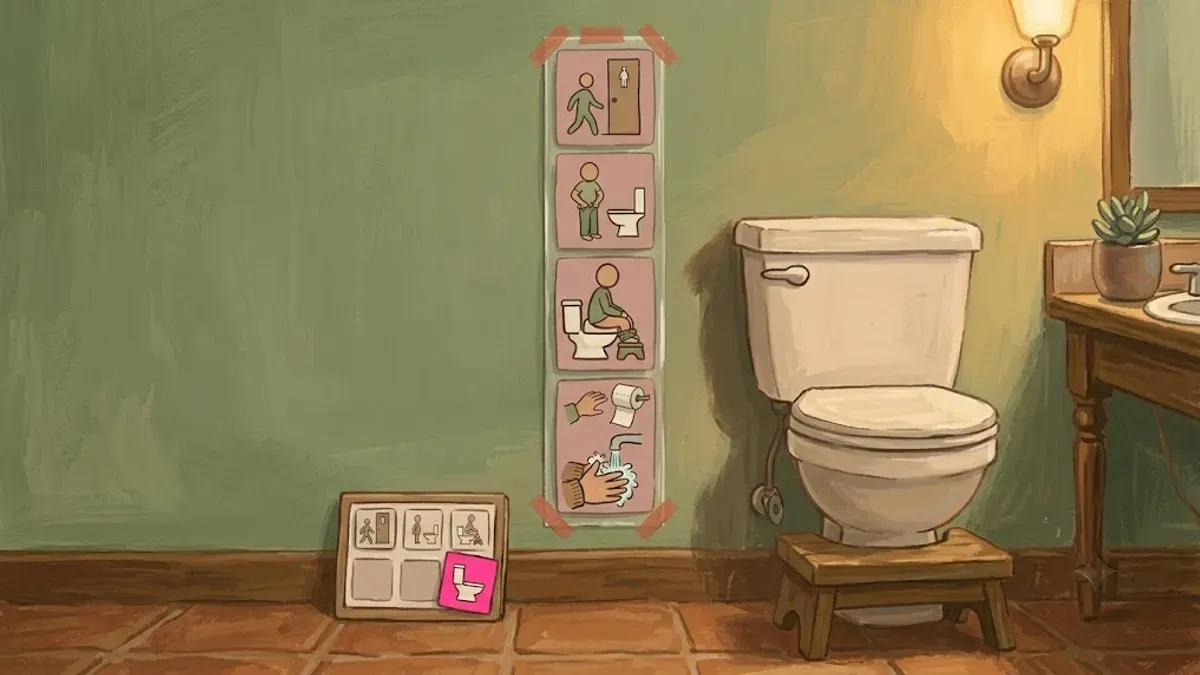
A picture schedule posted at eye level takes the guesswork out of the routine. Your child can look up and follow the sequence without waiting for you to prompt them each step.
- Pull down pants
- Sit
- Try
- Wipe
- Pull pants up
- Wash hands
Print photos or simple line icons, laminate them, and tape the strip at your child’s eye level. A potty training visual schedule works because each picture replaces a spoken instruction your child has to hold in working memory. If a laminating project is the last thing you have energy for, a ready-made visual schedule card set does it for you: a stack of picture cards on a felt board you rearrange as the routine changes. The one most parents land on carries the Amazon’s Choice tag and a 4.7-star average across 300-plus reviews.
A 2023 systematic review of 10 studies found that visual supports reduce challenging behaviors and build independent toileting skills in autistic children by providing clear, predictable expectations.
Social stories can do the same job for anxiety. A short three-page story that walks through the bathroom sequence, including washing hands and walking back out, can preview the whole experience before the scheduled toileting sit even starts.
PECS, AAC, and signaling ‘I need to go’
If your child is nonverbal or doesn’t yet ask reliably with words, they need one consistent way to signal the bathroom.
The Association for Science in Autism Treatment reports that children reach near-100% requesting success after just a few PECS sessions, with documented drops in challenging behaviors alongside it.
Whatever tool fits your child, the setup is the same:
- PECS toilet card: they hand it to you, you go immediately
- AAC device: one programmed button, within reach at all times
- Dedicated button: press it, and you respond every single time
Your consistency is what makes the signal stick.
Reinforcement When Sticker Charts Don’t Work
Honoring the request is half the loop; the other half is what your kid gets the second they actually go. Here’s why the sticker chart on your fridge isn’t pulling its weight, and the approach that does.
Why sticker charts fall flat, and what to use instead
A sticker is a promise of a reward later. For a lot of autistic kids, “later” might as well be never, and a smiley face on a chart means nothing if it doesn’t connect to the moment they sat and produced.
The fix is to drop the chart and pick one thing your kid would crawl across the floor for. A favorite snack, ninety seconds with a specific video, a fidget they only get here. That single high-value item is your reinforcer, and it lands the instant they finish, not at the end of the day.

This is positive reinforcement stripped to its core. No abstraction, no aversion to a chart that never paid out, just a reason to do it again. If charts have flopped for you the same way they flop for many kids with adhd and potty training, this is the swap.
Borrowing from ABA: prompting, fading, and data
Applied behavior analysis gives you a clean structure for the same idea. Prompt each step (point to the stool, gesture to sit), reinforce the second it happens, then slowly pull your prompts back as your kid takes over.
That pulling-back is fading, and it’s the whole game. You’re not doing it forever; you’re handing the routine to them one step at a time.
The ABA potty training method leans hard on data, and so should you. Your sits sheet already shows what your eyes miss, a dry stretch getting longer, an accident shifting earlier. If you’re working with a board certified behavior analyst, bring that sheet. Whether you call it ABA therapy potty training, potty training ABA, or just your own tracking, behavioral reinforcement plus honest data is what turns a good week into a trained kid.
Accidents, Constipation, and Regression
Every trained kid still has accidents, still gets backed up, still slides backward after a hard week. Here’s how to handle the three setbacks that derail more potty plans than anything else.
Handle accidents with zero negative reaction
The accident itself isn’t the problem. Your face is.
When your kid wets, keep your voice flat and your reaction boring. No sigh, no “oh no,” no lecture. Toileting accidents that get met with frustration teach an autistic child that the bathroom is a place where they fail, and that aversion stalls everything you’ve built.
Narrate the next step instead. “You’re wet. Let’s go change.” Walk them through it the same calm way every time, and have them help: carry the wet pants to the basket, grab a dry pair, wipe the floor with you. That participation isn’t punishment, it’s part of the routine, and it keeps an accident from snowballing into a power struggle or a meltdown.

Treat the cleanup the same way you treat a successful sit: calm, neutral, no drama.
Constipation and GI issues that stall progress
Gut problems sabotage potty training before you ever see them. A meta-analysis of 126 studies in Frontiers in Psychiatry found 48.67% of autistic people report gastrointestinal symptoms, with constipation among the most common.
Here’s how it derails you. A hard, painful bowel movement teaches a kid to hold it. Withholding makes the next one harder, the next one hurts more, and now they’re clenching on the toilet instead of going. You read it as defiance. It’s pain.
This one isn’t yours to fix at home. If sits keep ending with nothing or you suspect withholding, talk to your pediatrician first, because untreated constipation and other GI conditions quietly cause both accidents and incontinence. Sort the plumbing out before you blame the plan. There’s more in our guide to potty training constipation.
Recovering from regression
A stomach bug, a new baby, a move, a different classroom, any of these can knock a trained kid back to square one. That doesn’t mean you start over.
Regression after a disruption is the routine breaking, not the skill vanishing. So rebuild the routine, don’t rewrite the plan. Drop back exactly one step from wherever they were solid: if they were independent, go back to scheduled toileting and timed sits for a week. If sits had stretched to every two hours, tighten them up again.
Keep it short and unbothered, the same script, the same reward, until the rhythm clicks back. It usually returns far faster than it came the first time. For the full sequence start to finish, see our complete potty training guide.
Found this useful? Save it for the next rough afternoon.
Questions parents ask me about this
How do you potty train a child on the autism spectrum?
Start with scheduled sits every 30 minutes during training hours, a 5-6 step visual schedule at the child's eye level, and a high-value reinforcer delivered within seconds of a successful sit. Skip the sticker chart. An immediate, tangible reward lands far better than a delayed abstract one. Track each sit on a simple data sheet so you can find the natural voiding window and build the schedule around it.
Can you really potty train an autistic child in 3 days?
Some kids make real gains in a focused three-day block, but the method looks different than the standard toddler version: you need at least a week of pre-teaching and bathroom desensitization before that intensive stretch begins. For many autistic children, especially those with stronger sensory sensitivities or a later start, reliable toileting takes weeks to months of consistent practice. Think of the three-day block as a launchpad, not the finish line.
Should I coordinate potty training with ABA or occupational therapy sessions?
Yes, and it is worth looping in both if your child already has a team. A BCBA can build a prompting and reinforcement plan specific to your child's learning style and help you fade prompts systematically. An OT can address any sensory piece that is stalling things: the clothing texture, the footstool height, the lighting, the flush sound. Bring your data sheet to both appointments so they can see the pattern, not just your summary.
How do I manage potty training in public restrooms and at daycare?
Public restrooms are a separate sensory environment, so treat them as a new training target once the home routine is solid. Auto-flush sensors are the biggest hurdle, so carry a small sticky note to cover the sensor during the sit, then let your child control when it flushes as a gentle, predictable desensitization step. For daycare, share your exact visual schedule and the script caregivers use at home; consistent language and routine across settings is what makes the skill transfer.
Which apps or tech tools help with autism potty training?
A visual timer on any device structures the sit without the child watching an adult count down. Visual schedule apps can display the bathroom steps with real photos of your child's actual toilet and bathroom, which tends to work better than generic clip art. Beyond that, the most useful tool is still a simple data sheet (paper or a notes app), because the pattern in the numbers tells you more than any automated reminder.
How do I avoid caregiver burnout during a long training stretch?
Set a realistic definition of a good day: a child who sat consistently and stayed calm is a real win, even if nothing landed in the toilet. Split the scheduled sits with another caregiver when possible, because six to eight hours of active coaching is genuinely exhausting. Give yourself permission to run the routine without problem-solving every session. Same script, same schedule, same reward is the goal, and consistency matters more than perfection.
How do I keep siblings from derailing the toileting routine?
Give siblings a plain heads-up: the bathroom is the training child's space during sit times, and interruptions break the calm you built. Keep a small activity box near the door so a sibling has something to do during the two to three minutes of a sit. If a sibling does disrupt a moment, stay neutral and finish the routine anyway. The script and reward do not change because an audience showed up.
Written by
Nora Hayes
Mom of two and a former preschool aide. I share the screen-free sensory play and calm-down ideas I test at my own kitchen table, plus what the moms in my little meet-up swear by. A parent passing on what works, not a doctor or a therapist.
More about NoraKeep going
All Potty Training-
 Potty Training
Potty Training Reward Chart: 20 Ideas Under $3
Skip the toy aisle: build a potty training reward chart with 20 ideas under $3 you already own. Grab the plan that motivates a stubborn toddler.
-
 Potty Training
How to Potty Train a Boy (and How a Girl Differs)
How to potty train a boy in 3 to 6 months: the readiness signs, the step-by-step method, and the small things that differ for girls.
-
 Potty Training
Potty Training Sticker Chart Printable (Free Download)
Free potty training sticker chart printable that survives travel and routine resets. Print, sticker, reward, reuse anywhere. Download now.
-
 Potty Training
Potty Training Certificate: A Just-Do-This Guide
Charts skip the finish line. Make a potty training certificate that gets your toddler over the line for real. Print yours tonight.