Family Chore Chart for Mixed-Age Siblings

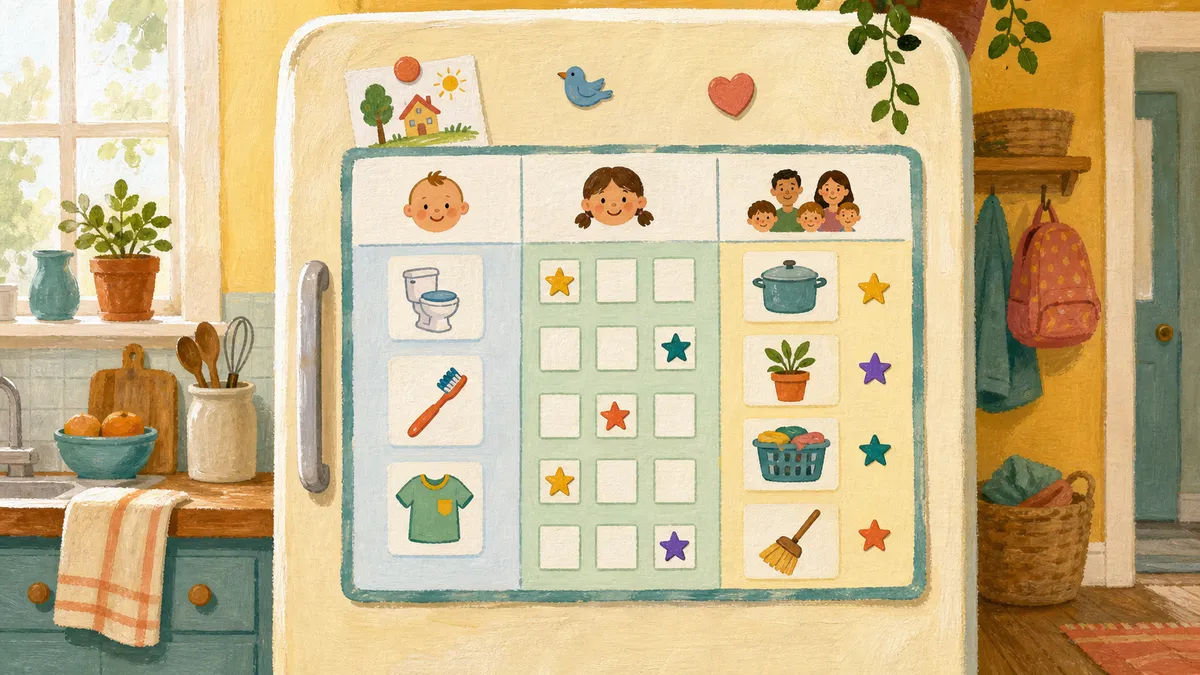
The family chore chart that finally stopped getting ignored at our house is the one where everyone gets their own column, toddler included. I’m Nora Hayes, a former preschool aide raising a 7-year-old and a 3-year-old, and running two separate charts is exactly how they end up buried under the fruit bowl by Tuesday.
This guide walks you through building that chart, folding potty training and daily routines into it, and how to keep it working once the novelty wears off.
The plan in brief:
- Split one chart into three columns: potty and routine for the toddler, chores for the big kid, shared family tasks for everyone
- Picture icons on the toddler side, written tasks on the older side, so each kid reads their own column
- Hang it on the fridge and mark it off together every morning and bedtime
Why One Chart Beats Three Separate Ones
One chart on the fridge does the job that three taped-up sheets keep failing at: it lets both kids see everyone’s tasks in a single glance, so nothing falls through the cracks. Three charts means three things to update, three things to forget, three things curling off the wall by Thursday.
I ran the split-sheet version for about two months when Eli was 6 and June had just turned 3. The potty chart lived by the bathroom, the chore list lived by the fridge, and June’s routine cards lived nowhere reliable. I was the only one who knew where anything was, which defeats the point. The whole reason you want a chore chart that doubles as a responsibility tracker is to get the tracking out of your head and onto the wall.
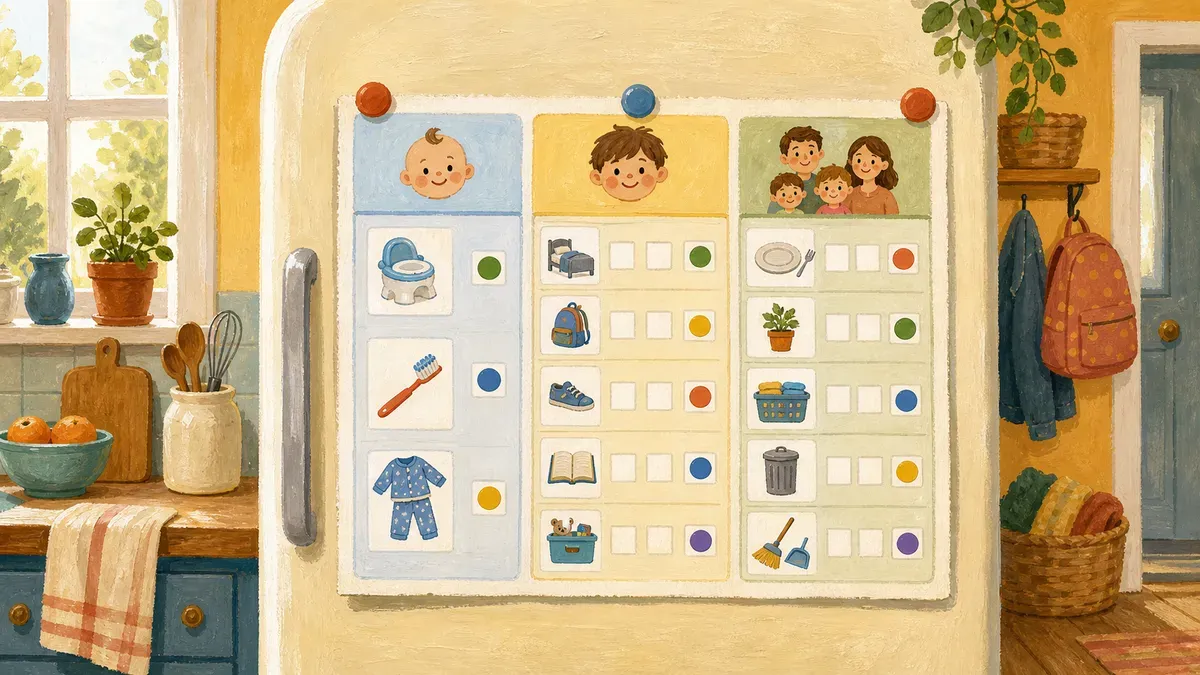
Most households juggle family chores with nothing shared to look at. A Touchstone Research survey found 89% of parents assign chores, yet only 29% track them in any formal way. One board fixes that overnight, and it’s the simplest of the family chore chart ideas because it asks less of you, not more.
The quieter win is buy-in. When June sees Eli’s box and Eli sees hers, chores stop feeling like a punishment aimed at one kid. It becomes household management everyone’s part of, with built-in accountability nobody had to lecture about. Pair it with simple reward chore charts and the responsibility sticks. One chart, less organizing, more actually done.
How to Build a Combined Family Chore Chart Step by Step
Building it took me one nap time and a pack of dollar-store stickers. Here’s the order I do it in: lay out the three jobs, match tasks to each kid, then decide how they mark things done and what they get for it.
- Draw three vertical zones on one sheet, one per role in the house.
- Fill each zone with only the tasks that child can actually do.
- Choose a marking method each kid can run solo, then name one reward for the finished week.
Map the Three Jobs Onto One Layout
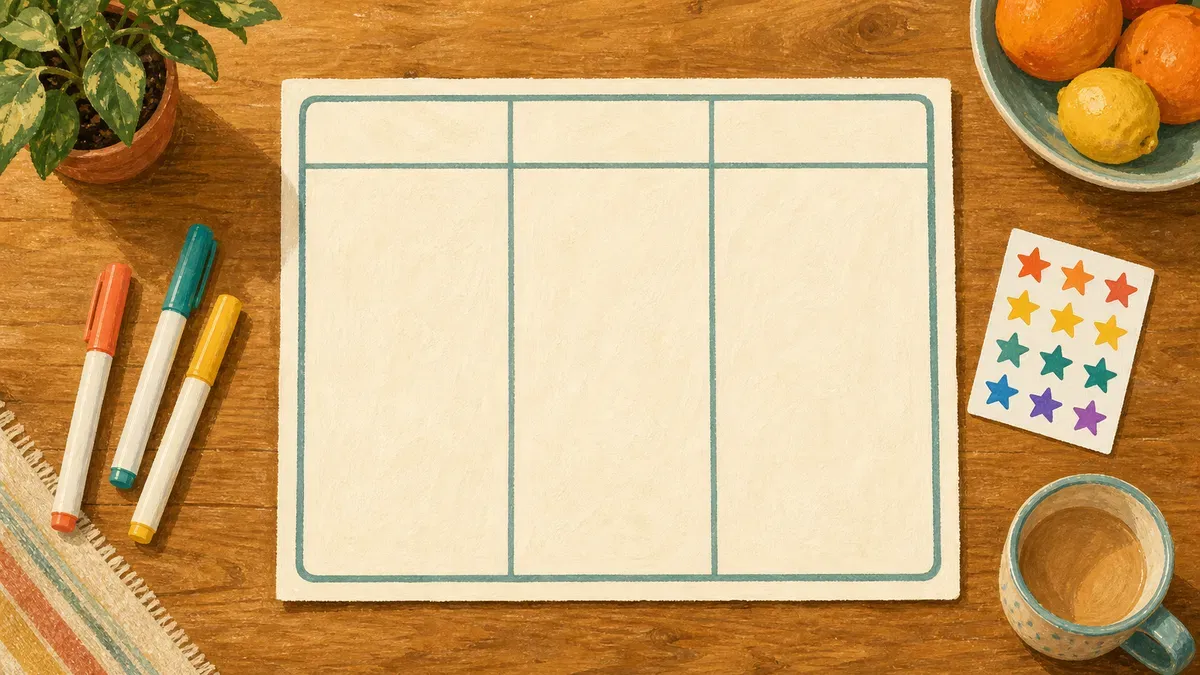
Grab one sheet and divide it into three vertical zones:
- Left: your toddler’s potty-and-routine column
- Middle: the school-age kid’s chores
- Right: shared household tasks every family member pitches in on, like feeding the dog or wiping down after dinner
Think of those zones as three lanes on one road, not three separate roads. The whole point of building a single family chore list this way is that nobody has to walk to a different sheet to see what’s left.
Keep the columns the same width. It signals, without you saying a word, that the three-year-old’s job of putting shoes away counts as much as the seven-year-old’s job of clearing plates. Title each zone with the kid’s name at the top so there’s no arguing over whose lane is whose.
One sheet, three lanes, every job in plain sight.
Leave a little blank space at the bottom of each lane. You’ll add and swap tasks for weeks before it settles, and a crammed chart with no room is the first thing that gets abandoned.
Pick Tasks That Fit Each Age
Now fill each lane, and this is where most charts go wrong. People load the toddler column with stuff a toddler can’t do yet, then wonder why it flops.
For the little one, pick two or three potty steps and one or two routine bits, drawn as simple icons. A potty, a toothbrush, a sock. The American Academy of Child and Adolescent Psychiatry notes that kids aged two to three can put toys away and dress themselves with help, so a “toys in the bin” icon belongs here. That same guidance on age-appropriate chores puts wiping tables and putting laundry away in reach by six or seven, which is your older kid’s lane.
Write the big kid’s tasks as words, and tag each one daily or weekly so the job chart tracks an actual rhythm:
- Daily: make bed, clear your plate, feed the dog
- Weekly: strip the sheets, wipe the bathroom counter, take out recycling
- Rotating: swap who handles the trash run so it never feels like one kid’s punishment
That daily-versus-weekly split keeps responsibility from blurring into “do everything, always.” A weekly chore can sit unchecked Tuesday and that’s fine. A daily one resets every morning. Kids read that difference faster than you’d think.
Set the Tracking and Reward Rules
Last step: decide how a task goes from undone to done, and what a finished week buys. Keep the marking dead simple, because a system your tired kid can’t run alone is one you end up running for them.
The marking method should match the kid:
- Toddler: a sticker she peels and slaps on the icon
- School-age kid: a dry-erase checkmark feels more grown-up and fits the to-do-list stage
That tiny bit of gamification, the satisfying mark, is half of what makes it stick.
Then tie a reward to the completed week, not to every single box. Chasing a prize per task turns into bargaining fast. One reward at week’s end keeps the accountability on the whole stretch.
The right reward depends on your house and what actually clicks for each kid:
- Older kid: a small allowance tied to the completed week
- Little one: a special outing works better than coins at this age
If you go the money route, you’re in good company: an AICPA survey found 80% of allowance-giving parents make their kids earn at least some of it through chores. For a fuller setup on pairing dollars with tasks for the under-eight crowd, this allowance chore chart guide walks through the amounts. Pick one reward, name it on the chart, and let the finished week speak for itself.
Folding Potty Training and Daily Routines Into the Chart
Chores are only half of what a little kid’s day actually runs on. The other half is the boring stuff that keeps the wheels on, potty trips, teeth, getting dressed, and that lives on the chart too, split by who can read and who can’t.
A Picture Routine Column for the Toddler
A tiny toilet for potty trips, a toothbrush, a shirt, a sun for morning and a moon for bedtime. June’s column on our fridge has eight little pictures and not one written word.
Keep the daily routine short. Picture schedules work best for this age when you hold them to about three to five steps at a time, per guidance on visual schedules for young kids, so a pre-reader isn’t drowning in a wall of icons. I run morning as one mini-strip and bedtime as another instead of one giant ladder of twelve things.
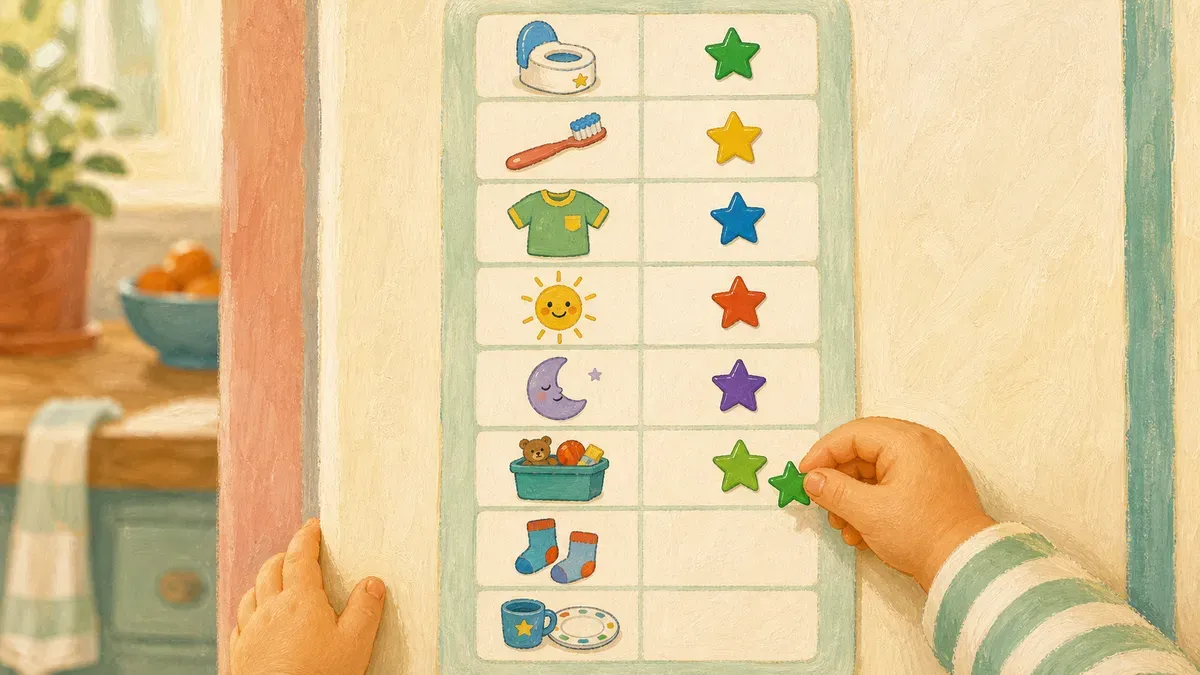
For potty training specifically, the win is independence. The toddler sees the toilet icon, goes, comes back, and slaps a sticker on it herself. Stickers are the whole engine here, the doing and the reward in one move. June would do the potty step purely to earn the sticker, which is exactly the bribe I’m fine with.
The toddler’s column is a map a child who can’t read can still follow on her own.
Written Chores and Schedule for the Big Kid
Eli’s column skips pictures entirely and runs on words he reads himself. Eli’s says “feed the cat,” “make your bed,” “reading 15 min,” plain text he checks off without me hovering.
Mix daily tasks with a weekly rotation so the kids schedule chart doesn’t go stale. Dishwasher and lunch-packing make solid rotating household tasks, since AACAP lists loading and unloading the dishwasher and packing their own school lunch as jobs eight-to-eleven-year-olds handle solo, and a six-or-seven-year-old grows into them.
Two things make it work:
- He reads the list without any prompting from me.
- He checks it off himself, so the responsibility stays with him and not with me.
If you want free printable routine charts sorted by age, the chore chart for kids by age lays out who’s ready for what. One side learns to follow pictures, the other learns to read his own list. Same chart, two readers, zero nagging from the doorway.
Three Chart Formats Worth Knowing About
You don’t have to draw a perfect grid from scratch. These are the three formats that cover most homes, plus the dead-simple way I print, hang, and reuse them week after week.
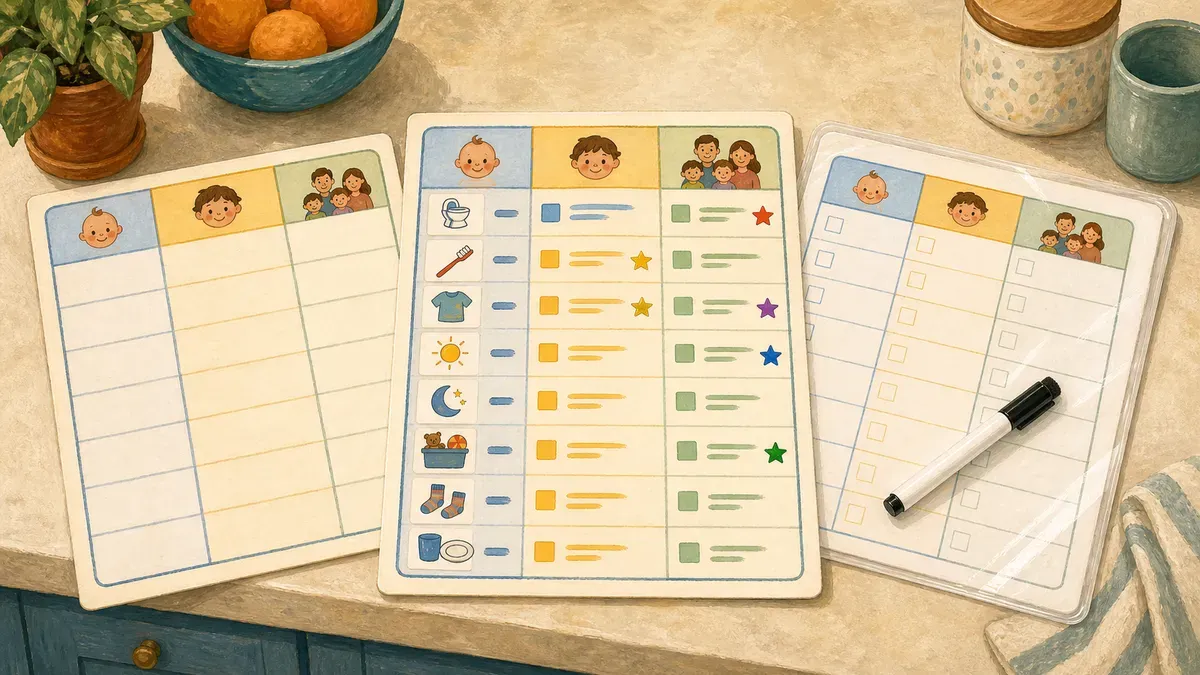
Which Printable Format to Choose
Three versions cover most homes, and the right one depends on how much setup you’ve got left in you tonight.
The blank one is where I started, scribbling June’s icons in pencil before I trusted them in pen.
- Blank grid: three empty columns you fill in by hand, so it bends to whatever your kids actually do
- Filled example: toddler picture row and big-kid written list already done; use it as a model when staring at empty boxes is the thing stopping you, tweak a task or two and you’re set
- Laminate-and-reuse: print once, slide into a sleeve or run through a laminator, add a magnetic strip for the fridge, wipe clean every Sunday
If you’ve got a sensory kid who loves wiping the board, that printable family chore chart turns into its own little job. For a pre-reader who needs pictures over words, this childrens chore chart printable for pre-readers pairs nicely with the dry-erase sleeve.
Decision fatigue winning tonight? Sketch the filled version on any sheet of paper, hang it, edit it later.
How to Make, Hang, and Reuse It
Draw your grid on standard letter paper and print or hand-letter the tasks so the columns stay even. No special paper, no color ink required.
Then get it on the fridge. The refrigerator is the one surface everybody passes throughout the day, so it beats a bedroom wall nobody checks. I use two magnets up top and let the bottom hang loose so little hands can reach the boxes.
To reuse it for your weekly chores, laminate the sheet or drop it in a clear sleeve. A dry-erase marker handles the checkmarks, a damp cloth resets it, and your whole organization system costs about ninety seconds of Sunday-night prep. One sheet, a year of weeks. That’s the part my exhausted self appreciates most.
Keeping the Chart Working for Both Kids
The chart that wins isn’t the one you build, it’s the one still on the fridge in March. Most of them die quietly: the marker dries out, nobody resets it, and one Sunday you just stop. Here’s how I keep ours alive past the first burst of excitement.
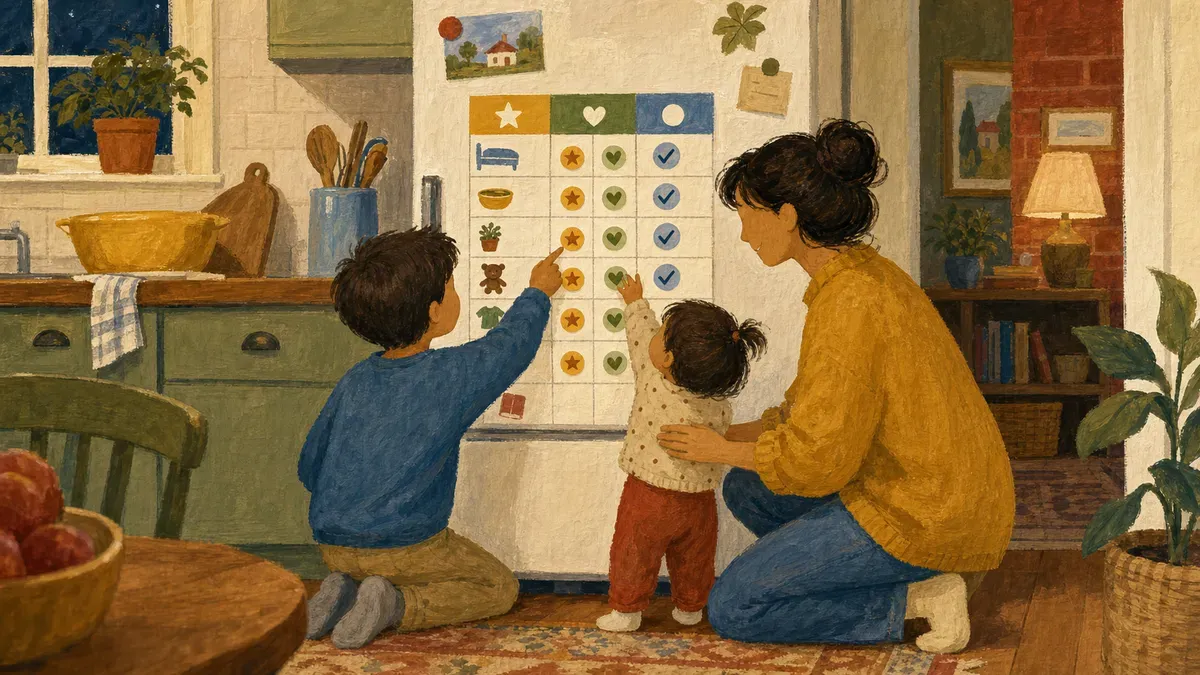
A few habits do most of the heavy lifting:
- Review it together, same time every week. Sunday night at our house, all three of us at the fridge. Eli reads his line, June peels her last sticker. That little ritual builds buy-in, not the chart itself.
- Retire a task before it quietly dies. If a job gets skipped three weeks in a row, don’t chase it. Swap it out for something smaller or different. A task nobody does is just a reminder that the chart isn’t working.
- Let it change. A family organization board that can’t adapt gets ignored by April. Swap an icon, add a line, drop one that flopped. June outgrew the toothbrush picture in a month.
- Praise the streak, not the chart. “You packed your bag four days running” lands harder than “good job doing chores.”
If you’re tweaking which jobs land where, my notes on age appropriate chores save a lot of trial and error. Treat any family chore list template you grab as a starting point for your own household management, then bend it to your two kids.
It’s not just busywork, either. A 2022 study of 207 kids in the research on habit formation and routines in kids found that regular self-care and family-care chores predicted better working memory and impulse control. The accountability and parenting work behind these family chore chart ideas does more than tidy the kitchen.
For more setups, swap ideas, and ready-to-print options, browse our full library of reward and chore chart guides. Keep it simple, keep it visible, and let a flopped week be a flopped week. You reset on Sunday and start again.
Found this useful? Save it for the next rough afternoon.
Questions parents ask me about this
How do I make a family chore chart for multiple kids?
Start by mapping every zone in your house, then match tasks to each kid's age and ability. Give each child their own column on one shared chart so everyone sees the full picture at a glance. Use picture icons for pre-readers and plain written text for kids who can read independently. Keep it on the fridge, not tucked in a drawer.
What chores are age-appropriate for a toddler versus a school-age kid?
Toddlers do best with simple put-away tasks like toys and small items, plus basic self-care steps built into their daily routine. School-age kids around six or seven can handle wiping down tables, helping with laundry, and simple kitchen tasks. The gap matters: what bores a seven-year-old overwhelms a three-year-old, so keep toddler tasks to three to five steps max and school-age lists to a manageable daily and weekly mix.
Should I tie an allowance to the family chore chart?
Most families who give an allowance do connect it to chores, and tying the reward to a completed week rather than every individual task tends to work better. It teaches kids to see the whole job through, not just cherry-pick the easy ones. If allowance is not part of your plan, stickers, a small privilege, or a family outing as a streak reward works the same way.
How is a routine chart different from a chore chart?
A routine chart covers the sequence of a morning or bedtime: brush teeth, get dressed, eat breakfast, and so on. A chore chart tracks household contributions like clearing dishes or taking out the recycling. The clearest approach is to fold both onto one shared chart, putting daily routines in the toddler column and household tasks in the older-kid and shared columns, so the whole family works from one visible board.
Are there digital or app-based family chore chart options?
Yes, several apps let families assign tasks, track completion, and even tie points to rewards digitally. They work well for older kids who are already comfortable with a device. For toddlers and preschoolers, a physical chart on the fridge wins every time because they can touch it, place a sticker, and see their progress without needing a screen.
How often should we rotate chores between siblings?
A good rule of thumb: keep daily tasks fixed (kids know what's theirs) and only rotate the weekly or once-in-a-while jobs, so the swaps feel manageable instead of like starting from scratch. You can flag which tasks rotate on the chart itself so kids see the swap coming rather than feeling blindsided. Some families rotate on Sunday as part of a reset ritual; others swap every other week if their kids do better with more consistency.
How do I keep my kids motivated to use the chart long term?
When one child finishes the week and the other doesn't, acknowledge the win quietly without turning it into a competition. The goal is the habit, not a sibling scoreboard. If the chart starts feeling stale after a month or two, let the kids pick new colors or swap out a few icons for a quick visual refresh.
Written by
Nora Hayes
Mom of two and a former preschool aide. I share the screen-free sensory play and calm-down ideas I test at my own kitchen table, plus what the moms in my little meet-up swear by. A parent passing on what works, not a doctor or a therapist.
More about NoraKeep going
All Reward & Chore Charts-
 Reward & Chore Charts
Age Appropriate Chores by Age (Toddler to Teen)
Most kids handle real chores younger than you think. Get age appropriate chores by age, from 3-year-olds to teens, and start building habits today.
-
 Reward & Chore Charts
Allowance Chore Chart: How to Start With Little Kids
Set up an allowance chore chart that ties money to effort: paid-vs-unpaid rules, prices by age, 100 chore ideas, and the best charts. Start today.
-
 Reward & Chore Charts
Childrens Chore Chart Printable with Pictures
Pre-readers can't follow word lists, but they can follow pictures. Free printable chore chart for toddlers and preschoolers, ready to laminate.
-
 Reward & Chore Charts
Chore Chart vs Reward Chart: Which One Your Kid Needs
Chore chart, reward chart, or responsibility chart? Find out which fits your child's age, build one in 5 steps, and snag a free template.