Children's Morning Routine Chart That Ends Door Meltdowns

Some links here are affiliate links. If you buy through one, I may earn a small commission at no extra cost to you. As an Amazon Associate I earn from qualifying purchases. I only point to things I'd actually use with my own two.
A children’s morning routine chart is a row of pictures, one per task, that your toddler moves through from wake-up to shoes-on, so the morning runs on the chart instead of on your nagging. I’m Nora Hayes, a former preschool aide raising an autistic 7-year-old and a 3-year-old, and the fastest fix I’ve found for the get-out-the-door scramble is seven picture-only cards your kid physically moves as each step gets done.
This guide walks you through the seven cards to use, how to build and laminate the thing tonight, the chart style that survives your fridge, and how to get a toddler to actually follow it.
The plan in brief:
- Pick 7 picture-only cards: wake up, potty, get dressed, breakfast, brush teeth, shoes, backpack.
- Print, laminate, and add velcro so your toddler moves each card as they finish.
- Run the same card order every morning for 2 weeks before adding rewards.
Build Your Toddler’s Chart in 5 Steps
You can have this thing built and stuck to the fridge before bedtime tonight. Three moves get you there: nail down the morning jobs in the right order, print and laminate the cards, then run a quiet two-week trial before you so much as whisper the word sticker.
- Map out every wake-up-to-shoes task in the exact sequence your family runs it.
- Turn each task into a picture card, laminate it, and add velcro so your toddler can move it.
- Work the same card order every morning for two full weeks before introducing any sticker or reward.
List the Morning Jobs in Order
Grab a scrap of paper and write down what actually happens between wake-up and shoes-on at your house. Not the dreamy version. The real one. Wake up, potty, get dressed, eat breakfast, brush teeth, shoes, out the door.
Keep the list short. A 2-year-old does best with four or five steps; a 4-year-old can handle six or seven, and past that they tune the whole chart out the way you’d tune out a three-page to-do list. So pick the morning tasks that matter and drop the ones that don’t.
Order matters, and the only order that works is the one your mornings actually run.
- If your kid always eats before getting dressed, the chart eats first
- The sequence on the wall has to match the sequence out the door
- A chart that doesn’t mirror your real flow is one more thing nobody follows
This is the bones of any visual schedule template worth taping up.
Print, Laminate, and Add Velcro
Now make the cards physical. Print one picture per job, big and simple, on regular paper. A free printable works fine here, and so does anything you sketch yourself. The picture does the reading, so the image matters more than the label.
Laminate each one. A pack of 4x6 thermal laminating pouches is cheap (check the current price on Amazon), and lamination is the difference between a card that survives a sticky breakfast and one that curls up by Thursday. The Uinkit box I keep in the closet is an Amazon’s Choice 120-pack, 4.7 stars across 290+ ratings, and it laminates far more cards than one chart will ever need.
Then back every card with a self-adhesive velcro dot, and press the matching half onto a board or straight on the fridge. Parents clearly trust the sticky-back VELCRO Brand dots here: a 4.8-star average across 8,300+ reviews, and one 200-pack covers a full set of cards with plenty left over for the next chart.
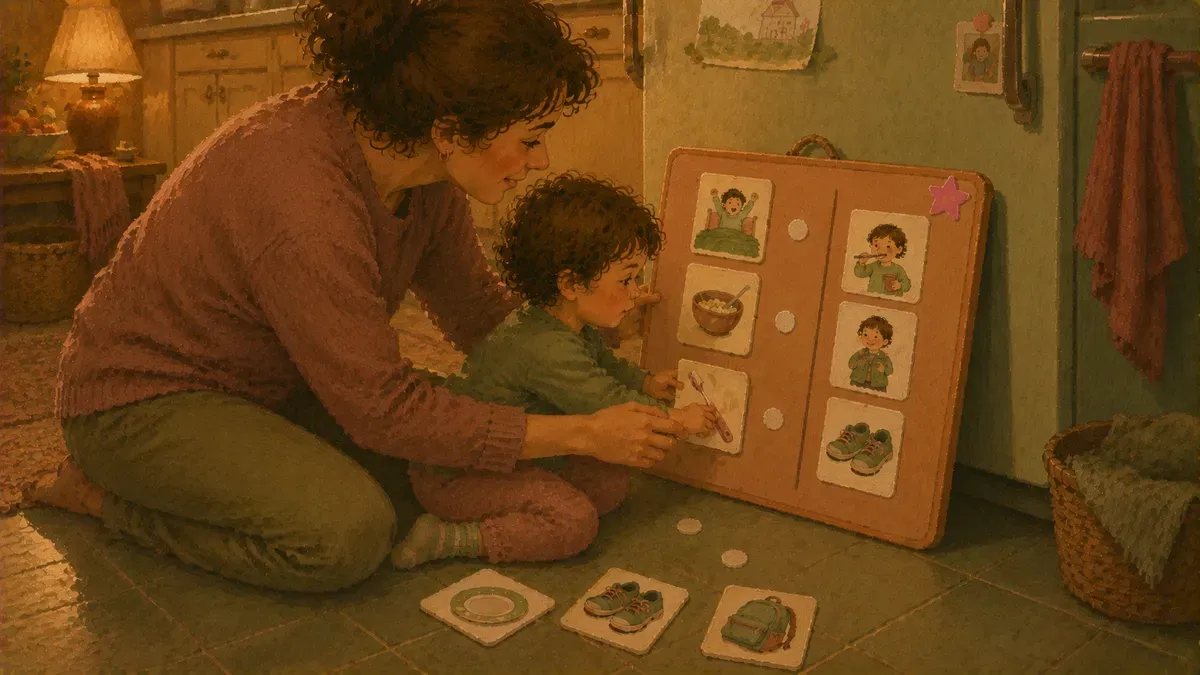
That velcro is the whole point. A toddler who peels a card off and moves it to the done side is doing the routine with their hands, not just looking at a poster. For more layouts and ready-to-print sets, our guide to visual schedules routines walks through the options.
Run a 2-Week Trial Before Adding Rewards
Here’s the part everyone skips. Stick to the same card order, every single morning, for two weeks, and hold off on any reward.
Staying consistent is what builds the habit. A toddler’s executive function is still wiring itself, so the win isn’t a happy chart on day one. It’s the morning they reach for the potty card before you’ve said a word.
- Same cards, same sequence, no exceptions
- Zero rewards for the full two weeks
- Low-pressure: narrate the steps together, don’t quiz
Those steady family habits do quiet work over time. A 2024 longitudinal study found in research on visual routines and child executive function that more frequent family routines were linked to significantly less acting-out behavior down the road. You won’t see that in fourteen days. What you’ll see is a kid who needs less nagging, which is the foundation any reward system is supposed to sit on later.
If it flops some mornings, that’s normal. Reset the cards at night and run it again tomorrow. The routine earns its keep slowly, and that’s exactly the point.
The 7 Cards Every Toddler Chart Needs
Not every card pulls its weight. Two things make or break a toddler’s chart: the picture on each card, and whether the whole row actually fits the morning you’ve got.
The seven cards that cover most toddler mornings:
- Wake up
- Potty
- Get dressed
- Breakfast
- Brush teeth
- Shoes
- Backpack
Picture-Only Cards for Pre-Readers
Your toddler can’t read “brush teeth.” They can read a toothbrush. That’s the whole reason the cards are pictures and nothing else. A pre-reader scans the image, knows the job, and moves the card without you reading anything aloud.
Keep each picture brutally simple: one object, one clear action, nothing busy in the background. A plate of food for breakfast. Underwear and a shirt for getting dressed. A potty for the bathroom trip. If you have to explain what the drawing is, it’s too clever for a three-year-old.
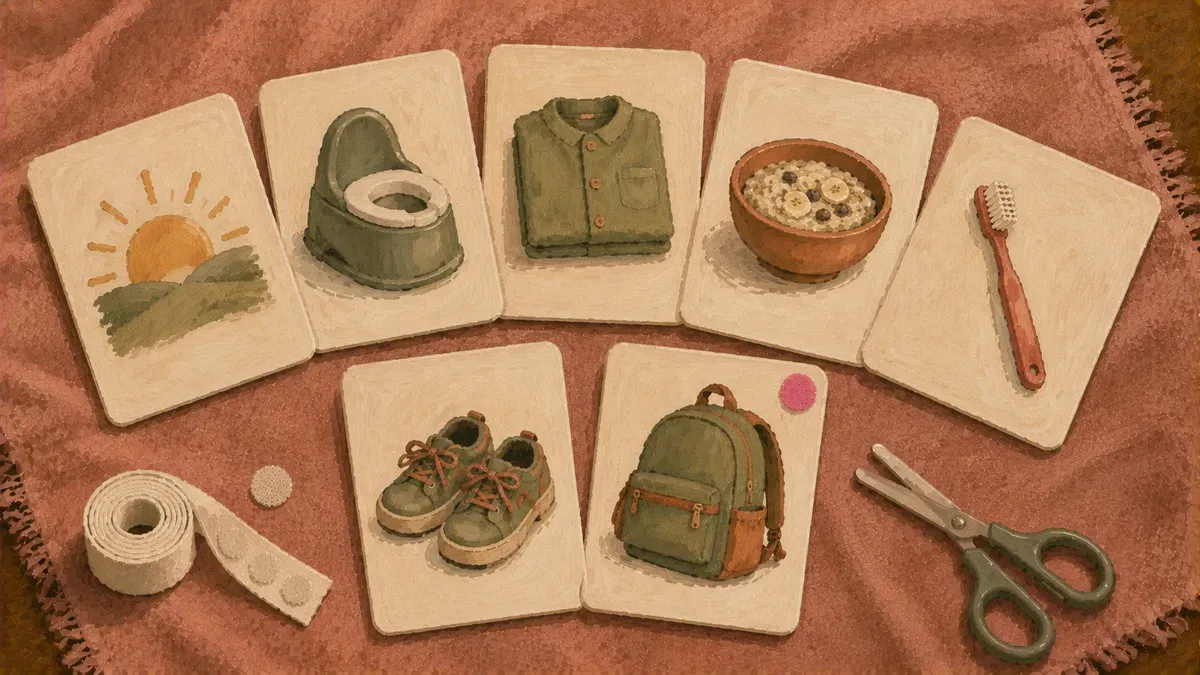
You don’t need to be an artist. Stick figures work. So do free clip-art images, photos of your own kid doing the task, or a printable picture schedule you just laminate and go. Pictures aren’t a cute extra here. A review by Koyama & Wang pulled together 23 studies on picture-based activity schedules showing kids learned routines like toothbrushing from images alone. Whatever you use, the morning routine pictures should stay the same every single day so the routine cards become predictable.
Time Estimates for Each Job
Here’s where most charts quietly fail: the row of jobs takes longer than the morning you actually have. So pencil a rough minute next to each task before you commit to the order.
Most of those tasks are faster than parents expect:
- Dressing: about 4 minutes
- Breakfast: about 10 minutes
- Teeth: a fast 2 minutes
- Potty, shoes, and coat: a few minutes each
Add those morning tasks up and you’ll see the real number, usually half an hour or so of moving parts.
Give the whole thing room. A relaxed toddler morning runs closer to 45 minutes to an hour, which leaves space for a kid to do jobs themselves instead of you doing it for them. Print a blank toddler schedule and write your own times in beside each card first. A daily routine that’s timed to your real clock stays organized; one that ignores the clock turns into the same rushed scramble you were trying to escape.
Choosing a Chart Style That Fits Your Fridge
The format you pick matters less than whether it survives a 3-year-old, so let’s match the chart to your kid and your patience. Two decisions: which surface, and whether you build it yourself or grab a download.
Velcro, Dry-Erase, or Magnetic
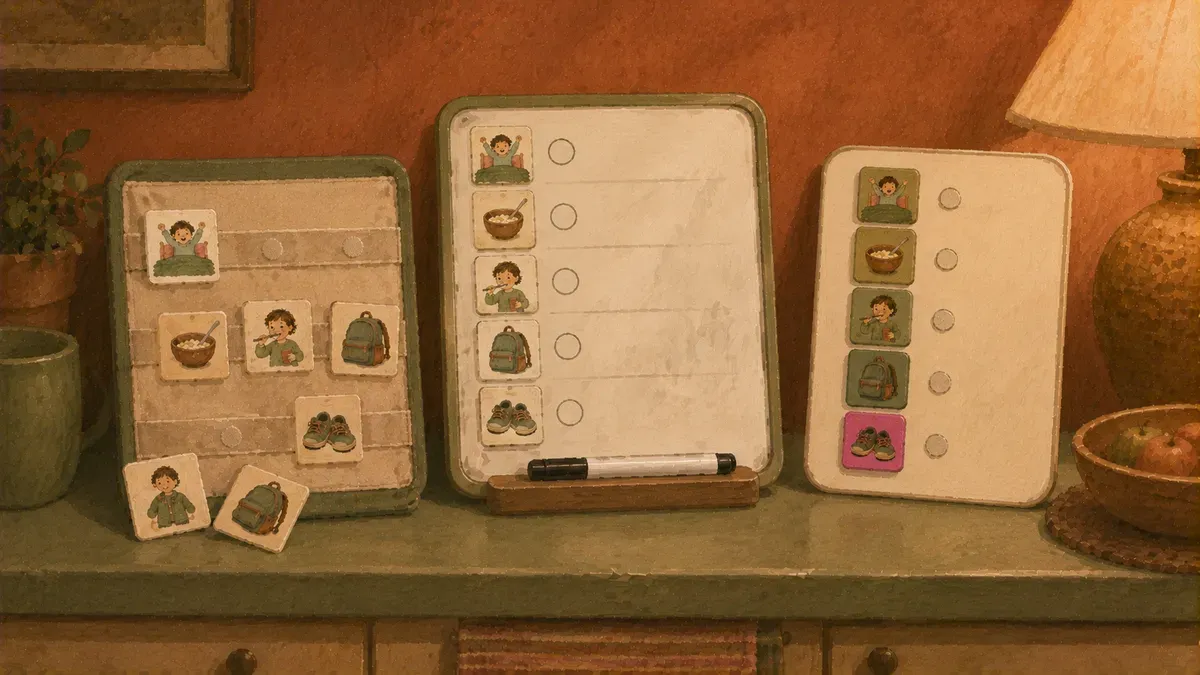
Three formats, three different failure modes. Here’s how they compare:
| Style | Popular pick | Durability | Toddler runs it solo | Parents’ rating |
|---|---|---|---|---|
| Velcro / felt cards | Large felt visual schedule board | High, made for non-readers | Yes, moves the cards himself | 4.7★, 2,000+ reviews |
| Dry-erase (magnetic) | 2-in-1 magnetic routine chart | Mid, the marker wanders off | No, you do the writing | 4.3★, 580+ reviews |
| Magnetic tiles | inamio magnetic reward chart | High | Partly, loose magnets risky under 3 | 4.6★, 2,000+ reviews |
For a non-reading toddler who needs to touch the chore chart to believe a job is done, velcro or felt cards win on durability and independence, so the felt board up top is the one I hand beginners. Save the dry-erase option for when your kid can hold a marker and your routine still shifts week to week. Magnets wipe clean and look tidy, but wait until your child is past the everything-goes-in-the-mouth stage. Those sets are rated ages 3 and up for a reason.
Free Printable vs DIY From Scratch
A free printable gets you a finished morning checklist tonight: download, print, laminate, done. The catch is you take the icons and order someone else chose, which usually fits but sometimes won’t.
Building your own from scratch means snapping photos of your actual kid doing each task and arranging them in your order. It’s more time, and it lands harder because your kid points at the picture and goes “that’s me.” If you want the middle path, start with a printable blank visual schedule template you can fill in yourself and drop in your own cards.
My honest take: grab the free printable first. If your kid actually uses it after two weeks, then spend the hour on a custom routine chart. Don’t build the deluxe version for a habit that hasn’t stuck yet.
Getting Your Toddler to Actually Use It
A chart on the fridge is just decoration until your kid wants to touch it. This is about buy-in: a light reward that keeps the momentum going, and what to do on the mornings it all comes apart anyway.
Low-Pressure Rewards That Keep Momentum
Skip the elaborate sticker economy. The pull you want is small and kid-owned: they get to move the card, and the card moving is the reward. Small choices work well here:
- Peel one sticker onto the chart after teeth
- Pick what’s for breakfast
- Choose which song plays while they get dressed
Tiny choices, big sense of control.
Go easy on the prizes, though. Researchers including Lepper and colleagues found that preschoolers paid to do something they already enjoyed did it less once the reward stopped, so a daily payout can quietly erase the motivation you were building.
Use the reward to start the habit, then let pride take over. Once your toddler is running the routine on their own most mornings, child-behavior guidance suggests phasing out the chart’s rewards around the 85% mark and leaning on plain praise instead. “You did your whole chart, all by yourself” lands harder than a sticker by then.
When Mornings Still Fall Apart
Some mornings the chart loses. Dawdling, a flat “no” at the dressed card, a kid melting onto the kitchen floor. Don’t scrap the system over a bad day. Point at the next picture instead of repeating yourself, and let the card carry the reminders: “What’s next on your chart?” beats the tenth verbal nag.
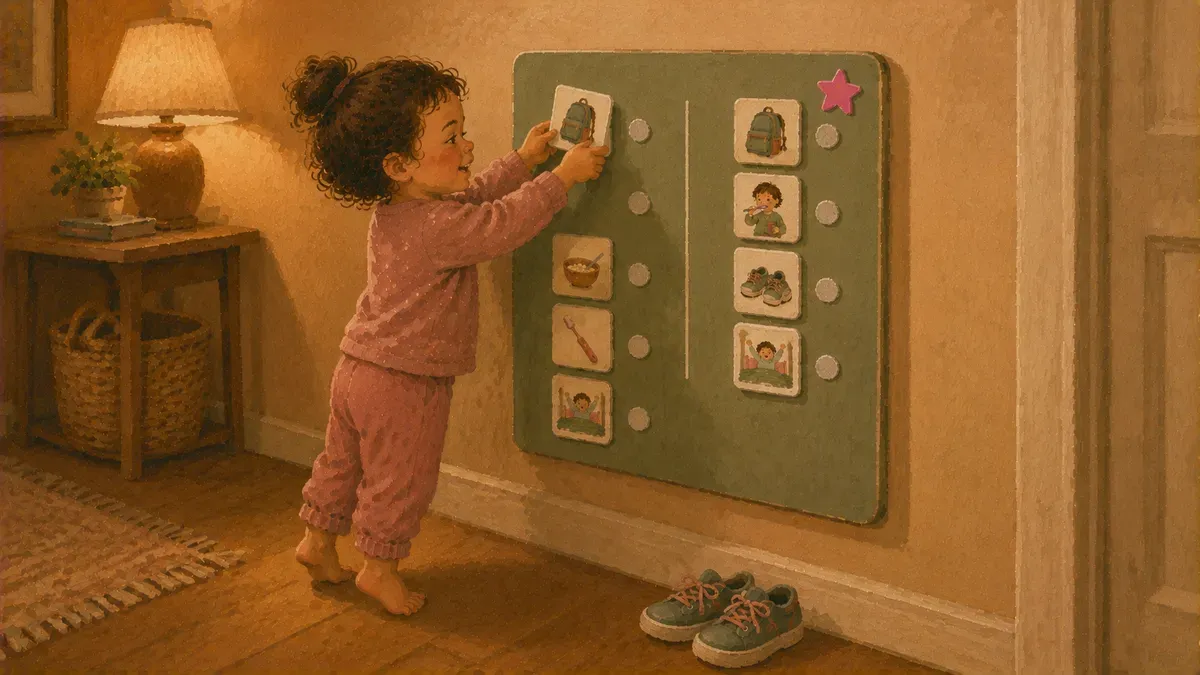
Keep the order identical and stay consistent through the routine battles, but bend on the small stuff. If breakfast and dressed swap places one morning, that flexibility is fine, as long as the cards still move.
ADHD and autistic toddlers lean on the chart for executive function support, so they need more structure, not less, and more lead time before each transition. If you’re meeting daily resistance, introduce visual schedule power struggle walks through the gentler on-ramp. And if tantrums are frequent and long, the kind StatPearls notes in a small share of one- to three-year-olds running 15 minutes or more several times a week, that’s a sign to loop in your pediatrician, not push the chart harder.
Keeping the Routine Working Long-Term
A chart that worked in October can fall flat by January, and that’s not failure, it’s your kid and the calendar both moving. Two moments tend to break a routine: the season flips, and your toddler outgrows needing the pictures at all.
Adjusting for Back-to-School and Seasons
Don’t rebuild from scratch when summer ends. Swap two or three cards and shift the timing.
A September morning needs a “pack the backpack” card that July never did. Winter means a coat-and-boots card the warm months skip. Swap out whichever cards no longer fit the season and adjust the timing to match. That little bit of flexibility is what keeps the routine chart from going stale.
The bigger reset is timing. After a loose summer, mornings have to start earlier again, and that transition is worth taking seriously. Research published in the journal Sleep found a regular bedtime routine is tied to better sleep in young kids and fewer daytime behavior problems, so back-to-school is really a bedtime fix first. Pull bedtime ten minutes earlier each night for a week before the alarm moves. The chart stays your anchor while everything around it shifts.
Fading the Chart as Independence Grows
One day your kid moves the breakfast card before you’ve pointed, then starts skipping the chart entirely. That’s the goal, not a problem.
Fade it the way an OT fades a prompt. The approach behavior therapists call prompt fading, easing off physical and verbal cues until a child does the routine alone, is exactly what you want here: less chart, not more praise.
Start with the cards your child ignores.
- Brushing teeth without a glance? That card comes down.
- Still stumbling over a step or two? Those stay up.
Over a few weeks the chart shrinks to a single trouble spot, then to nothing.
The routine doesn’t disappear, it moves into their head. That’s executive function taking root, which is exactly what you were building toward. When you do need a visual support again, for a new bedtime or a chore stretch, you’ll already know the moves, and our complete guide to visual schedules and routines walks through fresh setups. Self-reliant mornings are the real family habit you were building all along.
Found this useful? Save it for the next rough afternoon.
Questions parents ask me about this
What should a morning routine chart for toddlers include?
The core cards are wake up, use the potty, get dressed, eat breakfast, and brush teeth. Those five cover every get-out-the-door morning. Some families add wash hands or grab backpack depending on the child's age and schedule. Keep it to the tasks your toddler actually does in order, nothing aspirational.
At what age can a toddler start using a morning routine chart?
Most toddlers are ready around age two, when they can point at pictures and understand simple sequences. The chart carries that remembering so they don't have to. A two-year-old needs four or five cards; by four you can stretch to six or seven as attention and stamina grow.
How many pictures should be on a toddler's morning routine chart?
Four to five pictures for a two-year-old, six to seven for a four-year-old. More than that and the chart stops being a helper and starts being a wall of demands. Start small, get the routine clicking, then add a card if you genuinely need to.
Should I use rewards or stickers with a morning routine chart?
You can use stickers to get the habit started, but the goal is to phase them out once the routine is clicking. Moving the card across the board is its own small reward for most toddlers, and that physical act is usually enough once the routine feels familiar. Fade to plain praise around the time your child is completing the routine most mornings without prompting.
How long does it take for a morning routine chart to start working?
Give it two full weeks with the same card order every day before you judge it. The first few days are usually rough. By day ten most toddlers know what comes next before you even point. Expect the full routine to feel smooth somewhere in weeks three or four.
What if my toddler refuses to follow the morning routine chart?
Point at the next card instead of repeating the instruction. Nagging makes kids dig in; the chart redirects without a power struggle. If refusal is happening every morning for weeks, check whether the routine has too many steps, whether the pictures match what your child actually does, or whether there's a transition happening at home that's disrupting sleep. Frequent long tantrums every single morning are worth mentioning to your pediatrician.
Do morning routine charts work for kids with ADHD or autism?
Visual schedules are especially helpful for kids who need predictability and struggle with transitions. For autistic or ADHD toddlers, keep the order identical every day and give an extra heads-up before each step. Lead time matters more than the chart itself. These kids often need a little more runway, but the picture-by-picture structure tends to work very well once it's consistent.
Written by
Nora Hayes
Mom of two and a former preschool aide. I share the screen-free sensory play and calm-down ideas I test at my own kitchen table, plus what the moms in my little meet-up swear by. A parent passing on what works, not a doctor or a therapist.
More about NoraKeep going
All Visual Schedules-
 Visual Schedules
Visual Schedule Printable: 20 Picture Cards + Free PDF
Visual schedule printable with the 20 picture cards every toddler home needs. Free PDF to download, print, and start using tonight.
-
 Visual Schedules
Visual Schedules: A Beginner's Guide for Parents
Most visual schedules fail before day three. Learn how they work and build your first board in 5 steps your child will actually follow. Start today.
-
 Visual Schedules
Toddler Schedule: Build One With Picture Cards
Your 2-year-old can't read a clock yet. Build a toddler schedule with picture cards in 5 steps that stop nap fights and meltdowns. Start today.
-
 Visual Schedules
Free Printable Daily Routine Chart Kids Will Follow
Grab a free printable daily routine chart your child will actually follow, plus picture cards and tips to make any routine stick. Download now.