Morning Routine Printable That Ends the Yelling

Some links here are affiliate links. If you buy through one, I may earn a small commission at no extra cost to you. As an Amazon Associate I earn from qualifying purchases. I only point to things I'd actually use with my own two.
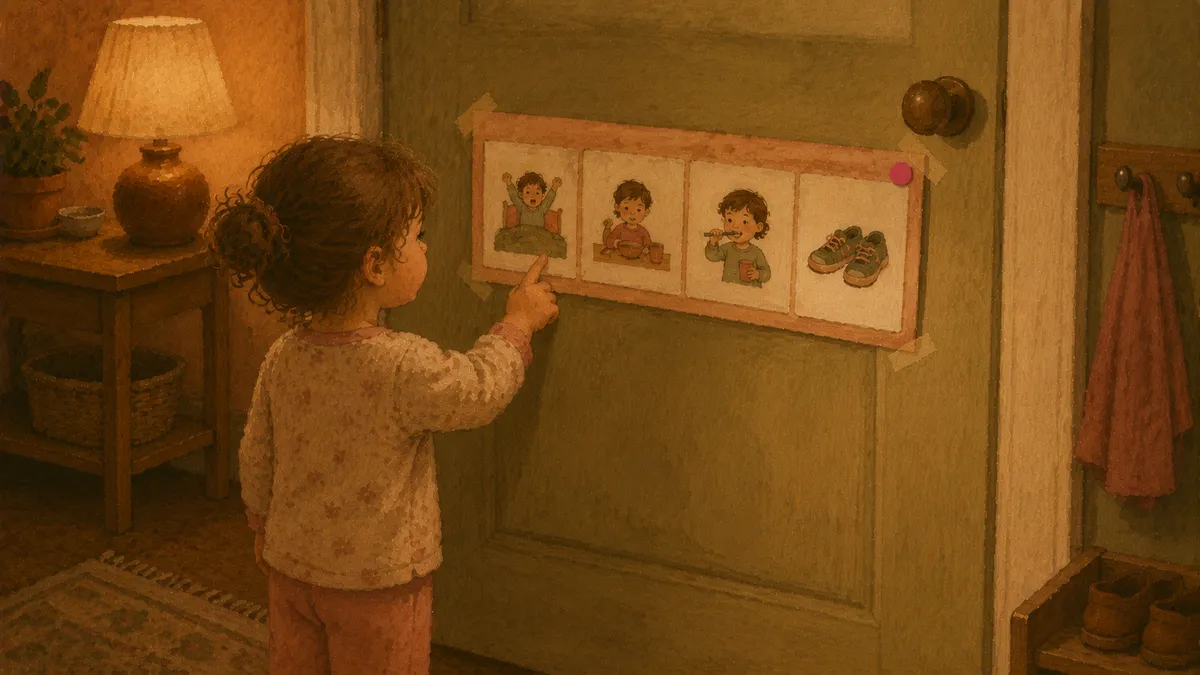
A morning routine printable gives kids a visual sequence to follow so they stop waiting for you to call each step. Mornings stress most families out, and OnePoll research of 2,000 parents found over half said getting ready caused the most anxiety in their day. I’m Nora Hayes, a former preschool aide, and below I’ll walk you through building the chart, the tasks to put on it, and how to make it stick.
The plan in brief:
- Download the free editable chart and fill in 5 to 7 morning tasks
- Print it, laminate it, and add Velcro dots so kids move each card themselves
- Hang it at your child’s eye level and let them run it for one week
Build Your Morning Routine Printable in 6 Steps
Here’s the whole build in one line: download the chart, print and laminate it, then add Velcro so your kid moves the cards instead of you reciting the list. Each step below takes minutes, and most of it uses stuff already in a junk drawer.
- Open the file and swap in tasks that match your kid’s actual morning
- Run cardstock through a laminator at 5-7 mil
- Trim the cards and soften the corners
- Dot each card and the board with Velcro
- Mount the board where your child can reach it without help
Download and edit the free chart
Start with the file. Grab the free editable morning routine chart, open it, and swap the default tasks for the ones that actually happen in your house. If your kid eats before getting dressed, put eat first. If teeth come last because that’s the only order they’ll tolerate, type it that way.
This is the part most parents skip, and it’s the part that makes the chart stick. A generic printable with someone else’s morning on it gets ignored by day two.
Keep it to five or seven morning tasks. More than that and a three-year-old just sees a wall of pictures and shuts down. Edit, then print a test page on plain paper to check the spacing before you commit the good cardstock.
Five tasks your kid can finish beats ten tasks they’ll abandon.
Print, laminate, and cut the cards
Print the final version on cardstock, not copy paper. Copy paper buckles the second a sticky hand grabs it. Cardstock holds up, and it feeds through a laminator without curling. The pack I reach for is an Amazon’s Choice, comes in 50 colors so a kid can pick their own, and more than 700 parents rate it 4.8 stars.
Laminating is what turns a one-week craft into a chart that survives a year. If you don’t own a home laminator, this is the project that finally justifies buying one, and the Amazon’s Choice model most parents land on has over 100,000 reviews holding at 4.9 stars (check the current price on Amazon). Film thickness matters more than people expect:
- 5 mil: the sweet spot for cards this size, holds up to daily handling without going floppy
- 7 mil: worth stepping up to if your kid is rough on everything they touch
Let the sheet cool flat, then cut out each picture card. Round the corners with scissors so nobody catches a sharp edge. A laminated surface also means you can write on the cards with wet erase markers and wipe them clean, handy if you’d rather skip the moveable routine cards and just check things off.
Add Velcro and hang it at kid height
Now make it moveable, because moving a card is what gives a kid the win. The VELCRO Brand back-to-school guide suggests hook-side dots on the board and loop-side on the cards, pressed firmly so they actually grip.
Skip the wall? Magnetic tape and binder rings work just as well:
- Fridge: magnetic tape on the back of each card, no wall needed
- Flip chart: binder rings let them flip from one task to the next
If you’d rather not build from scratch, this printable blank visual schedule template lays out the same Velcro setup ready to print.
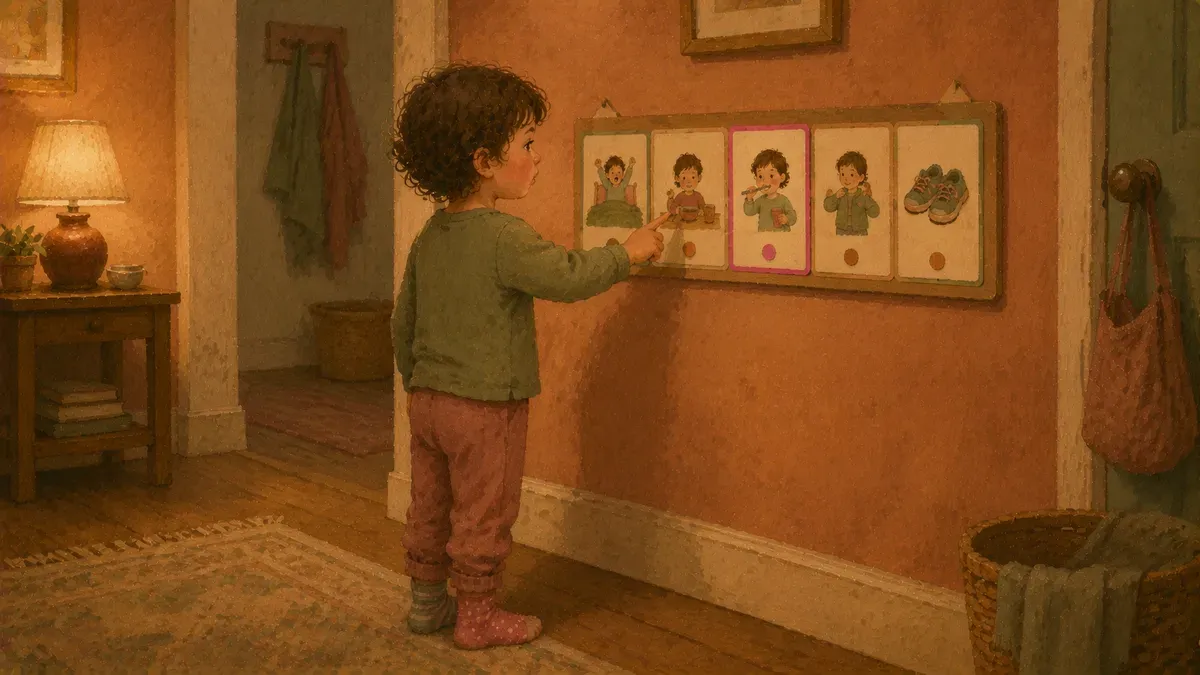
Hang the finished board at your child’s eye level, not yours. A chart at the light switch is decoration; one at knee height is a tool they reach for, move the cards on, and run themselves.
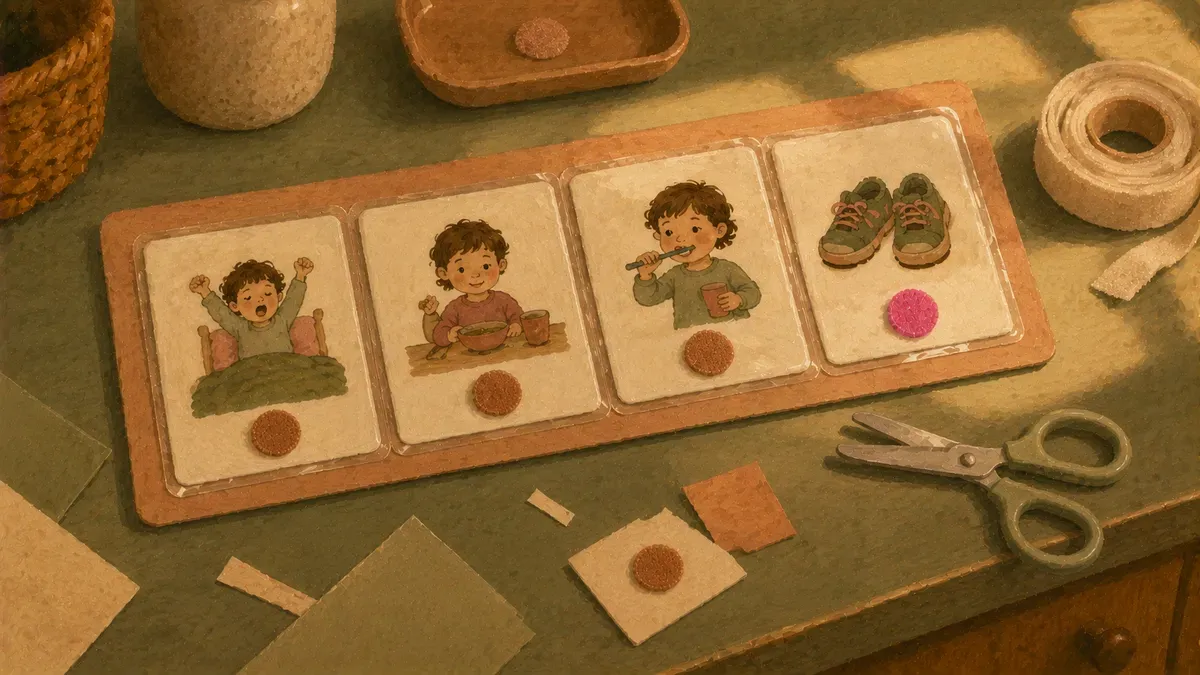
Setup done, the rest is just letting them move the cards. Hang it low, step back, and let the chart do the talking tomorrow morning.
Why a Visual Chart Stops the Morning Yelling
The chart isn’t decoration. Once it’s on the wall, two things shift, and they’re the whole reason this works: the reminders stop coming from you, and your kid finally has something they can read without words.
It moves nagging off the parent and onto the chart
Think about what mornings sound like right now. Shoes. Did you brush? Where’s your backpack. You become a human alarm clock that goes off every ninety seconds, and your kid learns to wait for the next ping instead of moving on their own.
The chart takes that job. It becomes the boss. Instead of “go brush your teeth,” you point and ask “what’s next on your chart?” and the answer is already there. That tiny swap turns a kid who waits to be told into a self-starter who checks the board and moves down the list.
The nagging doesn’t disappear, it just changes hands, from you to a piece of laminated paper that never loses its temper.
That’s where the real win lives. It asks the same calm thing every day, and that consistency is exactly what builds child independence. You stop being the enforcer and become the person who just points.
Why kids respond to pictures over verbal reminders
There’s a reason the pictures matter more than the words. Young kids are wired to look before they listen, and a spoken instruction evaporates the second it leaves your mouth.
A peer-reviewed study in research on visual supports for children’s routines (BMC Pediatrics) found that words shown in a visual-plus-audio format were recalled by nearly all the children tested, while words said out loud alone fell off a cliff. Researchers called it the visual superiority effect and noted that younger children are inclined to “look and not listen.” A picture of a toothbrush just sticks where “brush your teeth” doesn’t.
That’s the quiet engine behind a morning routine chart.
- Picture cards do the reminding so you don’t have to.
- Transitions stop being a fight because the next step is already visible.
- The whole getting-ready stretch loses its power-struggle edge.
For more setups built on the same idea, see our visual schedules routines guide.
Give it a week and the pictures start doing the work your voice used to. That’s the real shortcut to getting door yelling under control, and it’s how habit formation finally sticks.
What Tasks to Put on a Morning Routine Chart for Kids
Now for the part everyone overthinks: what actually goes on the chart. Below are the core tasks every chart needs, how to match the count to your kid’s age, and the one cue at the bottom that makes them want to finish.
Core morning tasks every chart needs
Keep it boring on purpose. A morning routine chart for kids works because it lists the same handful of get-ready jobs in the same order, every single day.
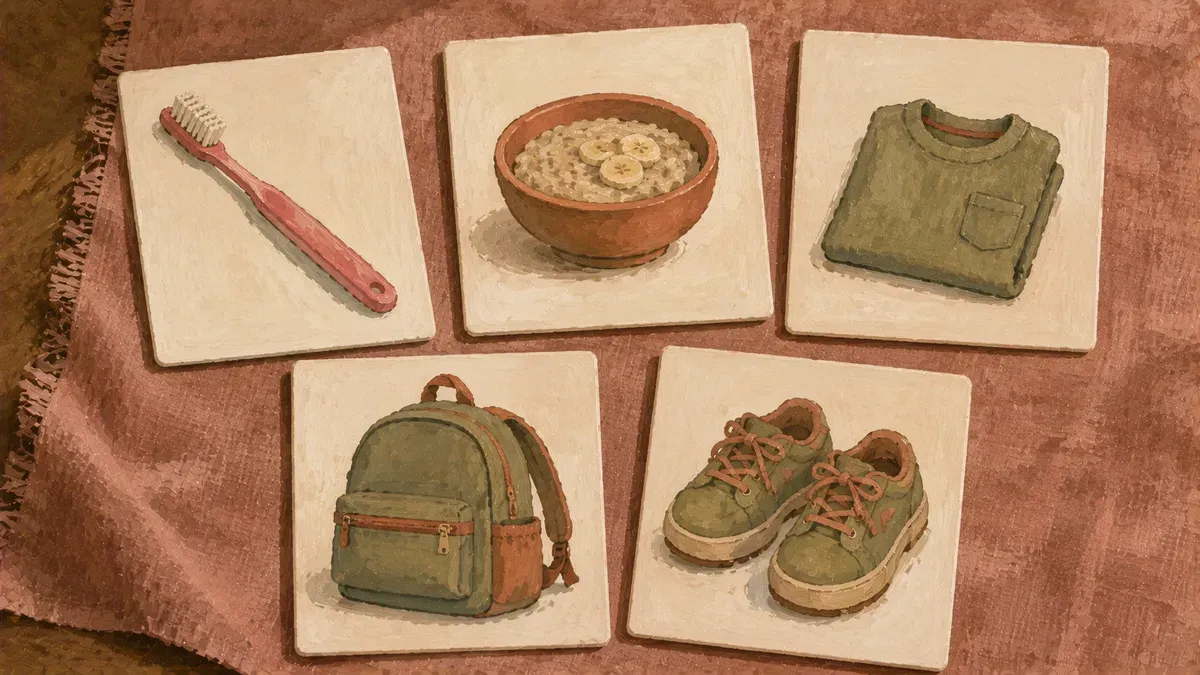
Your non-negotiables, the ones that get you out the door:
- Get dressed (clothes laid out the night before)
- Eat breakfast
- Brush teeth
- Pack the backpack
- Shoes on, by the door
That’s the whole spine of it. Brushing earns its spot every time, because the CDC recommends kids brush twice a day with fluoride toothpaste, so the morning round is half of what their teeth need. (Under age 2, check with your dentist before using fluoride.)
Add a wildcard or two if your mornings need it: brush hair, make the bed, potty, give the dog water. Skip anything that isn’t truly daily. A chart cluttered with once-a-week chores stops being a routine and starts being a to-do list nobody reads.
Matching the task count to your child’s age
Here’s where most charts go wrong. A toddler and a second-grader do not get the same list, and handing a two-year-old eight steps is a meltdown in waiting.
Keep the count honest to what your kid can hold in their head.
- Ages 2-3: four or five picture cards, tops
- Ages 4-5: six or seven cards, pictures over words
- Ages 6+: a fuller sequence, possibly split into morning and after-school sides
The magic of a short list is that it’s beatable. A kid who finishes all five routine cards feels like they won, and that small daily win is what builds child independence and the consistency you’re actually after. A list too long to ever complete teaches the opposite.
Older kids? Stretch it. A seven-year-old can run a fuller sequence and even split it into a morning side and an after-school side. If you want a deeper breakdown by stage, our children’s morning routine chart guide walks through it age by age.
Adding a reward or screen-time cue
Finish the chart with a payoff. The last card shouldn’t be another chore, it should be the thing your kid is racing toward: a sticker, a star, ten minutes of a show, a few minutes of tablet time once the backpack’s by the door.
This isn’t bribery, it’s just how habit formation gets a foothold. A 2025 NIH study on reward-based routines for kids with ADHD found children in the reward group showed roughly three times greater improvement in sustained attention than those without one. Closing the sequence with something earned is what turns a chart into a chore chart that actually runs itself.
- One reward at the end beats a points economy you’ll quit tracking by Thursday.
- Add a calm-down card near the top so a hard start doesn’t blow up the whole chart.
- Some days the win is just getting back on track, and that counts.
Pick the Chart Format That Fits Your Family
The calm-down card only helps if the chart underneath it is one your kid will actually touch. Here’s how to match the build to your child, then tweak it when they need more structure.
Velcro, flip, dry-erase, or checklist
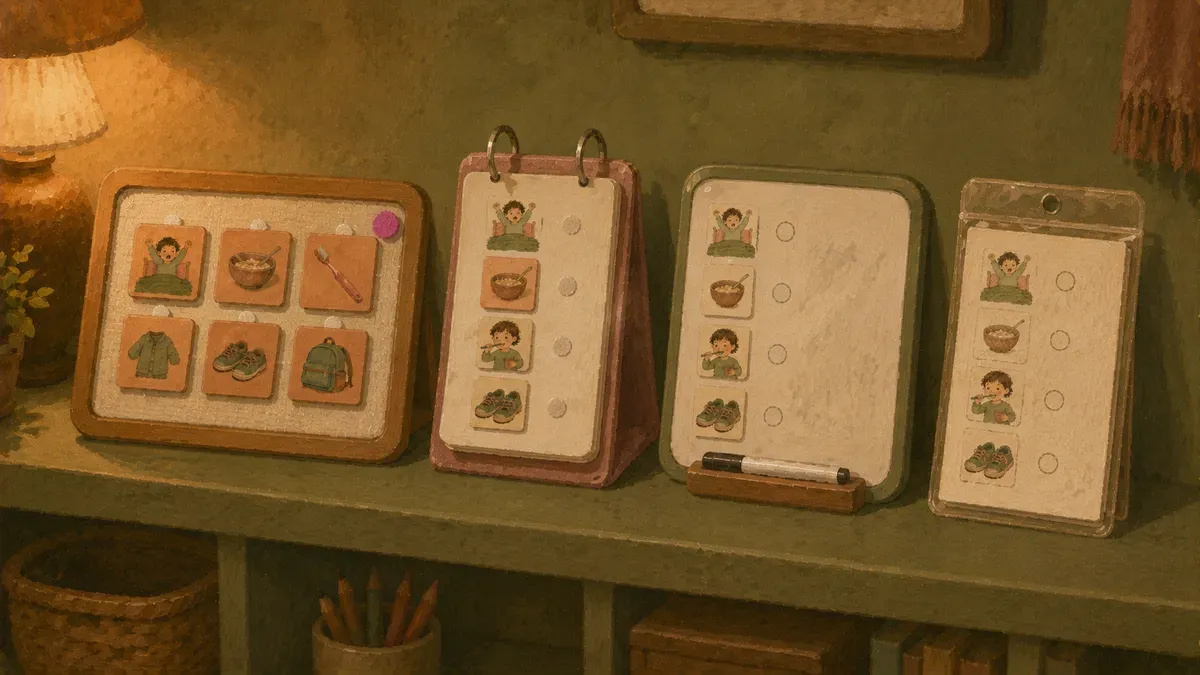
Four builds cover almost every family. A Velcro board with detachable routine cards is the gold standard for little hands: they move a card to a “done” pocket and feel the progress. A flip chart hangs on a ring and your kid flips each task over as they finish it. A dry-erase version lets you write tonight’s tasks and clean them off with wet erase markers. The checklist is the cheapest, a printed page in a sleeve or taped inside a file folder.
This table sorts the four by cost to build, how reusable each one is, and the kid it suits best:
| Format | Cost to build | Reusable | Best for |
|---|---|---|---|
| Velcro cards | Medium (cards + dots) | Years | Toddlers, tactile kids |
| Flip chart | Low to medium | Years | Ages 4-6, loves the flip |
| Dry-erase | Low | Daily rewrite | Changing schedules |
| Checklist | Lowest | Wipe or reprint | Readers, big kids |
Most families land on Velcro for the under-five crowd and a plain checklist for a reader who just wants to tick boxes. The right format is the one your kid will reach for, not the one that photographs well.
Two of those builds lean on one cheap add-on. A flip chart hangs off a set of rings, and any laminated card begs for a marker you can wipe clean without the ghosting a dry-erase pen leaves behind. Here’s what stays in my drawer for both:
| Tool | What it does | Parents’ rating |
|---|---|---|
| Binder rings | Thread the cards so your kid flips to the next task | 4.7★, 5,000+ reviews |
| Wet erase markers | Write on laminated cards, wipe with a damp cloth, no smears | 4.6★, 12,000+ reviews |
Adapting the format for ADHD or autism
A kid who runs on predictability does best with the most physical, least-changing build you’ve got. Velcro picture cards win here, because moving a card is a clear before-and-after your child can both see and feel. Keep the same cards in the same order every single day; that consistency is the whole point, and shuffling the layout quietly undoes it.
Visual schedules are a documented support for autistic kids, with guidance on visual schedules for children with autism linking them to more on-task behavior and smoother transitions. If your kid leans non-reader, go heavier on pictures and lighter on words. A dedicated visual schedule printable with photo-style cards gives a sensory kid something solid to hold while they reset between tasks.
Get the Chart to Actually Stick
You hung it, you laminated it, and your kid walked right past it. That happens, so here’s how to win the holdout over, and how to quietly retire the chart once the routine lives in their head.

What to do when your child ignores the chart
A chart your kid ignores isn’t a failed chart. It’s an unfamiliar one. Introduce it cold on a frantic Tuesday and of course it gets blown past.
So practice it when nobody’s rushing. A lazy Saturday, pajamas still on, walk through the cards together like a game. No clock, no stakes.
If they still stall, your list is probably too long. Cut it. A kid who flames out at task three will finish a chart of four, and finishing is the thing that builds momentum.
Then hand over control. Let them move the cards, flip the tab, check the box themselves. The whole point is a kid who grabs the first card without being asked, not a parent reading the chart aloud.
- Practice on a calm day, never mid-rush
- Shorten the list until they can beat it
- Let their hands do the moving
That small hit of “I did it” is what keeps them coming back. For more troubleshooting setups, our complete guide to visual routines digs deeper into stubborn mornings.
Fading the chart as the routine becomes a habit
Here’s the goal nobody tells you: the chart is supposed to work itself out of a job. Once the sequence is automatic, the cards become training wheels you can pull off.
Don’t yank it overnight, though. Habit formation takes longer than a sticker chart promises. A PMC review of habit research found a new automatic behavior usually needs about 66 days of repetition, and a missed day here or there won’t undo your progress. Consistency over weeks, not a perfect streak.
So fade it slow.
- Pull the cards they’ve clearly internalized, the ones they do without a glance
- Keep the sticky tasks visible a while longer
When most of it runs on autopilot, swap the full board for a tiny backup, a free printable daily routine chart tucked on the fridge for off days. Summer routine wobbles, a new sibling, a rough week, and you just point them back to it.
That’s the win. Not a chart on the wall forever, but a kid who gets out the door without one.
Found this useful? Save it for the next rough afternoon.
Questions parents ask me about this
Where can I download a morning routine printable for kids?
Search for a free editable morning routine printable on sites that offer downloadable PDF templates. Look for one that lets you add your own tasks and swap out picture cards. Editable versions are worth it because every family's morning looks different, and a chart that matches your actual sequence is the one your kid will follow.
What age should a child start using a morning routine chart?
Most kids are ready between two and three. A two-year-old can follow a four- or five-card picture chart if each card shows a single, concrete task. By four, most kids handle six or seven steps. The key at any age is keeping pictures front and center. Words alone won't work until they're reading confidently.
How many tasks should be on a kids morning routine chart?
Five to seven is the sweet spot for most kids. Younger toddlers do better at the low end (four or five cards), and older kids can handle six or seven. If your child consistently stalls or skips cards, shorten the list. A chart they can finish every day builds more independence than an exhaustive one they abandon by Wednesday.
What should I laminate the chart with if I don't have a laminator?
Clear contact paper works well and costs almost nothing. Cut a piece slightly larger than your chart, press it on one side, flip it, and repeat. It won't hold up as long as a laminator pouch, but it protects against morning spills and sticky fingers. For a sturdier result, print on cardstock first before applying the contact paper.
How do I keep my child from losing interest in the chart?
Hand them the control. Let your child be the one who moves the cards or checks the boxes. Kids stay engaged when they're doing the action, not watching you do it. If interest drops, shorten the list so they can finish and feel the win. A calm practice run on a slow weekend morning, before you need it to work on a Tuesday, also helps reset the routine.
Can I use the same chart for two kids on different schedules?
You can, but separate charts work better. When each child has their own board hung at their eye level, there's no waiting for a sibling to finish with shared cards and no confusion about whose task is whose. Two small charts cost the same as one big one, and the independence payoff is worth it.
Written by
Nora Hayes
Mom of two and a former preschool aide. I share the screen-free sensory play and calm-down ideas I test at my own kitchen table, plus what the moms in my little meet-up swear by. A parent passing on what works, not a doctor or a therapist.
More about NoraKeep going
All Visual Schedules-
 Visual Schedules
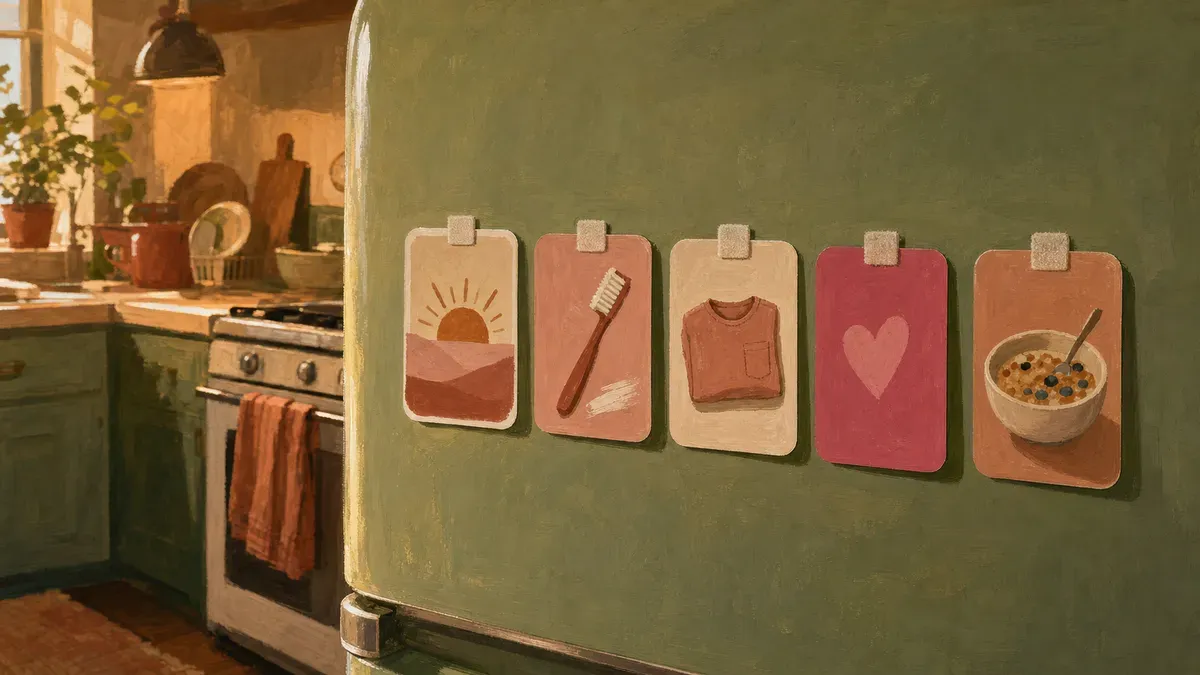
Visual Schedule Printable: 20 Picture Cards + Free PDF
Visual schedule printable with the 20 picture cards every toddler home needs. Free PDF to download, print, and start using tonight.
-
 Visual Schedules
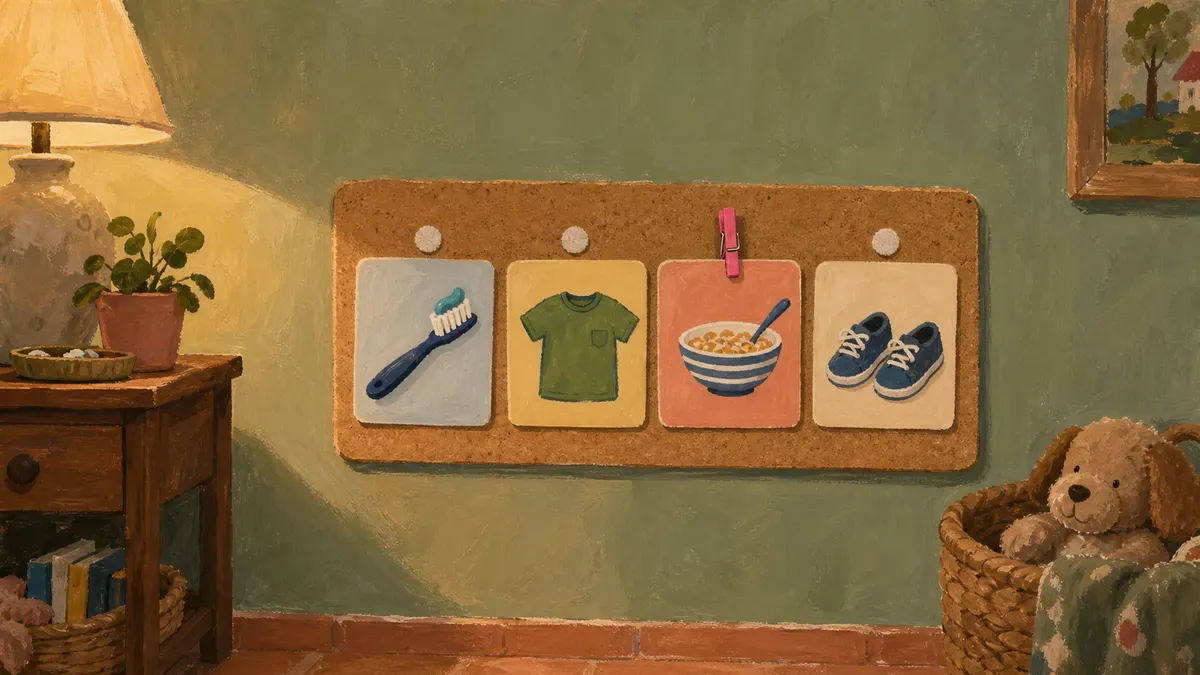
Visual Schedules: A Beginner's Guide for Parents
Most visual schedules fail before day three. Learn how they work and build your first board in 5 steps your child will actually follow. Start today.
-
 Visual Schedules
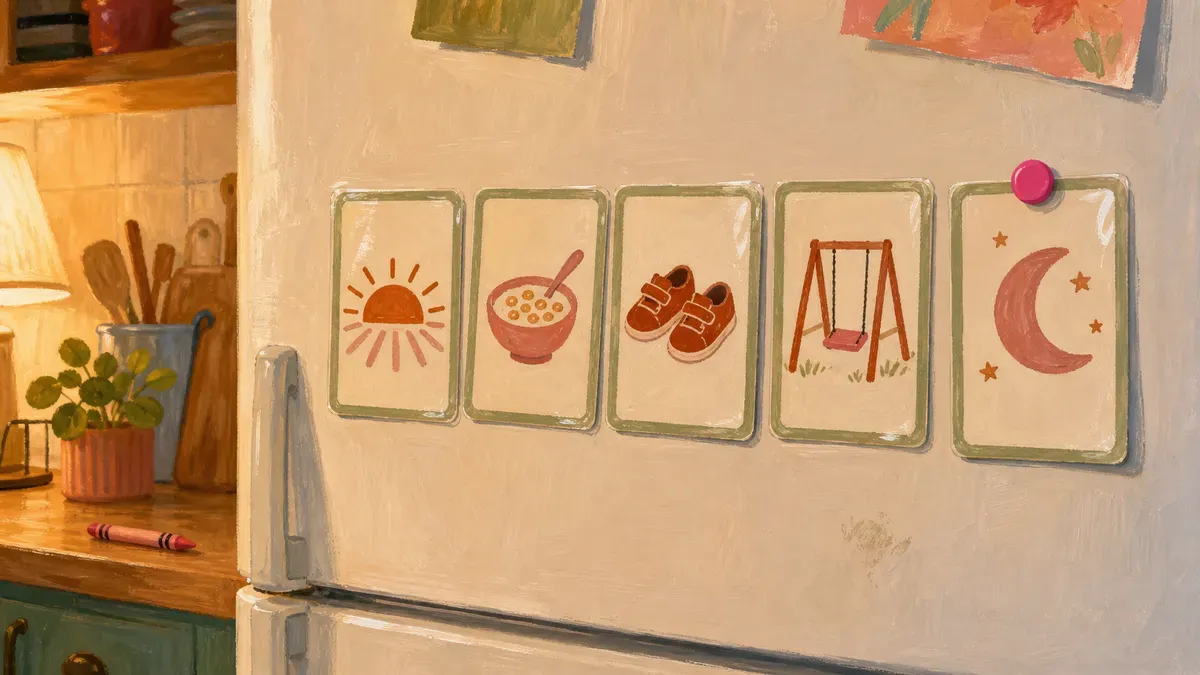
Toddler Schedule: Build One With Picture Cards
Your 2-year-old can't read a clock yet. Build a toddler schedule with picture cards in 5 steps that stop nap fights and meltdowns. Start today.
-
 Visual Schedules
Free Printable Daily Routine Chart Kids Will Follow
Grab a free printable daily routine chart your child will actually follow, plus picture cards and tips to make any routine stick. Download now.