Chore Chart for Kids: Steps a 4-Year-Old Can Actually Do

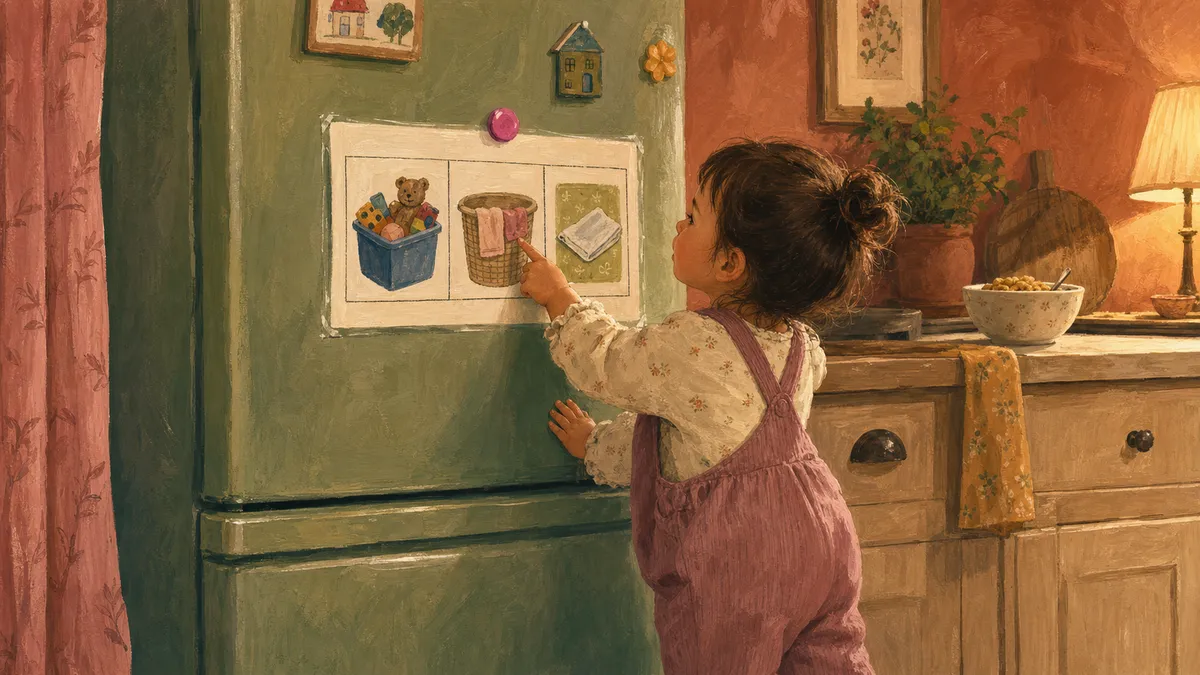
The fastest way to build a chore chart a preschooler will follow is to skip words and use pictures: pick three jobs your kid already half-knows and hang a photo of the finished result where they’ll see it.
I’m Nora Hayes, a former preschool aide and mom to a sensory-seeking 7-year-old and a 3-year-old, and a picture chart is the one thing that finally got my youngest clearing her own breakfast bowl without me hovering. This guide walks you through building it in four steps tonight, choosing jobs that fit your kid’s age, and folding it into the day without it turning into a sticker-chart bribe war.
The plan in brief:
- Pick 3 picture chore cards your child can do alone, like put toys in the bin.
- Print, laminate, and add velcro so cards move from ‘to do’ to ‘done’.
- Run the same 3 cards every day for two weeks before adding a fourth.
Build the Chart in 4 Steps Tonight
You can have a working chart up before bedtime, and it costs you about fifteen minutes of setup, not a Pinterest weekend. Here’s the build: pick the right three jobs, print and laminate them, then leave them alone for two weeks while they sink in.
- Pick a short job list she can nail without you watching.
- Get the cards laminated so they last beyond the first morning.
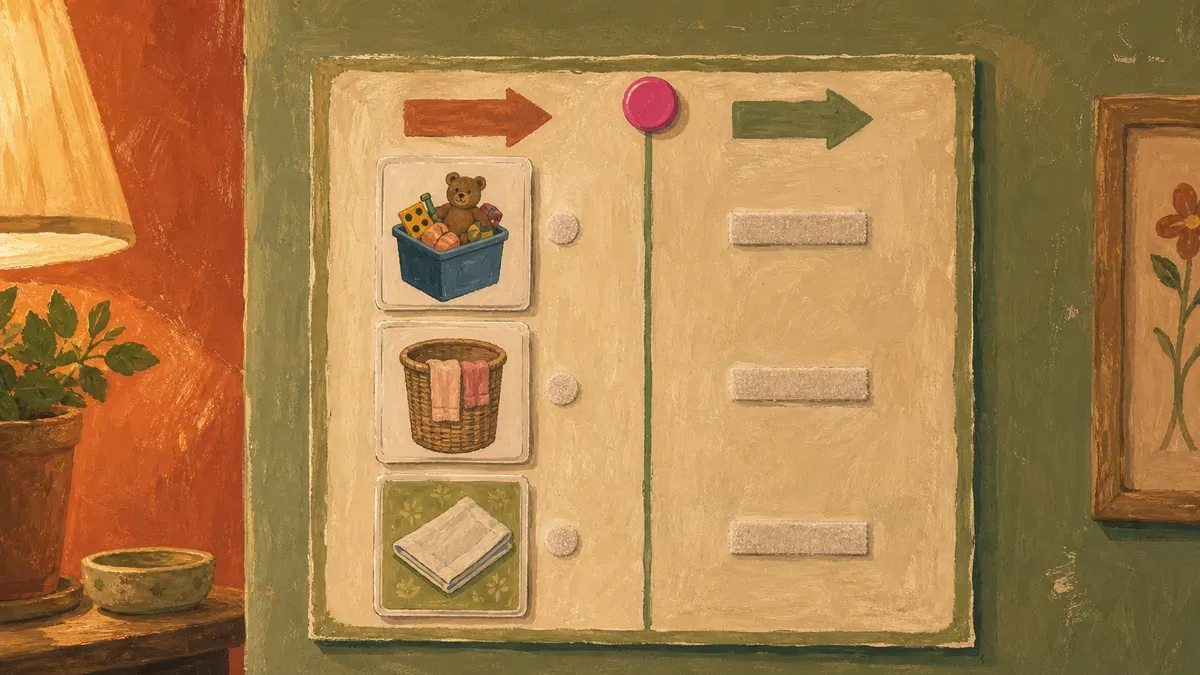
- Set up a velcro board with a “to-do” side and a “done” side.
- Keep the exact setup unchanged for a full fourteen days.
Choose Three Tasks She Can Finish Alone
Three jobs. That’s the whole list, and every one of them has to be something she can finish without you hovering.
The trap is picking chores that secretly need a grown-up. “Make the bed” sounds simple until you watch a three-year-old wrestle a duvet. So lean on jobs with a clear finish line. The American Academy of Child and Adolescent Psychiatry lists age-appropriate chores for two- and three-year-olds that each have a clear, visible finish line:
- Putting toys away
- Putting groceries away
- Dropping laundry in the hamper
When June was three, her three were toys in the bin, dirty clothes in the hamper, and napkin to the trash after lunch. All simple tasks, all winnable solo.
Three jobs your kid already half-knows beats five she’ll need rescuing on.
Keep the job cards concrete and household-sized. Skip anything that ends in “sort of” or “with help.” Age-appropriate chores at this stage are about the win, not the workload, so the chart feels beatable from the very first morning.
Print, Laminate, and Add Velcro
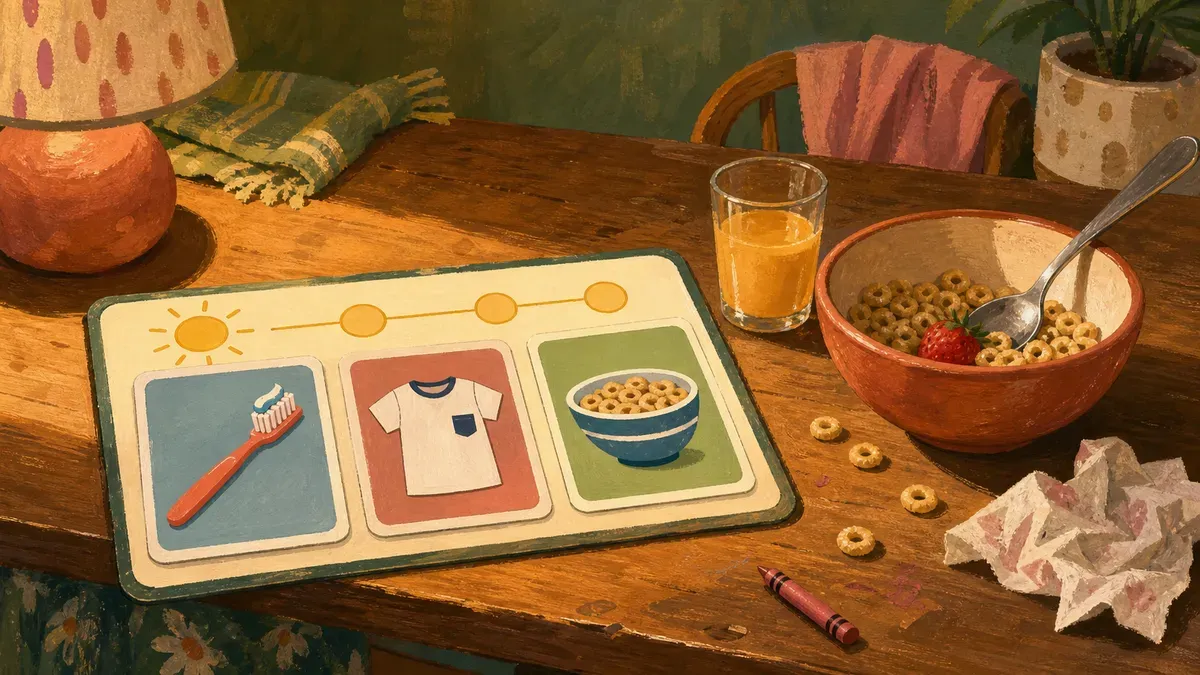
Print your three picture cards, one job per card, photo of the finished job facing up. A free visual schedule template you can adapt gives you the layout if you don’t want to build one from scratch. A printable checklist or a quick PDF checklist works too, as long as each task gets its own card.
Then laminate. This is the step people skip and regret, because bare paper survives about two sticky-handed mornings. Go with 5-mil laminating pouches, which a guide to laminator pouch thickness recommends for materials kids handle daily, since they balance stiffness and clarity. My cards have lived on the fridge for two years and still wipe clean.
The part that makes it click is velcro. Here’s the setup:
- Stick a soft dot on the back of each card
- Stick a hard strip on your board, one side for “to-do” and one for “done”
- She peels a card off and slaps it onto done herself
A few build notes:
- Velcro dots travel and re-stick; the magnet method works only on a metal board
- Round the card corners so the lamination doesn’t peel
- Make a spare set, because one card will go missing
The moving is the reward. She’s not waiting on a sticker from you, she’s doing the satisfying thing herself.
Run the Same Three Cards for Two Weeks
Resist the urge to add a fourth job on day three. The same three cards, same order, every single day for two weeks. That repetition is doing quiet work.
A 2024 peer-reviewed study published in PMC on family routines and child behavior found that more frequent family routines were linked to fewer behavior problems in kids. Repetition is what you’re after, and here’s what that sameness actually does:
- Mornings stop being a negotiation and become just-what-we-do
- A steady daily rhythm builds the responsibility muscle better than novelty does
- New cards feel exciting to you and confusing to her
So hold the line for two weeks. If a card flops one morning, that’s fine, try again tomorrow. Once those three run on autopilot, you’ve got room to add a fourth, and the next one slides in without a fight.
Why a Picture Chart Beats a Sticker List for This Age
A sticker list asks a three-year-old to read, and she can’t yet, so you end up reading it for her every single morning. Pictures skip that whole step, and the research on what chores do for a little brain is the part most parents never hear.
Pictures Speak Before Reading Does
Watch a preschooler with a sticker chart and you’ll see the catch fast. The words mean nothing to her, so you become the chart, calling out “now the hamper, now the napkin” on a loop. A picture job card hands that job to the image instead.
This is the whole reason a preschool visual schedule works. Pre-readers follow a photo of a finished task the second they see it, no adult voice required. According to Brightwheel, visual cues clarify tasks for kids who can’t read yet, and the pictures double as environmental print, so a child starts recognizing the word next to the image too.
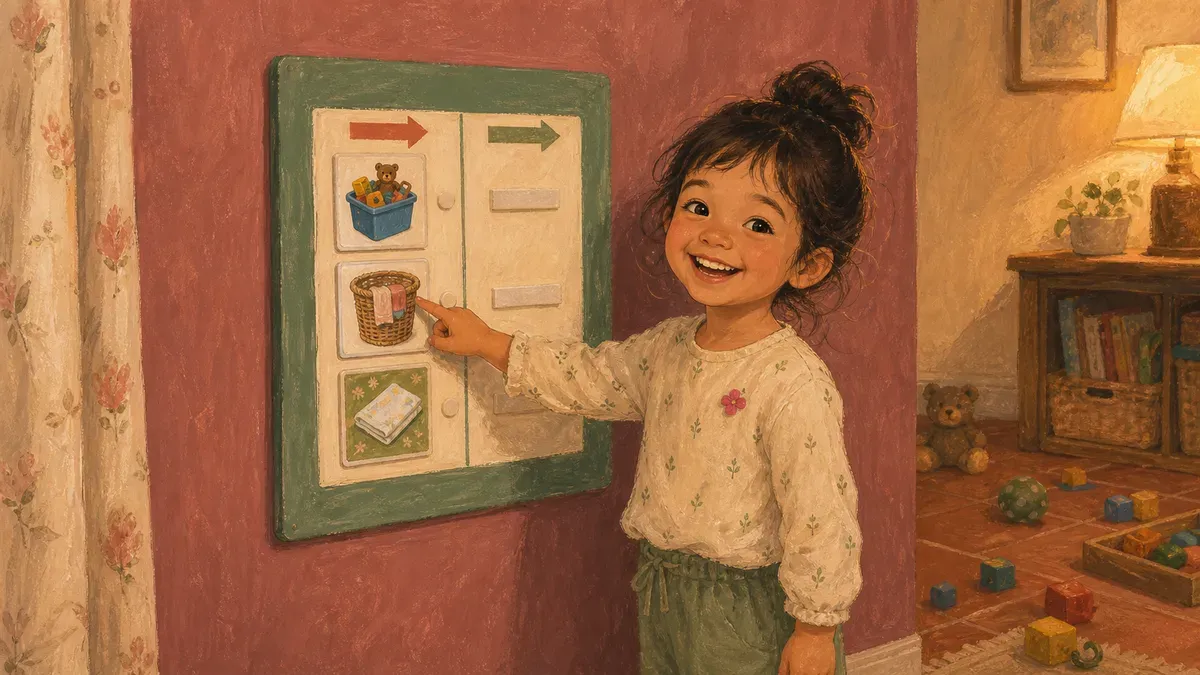
At my house, June points at her toy-bin photo and goes, before I’ve said a word. That’s the win: the picture nags so you don’t have to. If this format is new to you, our beginner’s guide to visual schedules walks through the setup.
What Chores Do for a Growing Brain
The payoff goes deeper than a tidy living room. A small job is real practice at the skills a preschooler is still building, and the research on early chore participation and child development backs that up.
A 2022 study of kids ages 5 to 13 found that doing self-care and family-care chores predicted stronger working memory and better impulse control, even after the researchers accounted for age and disability. Those are the executive-function muscles a three-year-old leans on to wait, switch tasks, and finish what she started.
The long view is just as good. Marty Rossmann’s University of Minnesota work found that kids who started helping around the house at ages three to four turned into more self-sufficient young adults than those who waited until their teens.
A visual schedule for preschoolers isn’t busywork. It’s the earliest, lowest-stakes rep of responsibility and the life skills that ride on it.
None of this means a chore card builds a genius. It means a tiny daily habit, done with her own two hands, quietly grows the muscles she’ll use for years.
Age-by-Age Chore Cards From Toddler to Kindergarten
The right job depends entirely on the age, so here is what actually sticks at each stage, from a wobbly two-year-old to a kid headed for kindergarten. Match the card to what their hands can already do, not what you wish they could.
Ages 2 to 3: One-Step Helpers
Keep it to one move at this age. A toddler can do exactly one thing and then look at you for the next thing, so every card has to be a single finished job they can picture in a second.
At this age every winning card shares one trait: Age-appropriate chore guidance for young children backs this up: kids ages 2 to 3 can put toys away and dress themselves with help.
Good one-step starters for a toddler chore chart:
- Toss dirty laundry in the basket
- Wipe a small spill with a cloth
- Put toys in one labeled bin
- Drop the napkin in the trash
- Set their own cup on the table
These are simple tasks, not real household chores yet, and that is the point. Pick age-appropriate chores their hands can finish alone, and they will actually do them.
Ages 4 to 5: Multi-Step Jobs
Now you can stack a couple of moves together. A four- or five-year-old can hold two or three steps in their head, so the job cards graduate from one photo to a short sequence.
Feeding the pet, making the bed (not perfectly), and helping clear the table after dinner are all fair game for this stretch. My Eli started clearing dinner plates around this age, and the chore list on our fridge finally had jobs with real moving parts.
Solid multi-step jobs for schedules built for 4 year olds:
- Set the table: napkins, then forks, then cups
- Make the bed: pull up the blanket, lay the pillow, smooth the top
- Feed the pet: scoop, pour, refill the water
- Clear their plate, scrape it, stack it in the sink
These carry real life skills, and the win is letting them do the whole thing badly. A lumpy bed is a finished bed.
Break One Chore Into Picture Steps
Here is the move that saves you from the “I don’t know what to dooo” whine: split one chore into three picture sub-steps so they are never stuck guessing what comes next.
Take making the bed. Instead of one card, make three picture job cards in order: a photo of hands pulling the blanket up, a photo of the pillow set in place, a photo of the smoothed top. The kid follows the pictures like a tiny recipe, no reading required.
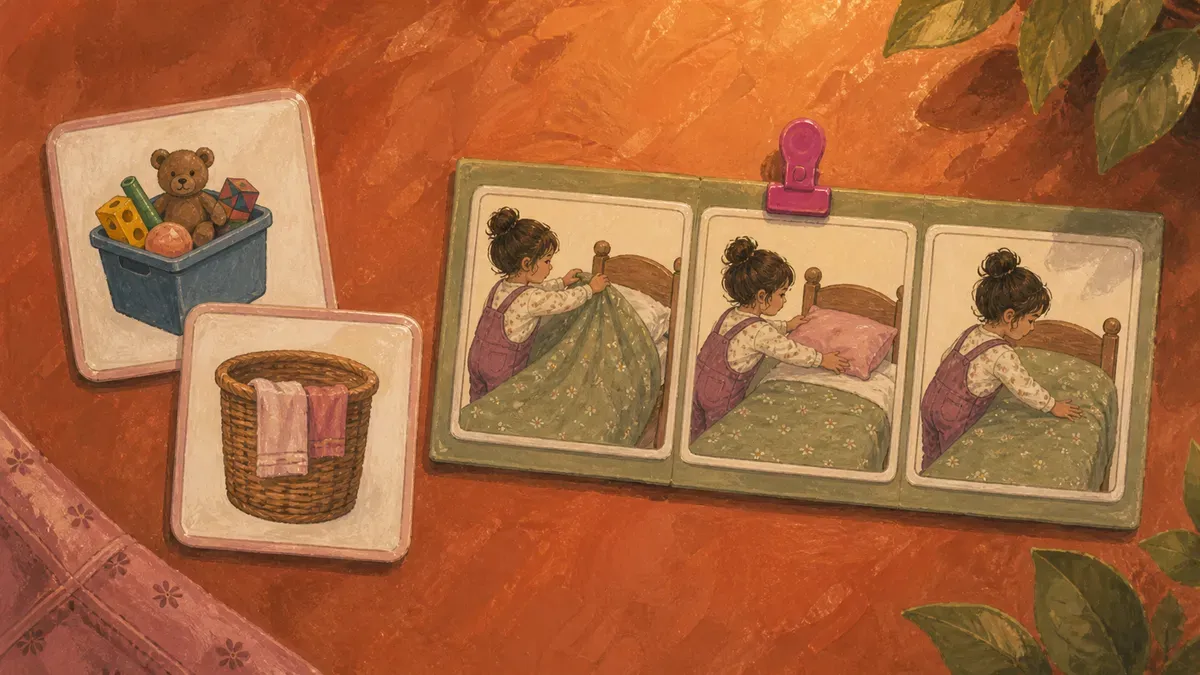
I laminated a three-card bed strip for June and clipped it to her headboard, and the daily routine ran itself. If you want a fuller rhythm to slot these into, a toddler schedule built around picture cues gives the simple tasks somewhere to live. Three small steps beat one big blurry instruction every single time.
Fold Chore Cards Into Your Daily Routine
A chore card that lives in a drawer never gets used. The trick is to clip it onto a habit your kid already runs on autopilot, then let the card itself carry the hard moments.
Anchor Chores to Morning and Bedtime
Don’t make the chore its own event. Tack one or two cards onto the routine your child already moves through without a fight.
- At wake-up: we keep June’s cards by the bathroom door, with “toys to the bin” as the last card in the strip
- She’s already brushing and dressing, so the chore rides the tail end of what her body already knows
- After dinner: a single “napkin to the trash” card slots into the walk to bed instead of becoming a separate ask
That daily rhythm is exactly why visual supports earn their spot at this age. NAEYC names them as a proactive strategy that helps children engage in the daily routine, navigate transitions, and build independence. A pictorial schedule for preschool kids isn’t a wall of rules. It’s a track your child can follow without you narrating every step.
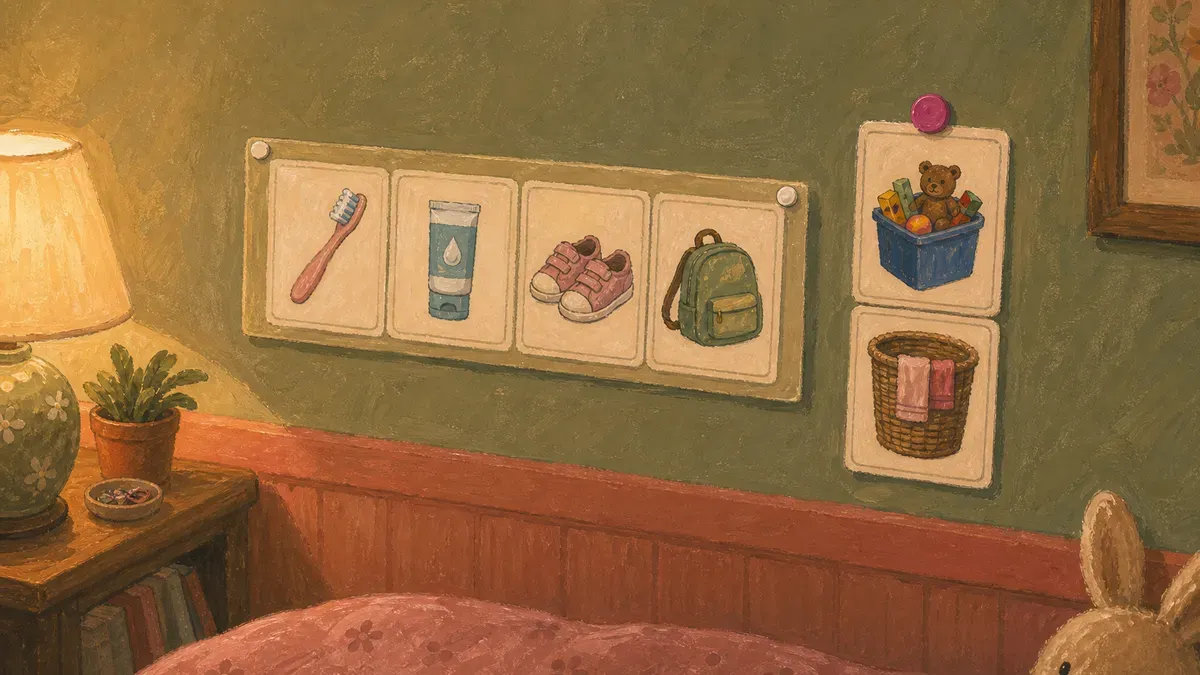
Use Cards to Smooth Hard Transitions
The meltdown is rarely about the chore. It’s about being yanked off something fun.
Moving the card gives that yank a shape. When it’s time to stop playing, June walks over and slides the card to the done side herself, and that small physical act tells her body the transition is happening before I ever say “clean up.” The hand does the work the words can’t.
- Point at a picture schedule instead of repeating yourself, and the nag loop breaks
- The picture, not your tired voice, becomes the thing she’s negotiating with
If you want the wider system these cards plug into, our visual schedules routines guide maps the whole family routine. The card does the asking. You just have to follow it too.
Handle Resistance Without a Reward Bribe War
Some mornings the card gets a flat “no,” and the fix isn’t a bigger prize. Here’s the praise that actually sticks, and the two-step move for the day your kid pretends the card doesn’t exist.
Praise the Effort, Skip the Sticker Economy
The trap with a responsibility chart for kids is the slow creep of bribes. One sticker stops working, so you add a treat, then a bigger treat, and now you’re negotiating with a three-year-old over a marshmallow. The reward becomes the point, and the chore becomes the toll.
There’s real backing for skipping that race. A research review on praise versus rewards in motivation from Edward Deci and colleagues found that tangible rewards tend to erode a kid’s own drive to do a task, while plain verbal praise and encouragement did not, and sometimes lifted it.
- Name what they actually did: “you carried the whole basket” or “you remembered the napkin without me asking.”
- Skip the sticker. Specific praise beats sparkly prizes with June, every single time.
Describe what they actually did, and the doing becomes its own reward system.
When the Card Gets Ignored
The card gets ignored. It happens to every kid, and a power struggle only makes the chart the enemy.
My two-step is boring on purpose: - Step one: point at the card, no lecture. “Toys to the bin, then snack.” The picture makes the ask, so I’m just the pointer.
- Step two, if that’s still a no: “Let’s do it together, you grab the blocks, I’ll get the books.” Shared job, not a standoff.
That second step is the whole secret. You’re not letting the chore slide, you’re folding it back into the family routine as a job you tackle as a team. Most days June finishes the last piece herself once the standoff is gone.
If you want a fresh strip for a kid who’s tuned the old one out, grab a free printable daily routine chart and swap the photos. For the bigger picture, our full library of visual routine guides walks you through every part of the day.

Found this useful? Save it for the next rough afternoon.
Questions parents ask me about this
What chore chart works best for young kids?
A picture-based chore chart beats a word list for any child who can't read yet. Three laminated photo cards on a velcro to-do/done board give a preschooler a clear visual target and the satisfying physical act of moving each card when the job is finished. Start with just three jobs and run the same cards in the same order for two weeks before adding anything new.
At what age can a child start using a chore chart?
Most kids are ready around age two or three for simple one-step jobs: dropping toys in a bin, tossing a napkin in the trash, putting a shirt in the hamper. At four and five they can handle multi-step tasks like making a bed, setting the table, or feeding a pet. A picture chart works at both stages; the complexity of the chore grows, but the format stays the same.
Should I pay or reward my preschooler for doing chores?
Skip the tangible rewards for routine household jobs. Say what you saw: "You remembered the napkin all by yourself" lands better than a sticker. Save prizes for genuinely big milestones, not Tuesday's toy pickup.
How many chores should a 4-year-old have on the chart?
Three chores is the right starting number. That is enough for a child to feel capable without being overwhelmed, and a short list is easier to fold into a morning or bedtime strip that actually gets done. Once your child finishes all three without reminders for two solid weeks, add a fourth.
How do I adapt a chore chart for an autistic or ADHD preschooler?
Picture cards are already a strong fit because they replace your voice with a visual cue the child can check independently. Anchor each card to an existing part of the day rather than introducing a standalone chore time, and keep the sequence identical every day so the routine feels predictable. Moving the card from the to-do side to the done side adds a physical transition signal that many kids who need extra structure find genuinely steadying.
Do laminated picture chore cards hold up to daily use?
Yes, when the laminate is thick enough. Five-mil pouches survive the daily grab-and-move far better than thinner ones, which tend to crack at the edges after a few weeks. Cards run through a good laminator can last two or more years of daily use without needing to reprint.
Is a digital app or a printed chore chart better for this age?
A printed chart wins for preschoolers. A phone or tablet drops a device into the middle of a routine you are trying to make screen-free, and swiping a screen does not give the same physical feedback as sliding a velcro card to the done side. Once a child can read and manage a simple app on their own, digital tools become more practical; before that, print and laminate.
Written by
Nora Hayes
Mom of two and a former preschool aide. I share the screen-free sensory play and calm-down ideas I test at my own kitchen table, plus what the moms in my little meet-up swear by. A parent passing on what works, not a doctor or a therapist.
More about NoraKeep going
All Visual Schedules-
 Visual Schedules
Visual Schedule Printable: 20 Picture Cards + Free PDF
Visual schedule printable with the 20 picture cards every toddler home needs. Free PDF to download, print, and start using tonight.
-
 Visual Schedules
Visual Schedules: A Beginner's Guide for Parents
Most visual schedules fail before day three. Learn how they work and build your first board in 5 steps your child will actually follow. Start today.
-
 Visual Schedules
Toddler Schedule: Build One With Picture Cards
Your 2-year-old can't read a clock yet. Build a toddler schedule with picture cards in 5 steps that stop nap fights and meltdowns. Start today.
-
 Visual Schedules
Free Printable Daily Routine Chart Kids Will Follow
Grab a free printable daily routine chart your child will actually follow, plus picture cards and tips to make any routine stick. Download now.