Sensory Table Activities: 25 Prompts That Last 30 Minutes

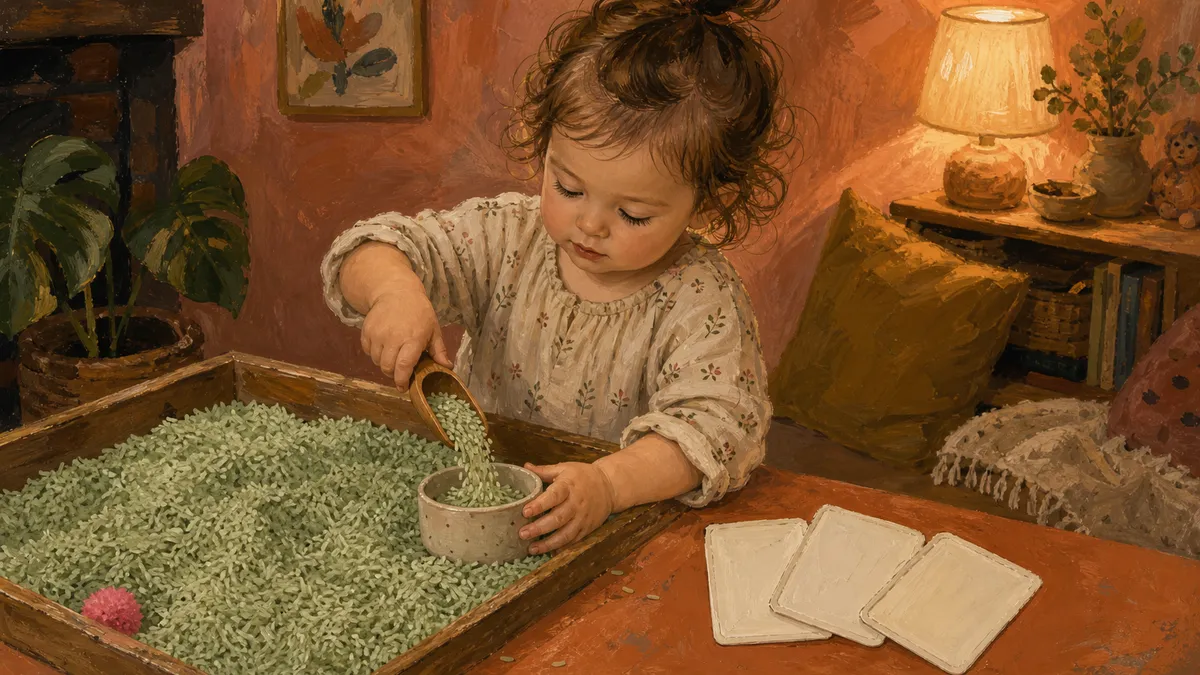
I’m Nora Hayes, a former preschool aide and mom of a sensory-seeking autistic kid, and sensory bin task cards are the single thing that turned five-minute dumps into twenty-minute play sessions at my house. Without a prompt to guide them, most kids dump, stir, and walk away, and a single task card is what resets their attention.
Below you get 25 prompts covering sensory table activities that work with any filler you already own, plus how to match tools and fillers so a single bin quietly covers reading, math, and motor skills.
Three moves make the difference between a five-minute dump and a thirty-minute session.
- Hand over one prompt with a clear finish line
- Swap the tool every five minutes, not the filler
- Save a themed prop for the second wave
How to Run a Sensory Bin Session That Lasts 30 Minutes
A bin that holds a toddler for half an hour isn’t about a fancier filler. It’s about how you hand it over, when you switch the tool, and what you save for the moment their interest starts to drift.
- Start with one concrete prompt and hand them the next when they finish.
- Offer a fresh utensil every five minutes so their hands stay engaged without changing the filler.
- Drop in a themed prop the moment interest starts to drift for a real second wave.
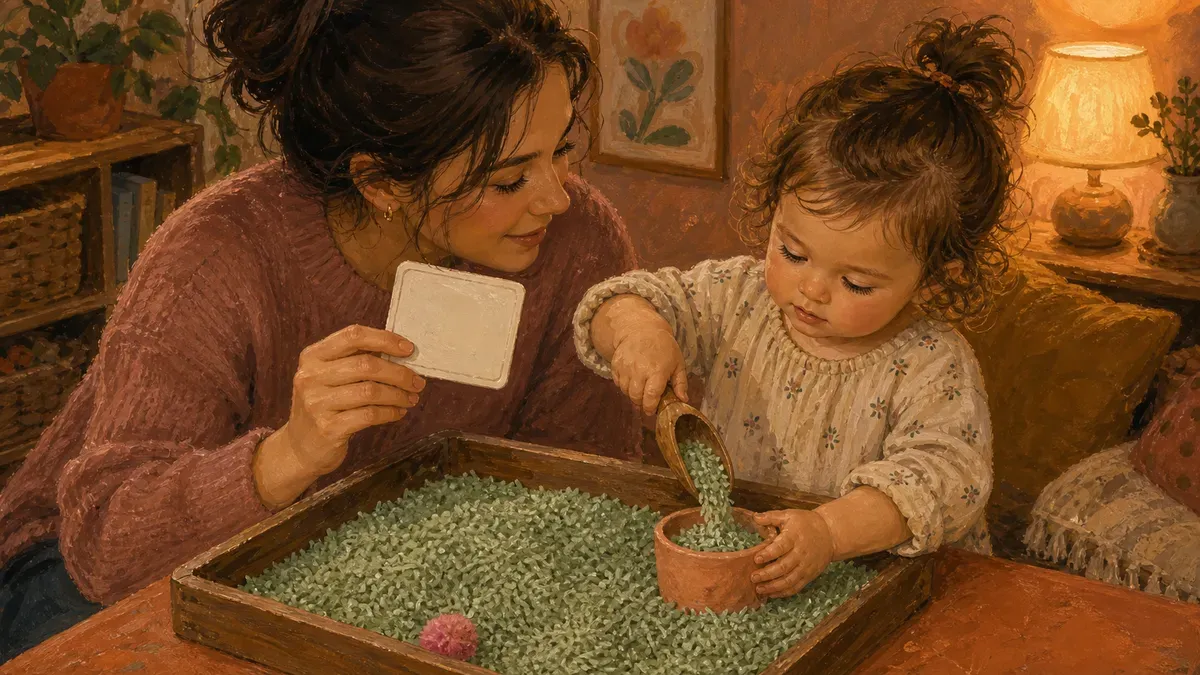
Give One Prompt at a Time, Not the Whole Bin
Set the bin down, say “go play,” and you’ll get about four minutes before they wander off. A toddler doesn’t know what to do with open-ended. They know what to do with one small job.
So give them one small job with a clear finish line.
- “Pour two cups, then stop.”
- “Find me three red beans.”
- “Scoop until the funnel is full.”
When they’re done, you hand over the next one.
The research backs the instinct here, with a twist. A summary of preschool play studies from Lovevery notes that child-initiated choice produces the longest attention, and an adult presenting the whole activity produces the shortest. The sweet spot sits in between: you offer the prompt, they own the doing.
Keep the prompts to scooping, pouring, and transferring at first. These are the moves toddlers already love, so a prompt feels like a game, not a chore. That’s the backbone of most sensory bins for toddlers, and it’s why one card at a time outlasts a dumped-out bin, every single time.
Rotate the Tool Every Five Minutes
Same filler, new tool. That’s the whole trick for stretching the middle of a session, the part where pouring starts to feel old.
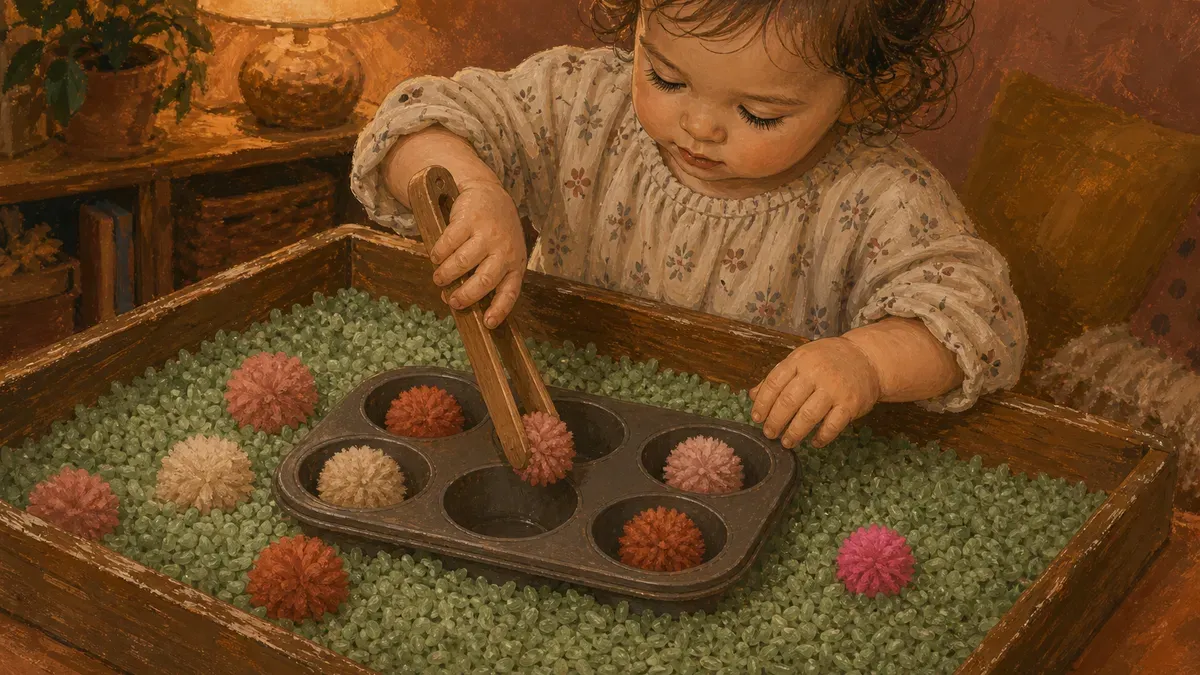
Set a quiet five-minute timer. When it dings, swap the scoop for a pair of tongs, then the tongs for a turkey baster, then the baster for tweezers. The rice never changes. The hand does, and a fresh grip resets their focus like a tiny reset button.
Each tool trains something different, and the OT Toolbox confirms these are all groundwork for handwriting and scissors.
- Tongs: pincer grip and bilateral coordination
- Tweezers: hand strength, thumb opposition, eye-hand coordination
- Baster: squeeze-squish satisfaction plus hand-eye coordination, all from a kitchen drawer
Don’t announce the swap as a transition. Just place the new tool in the bin and watch them reach for it.
Add a Theme or Hidden Treasure Last
You’ll feel the moment the pouring runs dry. Heads up, eyes drifting, that “I’m done” wiggle. That is your cue, not the end of the session.
This is when the theme comes out. Drop a handful of plastic dinosaurs in and turn it into hide-and-count. Bury little ocean animals and ask them to sort the sharks from the fish. The filler you’ve used for twenty minutes suddenly becomes a beach, a jungle, a digging site.
That shift buys a real second wave, often ten more minutes, because you’ve changed the game without changing the setup. Loose parts flip the script on the filler they’ve already touched for twenty minutes. - A scoop of rice becomes a snowstorm, a cup becomes a cave.
- A pinch of pretend pulls them back in when the pouring runs out.
This lands right on schedule. Zero to Three explains that between two and three, toddlers start using objects to stand in for other things, a pillow becoming a pizza, and imaginative play grows more complex from there.
Keep the themed props in a jar by the bin so you’re never hunting for them mid-meltdown. The theme is the encore, and on a good day, the encore is the longest part of the show.
25 Task Card Prompts to Try With Any Filler
Print these on index cards, drop them in a jar by the bin, and you’ve got a month of sessions that never repeat. They sort into three jobs: pouring and measuring, sorting and hunting, then pretend play once the hands are warm.
- Pouring and measuring prompts: the easiest entry point, works cold with almost every kid.
- Sorting and hunting prompts: tongs, tweezers, hidden objects, longer sessions.
- Pretend play prompts: story setups that give the same filler a second life once hands are warm.
Pouring, Scooping and Measuring Prompts
Start here, because pouring is the easiest win and the one almost every kid will do cold. Hand them a cup, point at the line, and let them chase it.
- Fill the cup to the blue line, then dump it back and do it again.
- Count how many scoops it takes to fill the small jar.
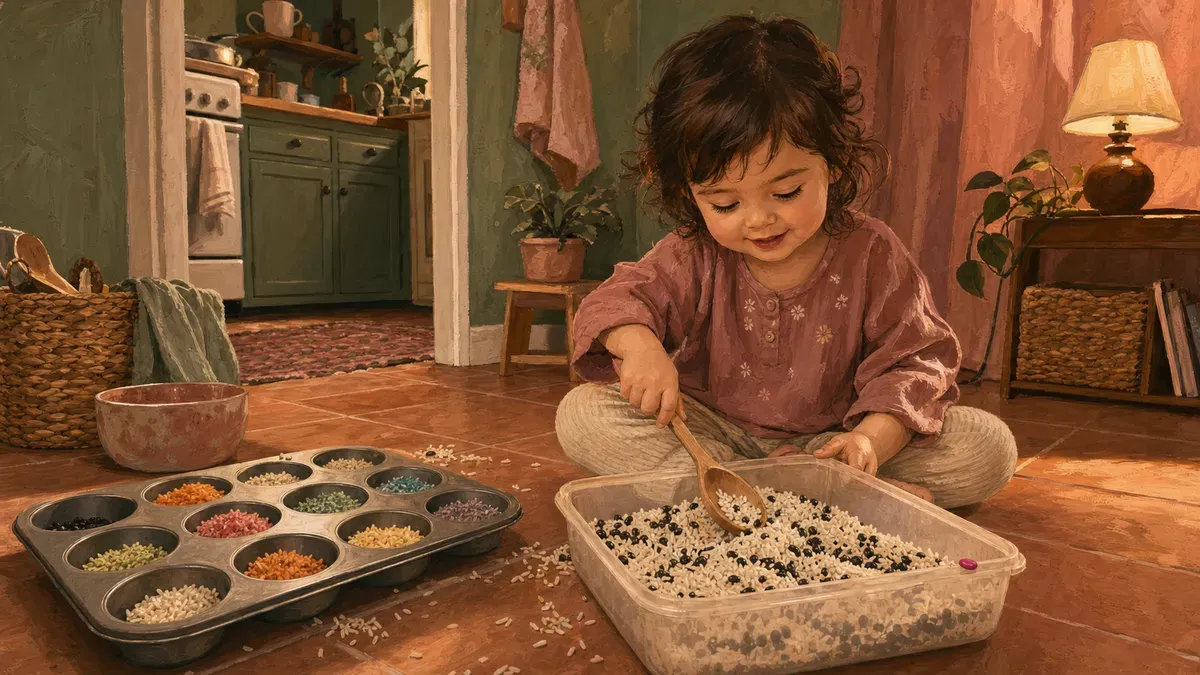
- Move the rice from the big bowl to the muffin tin, one scoop per cup.
- Use the baster to suck up water and squirt it into the egg carton.
- Pour from the tall cup into the short one without spilling.
- Fill three cups so they all match.
- Funnel the beans into the bottle until it’s half full.
- Scoop with your left hand, then switch and scoop with your right.
The measuring ones do double duty. Counting scoops out loud is early math hiding inside a chore, and the back-and-forth pouring is pure grip strength and hand-eye coordination. According to the OT Toolbox on scooping and pouring, these motions build pincer grasp, wrist control, and hand strength, the same skills a toddler leans on when they start self-feeding with a spoon around 13 to 15 months.
The spill is part of it. A kid who never overfills the cup isn’t learning where the line is.
Keep the prompts to one verb with a finish line, and you’ll get more out of them. “Fill to the blue line” beats “play with the scoops” every single time.
Sorting, Hunting and Fine Motor Prompts
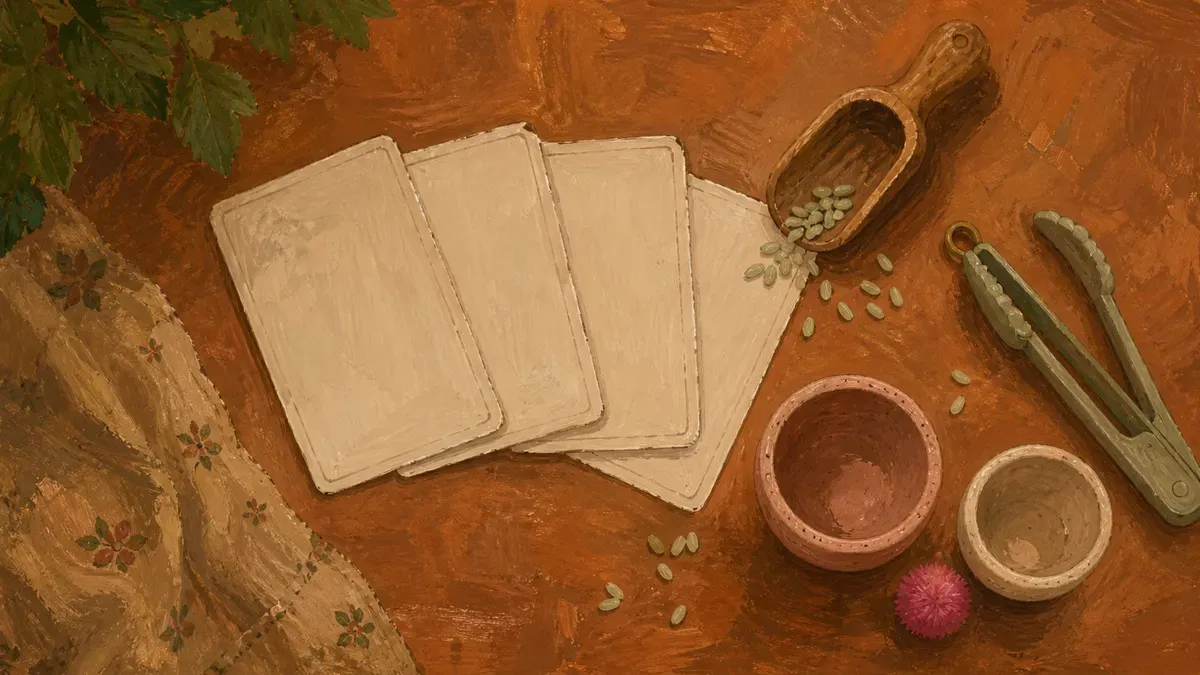
Swap the scoop for tongs and the whole game changes. Now they’re pinching, hunting, and looking close, which is harder work for little fingers and lasts longer because there’s a hidden payoff.
- Find all the red pom-poms and drop them in the cup.
- Use the tongs to move every button into the ice tray, one per slot.
- Sort the loose parts by color into three bowls.
- Hunt for the five hidden animals and line them up.
- Pick up the beads with tweezers, no fingers allowed.
- Find every object that’s smooth, then every one that’s bumpy.
- Drop the pom-poms into the bottle one at a time with the tongs.
- Match each lid to its jar.
- Dig out all the spoons and hand them to me.
Tongs and tweezers force the pincer grip, the pads of thumb and finger doing the work instead of a whole fist. A pediatric PT review of grasping patterns traces that grip from 8 to 11 months up through the static tripod grip at 3.5 to 4 years, the direct precursor to holding a pencil. The “find every smooth one” prompt adds tactile discrimination, telling textures apart by feel, which is its own quiet skill.
The hunting cards earn the longest sessions. Hide a few treasures in the filler before you set the bin out, and the search alone can buy you ten extra minutes. If you want more ideas like these, here’s how to use sensory bin task cards stretch on the rough days.
Pretend Play and Story Prompts
This is where the bin stops being a chore and becomes a world. Once the pouring and pinching have run their course, a story prompt gives the same materials a second life as small world play.
- Feed the hungry dinosaurs, one scoop of “leaves” each.
- Drive the dump truck through the construction site and unload the gravel.
- Run an ocean rescue and pull every sea creature to safety on the rock.
- Bury the dino bones, then dig like a paleontologist to find them.
- Bake muffins in the tin and serve them to the animals.
- Mix the blue water and the yellow water and see what happens.
- Take the cars through the car wash and dry them on the towel.
- Build a nest and tuck the little eggs inside.
These lean on something toddlers do naturally. Lurie Children’s Hospital notes that by age 2 to 3, kids start combining actions into whole play scenes and using one object to stand in for another, a block becoming a phone, a scoop of rice becoming dino food. You’re not teaching imaginative play here. You’re handing it a stage.
Mix the role play with the themed setup you already have and the prompts stretch even further. The color mixing card is the one June asks for by name, and watching green appear never gets old, even at the kitchen table on a Tuesday.
Choosing Fillers and Tools That Match the Prompt
A prompt only works if the stuff in the bin can actually do what you asked. Match the filler to the job first, then grab the right tool, and most of the 25 cards run themselves.
Best Fillers for Each Type of Prompt
Mass General for Children suggests exploring one texture at a time for 20 minutes, which maps to exactly how a task card session runs. One filler, one mess level, one prompt at a time.
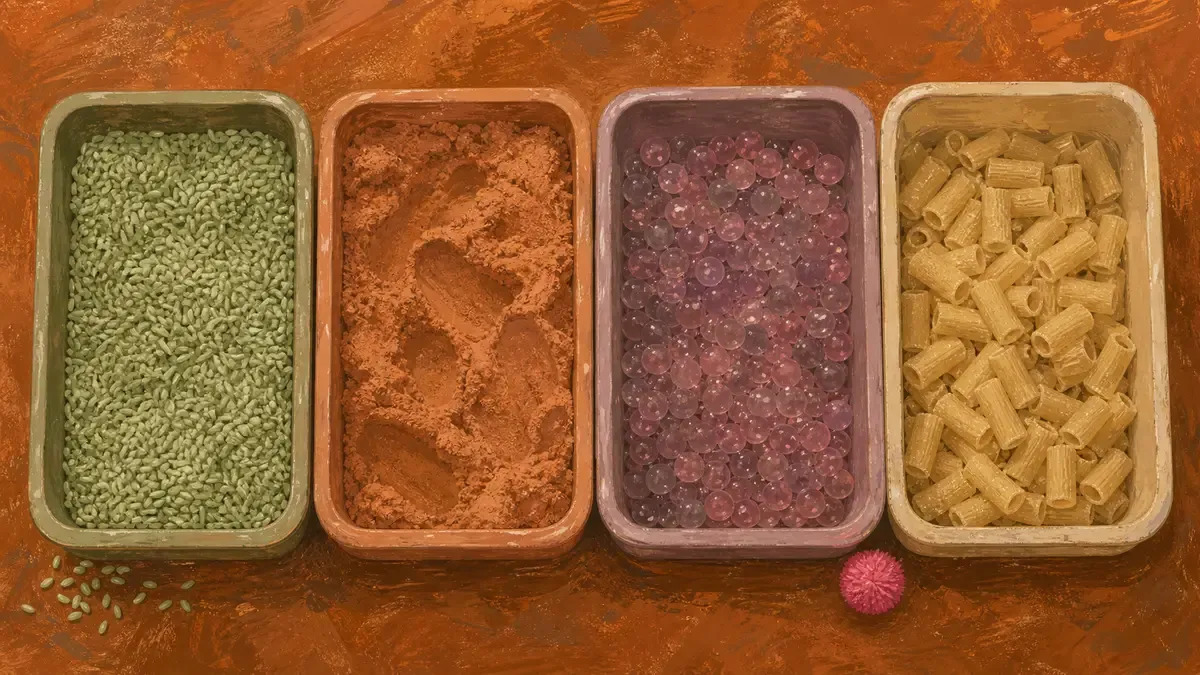
- Dry rice or pasta: low mess, perfect for pouring and counting
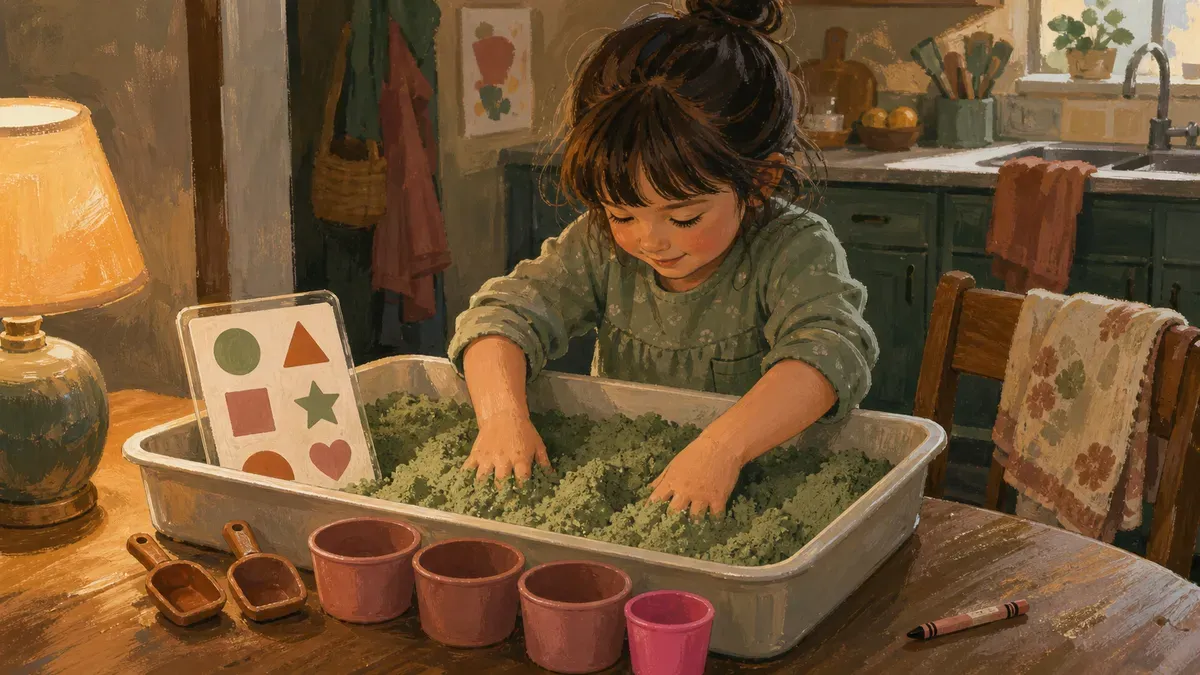
- Kinetic sand: medium mess, holds a shape for molding cards
- Water beads: higher mess, made for scooping and transfer (skip for the under-2s)
When you’re stuck, raid the pantry first. I keep a running list of sensory bin fillers you already have so I’m never buying something rice could do for free.
The Tool Kit That Powers the Prompts
Five cheap tools unlock almost every card.
- Scoop or measuring cup: runs the pouring prompts and sneaks in early math
- Baster: hand-eye coordination built into one action, aim the tip and squeeze
- Tongs: full-hand squeeze, best for transfer cards and picking up bigger items
- Tweezers: pincer grip, the same motion a kid uses to hold a crayon
- Cups: fill them, dump them, nest them, and you have a sorting card on your hands
None of this needs a special-toy budget. Most of my favorite sensory play toys came straight out of a kitchen drawer. Match the tool to the prompt, and the card does the teaching for you.
Why One Bin Can Cover Reading, Math and Motor Skills
The same bin that kept your kid busy is quietly doing three jobs at once. Below, what each prompt actually builds, and how to size the prompt to the kid in front of you.
The Developmental Skills Each Prompt Builds
A pour looks like nothing. But aiming a stream of rice into a cup and stopping before it overflows is hand-eye coordination in real time, the same wiring a kid leans on later to copy a letter onto a line.
Switch to a sorting card and you’ve changed the muscle. Pinching one bead at a time trains the pincer grip, that thumb-and-finger pinch that turns into a proper crayon hold. Two hands working a funnel together is bilateral coordination, plain and simple.
Then there’s the counting. “Scoop three, pour them out” sounds like a game, and it is, but it’s also early math sneaking in the back door. The Encyclopedia on Early Childhood Development notes that six categories of math, sorting, counting, magnitude, patterns, and more, surface on their own in ordinary play. The math is happening whether you call it math or not.
That’s the whole trick. One bin, several fine motor skills, and a side of reading and math, with zero worksheets.
Tuning Prompts for Toddlers Through Preschoolers
Same card, different kid. The art is dialing the prompt up or down to meet the age in the chair.
Age changes what you ask for:
- Ones: Pour, dump, refill, repeat. That’s proprioceptive feedback and tactile discrimination, the heavy hands-deep stuff little ones crave, and it’s plenty. No need to bolt counting onto a kid who just wants to feel the rice run through their fingers.
- Twos and young threes: Add a finish line. Count the scoops, sort the red from the blue, match two things that go together.
Research on how sensory play supports fine motor development from MSU Extension ties this combine-touch-with-looking work to pattern recognition and early predicting, the building blocks of preschool activities to come.
Preschoolers can hold a whole story arc, so ask for sequence: first fill the truck, then drive it to the farm, then unload. If you’re tuning bins for a sensory-seeker who needs to move before they can sit, my notes on sensory bins for autism walk through scaling for sensory needs specifically. Watch the kid, not the card, and let their answer tell you which way to turn the dial.
Keeping Bins Fresh: Rotation, Cleanup and Storage
The fastest way to kill a bin is to leave it out until your kid walks past it like furniture. Two habits stop that: a tiny rotation so the same stuff feels new, and a teardown fast enough that you’ll actually do it.
Build a Simple Rotation So Bins Never Get Stale
You don’t need ten bins. You need two or three and a swap day. Keep one base sensory filler going for a week, then change one thing the next week. Same rice, new theme. Or same theme, new texture underneath.
Here’s the rotation I run at my house:
- Week one: rice base, plain pouring and scooping, nothing extra.
- Week two: same rice, but I drop in a themed play layer. Hidden farm animals, a jar of loose parts, a little small world setup.
- Week three: swap the filler entirely. Dry pasta, beans, kinetic sand.
Three weeks, three “new” bins, and the only thing I bought was a bag of pasta. Change one variable at a time, not the whole thing. A kid reads a familiar bin with one surprise as worth poking at. A bin that’s totally different reads as starting over, which is more setup for you. Want a calendar you can just follow? I mapped out a sensory bin rotation system ended bored at our place.
Cleanup and Storage That Takes Five Minutes
The mess is why most bins get retired, so plan the cleanup before you start. Lay a flat sheet or a shower curtain under the bin. When you’re done, lift the corners, funnel the spill back in, shake the sheet out over the trash. Most of your texture problem, gone in thirty seconds.
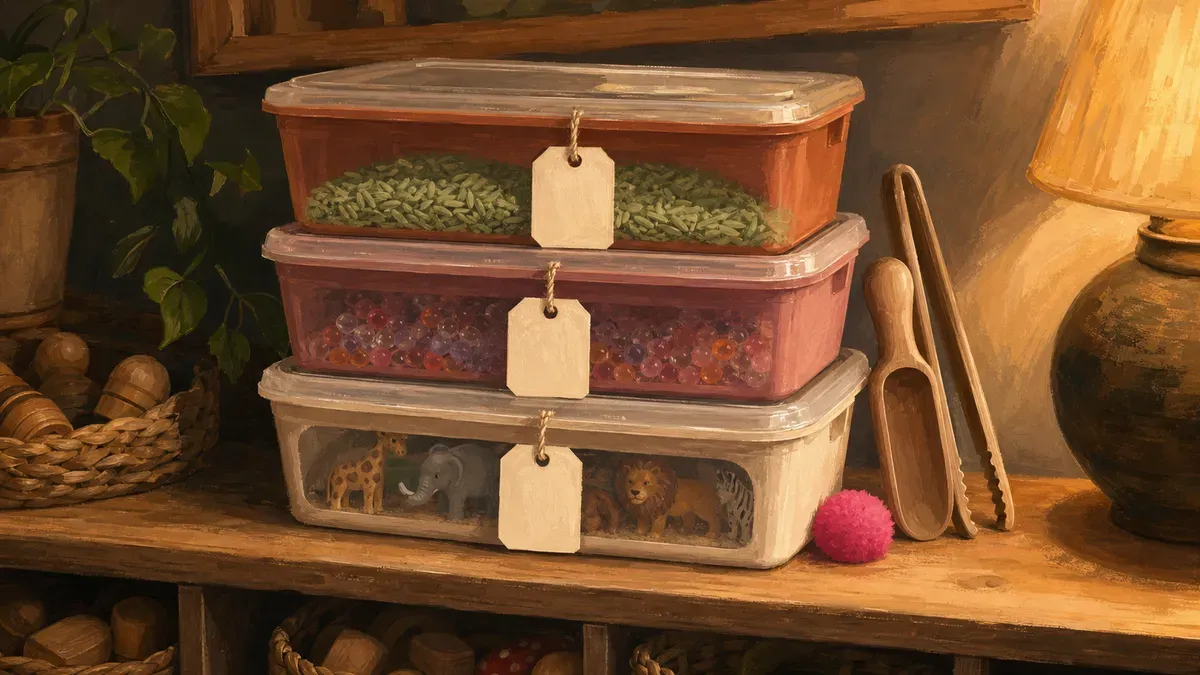
- Rice and pasta: scoop back into labeled lidded bins, lid on, done.
- Water beads: sieve, pat dry, seal, and set on a high shelf away from little siblings.
If you use them, follow this safety guidance on small objects and choking hazards for young children and only buy beads that meet the 2025 federal standard. Label every lid with what’s inside and the prompts it pairs with, and you’ll find more storage and safety basics in our complete toddler sensory bin guide. Future-you, on a no-energy night, reaches for the bin that’s already ready instead of the screen.
Found this useful? Save it for the next rough afternoon.
Questions parents ask me about this
What do you actually do with a sensory bin besides let kids dump it?
You give the play a purpose with a task card prompt: count the scoops into a muffin tin, sort the red beads from the blue ones, or act out a story with a few small animals buried in the filler. Dumping is the warm-up, not the whole session. A one-verb prompt with a clear finish line is all it takes to turn a dump into twenty minutes of focused play.
How long should a sensory table activity last for a toddler?
About twenty minutes is a realistic target, though some sessions run shorter and that is fine. If your child loses interest at ten minutes, follow their lead and call it a win. The goal is a calm, engaged stretch of time, not hitting a specific number.
What age can a child start using sensory table activities?
Babies explore texture from the earliest months, so even infants can do supervised touch-and-feel with safe materials. Toddlers around one year get a lot out of pouring and scooping, while two- and three-year-olds can handle sorting, counting, and basic pretend play prompts. Scale the task to what your child is already doing: ones pour and dump, twos count and sort, preschoolers sequence a short story.
What should I do if my toddler keeps eating the sensory bin filler?
Switch to a taste-safe filler immediately. Under two, assume everything goes in the mouth, because it will. Cooked pasta, puffed rice cereal, or plain oats are solid starting points. Anything that would be dangerous if swallowed stays out of the bin until your child has reliably stopped mouthing.
How do I stop my toddler from dumping the sensory bin on the floor?
Lay a sheet or shower curtain under the bin before you start, so dumping becomes a containment problem you already solved. A prompt on a task card also redirects the dump impulse into something purposeful. If floor-dumping keeps happening, try a smaller bin with less filler so there is less to throw.
Are sensory bins safe for kids who mouth or put materials in their mouths?
Yes, with the right filler. Taste-safe options like cooked pasta, oats, or safe-to-eat rice puffs work well for mouthy kids. Avoid water beads, small pebbles, kinetic sand, and anything with a choking risk until the mouthing phase is well past. When in doubt, taste-safe first, always.
How do sensory table activities help children with autism or sensory processing differences?
For a sensory-seeker who needs to move and touch before they can sit still, a bin gives them a sanctioned way to get that input. Repeated, predictable sensory play can be part of a broader sensory diet, though what works varies enormously from child to child. If your child has a sensory processing difference, use the bin as one tool and lean on their OT to figure out which fillers and prompts actually fit their profile.
What is the least messy filler for indoor sensory play?
Dry rice or dry pasta is about as contained as sensory filler gets. Both stay where you put them, clean up in seconds, and work with nearly every task card prompt. A sheet under the bin and a dustpan nearby means teardown is about thirty seconds, even on a tired night.
Written by
Nora Hayes
Mom of two and a former preschool aide. I share the screen-free sensory play and calm-down ideas I test at my own kitchen table, plus what the moms in my little meet-up swear by. A parent passing on what works, not a doctor or a therapist.
More about NoraKeep going
All Sensory Bins-
 Sensory Bins
Sensory Bin Fillers: 20 Pantry Items You Own Now
Skip the craft store: 20 sensory bin fillers already in your pantry tonight, sorted by texture, mess level, and age. Start one in minutes.
-
 Sensory Bins
sensory integration occupational therapy intervention: ADHD
Turn sensory integration OT into a home calm-down bin for ADHD kids. Task cards, bin ideas, and a setup that works on the hard days.
-
 Sensory Bins
Indoor Sensory Play: 18 Low-Mess Setups That Work
Dreading the cleanup? These indoor sensory play setups stay on the mat, work in apartments, and reset in minutes. Start tonight.
-
 Sensory Bins
Sensory Play 2 Year Olds: 12 Bins That Hold Focus
Most sensory bins lose a 2-year-old in 90 seconds. These 12 sensory play ideas for 2 year olds actually hold attention. Start one tonight.