When Do Babies Start Talking? A Month-by-Month Guide

I am a parent sharing what worked at my house, not medical advice. For anything to do with your child's development or sensory needs, talk to your OT or doctor.
When do babies start talking? Most babies say a true first word around their first birthday, with a real run of words and short two-word combos showing up between 18 and 24 months. I’m Nora Hayes, a former preschool aide and mom of two (one of them a chatty, late-blooming sensory-seeker), and the question I hear most from tired parents is whether their kid is “on track.”
This guide walks you through the milestones month by month, what speeds talking up or slows it down, why pointing and gestures matter more than people think, and the signs that mean it’s time to call for a speech evaluation.
The Short Answer: When Most Babies Say a First Word
Most babies say a first word somewhere between 10 and 14 months. That’s the range, not a cliff. A baby who’s quiet at 11 months and chatty at 13 is doing just fine.
The classic milestone you’ll see everywhere is 12 months, and that’s a reasonable middle point. But “first word” is a little squishy as a measure. It means a sound your baby uses consistently to name something specific: “ba” always for bottle, “da” always for Dad. Babbling syllables don’t count yet.
Parents often wonder when their infants will hit these marks, but language development doesn’t follow a single timetable. Plenty of kids blow past those markers early; others arrive right on time at 14 or 15 months. What matters more than the exact age is the trajectory, and a few specific signs tell you more than any birthday:
- Making consistent eye contact
- Pointing to get your attention or show you something
- Playing back-and-forth games, like peekaboo or rolling a ball
For babies, talking starts well before talking. The sounds, the gestures, the reaching: those are the first words, just not the verbal ones.
Speech Milestones From Birth to 24 Months
Here’s the rough map of when children start talking, from the first vowel sounds to the day they string two words together. Treat it as a typical path, not a deadline your kid is failing.
Cooing and Babbling (0 to 9 Months)
When babies start talking, it’s been building for months in the babble. The very first sounds are coos, those drawn-out vowels like “ooh” and “aah” that show up around six to eight weeks. From there it builds into babbling, which is where consonants finally join the party.
The timing tracks pretty closely. The shift from cooing to babbling happens between 4 and 7 months for most infants, according to The Bump.
What you’ll hear next is the fun part: reduplicated babbling. That’s the repeated-syllable stuff, “baba,” “gaga,” “dadada,” on a loop while they bang a spoon on the high chair tray. It sounds like nonsense. It isn’t.
This is real pre-linguistic communication. Your baby is testing what their mouth can do, copying the rhythm of your speech, learning that sounds get a reaction.
Three things that pay off most at this stage:
- Narrate everything out loud: diaper changes, walks, meals, all of it.
- Name the dog, the cup, the spoon. Repeat their babbles back.
- Auditory exposure beats any toy on the market.
So when does a baby start talking in any meaningful way? Infants begin right here, in the babble, long before a real word arrives.
They’re listening to every word, banking the sounds they’ll need when they start speaking for real.
First Words and Saying Mama and Dada (9 to 14 Months)
Then one day the babble points at something. That’s a true first word: a sound your baby uses on purpose, for the same thing, every time. Not the accidental “dada” aimed at the ceiling fan, but the deliberate one when your partner walks in.
Most babies land a first word somewhere in the 10 to 14 month window, and the early ones are usually whatever they care about most. Milk. Dog. Ball. The cat. Don’t expect crisp pronunciation, expect a consistent stab at it.
The mama and dada question deserves its own answer, because parents agonize over it. When do babies say mama as a name and not just a sound? Babies start babbling “mamamama” or “dadadada” between 6 and 9 months, but the move to using it as a real name for a specific parent usually happens by 12 months, per The Bump.
So when your seven-month-old yells “dada” at the wall, that’s practice. When your one-year-old says it the second your husband walks in the door, that’s a word. Same goes for when babies start saying words like “mama” with intent behind them.
Gestures come first, and they count:
- Pointing, waving, reaching: expressive language before the voice catches up.
- A baby pointing at the cookie jar is saying something. Name it.
- Spoken words tend to follow once you honor the gesture.
A quick reality check on the official side: the CDC milestone checklist says by 15 months kids should try to say one or two words besides mama or dada, like “ba” for ball. That’s the floor to watch, not the average for when a baby says a first word.
Vocabulary Burst and Two-Word Phrases (14 to 24 Months)
For a while, vocabulary growth feels glacial. A new word every week or two, if that. Then somewhere after 14 months, the dam breaks.
This is the language burst, and it’s wild to witness. Kids in this stretch stop learning words one at a time and start grabbing several at once. University of Iowa research found the spurt is almost mathematically inevitable once a child meets more hard words than easy ones during repeated exposure, reported by ScienceDaily.
Wondering how many words a 12-month-old should say at the front end of all this? Often just a handful, sometimes only one or two, and that’s squarely normal. The count matters far less than the steady climb.
Then comes the good stuff: two-word phrases.
- “More milk.”
- “Bye dada.”
- “Up me.”
This is telegraphic speech: the words that carry meaning, with no glue words yet.
The CDC anchors the timeline with two checkpoints:
- 18 months: 3 or more words besides mama and dada
- 24 months: 2-word phrases
My June hit her word burst right around 19 months and went from maybe fifteen words to chattering at the dog inside a month. It’s not a slow build at that point, it’s a flood. When it comes, you’ll know.
What Shapes How Early a Baby Talks
Two kids can grow up in the same house, eat the same snacks, hear the same bedtime books, and start talking months apart. Some of that gap comes down to the body they were born with, and some of it comes down to the world humming around them all day.
Hearing, Health, and Individual Pace
Talking starts with listening, so hearing is the first thing I’d look at. A baby learns words by soaking them in, and even mild, one-sided hearing-related issues can slow that down. Kids with mild-to-moderate hearing loss in one ear hit speech and language delays at a rate of 25%, Cleveland Clinic reports, compared to about 6% of kids overall. That’s why the newborn hearing screen matters, and why ear infection after ear infection is worth a mention to your pediatrician.
Birth history plays a part too. Babies born early often talk on a later clock, and the earlier the birth, the bigger the effect, per a sibling study of more than 26,000 children published on PubMed Central. Most preemies catch up; their timeline just runs from their due date, not their birthday.
- Receptive language (words a baby understands) almost always runs ahead of spoken words.
- Motor development feeds into it too, since the mouth is a muscle like any other.
- A late mover can be a late talker, and that gap alone does not mean something is wrong.
Every chart gives you an average, and knowing when to flag something, and whether you should call the pediatrician or wait a month, is a question worth raising at the next well visit.
Language Environment, Bilingual Homes, and Screen Time
The other half of language development is what your baby hears all day. A language-rich environment, meaning plenty of talking, narrating, and back-and-forth, gives them more raw material to copy. You don’t need flash cards. Naming the banana, the dog, the puddle, that’s the auditory exposure that builds a vocabulary.
A few things drive language growth more than raw word count:
- The back-and-forth matters most. Wait for the babble and answer it; that exchange teaches the rhythm of conversation.
- Face-to-face time beats background noise. Your baby is reading your face as much as your words.
- Parentese, that slow sing-song voice, holds attention better than flat adult speech.
Bilingual homes worry a lot of parents, and they shouldn’t. PubMed Central research following more than 2,300 babies found bilingual kids babble, say first words, and combine words right on the same schedule as kids hearing one language. Two languages, same milestones.
Screen time is the one to watch. The American Academy of Pediatrics recommends no screen time under 18 months apart from video chatting, partly because more daily screen time is linked to higher odds of expressive language delays. A show talks at your baby; it never waits for them to talk back. That waiting is the whole game.
How Pointing and Communication Cards Bridge to First Words
Long before a kid has the words, they have the want, and they will find a way to tell you. That bridge from a finger jabbing at the cracker shelf to an actual spoken “cracker” is one you can help build, and here’s how the two halves of it fit together.
Why Pointing and Gestures Come Before Speech
A point is a sentence your baby can’t say yet. When they jab a finger at the dog, or hold up a sippy cup for you to see, that’s pre-linguistic communication doing the job of words before the mouth catches up.
The encouraging part: gesturing well early tends to travel with talking well later. A peer-reviewed study tracking early communicative gestures found that gestures at 15 months lined up with stronger language at age 2 and age 3, and that the very objects a baby first pointed at showed up in their spoken words roughly three months down the road. A few things tend to happen in sequence once gestures get going:
- The point comes first, the word follows.
- A busy gesture vocabulary (lots of pointing, waving, showing) is a green flag.
- Receptive language, the understanding side, usually runs ahead of speech.
You can stack the deck with what speech folks call communication temptations: a snack jar with the lid screwed on tight, a bubble wand handed over closed. The mild “I need you” pressure invites them to reach, point, or sign. Baby sign language counts here too. A hand sign is just another bridge, and signing has never once kept a kid from talking.
Using Picture Cards to Turn Pointing Into Words
Here’s where a picture card earns its keep. Pointing tells you what; a card gives that want a face and a name your kid can see and hear at the same time.
The steps are simple and repeatable: 1. Your toddler points at the fridge.
- You hold up the milk card, say “milk,” and wait.
- Then hand it over. Every time, same word, same picture. You’re giving meaning a visual anchor, and that anchor is exactly what communication cards do for a reluctant or slow-to-talk toddler: they make the word easier to reach.
This is gentle on word acquisition because it never demands a word as the toll. The card carries the load while expressive language warms up. Plenty of kids start mouthing the word as they tap the picture, then drop the card once the sound sticks.
Start with five or six high-want cards, the snack, the drink, “more,” “all done.” My 12 communication cards every nonverbal toddler starter set covers the usual suspects, and the wider communication social skills hub walks through the rest. Same idea as baby sign language, just on paper.
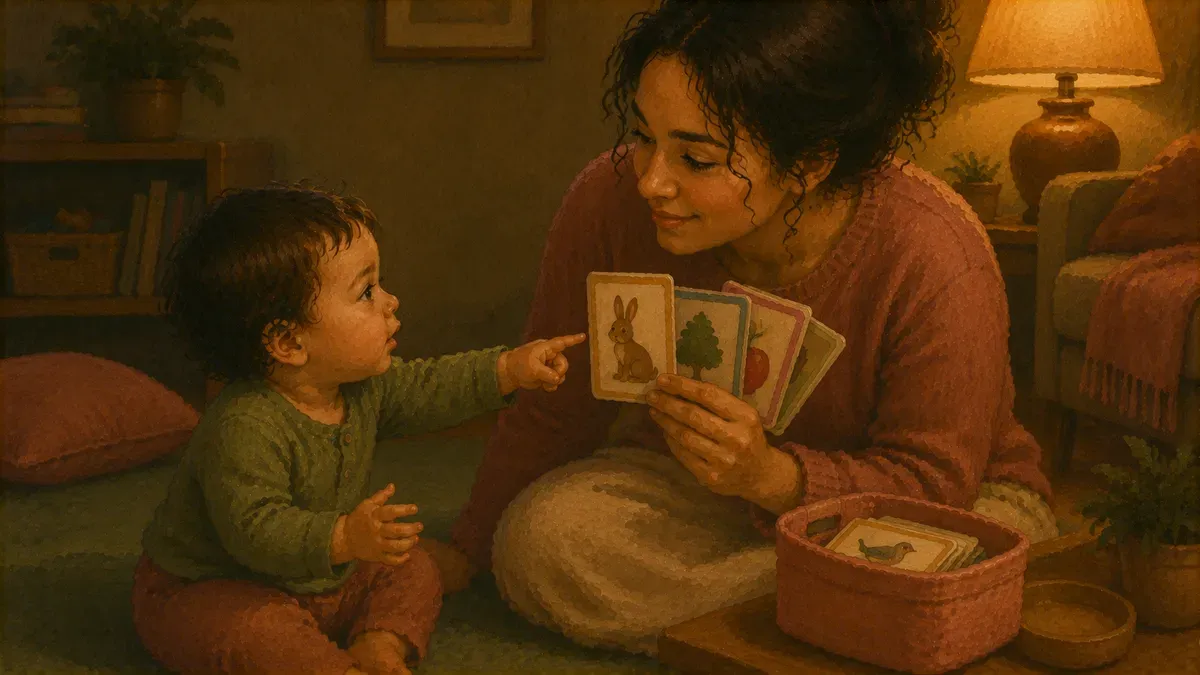
Pointing opens the door. The card holds it open until the word walks through.
Everyday Ways to Encourage Your Baby to Talk
You don’t need a curriculum to grow a talker. The two things that move the needle most are the way you talk all day long, and the little setups that give your baby a real reason to use a sound.
Talk, Narrate, and Use Parentese
Narrate your day like a sportscaster nobody asked for. “Mama’s pouring the milk. Cold milk. In the cup.” That running commentary, called parallel talk when you describe what your baby is doing, floods ordinary moments with words tied to real objects and actions.
The sing-song voice you slip into without thinking has a name: parentese. Stretched vowels, higher pitch, slow and clear. Babies lean toward it because it’s easy to track.
It also works. A University of Washington study published in PNAS coached parents to use parentese, and those babies babbled more and said more words by 14 months than the babies whose parents weren’t coached.
Three habits that turn talk into actual back-and-forth:
- Get down to eye level so it’s true face-to-face interaction, not voices from across the room.
- Pause after you say something. Two or three seconds of silence is your baby’s turn to answer, even if the answer is just a squawk.
- Treat every sound they make as a reply, and say something back.
That steady auditory exposure, the language-rich environment people keep talking about, isn’t really about quantity of words. It’s about the loop. You say a thing, you wait, they offer something, you build on it.
Play, Read, and Create Reasons to Communicate
A word only matters when your baby wants something badly enough to use it. So build in the reasons.
Read every day, but read like a slob. Skip the text, point at the dog, say “dog,” let her flip the pages backward.
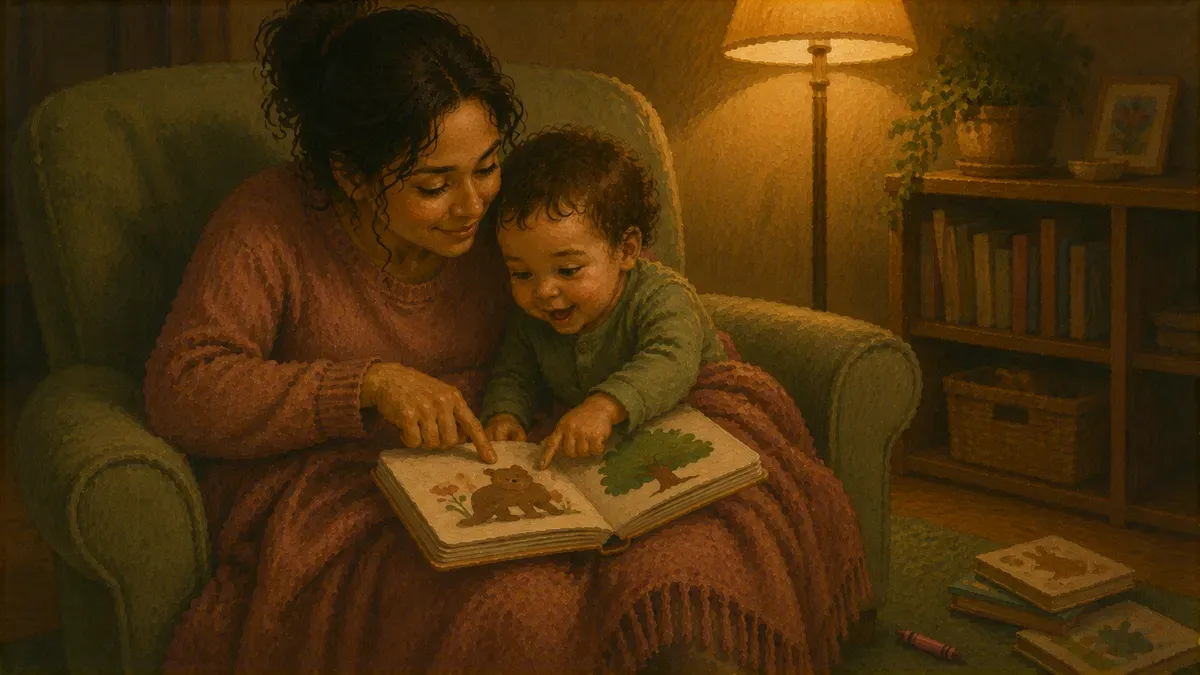
- Read every day — skip the text, point at the pictures, and name what you see.
- Label things during play: line up the blocks and say the colors, push the truck and say “go.”
- Use cause-and-effect toys that pop or light up, then pause and fish for “again?”
One more setup that earns its place: hand over a crayon but keep the paper. The gap between wanting and getting is exactly where a gesture, a grunt, or a word shows up, and every one of those is real vocabulary growth.
If your kid is past the baby stage and the words still aren’t coming, our games for speech therapy at home take this same play-based approach a step further. None of this is therapy. It’s just stacking the day with small invitations to talk, then leaving room for the answer.
Red Flags and When to Get a Speech Evaluation
Most of the time, a quiet toddler is just a toddler on their own clock. But a few patterns are worth a closer look, so here’s what actually counts as a red flag, how a speech delay differs from autism, and what early help looks like.
Warning Signs by Age
Forget tracking every word. Watch for the absences instead. The ones that make me suggest a friend call her pediatrician are pretty specific:
- No babbling, no back-and-forth sounds, by around 12 months
- No clear words by 16 months
- Losing skills she used to have, like a word or a wave that just stopped
- Not pointing, waving, or using gestures to ask for things
- No two-word combos by age 2
That last one ties back to the milestone checklist you’ve already seen in this guide, so I won’t repeat the numbers. The pattern that worries me most is regression. A late talker who is slowly building usually keeps her existing skills and adds to them. Losing words or eye contact is the signal to stop waiting and book a speech evaluation.
You don’t need a diagnosis to ask for a speech evaluation. If a language disorder is on the table, an SLP will sort out the why. The codes they work from, like ICD-10’s F80.1 for expressive language disorder and the broader F80.9, exist precisely so a speech delay gets named and worked on, not shrugged off. None of that is yours to memorize. It’s just proof the system has a clear path once you raise your hand.
Speech Delay vs. Autism: How to Tell
This is the question I get most, usually whispered, usually late at night. Here’s the honest version: a speech delay on its own and autism can look alike at first, and a few minutes of watching won’t settle it. What helps is looking past the words to the back-and-forth.
The difference often lives in social connection, not vocabulary. A child with a plain speech delay still wants in. - Points to share excitement, not just to request something
- Brings you the toy so you can look at it together
- Checks your face for your reaction
- Follows your gaze when you look at something across the room That last one, joint attention, is the big tell. One study comparing autistic kids with kids who had a developmental language delay found the language-delayed children responded to joint attention more often, and their gestures were richer and more communicative, while the autistic children showed a joint-attention gap separate from their language trouble.
Which brings up the reassuring part: signs that your autistic child will talk are often already visible before the words arrive. - Gestures: reaching, pointing, pushing things toward you
- Receptive language: she understands what you say even before she can answer back
- Shared looks when something catches her attention
- Physical requests: pulling you by the hand, dragging you toward what she wants Those are communication milestones doing their job, just on a different timeline. Early intervention helps either way, so you never have to be certain before you ask. For the wider picture of how all this connects, see our full guide to building communication and social skills.
Early Intervention and Working With an SLP
The word “evaluation” sounds scarier than the room actually is. A speech-language pathologist mostly plays. Bubbles, picture cards, toys, watching how your kid asks for more, that’s the job. The goal is figuring out where your late talker is and what would nudge her forward, not slapping a label on a 2-year-old.
And the playing works. A 2023 ASHA review of early speech and language programs found these interventions effective right after treatment, with kids who get early help more likely to catch up to peers. Earlier is genuinely better.
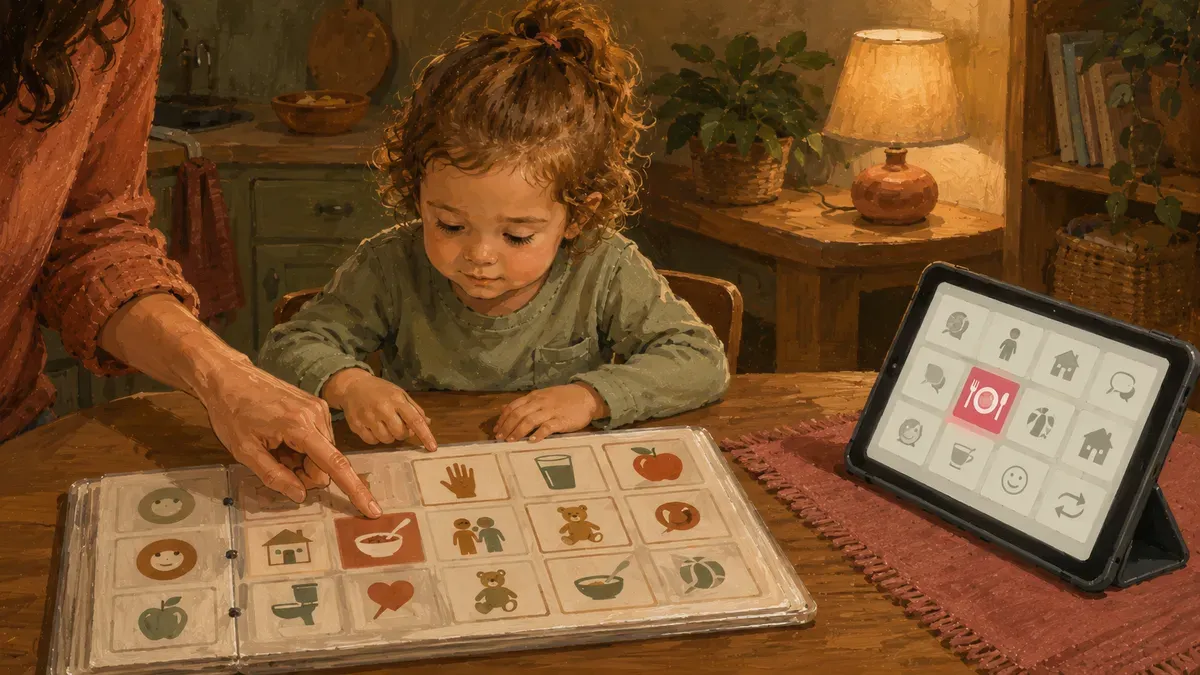
An SLP also won’t make your kid choose between talking and other tools. - Picture communication cards: a way to ask and answer right now
- Sign language: builds the back-and-forth while speech is still coming
- AAC devices: a full voice on a device, not a workaround If a language disorder turns out to be the case, you’ll have a plan and a partner. And if it’s just a slow start, you’ll get peace of mind. Either answer beats lying awake guessing.
Found this useful? Save it for the next rough afternoon.
Questions parents ask me about this
When do babies normally start talking and saying words?
Most babies say their first real word somewhere between 10 and 14 months, with 12 months being the typical landmark. By 18 months, many kids have 10 to 20 words. Two-word combos like "more milk" usually show up between 18 and 24 months. That said, some perfectly healthy kids take a bit longer, so one late word is rarely the whole story.
At what age do babies say yes?
"Yes" is a tricky one because it's abstract. Babies learn concrete words (mama, ball, more, no) well before they nail agreement words. Most kids don't use "yes" reliably until somewhere around 18 to 24 months, and even then it often sounds like an enthusiastic "yeah" before it becomes a clear word. No need to rush it.
How many words should a 12 month old say?
Anywhere from zero to a handful, and both can be fine. A 12-month-old typically has about one or two words, but some kids that age are still in the babbling stage and hit their word burst a month or two later. What matters more at 12 months is whether your baby is pointing, making eye contact, and responding to their name. Those gestures and social cues predict language better than the word count right now.
Is it normal for a 2 year old to not talk yet?
It depends on what "not talking" means. A 2-year-old with no words, no gestures, and no attempt to communicate is a reason to get a speech evaluation. Not to panic, but to move quickly, because early support really does help. A 2-year-old with 20 words and clear communication intent but no sentences yet lands in a gray zone worth discussing with your pediatrician. The regression piece matters too: if a child had words and lost them, bring that up right away.
Does baby sign language delay talking?
No. Research consistently shows it does not slow speech development, and for many kids it seems to support it. Sign gives babies a way to communicate wants before their mouth can form the words, which closes the wanting-getting gap that actually drives new words. Keep pairing the sign with the spoken word every time, and let speech take its own pace.
Can too much screen time delay my baby's speech?
Heavy screen exposure has been linked to delays in expressive language, which tracks with what early childhood guidance recommends: limit screens for babies under 18 months because screen time tends to replace face-to-face conversation, and language development runs on that back-and-forth. It's less about the device itself and more about what it crowds out: the eye contact, the turn-taking, the parent narrating what they see. Less screen, more talk, is the practical takeaway.
Do boys talk later than girls?
On average, boys tend to hit language milestones a bit later than girls, but the difference is small and the ranges overlap a lot. It doesn't mean a quiet 18-month-old boy is fine by default. The same red flags apply regardless of sex: no words by 16 months, no gestures, no two-word phrases by age 2. Use the milestones, not the gender average, as your guide.
Written by
Nora Hayes
Mom of two and a former preschool aide. I share the screen-free sensory play and calm-down ideas I test at my own kitchen table, plus what the moms in my little meet-up swear by. A parent passing on what works, not a doctor or a therapist.
More about NoraKeep going
All Communication & AAC-
 Communication & AAC
AAC Devices vs. PECS vs. Cards: Which Comes First
AAC devices, PECS, or cards first? See what each does, what it costs, and how to pick the right starting point for your child.
-
 Communication & AAC
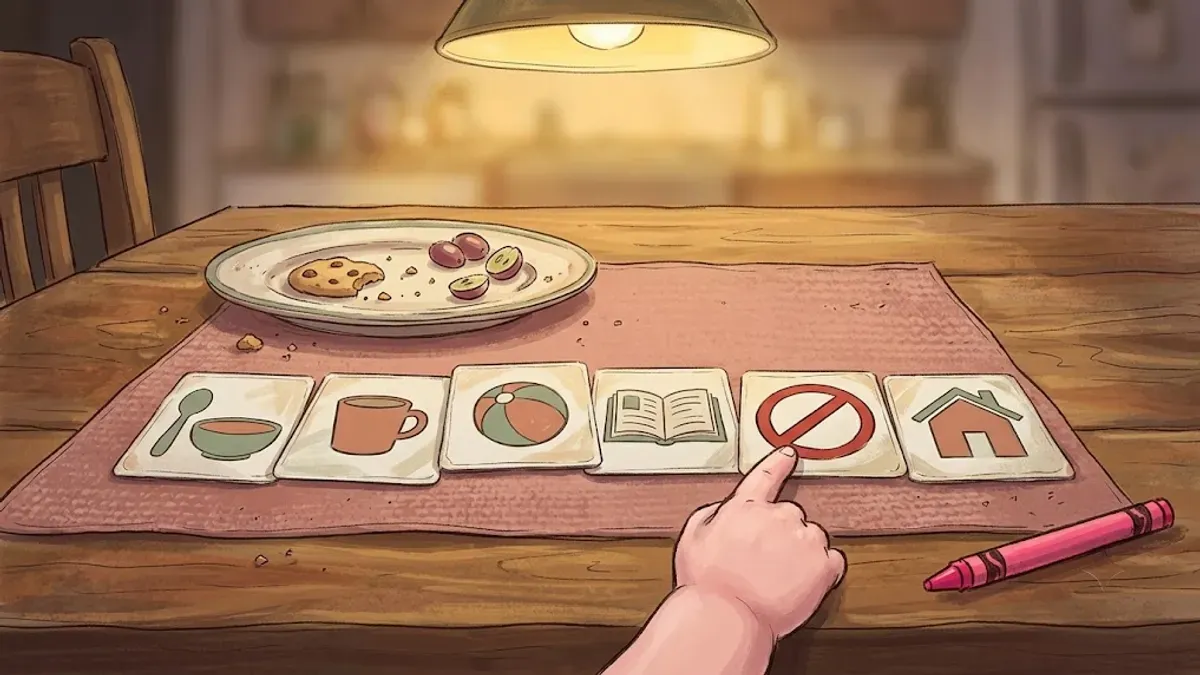
All Done PECS: 6 First-Word Cards to Cut Meltdowns
The all done PECS card is often a toddler's first word, and one of 6 first-word cards that halved our meltdowns. Print your own set free.
-
 Communication & AAC
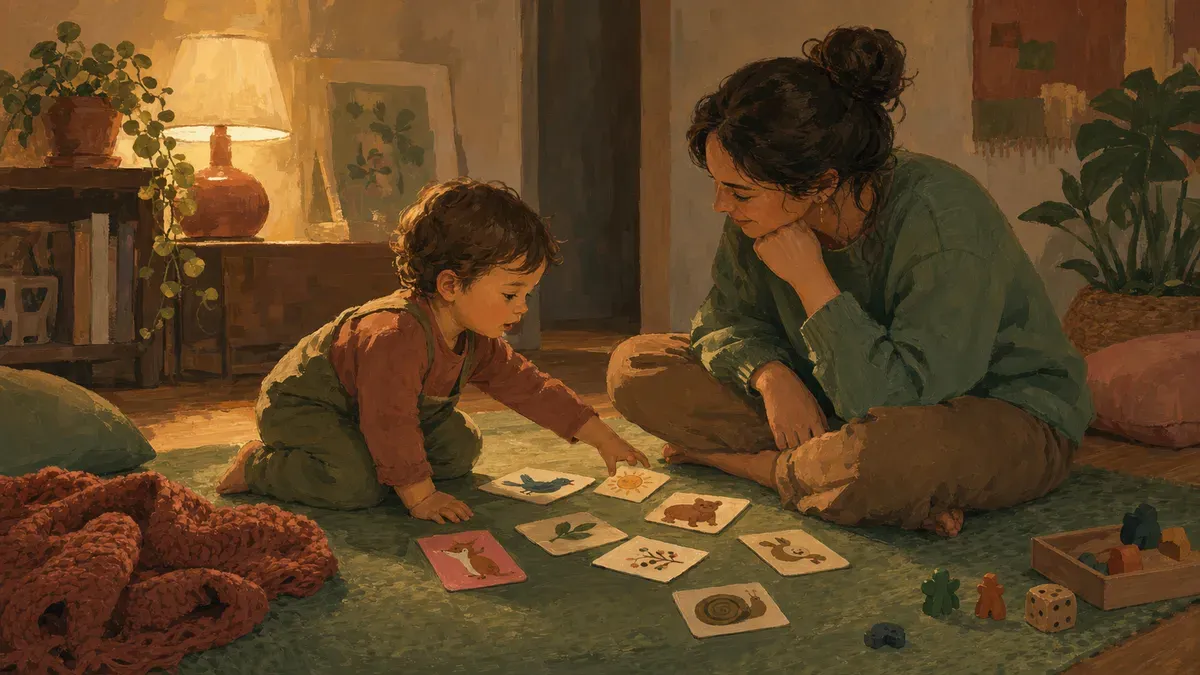
Games for Speech Therapy: Picks for Late Talkers
Most speech games target school-age kids. These games for speech therapy pull words out of late-talking toddlers. Start playing tonight.
-
 Communication & AAC
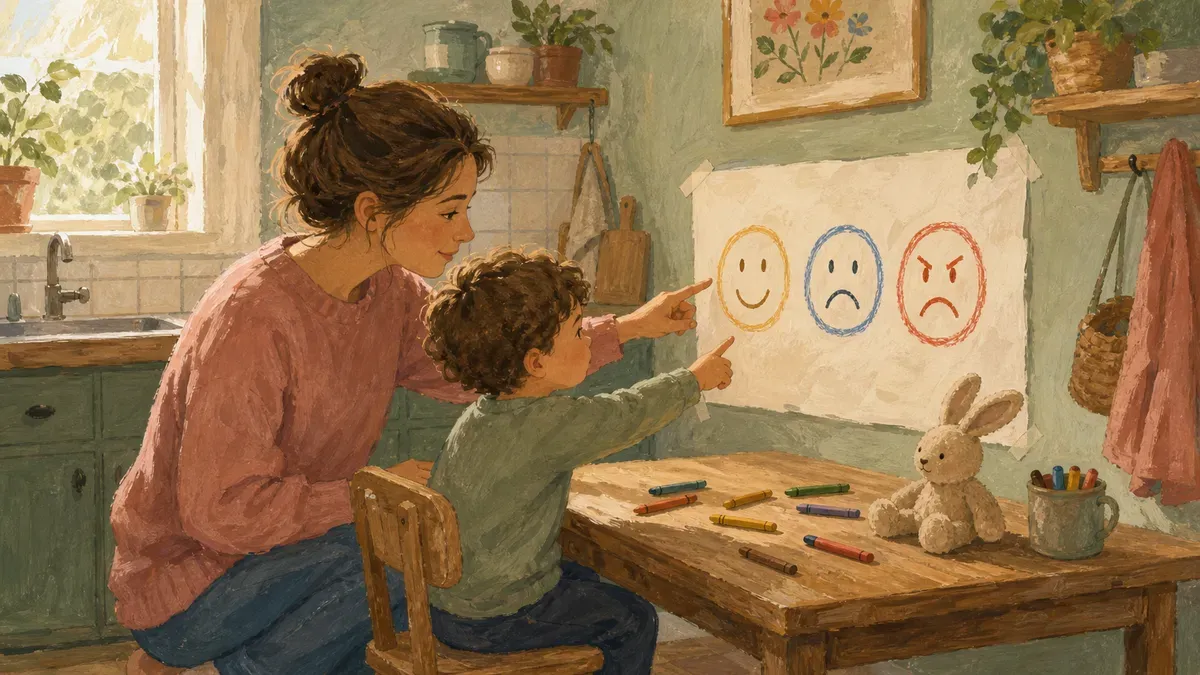
Second Step at Home: Teach Kids Big Feelings Daily
Second Step skills don't need a classroom. Turn 15 everyday moments at home into social-emotional learning that sticks. Start tonight at dinner.