Communication Cards: How to Start With a Late Talker

I am a parent sharing what worked at my house, not medical advice. For anything to do with your child's development or sensory needs, talk to your OT or doctor.
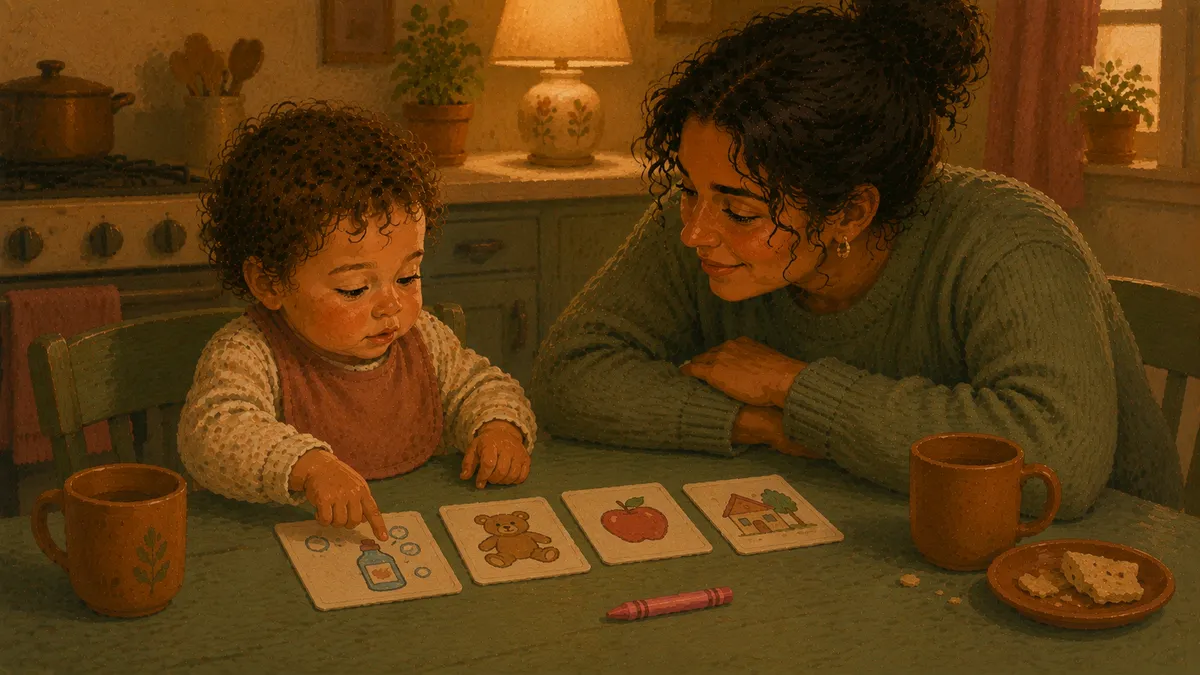
You can start using communication cards with a late talker at home this week, no laminator, no special app, no diagnosis required. I’m Nora Hayes, a former preschool aide and mom to an autistic seven-year-old, and I ran my first set of cards at our kitchen table when words were slow to come. The trick is small and repeatable: a handful of pictures for things your kid already wants, handed over the second they reach, every single day until it clicks.
The plan in brief:
- Print 5 cards for things your child wants most, like milk and bubbles
- Hold the card near the item and hand it over the moment they reach or point
- Repeat the same exchange every day at snack and play for two weeks
Make Your First Set in 20 Minutes (No Laminator Needed)
You don’t need fancy supplies to start, just a printer, scissors, and whatever sticky stuff is in your junk drawer. Here’s how to pick the words, make the cards last, and put them somewhere your kid can actually grab them.
- Choose your first five cards. High-want items from snack, play, and bath routines; the desire is the whole lesson.
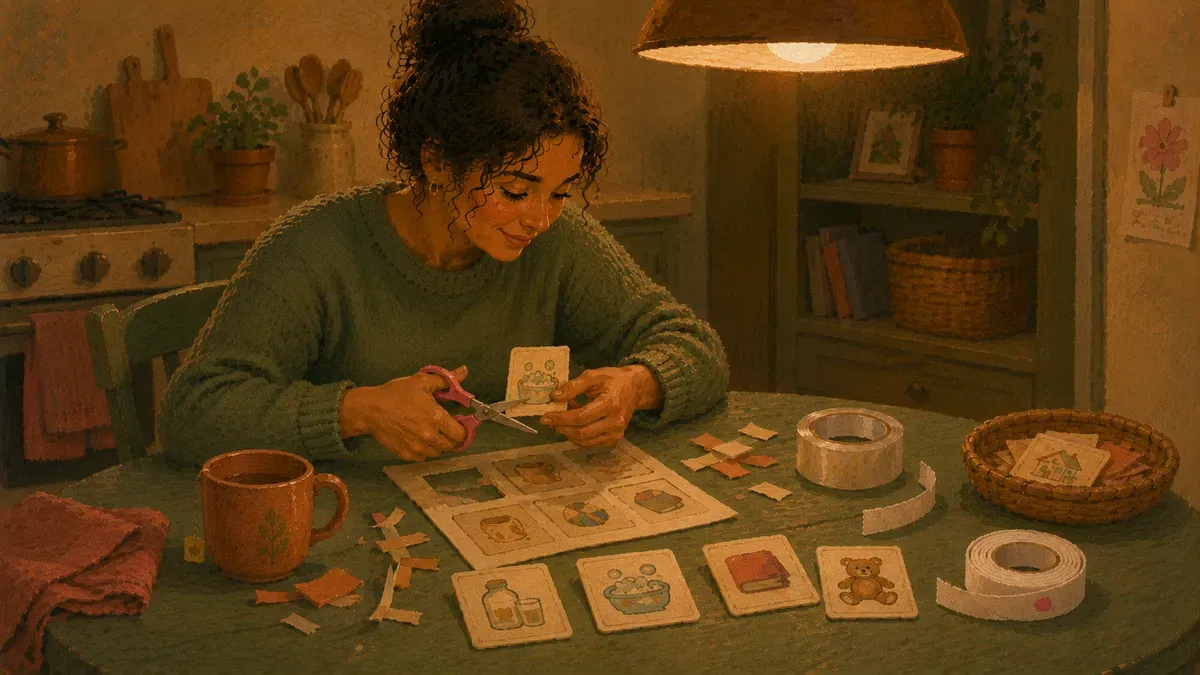
- Protect the printouts. Packing tape, contact paper, or a card sleeve turns a flimsy sheet into something that survives yogurt and chewing.
- Put the board within arm’s reach. A velcro strip on the fridge or a binder-ring flip set clipped to your belt loop works; it only helps when it’s there at the right moment.
Pick five words your child wants most
Start with what your kid already begs for. Milk. Bubbles. The crinkly ball. The snack they whine for every afternoon. These are your first cards, because the want is already there, and that want does all the heavy lifting.
Keep it tight at first. A small communication set of five high-want items beats a folder of fifty they shrug at.
Pick the five things your kid would lose their mind over, not the five you wish they cared about.
This is the same principle the Pyramid Educational Consultants build their first PECS lesson around: start with a few genuinely preferred items, because requesting something they love is the most motivating place to begin a communication system.
Build durable cards without lamination
No laminator? You don’t need one.
- Clear packing tape: lay the card down, cover both sides with overlapping strips, trim the edges. Wide tape and self-adhesive laminating sheets both work as no-machine stand-ins.
- Contact paper: the leftover roll from lining a shelf. Sandwich the card between two pieces, press out the bubbles, cut to size.
- A recycled card sleeve: an old trading-card or loyalty-card sleeve. Slide the picture in, done in five seconds.
Any of these turns a flimsy printout into a real communication card you can wipe down after a yogurt-handed grab. For the full printable set, see 12 communication cards every nonverbal toddler should have and run them through whichever method you’ve got.
Set up a grab-and-go board
Cards buried in a drawer get used zero times, so mount them where life happens.
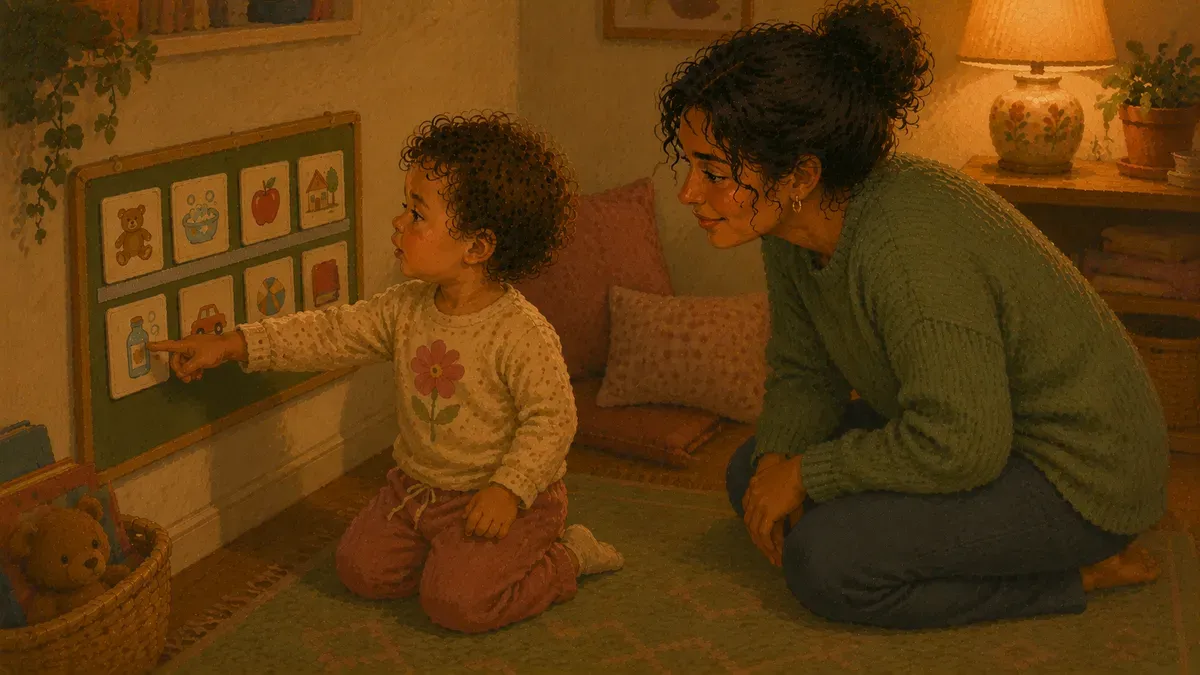
Stick a strip of sticky-back velcro on the fridge, the high-chair tray, or a cheap clipboard, then velcro each card on so it peels off for the exchange. No velcro board on hand? A binder ring through a hole-punched corner makes a flip-through set you can clip to a belt loop or a diaper bag.
Park your little velcro board or sentence strip wherever the routine lives, snack table, play mat, by the door, so the cards are always an arm’s length away when the wanting hits. A communication system only works if it’s there in the moment, not two rooms over.
Teaching the First Exchange Step by Step
With the cards parked where the wanting happens, the next job is teaching your child what they’re for. Here’s the whole thing in one line: prompt the hand-over, hand back the item the instant the card lands, then slowly stretch the distance between you. Three moves, in that order.
- Guide their hands through the card exchange.
- Deliver the item the moment the card touches your palm.
- Build distance gradually until the exchange holds across the room.

Prompt the hand-over, then fade your help
The first exchange almost never happens on its own, and that’s normal. The smoothest way to teach it borrows from PECS stage 1, which uses two grown-ups. One sits in front holding the snack your kid actually wants. The other sits behind and quietly guides the hands.
The job of the person behind is purely physical prompting: no talking, no pointing. When your child reaches for the bubbles, you gently help them pick up the card and place it into the open hand of the partner up front. That whole pick-up, reach, release move is the picture exchange.
- Today: guide the full pick-up, reach, and release.
- Tomorrow: nudge the elbow, let them do the rest.
- Day after: just wait.
Across the early PECS phases the goal stays the same: that exchange interaction happening with no help at all, started by your kid because they wanted something. If you’ve already worked on a finished card, the same fading logic carries straight over from all done pecs.
Respond instantly so the card means something
Speed is the whole lesson here.
- Card hits your hand → bubbles appear immediately.
- No praise first, no waiting for them to say it.
- Name it once as you hand it over: “Bubbles!”
That instant payoff is the reinforcer doing its job, and it’s the thing that makes the picture worth picking up again.
Why the rush? Because a slow response teaches the opposite of what you want. Wait too long and the card stops feeling connected to the result. A fast hand-back is how you support communication that genuinely sticks, and it’s where the frustration reduction comes from. The reach used to end in a tantrum. Now it ends in bubbles. That swap, from screaming to a card, is functional communication starting to click.
Increase the distance once it clicks
Once your child hands the card over smoothly while sitting right beside you, make it a little harder on purpose. Start by sliding the card a few inches farther from their hand so they have to reach or stand to grab it.
Then move yourself. Take a step back so they have to carry the card to you, not just drop it in a waiting palm. This is picture distancing, and it teaches a real-world truth: the person who can give you what you want isn’t always sitting in your lap.
Go slow and read your kid.
- Go slow and watch their reaction.
- If they give up on a bigger gap, shrink it back and try again the next day.
That’s the moment the whole communication system stops being a tabletop drill and starts being how your kid asks for things, wherever you happen to be.
Why Cards Help Late Talkers Find Their Words
If you’ve ever watched your kid melt down because they wanted something and couldn’t tell you what, you already know the real problem isn’t stubbornness. It’s that the words aren’t there yet, and the frustration fills the gap. Here’s why a stack of pictures helps with both.
Visuals lower the pressure to speak
For a late talker, every demand to “use your words” lands as pressure, and pressure shuts a kid down faster than almost anything. A picture takes that pressure off. Your child doesn’t have to find a sound on the spot. They point or hand you a card, and they’re understood.
That one shift does a lot. When a nonverbal or barely-verbal kid has a reliable way to ask, the meltdowns that come from not being understood start to drop off. Visual supports give them a channel that works while spoken language is still loading.
And here’s the part that surprises parents. Less frustration frees up real capacity. A kid who isn’t fighting to be understood has room to listen, copy a sound, try a word. The visual cards aren’t a detour around language development. They’re what clears the runway for it.
Cards build words, they don’t replace them
The fear I hear most often in conversations with other parents: “If I give my kid pictures, will they ever bother to talk?” The research on late talkers and language development is reassuring on this, and it’s worth saying plainly.
- A systematic review by Millar, Light, and Schlosser found that AAC interventions don’t inhibit speech production, and may actually support it.
- A later review by Schlosser and Wendt looking at children with autism reached the same place, with most studies reporting an increase in speech after AAC was introduced.
- Across both reviews, the consistent finding is that cards don’t compete with talking. They tend to walk alongside it.
That tracks with what I’ve watched happen. The card gives the meaning, you say the word back every single time, and the spoken word follows the picture. Functional communication first, verbal speech close behind. If you’re still wondering when do babies start talking and where your child fits, that timeline lives in another guide, along with our full library of communication and social skills guides.
Cards, PECS, and AAC Apps: Which Fits Your Child
You’ve got a working set of cards on the wall, so here’s the next fork in the road: keep it homemade, follow the full PECS protocol, or move to a tablet. Below is what each one actually asks of you.
Plain cards versus the formal PECS protocol
The cards you taped together this morning are the everyday kind: a picture, handed over, a thing handed back. That’s communication, full stop, and most kids start exactly there.
PECS is a different animal. It’s a structured six-phase protocol developed in 1984 by Andy Bondy and Lori Frost, grounded in applied behavior analysis, and the folks at Pyramid Educational Consultants describe it as using specific prompting, reinforcement, and systematic error correction, not just handing a kid pictures. The speech pathology picture cards an SLP pulls out in a session often run on this same framework, building from single requests up through the PECS phases toward full sentences.
So which are you doing? If you’re swapping one card for one want, you’re using a picture exchange the casual way. If you want every phase done by the book, that’s where a trained pro earns their keep.
When an AAC app makes more sense
Paper has a ceiling. Once your child wants to say more than a wall of cards can hold, a tablet with all things communication packed into one screen starts to make sense.
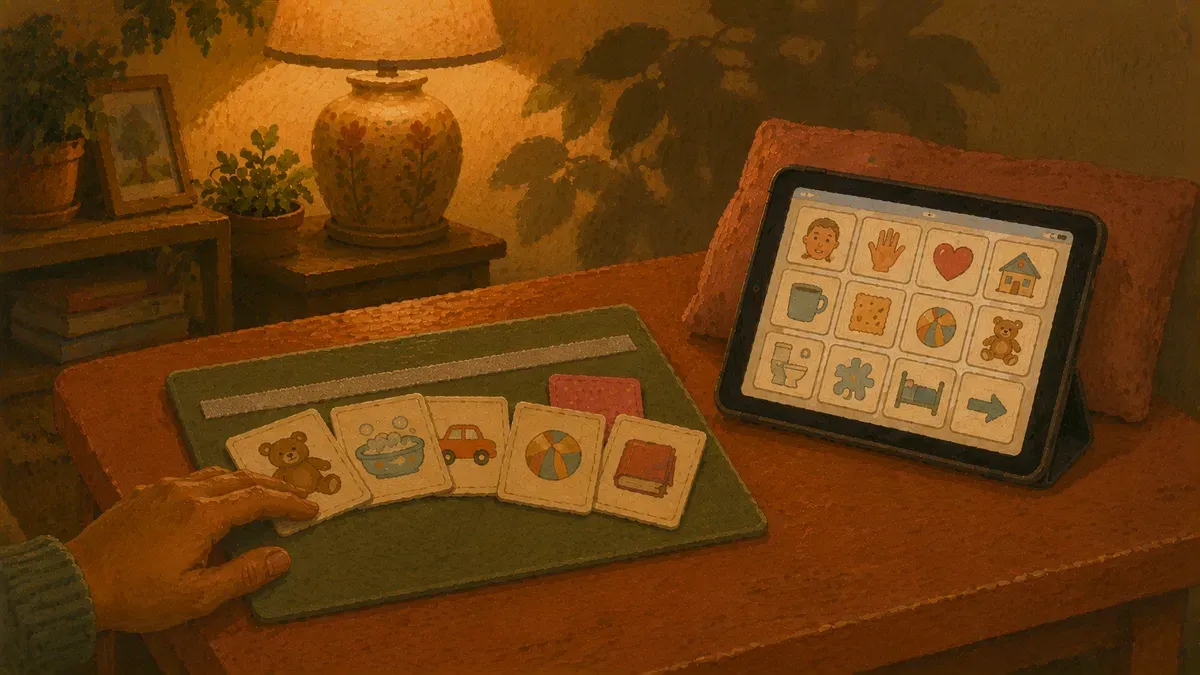
Here’s how the three options stack up on cost, vocabulary, and when each fits:
| Option | Cost | Vocabulary | Best when |
|---|---|---|---|
| Paper cards | Pennies | A handful you make | Just starting, want-based requests |
| AAC app | $100 to $300 | Hundreds, expandable | Outgrowing paper, wants sentences |
| Speech device | $1,000 to $5,000 | Large, built-in | A pro recommends a dedicated tool |
Those app and device ranges come from Speech and Language Kids, reflecting approximate 2025 retail and varying by vendor. Before you spend, loop in a speech pathologist, because picking the right vocabulary layout matters more than the price tag. There’s guidance on AAC for young children worth reading, and for the full breakdown of how AAC devices compare to cards, that lives in its own guide.
My take: stay on paper while it’s working, and let a pro tell you when it’s time to upgrade.
Troubleshooting Resistance, Routines, and Next Steps
Most of the bumps you hit are fixable without a pro. Here’s what to do when the cards get ignored, how to fold them into your day, and how to read the signs that your kid is ready for more.
If your child ignores or throws the cards
A thrown card almost never means the system failed. It usually means the item on it wasn’t worth the effort.
So go back to the start: pick something your kid would crawl across the floor for. Goldfish, the iPad, bubbles, whatever makes their eyes light up. A weak reinforcer gets you a weak result every time.
Next, cut the choices. One card, one thing they want, nothing else on the board to muddy the moment.
Then check your timing. If the reward shows up three seconds late, the connection breaks. Hand the item over the instant the card lands in your palm.
- Frustrated kid? Ease back to gentle physical prompting and let your communicative partner guide their hand again, which keeps the frustration reduction working in your favor.
If it falls apart today, that’s normal. Try again tomorrow with a better snack.
Weave cards into snack, bath, and play
Stop treating this like a lesson. A separate “card time” is one more thing to remember, and you’ll drop it by Thursday.
Instead, anchor the cards to stuff that already happens. Tape a milk card to the fridge. Clip a bubble card to the bath caddy. Tuck a couple in the toy bin lid.
Now every snack, every bath, every play session becomes a rep, and you didn’t add a single task to your day.
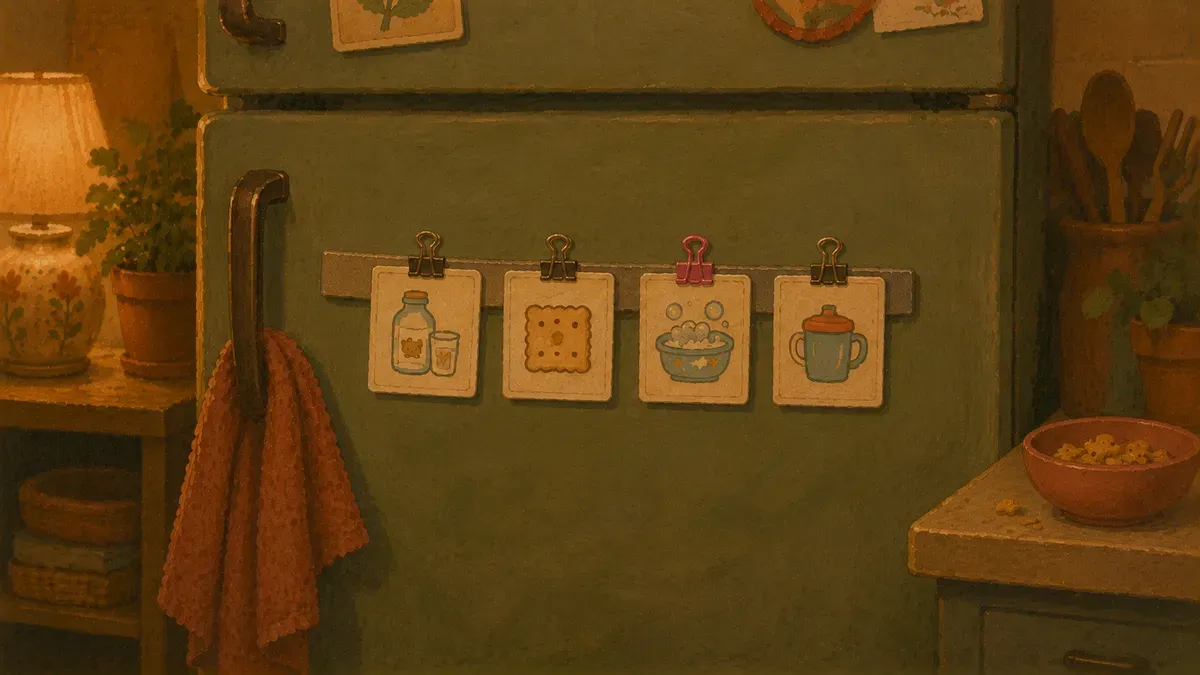
Building the communication system into your daily routines is the move backed by the AFIRM toddler practice guidance, which points to natural moments like snack and bath because that’s where your kid’s real wants live. Visual supports tucked into the day mean any caregiver, grandma included, can run it without a script. For more low-pressure practice, these games for speech therapy at home pair nicely with the cards.
Know when to add words or fade the cards
Watch for the signs your kid is outgrowing five cards. They reach for the board before you prompt. They want things that aren’t on it. They start pairing the picture with a sound.
That’s your cue to grow the communication system. Add new cards for the words they’re chasing, then bring in a sentence strip so “I want” sits in front of the picture.
That sentence-building stage has a marker worth knowing: per the Center for Autism PECS breakdown, kids typically start constructing sentences once they can use and tell apart 12 to 20 pictures.
Keep saying the word out loud as they hand you each card. Verbal speech tends to ride in on the back of the picture, and language development moves at its own pace. When in doubt, loop in your SLP and let them call the next step.
Found this useful? Save it for the next rough afternoon.
Questions parents ask me about this
How do I use communication cards with a late talker at home?
Start with five pictures of things your child wants most, like their favorite snack, a toy, or bubbles. Whenever they reach or fuss for that item, hold the card in front of them and wait for them to hand it to you before you give the item. Say the word aloud as you hand it over. Do this at the same moments every day, like snack and bath, until the exchange becomes habit.
At what age should I start using communication cards?
There is no minimum age. If your child is showing frustration because they cannot get their needs across, cards can help, whether that is at 18 months or 4 years. You do not need a diagnosis or a referral before trying them at home. If you have concerns about your child's speech development, a speech-language pathologist can help you build a plan alongside whatever you start now.
Will communication cards delay my child's speech?
No. Research consistently shows that picture-based communication does not hold back spoken language and often supports it. When a child is understood without having to speak, frustration drops, and that is when words tend to come. Keep saying the word out loud every time your child hands you a card, and you give spoken language the best chance to follow.
Do communication cards only work for autistic children?
No. Cards are useful for any child who is not yet talking enough to get their needs met, including late talkers, kids with other developmental differences, and children who simply communicate more easily through pictures for a stretch of time. The approach works because it removes the barrier of spoken output, not because of any specific diagnosis.
How many communication cards should I start with?
Start with five. More than that early on splits a child's attention and makes the learning harder. Pick the five things your child wants most, because a strong built-in reward is what makes the exchange worth doing for them. Once they are handing cards over reliably on their own without a prompt, you can begin adding more.
How do I store and organize communication cards without losing them?
A binder ring is the simplest option: clip the cards together and hang it where you use them most, whether that is the fridge, the snack cabinet, or the bath caddy. A velcro board on the wall keeps cards at your child's eye level and within reach. The point is that the cards are always at the moment you need them, not in a drawer.
Are printable communication cards as good as a paid AAC app?
For a first step, yes. Printed cards cost almost nothing, require no screen, and work exactly the same way for early exchanges. The practical limit of paper is vocabulary: once your child is communicating with many pictures and wants more words than you can print and manage, an app or dedicated device opens up more options. Start with paper, and let your child's growth tell you when to look further.
Written by
Nora Hayes
Mom of two and a former preschool aide. I share the screen-free sensory play and calm-down ideas I test at my own kitchen table, plus what the moms in my little meet-up swear by. A parent passing on what works, not a doctor or a therapist.
More about NoraKeep going
All Communication & AAC-
 Communication & AAC
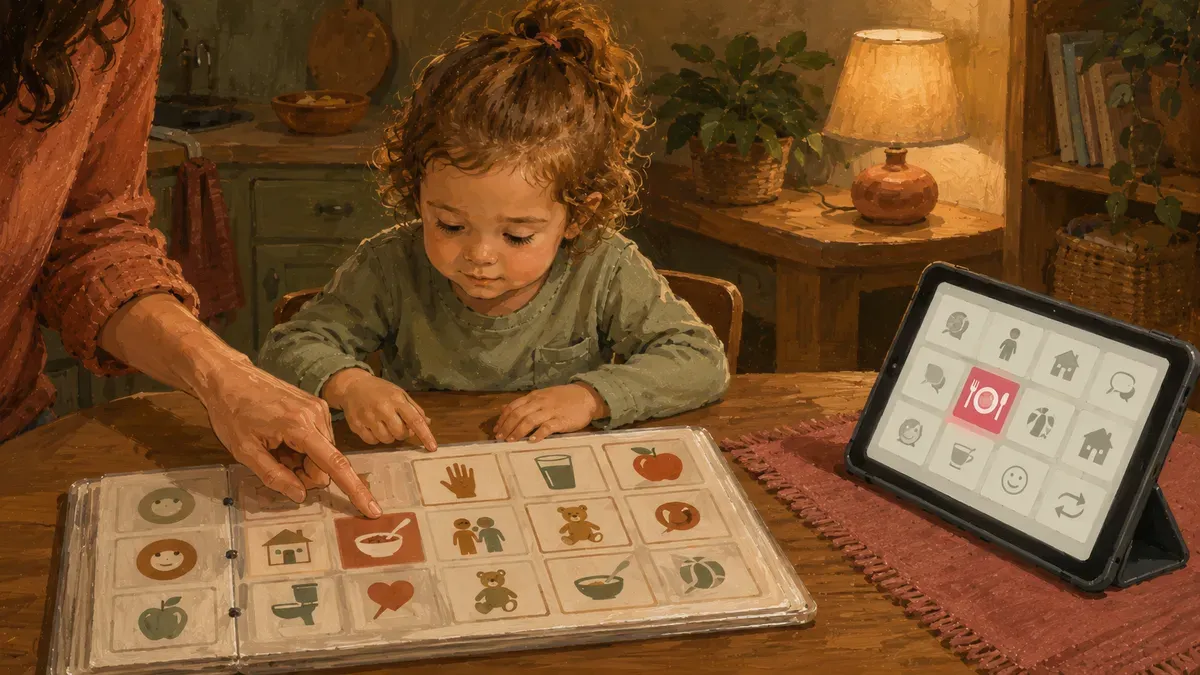
AAC Devices vs. PECS vs. Cards: Which Comes First
AAC devices, PECS, or cards first? See what each does, what it costs, and how to pick the right starting point for your child.
-
 Communication & AAC
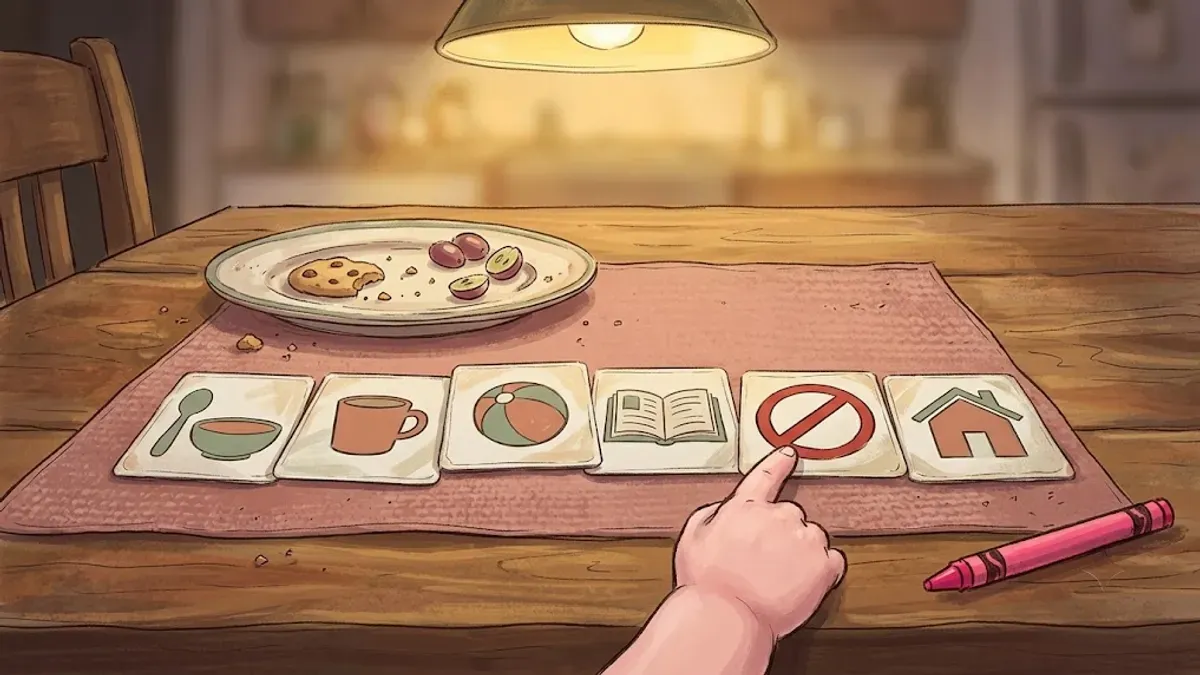
All Done PECS: 6 First-Word Cards to Cut Meltdowns
The all done PECS card is often a toddler's first word, and one of 6 first-word cards that halved our meltdowns. Print your own set free.
-
 Communication & AAC
Games for Speech Therapy: Picks for Late Talkers
Most speech games target school-age kids. These games for speech therapy pull words out of late-talking toddlers. Start playing tonight.
-
 Communication & AAC
Second Step at Home: Teach Kids Big Feelings Daily
Second Step skills don't need a classroom. Turn 15 everyday moments at home into social-emotional learning that sticks. Start tonight at dinner.