All Done PECS and 5 More First-Word Cards

I am a parent sharing what worked at my house, not medical advice. For anything to do with your child's development or sensory needs, talk to your OT or doctor.
Some links here are affiliate links. If you buy through one, I may earn a small commission at no extra cost to you. As an Amazon Associate I earn from qualifying purchases. I only point to things I'd actually use with my own two.
An all done PECS card is a small picture your kid hands you to say “I’m finished” without screaming it, and it leans on real evidence: PECS is the only AAC system Pediatrics (2012) classified as evidence-based for autism, per Pyramid Educational Consultants.
I’m Nora Hayes, a former preschool aide raising an autistic 7-year-old, and these six cards (I want, I need, break, eat, more, and all done) are the ones I’d hand a worn-out parent first, because they cover the wants and needs behind most toddler blowups.
Below I’ll walk you through what each card does, when your kid is ready for them, and how to get a set in your hands tonight, printed at the kitchen table or bought ready-made.
What the ‘All Done’ PECS Card Actually Is
The ‘all done’ card, defined
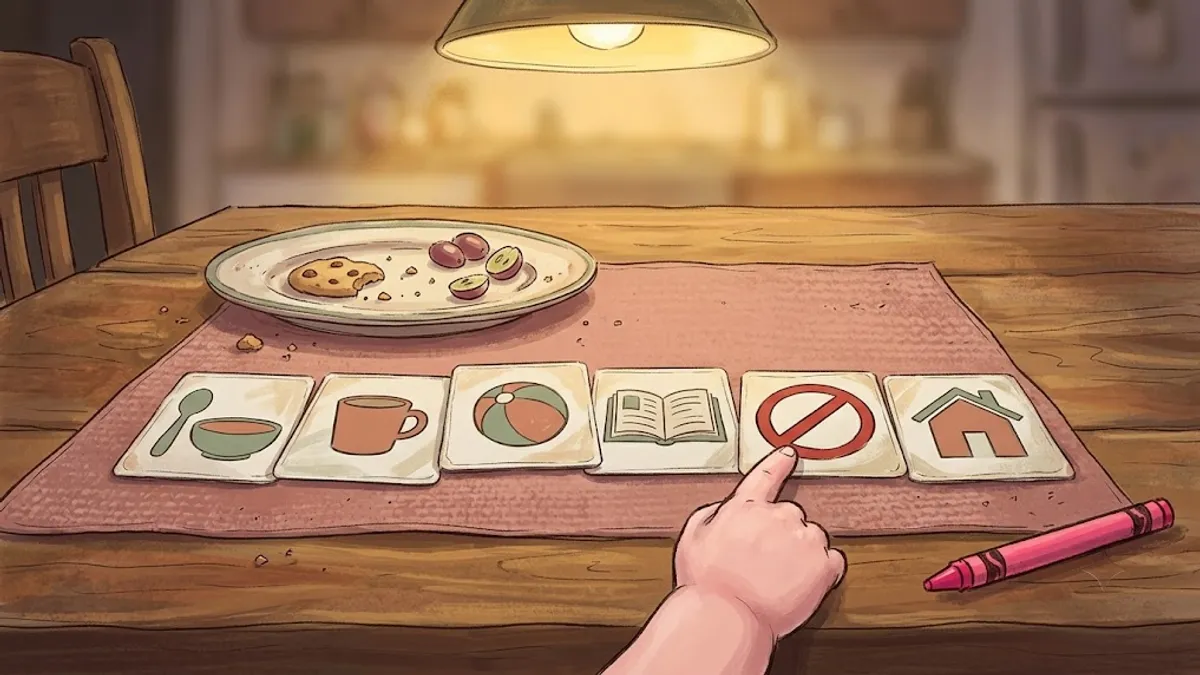
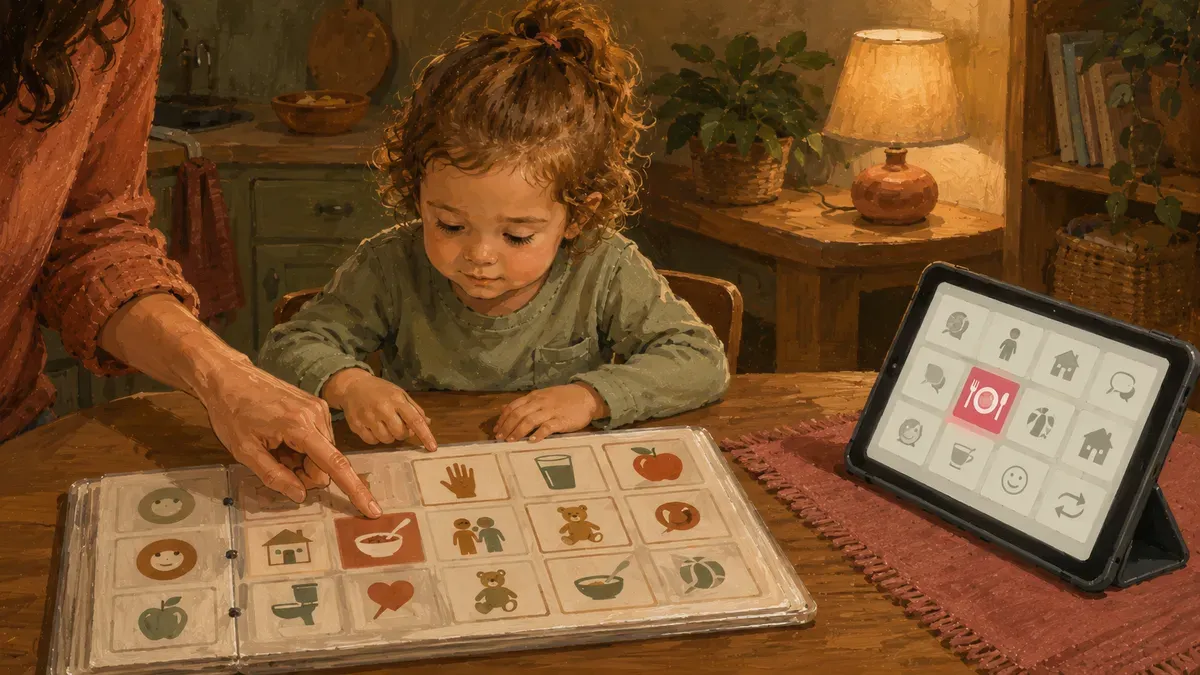
The all done PECS card is a single graphic symbol your child picks up and hands to you to say: this is finished. That’s the whole mechanic. One picture, one exchange, one clear message.
The picture exchange communication system was developed in 1985 by Andy Bondy and Lori Frost at the Delaware Autism Program around one act: hand a picture to a communicative partner, and they respond. The all done icon typically shows a red circle with a line through it, or two hands pushing outward, a visual that reads as “stop” or “finished” even before a child has words for it.
This card falls under requesting in communication social skills broadly: your child is not labeling the activity, they’re acting on it.
Why ‘all done’ is often the first card that sticks
Two motivators drive toddler communication:
- Getting more of something they love (nice, but not urgent)
- Getting out of something they hate (urgent, every time)
Without a working way to say “stop”:
- Crying, hitting, or shutting down fill the gap
- The all done exchange hands them a working exit instead
- Functional communication replaces the behavior that was doing the job before
The research backs this up.
Research on functional communication training, which includes picture-card exchanges for escape exactly like the all done card, found an average 90% reduction in problem behaviors like aggression and self-injury across multiple studies over a 5 to 10 month treatment span. The all done PECS card isn’t a formal behavioral intervention when you’re using it at the dinner table. But the principle holds: give the child a working way out, and they rarely need to fight their way out.
The 6 First-Word Cards That Do the Heavy Lifting
Not every word is worth a card on day one. These six pull the most weight because each one hands your toddler a way to act on a feeling instead of melting under it.
‘I want’ and ‘I need’: the requests that unlock everything
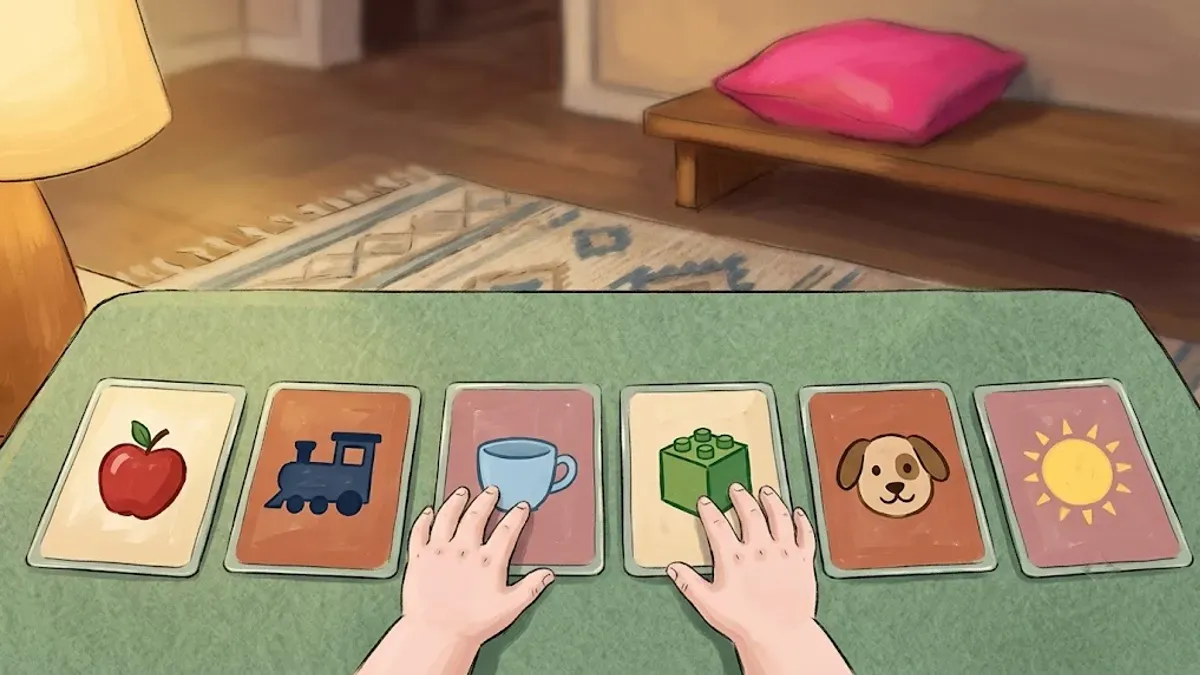
Start here. A child who can hand you an “I want” card has just traded pointing and crying for an actual request, and that swap changes the whole dynamic. Instead of guessing why June is fussing at the snack cupboard, she gives me a picture and tells me.
That first exchange teaches the rule underneath all of this: a symbol gets you the thing you want. “I need” works the same way for the stuff that isn’t a treat but still matters, like a blanket or a turn on the swing.
The trick is to anchor these cards to a real motivator. Pair the picture exchange with a preferred item your kid already loves, and the requesting clicks fast. No favorite involved, and the functional communication has nothing to push against.
‘Break’ and ‘I need a break’: heading off overload
The other cards on the board get your kid something they want. This one gives them the words to say “this is too much” before it tips over, which means they can come back to the task instead of shutting down completely.
A break card gives a kid a way to say “this is too much” before the room gets too loud, the texture gets too gross, or the task runs too long. It’s self-advocacy in one picture. You catch the buildup, hand them the option, and let them step away instead of escalating.
This isn’t a soft idea. As a behavioral intervention, teaching a child to exchange a “break, please” picture instead of acting out to escape a task is documented practice, including in federal research on functional communication training from the U.S. Department of Education. Among visual supports, a break card earns its spot.
‘Eat,’ ‘more,’ and ‘all done’: the mealtime trio
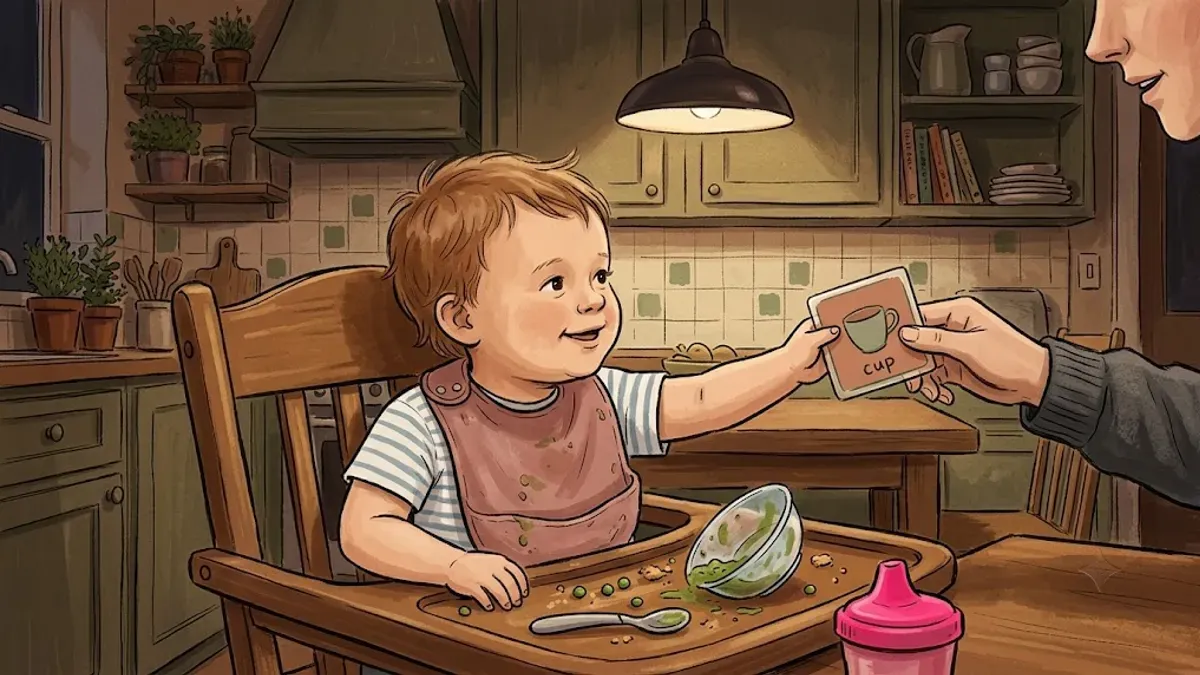
Meals are where a lot of toddler battles live, so these three graphic symbols hand your kid the controls. The eat icon starts it. They tell you they’re hungry instead of arching their back in the highchair while you guess.
“More” runs the middle. A toddler who can request another bite of the good stuff stays in it longer, and it’s an easy win because the food is its own reinforcer. The requesting is built right in.
“All done” ends it cleanly, no plate on the floor required. Together they hand over the start, the middle, and the stop of a meal, and that small bit of control through picture exchange does more for functional communication than any “two more bites” ever did. If you want the wider set, here’s our list of 12 communication cards every nonverbal toddler can use.
How These Cards Cut Meltdowns Before They Start
Most meltdowns don’t arrive without warning. There’s a moment before the storm: the raised shoulders, the wandering eyes, the kid who goes still right before they blow. The problem is that a child who can’t speak yet has no way to flag that moment for you. So it passes, unaddressed, and you both end up on the floor.
That’s the gap picture exchange fills. When a child learns to hand you a break card before they’re already spinning out, they’re doing something significant: spontaneous communication at the exact second it matters. They’re not waiting for you to guess. They’re not melting down to get their message across. They’re using visual supports to say I need out before the window closes.
The behavior goes down because the need gets met.
After a week of consistent card use, most parents notice the same shift: fewer explosions at transition time, more reach-and-hand moments before the peak. The behavioral intervention almost becomes secondary, because the communication does the work.
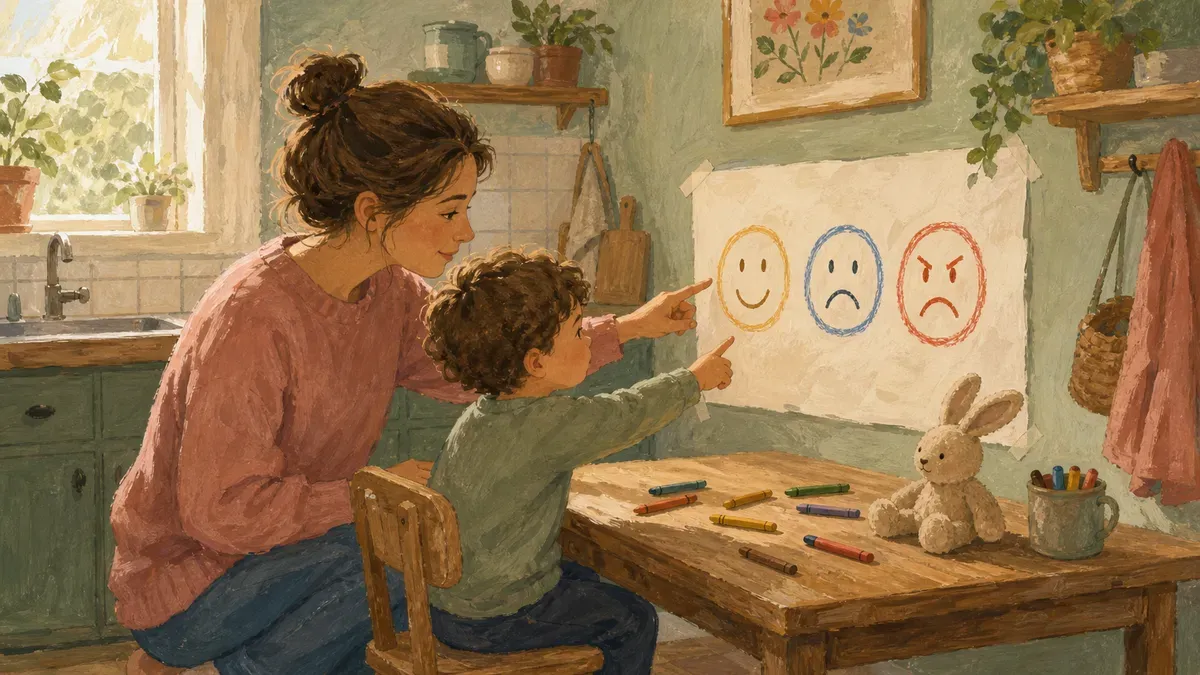
For parents, this translates to something practical. Put a feelings chart near the card display so a child who can recognize scared or angry has a second channel alongside the cards. And if your kid tends to hit overload at transitions, a build calm down corner card set pairs naturally with the break card. One signals the need; the other gives somewhere to land.
When Your Toddler Is Ready to Start
The short version: if your kid wants something they can’t ask for, they’re ready. You don’t wait for a word count. Here’s how the timing actually shakes out, from the first sounds to the moment a picture card starts pulling its weight.
Typical first words vs. first picture cards
Think about what most babies blurt out first. The NIDCD’s early communication and language milestones lists the usual suspects: ‘Hi,’ ‘dog,’ ‘Dada,’ and ‘Mama’ around the first birthday. Sweet, social, and almost useless when your toddler is screaming because snack time ended.
A baby’s first words list is built on connection. A starter card stack is built on need. That’s the whole difference.
Picture cards skip the cute and go straight to function. Instead of waiting for the most common baby first words to arrive on their own schedule, you hand your kid a way to say all done, more, or I want today. One list is social communication. The other is functional communication, and for a frustrated toddler, requesting beats greeting every time. That gap is exactly why early intervention often starts with graphic symbols instead of vocabulary drills.
What age first words usually show up
So what age do babies say their first word? It’s a range, not a deadline.
Per the NIDCD, most kids land one or two words by their first birthday, and by 15 months they’re usually trying one to two beyond mama and dada. But “usually” hides a lot of wiggle. Plenty of toddlers talk later and turn out perfectly chatty, which is why I never treat a calendar as a verdict.
The question of when babies typically begin to talk matters less than whether your kid has a reason to communicate right now. If you’re worried about whether your baby has started talking yet, that’s a conversation for your pediatrician or a speech therapist, not a milestone chart. Cards give nonverbal communication a home while you sort out the timeline.
Cards bridge to speech, not replace it
The fear I hear most: “If I give him a picture, will he ever bother to talk?”
Honest answer, backed by the research. Bondy and Frost, summarizing 25 years of picture exchange, found that using these systems doesn’t inhibit speech, it enhances the likelihood that spoken language develops or improves. A card isn’t a ceiling. It’s a ramp.
Wanting to know when do babies start talking is fair, but speech and symbols grow together, not in competition. Functional communication today builds the pathway for spontaneous communication tomorrow, and a speech therapist can help that generalization stick.
Print Your Own Cards or Buy a Set
Both work. The real question is how fast you need them.
Printing at home is free, and most families start there. Search for a basic needs communication board printable, print on cardstock, laminate if you can. The graphic symbols you need for a starter set (all done, eat, more, break) are available at no cost on dozens of sites. No laminator on the shelf? Self-sealing laminating pouches skip the machine entirely: you line up the card, press it shut with your hands, and that’s it, no heat. At 10 mil they hold up to a toddler’s grip, and other parents rate them 4.6 stars across 130-plus reviews. Plain paper works too; a caregiver has made perfectly good cards with a marker and index cards. The visual symbols don’t have to be beautiful to be understood.
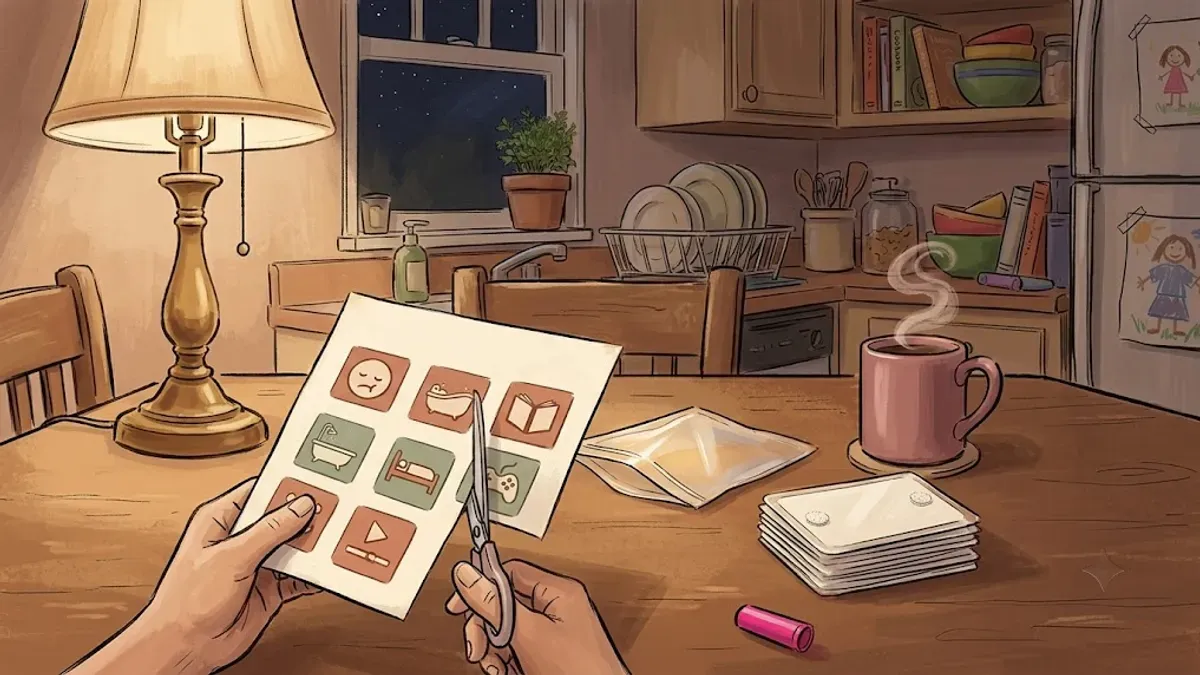
The tradeoff is time. You’ll cut, maybe laminate, punch holes, and back each card with a hook-and-loop dot so it sticks to a board. One 1,000-piece bag of those dots outlasts every card you’ll ever make, and it’s earned 4.7 stars over 2,500-plus reviews. All that prep is 30 to 45 minutes you may not have on a Tuesday night. A purchased set comes pre-laminated, color-coded, and sized for small hands. Some include a communication book with dividers already organized by category, which matters once you move past the first five or six cards and into the later instructional phases of PECS.
| Print at home | Buy a ready-made set | |
|---|---|---|
| Cost | Free | Check the current price on Amazon |
| Parents’ rating | n/a | 4.6★, 1,900+ reviews (Amazon’s Choice) |
| Setup time | 30 to 45 minutes (cut, laminate, punch, velcro) | Ready to use |
| What you get | Whatever symbols you print | 27 cards, sized for ages 3+ |
| Quality | Works fine; dollar-store laminate holds up | Pre-laminated, color-coded, sized for small hands |
| Organization | You build it | Some include a book with dividers by category |
| Effectiveness | Same | Same |
Neither choice affects how well the cards work. Eli’s first set came off my laser printer on a Saturday morning. We laminated them with dollar-store pouches. He used those cards for two years.
For a deeper look at getting started, the guide on communication cards walks through what to introduce first and how to build from there.
From First Cards to Full AAC
Six cards are a beginning, not a ceiling.
Once your child is exchanging those starter symbols reliably, the communication book grows. You add cards for specific foods, for favorite activities, for people they love. Over a few months a kid who handed you a single “all done” icon can navigate a whole page of symbols, picking what they need without a meltdown to ask for it. That shift in self-advocacy is quiet, but it’s real.
- Stay with picture exchange. Many kids use it for years, and there’s no reason to push past what’s working.
- Move to aac devices. A natural next step when a child is ready for more vocabulary and faster output. The goal isn’t the format; it’s independence in communication, the ability to make a need understood without depending on someone to guess right.
Eli still reaches for a physical “break” card on loud days, even though he talks now. The card is faster than finding the words when he’s already starting to overload. Augmentative and alternative communication doesn’t replace what a child can do. It fills the gaps when the other tools aren’t accessible in the moment.
If you want to keep building from here, our full library of communication and social skills guides covers what comes next.
Found this useful? Save it for the next rough afternoon.
Questions parents ask me about this
What is the all done PECS card and how do you use it?
The all done card is a single graphic symbol a child hands to their communication partner to signal they're finished. You prompt them to pick it up and hand it over at the natural end of an activity, then honor it immediately by transitioning them out. Over time, they start handing it without the prompt.
What size should I print PECS cards for little hands?
A 2-inch square is a common starting size for toddlers, and most printable symbol sheets come sized for exactly that. Small enough to carry in a communication book, big enough to pick up with a pincer grip. If your child is still working on fine motor, go slightly larger rather than smaller.
Should first-word cards use real photos or cartoon symbols?
Either works, and the research doesn't strongly favor one over the other for most kids. Some children, especially visual learners, connect faster with a photo of their actual cup or their actual snack. Others generalize better from a clean symbol. Start with whichever you can print today and watch what your child responds to.
How many cards should a beginner start with?
One. Start with the card tied to the strongest motivator your child has, whether that's food, a toy, or getting out of a situation that overwhelms them. Adding more cards too fast muddies the learning. Once they're handing that first card reliably and unprompted, add a second.
Do I need a speech therapist to start PECS at home?
You don't need one to start, but it helps to loop one in as you go. The first few cards with a motivated child are pretty intuitive. A speech therapist becomes most useful when you're troubleshooting, scaling up, or your child's needs are more complex. If your pediatrician has any developmental concerns, that conversation should happen before you wait on a referral.
What's the difference between a PECS card and a basic-needs communication board?
A PECS card is exchanged physically: the child picks it up and hands it to a person. A basic-needs communication board is a static display the child points to. Both are valid tools, and they serve slightly different situations. PECS builds the habit of initiating communication with another person; a board is often faster to set up and works well in spots where exchange isn't practical, like during a car ride.
How do I keep the 'break' card from becoming an escape from every task?
Honor the first few requests without question, because the goal is to teach the child they have a way out when they need one. Once that's established, you can start setting gentle expectations: take a short break, then come back for one more minute. The break card works best when a child already trusts it will be respected, so avoid the urge to deny it early on.
Can I laminate PECS cards, and what holds them together?
Yes, and you should. A dollar-store laminator pouch handles the wear from little hands, sticky fingers, and the floor. Hook-and-loop fastener strips let you stick cards to a communication book, a ring binder, or a velcro strip on the wall. A single ring through a corner hole is the simplest version if you only have a handful of cards to start.
Written by
Nora Hayes
Mom of two and a former preschool aide. I share the screen-free sensory play and calm-down ideas I test at my own kitchen table, plus what the moms in my little meet-up swear by. A parent passing on what works, not a doctor or a therapist.
More about NoraKeep going
All Communication & AAC-
 Communication & AAC
AAC Devices vs. PECS vs. Cards: Which Comes First
AAC devices, PECS, or cards first? See what each does, what it costs, and how to pick the right starting point for your child.
-
 Communication & AAC
Games for Speech Therapy: Picks for Late Talkers
Most speech games target school-age kids. These games for speech therapy pull words out of late-talking toddlers. Start playing tonight.
-
 Communication & AAC
Second Step at Home: Teach Kids Big Feelings Daily
Second Step skills don't need a classroom. Turn 15 everyday moments at home into social-emotional learning that sticks. Start tonight at dinner.
-
 Communication & AAC
Nonverbal and Verbal: 12 Toddler Communication Cards
Your nonverbal and verbal toddler can point before they speak. See the 12 communication cards every fridge needs to cut meltdowns. Start today.