Fine Motor Activities and the Order They Develop

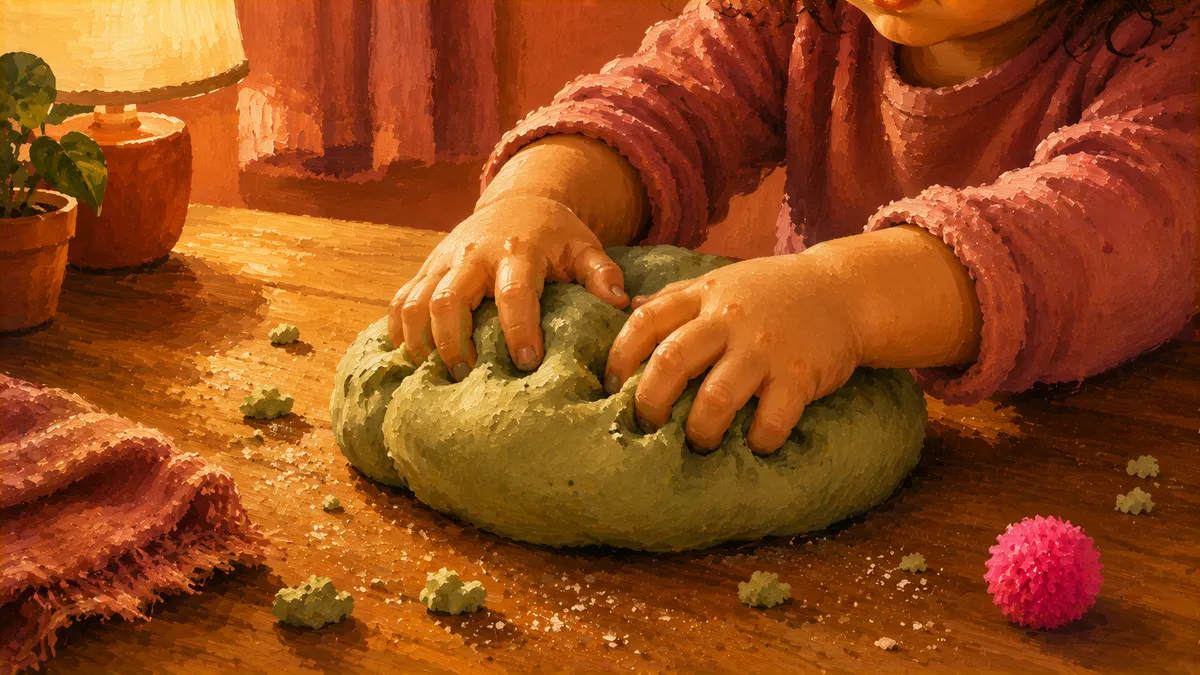
Fine motor activities are the small-muscle tasks that build hand control, the squeezing, pinching, and finger work that gets a kid from fisting a crayon to writing their name.
I’m Nora Hayes, a former preschool aide raising two kids (one a sensory-seeker), and the thing nobody told me early on is that these skills come in an order, so handing a 2-year-old a pencil before their hand is ready just frustrates everyone.
Here’s the real sequence skills follow, the milestones to expect at each age, the activities that match each stage, and when a flag is worth a chat with an OT.
What Fine Motor Skills Actually Mean
Fine motor skills are what the small muscles in your hands and fingers do when they work together on something precise.
The Small Muscles Doing the Work
Two sets of muscles make this happen.
- Extrinsic muscles, starting in the forearm: the firm grip you’d use to hang on a monkey bar
- Intrinsic muscles, living entirely inside the hand: precise finger positioning for tasks like writing, typing, or turning a key
Per Anatomy, Shoulder and Upper Limb, Hand Muscles, the hand holds about 20 of those intrinsic muscles.
That explains why “good with their hands” is the shorthand people reach for. Real hand function and dexterity come from those small muscles learning to fire in the right order, at the right moment. Fine manipulation, in the simplest meaning of the term, is doing something delicate with what you’re holding, like rolling a bead between two fingertips rather than just gripping it.
Everyday Examples You Already See
You’re watching these skills all day without naming them. Fine motor examples are the unglamorous stuff: doing up a button, scooping with a spoon, turning the page of a board book without taking three pages with it.
Here are a few examples of fine motor skills you’ll spot at home:
- A pincer grasp picking a single Cheerio off the tray with thumb and one finger
- Threading a chunky bead, which needs grasp plus a little precision
- Stacking blocks, where the release matters as much as the grab
- Peeling a sticker, pure finger isolation and patience
None of that looks like a milestone. It looks like Tuesday. But every one of those is small-muscle manipulation getting more practiced, and the trickier the move, the more finger control it’s quietly asking for.
Fine Versus Gross Motor Skills
Here’s where parents get tripped up. Fine and gross motor skills aren’t a ranking, they’re a sequence, and the gross stuff comes first.
The difference is clearer side by side.
| Gross motor | Fine motor | |
|---|---|---|
| Muscles used | Large body muscles (trunk, limbs) | Small hand and finger muscles |
| Examples | Rolling, crawling, climbing | Pinching a crumb, holding a crayon |
The part nobody tells you: the big skills are the foundation for the little ones. NAPA Center notes that foundational fine motor skills are built through gross motor play like tummy time, rolling, sitting, and crawling, because that’s where a child builds the core stability and shoulder strength needed to hold steady.
Think of it as bottom-up.
- Core stability keeps the shoulder anchored
- The shoulder steadies the wrist
- A steady wrist frees the fingers to do delicate work
- Bilateral coordination (both hands cooperating) and hand-eye aim layer on top of that
That’s why so much early fine motor development looks nothing like fine motor work. A kid wobbling on a balance beam is, oddly enough, training the hands that will hold a pencil years later.
The Real Order Fine Motor Skills Develop
Hands don’t jump from fist to fingertip overnight. They climb a ladder, each rung building the strength for the next, and the order matters more than the calendar does.
From Whole-Hand Grasp to Pincer Precision
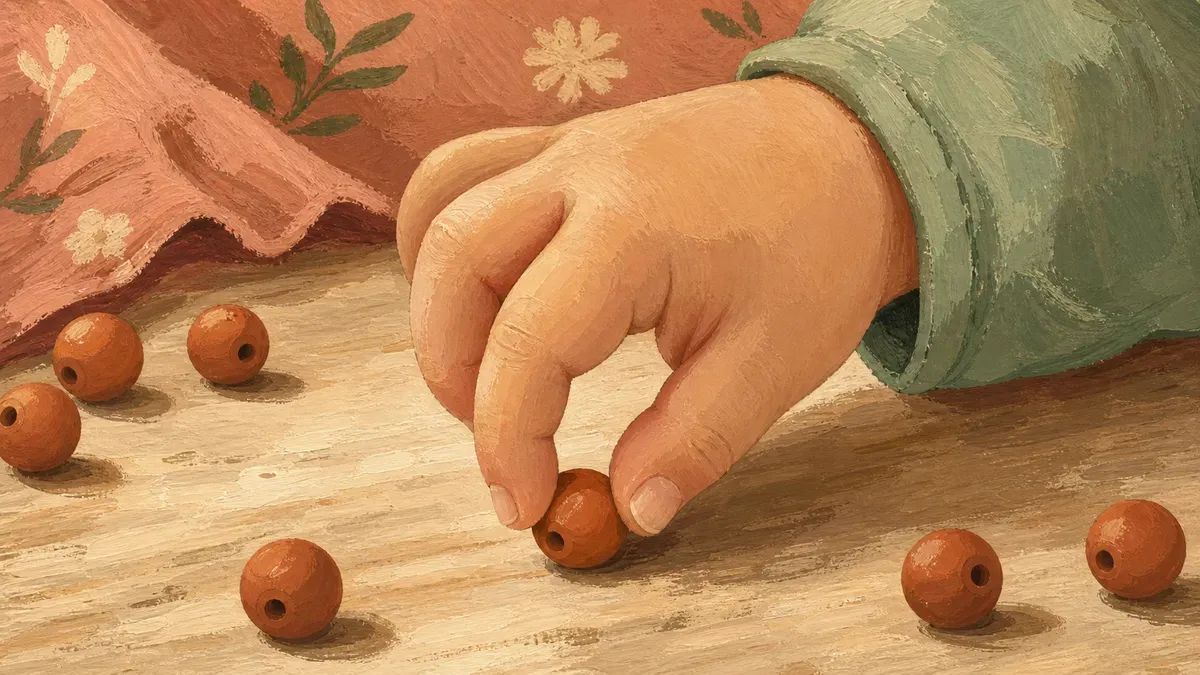
A newborn grabs your finger because they can’t help it. That’s the palmar grasp, a reflex present from birth that fades around the six-month mark, according to research on grasp pattern development from Cleveland Clinic. After that, the hand starts doing things on purpose.
First comes the rake. A baby sweeps Cheerios toward the palm with all four fingers like a tiny broom, no thumb yet, around that same six-month window. Then the thumb wakes up.
Near nine to ten months you get the inferior pincer, the pads of thumb and index finger pressing together. By the first birthday it sharpens into the superior pincer, true fingertip-to-fingertip pickup. That shift is opposition, the thumb learning to work against the fingers, and it’s the single biggest leap in early fine motor coordination.
The pincer doesn’t show up on its own. It rides on the palm arches forming, the wrist steadying, and the fingers slowly learning to move one at a time.
That finger isolation, one finger pointing while the rest stay folded, is what lets a kid push a single button instead of mashing the whole keypad. Each of these grasp patterns is a renovation of the last, never a brand-new build.
How Occupational Therapists Map the Stages
Watch how OTs sequence development and you’ll notice they don’t start at the fingers at all. The fine motor skills OT work I’ve watched with Eli’s therapist always travels inward to outward, big to small.
Occupational therapy maps it as a stack.
- Bilateral coordination: both hands working together on the same task
- Hand differentiation: one hand leading while the other holds steady
- Crossing the midline and settling into a dominant hand
Only once that’s solid does the OT focus move to the hand itself: in-hand manipulation, where a child shuffles a coin from palm to fingertips without help from the other hand, and separation of the sides of the hand, the pinky side gripping while the thumb side does the delicate work. A Shrewsbury OT resource lists that exact progression, with wrist stability holding the whole thing up.
This is why the order isn’t optional. You can’t shuffle a bead in your palm if your wrist still flops. You can’t step to the next rung before the one beneath you holds.
Why Pushing Skills Too Early Backfires
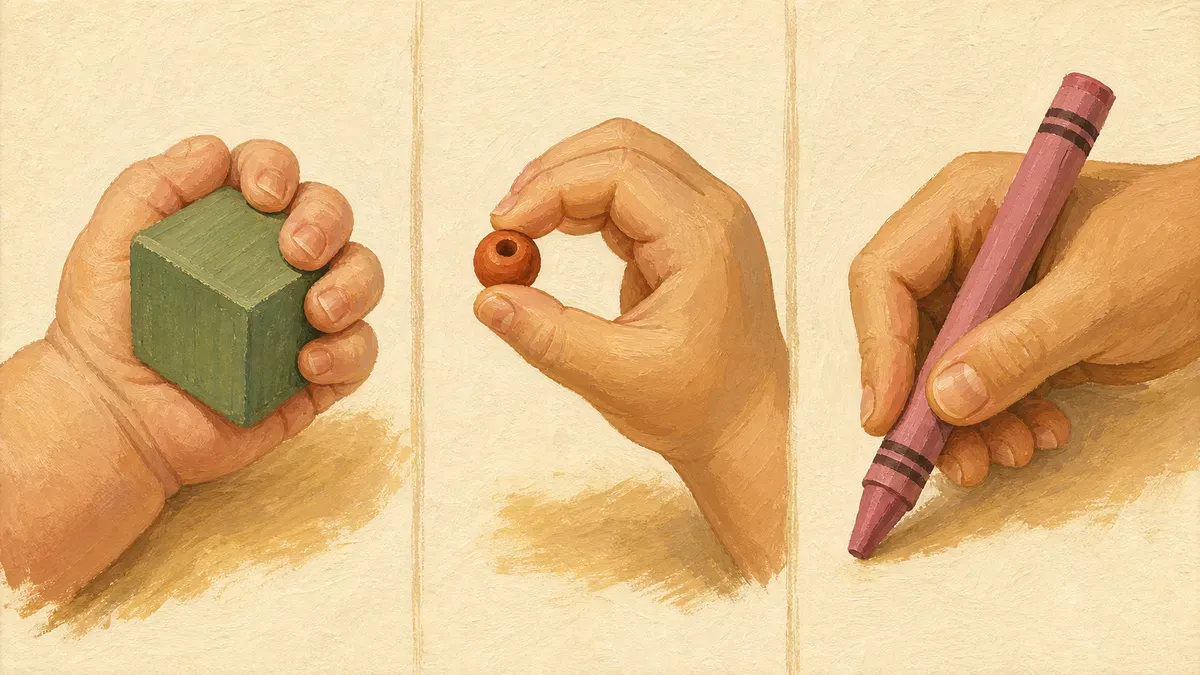
Hand a two-year-old a pencil and demand a neat tripod grasp, and you usually get the opposite of what you wanted. Without the hand strength and arches underneath it, the kid invents a workaround grip.
- A fisted or thumb-wrapped grip gets the job done today and gets harder to undo every month it’s practiced
- Visual-motor integration isn’t ready, so pressure control is off
- Frustration fills the gap where muscle and aim should be
One large review found that 5%-27% of children hit handwriting trouble, and that difficulty controlling pen pressure traces back to shaky foundational grip rather than how many worksheets a kid grinds through, per a 2019 study in the British Journal of Occupational Therapy.
The mistake I see most often is parents skipping straight to letters. Slow down and the pencil grasp shows up sturdier, and faster. If you want the play-based on-ramp, start with fine motor activities for toddlers before any tracing, and save the fine motor tracing handwriting scissor skills work for when the hand is actually ready.
Respect the sequence and the skill arrives on its own. Rush it, and you spend the next two years undoing a grip that never should have set.
Fine Motor Milestones by Age
So what does that sequence actually look like week to week at home? Here’s the rough timeline I watch for, split into the baby-and-toddler years and the busier preschool stretch.
Infancy to Two Years
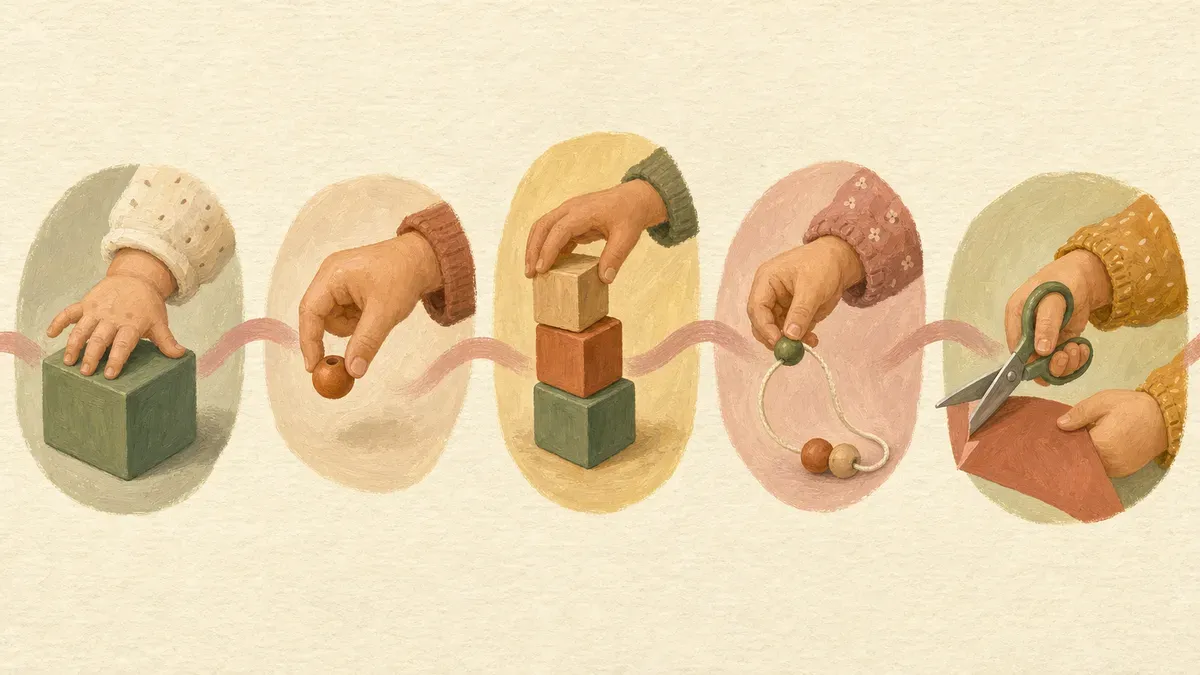
This is the messy, hands-in-everything phase, and that’s the point. Early on, babies rake at things with the whole hand, then learn to pass a toy from one hand to the other. The big leap in infant fine motor is the pincer grasp, when those small muscles finally pick up a crumb with just the thumb and one fingertip.
From there, toddlers put that new grip to work on real tasks. The first time I saw June, around 14 months, pinch a puzzle peg out of its slot with just her thumb and index finger instead of raking the whole board, I knew the wiring was clicking into place.
A few motor skills for toddlers you’ll likely see between roughly one and two:
- Grasping small bits with the tips of the thumb and index finger
- Scribbling with a fisted crayon (no neat lines yet, just enthusiasm)
- Stacking a small tower of blocks
- Drinking from an open cup without soaking the whole shirt
By the second birthday, the two hands start working as a team. The CDC’s developmental milestone guidance for young children notes that good fine motor skills for 2 year olds include holding a container in one hand and popping the lid off with the other, poking at buttons and knobs on a toy, and eating with a spoon. The manipulation you see in 2 year olds is more than gripping now.
The Preschool Years, Ages Three to Five
Now the hands get fussy and precise. Somewhere in here the tripod grasp shows up, three fingers steering a crayon instead of a whole-fist grab, and you’ll see your child settle on a hand they prefer.
The drawing gets recognizable too. Around three to four, per Lurie Children’s milestone guide, small motor skills for preschoolers start looking like this:
- Copying circles
- Threading medium beads onto a string
- Coloring mostly inside the lines
Scissors are the milestone parents ask me about most, usually too soon. Snipping with help is appropriate starting around age four, so if your three-year-old isn’t cutting yet, nobody’s behind. I dig into the why over in our guide to the right age for scissor skills.
By five or six, that visual-motor integration tightens up, which is also when stronger fine motor skills for 4 year olds carry into the next stage. At five and six, Lurie Children’s notes they can manage:
- Cutting along a square
- Copying a triangle
- The careful pencil control that sets up real handwriting
Threading, snipping, drawing shapes, they’re all the same skill wearing different costumes.
Fine Motor Activities That Match Each Stage
Once you know the order, picking the right activity gets easy: meet the hands where they are, not where the chart says they should be. Here’s what actually works at each stage, from a baby still figuring out a pincer grasp to a preschooler ready to build and snip.
- Infants and toddlers (under 2): Safe objects to pick up, drop, and mouth. Food counts as a fine motor activity too.
- Preschoolers: Resistance-based play like dough, lacing cards, and tweezers that make small muscles work.
- Building strength: Three levers (hand strength, finger isolation, and bilateral coordination) before any pencil work.
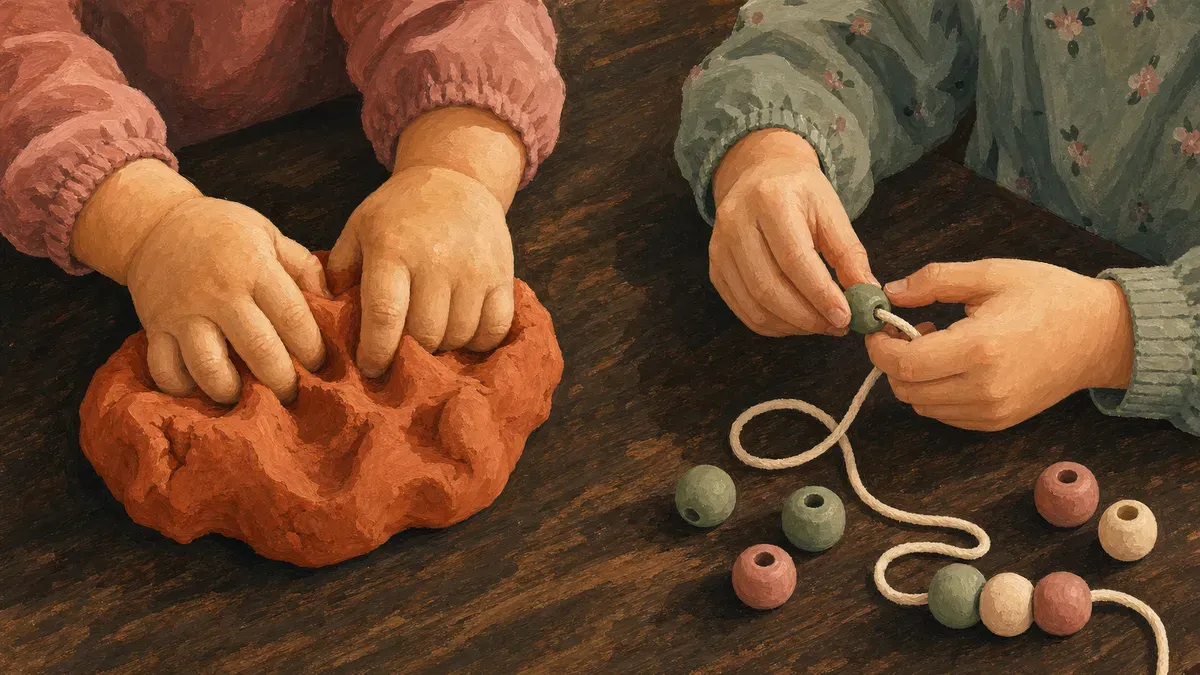
Play-Based Activities for Infants and Toddlers
For the under-2 crowd, you don’t need toys with a label. You need things to pick up, drop, and shove in a mouth. Fine motor activities for infants are really just safe objects within reach and the time to fumble with them.
The pincer builder everyone forgets is food. Cheerios on the highchair tray, one at a time, is the single best fine motor skills activity for 1-2 year olds I know. It’s self-correcting: they want the snack, so they keep practicing that thumb-and-finger pinch until they get it.
A few more that earned their keep with June:
- Board books with thick pages a small hand can actually turn
- Shape sorters for trial-and-error wrist twisting and lining-up
- A muffin tin and pom-poms to drop in, dump out, repeat
The goal isn’t a finished anything. It’s manipulation, small muscles working, the sensory feedback of squishing and grabbing. Keep the pieces big enough to be safe and let them lead. Fine motor activities for 2 year olds work best when you set it up and then step back.
Hands-On Activities for Preschoolers
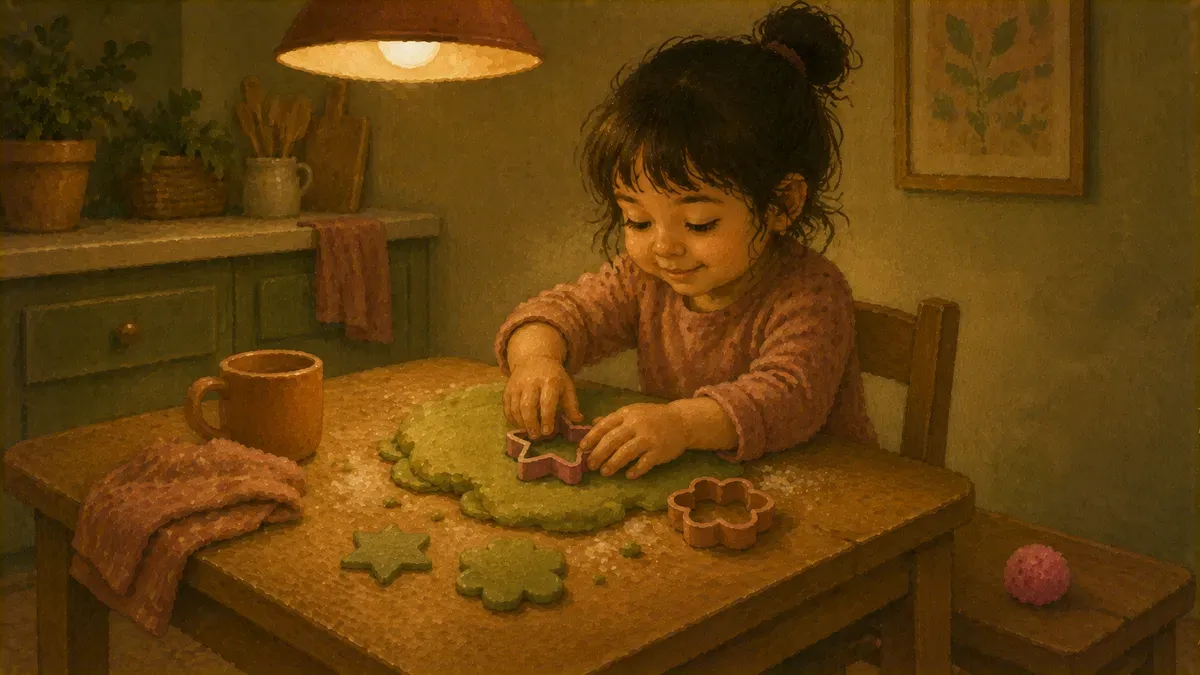
By preschool the hands are strong enough for resistance, and resistance is where the real fine motor skills activities live. The classic is play dough, and it earns the hype. The National Association for the Education of Young Children lists playdough as supporting hand strength, finger isolation, bilateral coordination, the pincer grasp, hand-eye coordination, and tripod-grasp development, which is most of the toolkit in one squishy ball.
From there, the best activities for motor skills are the ones that make small muscles fight against something:
- Lacing cards for threading and steady two-hand control
- Tweezers moving pom-poms into an ice tray
- Lego for the in-hand pressure of pressing bricks together
These activities of fine motor skills all sneak in the same drill: pinch, hold, place, repeat. Play dough doubles as a calm-down tool on a wound-up afternoon, which is its own kind of win. If you want more setups built around one material, I keep a running list of fine motor activities for preschoolers built around play dough so you’re not reinventing it every rainy day.
How to Strengthen Skills Without a Worksheet
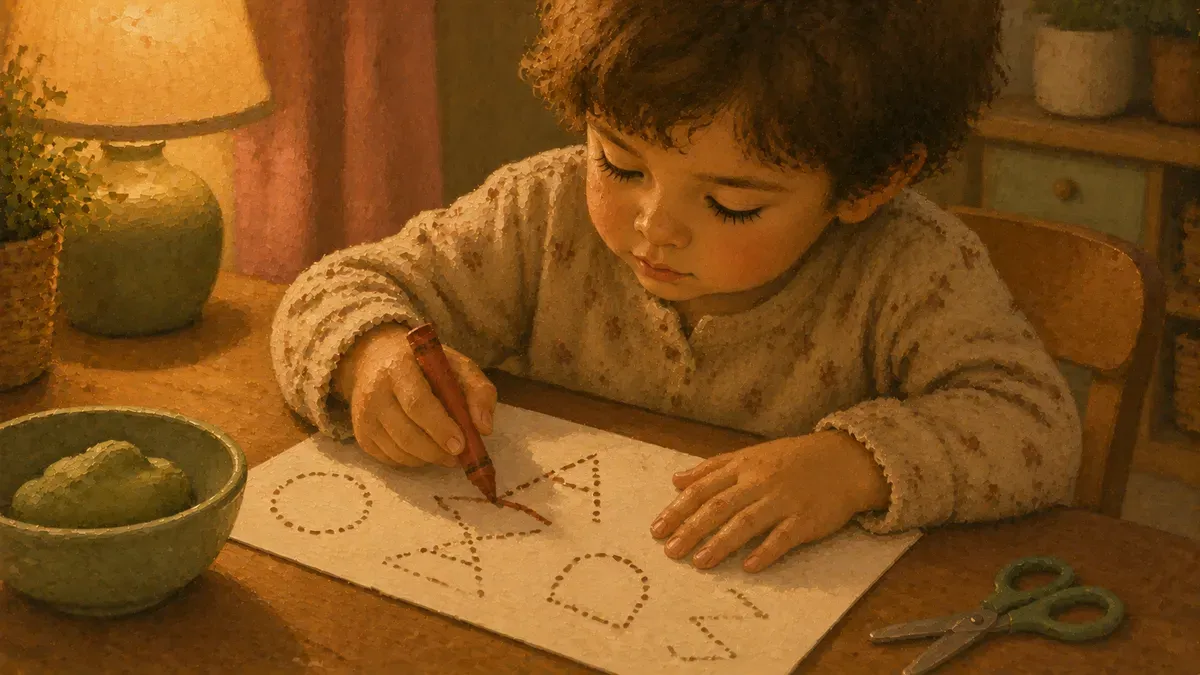
Here’s the part that surprises tired parents: how to improve fine motor skills almost never involves a worksheet. Drilling tracing lines before the hand is ready just builds a frustrated kid and a death-grip on the crayon. Strength comes first, then the pencil.
Think in three levers, all of them playable:
- Hand strength from squeezing, pinching, and pulling (play dough, spray bottles, tearing paper)
- Finger isolation from poking, pointing, and one-finger games
- Bilateral coordination from any task that makes two hands work as a team
Clothespins are my desert-island pick because they hit all three at once: pinch to open, hold steady, clip with purpose. The American Academy of Pediatrics put it plainly in its 2018 report on the power of play, saying play is how kids build the motor competence to master fine and gross motor skills, enough that they want pediatricians prescribing it at early well-child visits.
So skip the printable race. When the hands are ready, you can layer in visual motor activities that bridge play and pre-writing. Until then, keep it hands-on, keep it playful, and let the strength build itself.
When to Worry and How OT Can Help
Most of the time, hands build on their own schedule. But sometimes the order stalls in a way that’s worth a closer look, so here’s how to spot a real red flag and what an occupational therapist actually does about it.
Red Flags That Signal a Delay
One flop at the muffin tin is nothing. A pattern that doesn’t budge over months is the thing to watch. The clearest early signal is a missing pincer grasp: by the guidance on when to seek occupational therapy, absence of a pincer grasp at 9 to 12 months is a recognized red flag, and a baby past 12 months who still isn’t trying to pinch warrants an evaluation.
Skillpoint Therapy flags a handful of other patterns too:
- Trouble using utensils by about 2.5 years
- Steady avoidance of hand-skill activities (the kid who won’t touch puzzles, crayons, or buttons)
- Losing a skill they used to have
A persistently fisted grip well past infancy belongs on that list. So does a wrist that never seems to find its stability, fingers that won’t work one at a time, or grasp patterns stuck at an earlier stage while everything else moves on. None of these is a diagnosis. They’re a nudge to ask. If something about your kid’s hand function and fine motor development feels off and it isn’t shifting, trust that and book the eval.
What an Occupational Therapist Does
An OT is the person who turns “something feels off” into a plan. You don’t need a diagnosis to start, and you don’t need to wait until kindergarten.
An evaluation looks at the whole chain, not just the fingers. Per NAPA Center, an OT may use standardized tools like the 9-Hole Peg Test, the Box and Blocks Test, and grip dynamometry to measure grip strength, alongside plain observation of real tasks like threading beads. They check core stability and bilateral coordination too, because weak hands often trace back upstream.
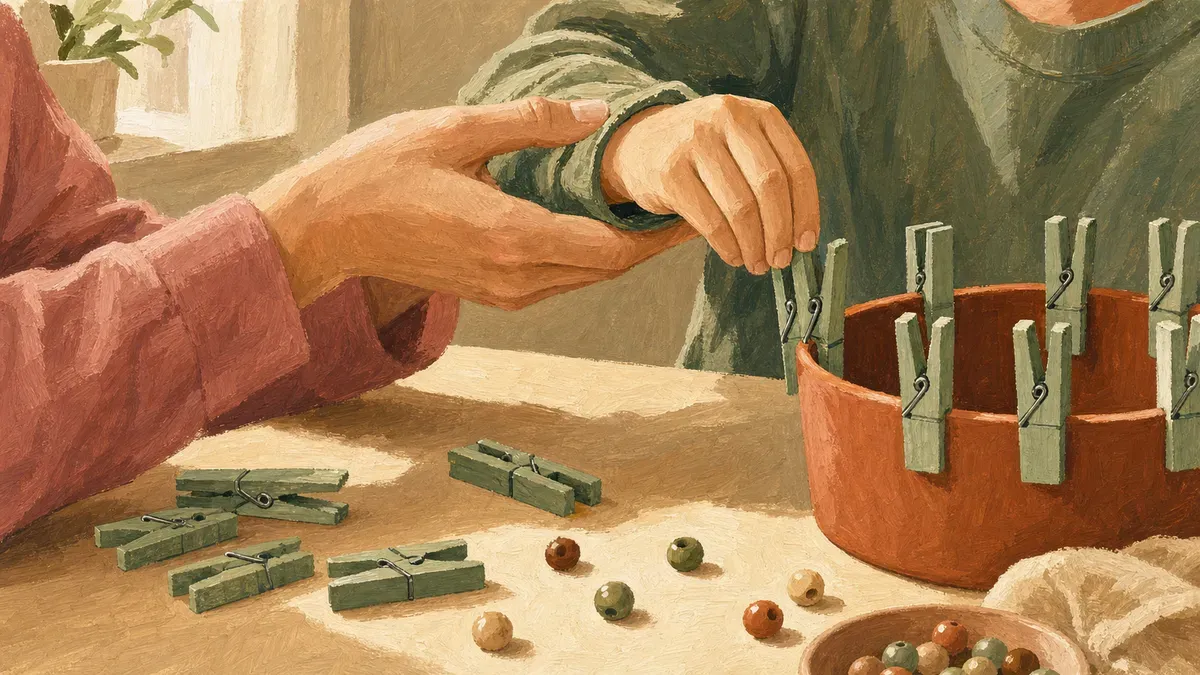
Then they build a plan that meets your kid where they are.
- Hand-strengthening play and finger isolation work
- Adaptive tools like chunky grips or slant boards
- Home, school, and daycare accommodations so children with limited motor skills face demands that match what their hands can actually do
If your kid is autistic or sensory, ask about sensory-friendly ot activities that won’t trigger a shutdown. And whatever the plan, keep playing alongside it, leaning on our complete fine motor skills guide to back up the work between sessions.
Found this useful? Save it for the next rough afternoon.
Questions parents ask me about this
What order do fine motor activities develop in toddlers?
Hand skills build from the inside out: core and shoulder stability come first, then wrist control, then precise finger work. Before a toddler can pinch a small bead, they need those bigger muscles settled underneath. So the activities that actually help at each stage match where the child is in that chain: weight-bearing on open hands and object transfers before pinching, pinching before in-hand manipulation.
At what age should fine motor skills be developed?
Fine motor development starts at birth and keeps building through the early school years. By the end of the first year, most kids show a pincer grasp. By two, they manage buttons, knobs, and a spoon. Between three and five, a tripod pencil grasp emerges, scissors snipping becomes appropriate around age four, and visual-motor precision tightens toward kindergarten. There is no single finish line; each stage sets up the next.
Are fine motor skills the same as gross motor skills?
They work together but they're not the same thing. Gross motor skills involve the large muscles of the trunk, arms, and legs. Fine motor skills live in the small muscles of the hands and fingers. The critical relationship is that gross motor stability comes first: a child needs core control and shoulder strength before the hands can do precise work. It's a sequence, not two separate tracks running in parallel.
How can I tell if my child has a fine motor delay?
A few patterns are worth watching: no pincer grasp emerging between nine and twelve months, no functional grip on utensils by around two and a half years, consistent avoidance of hand-based play, or losing a skill they had before. One off day is nothing. But if several of these show up together, or if a skill disappears entirely, that's a reason to request an occupational therapy evaluation. No diagnosis is required to get one.
Do worksheets help fine motor skills or is play better?
Play builds the underlying hand strength and finger coordination that worksheets can't. Squeezing play dough, pinching clothespins, threading lacing cards, and dropping small objects into containers develop the muscles and movement patterns that eventually make pencil work possible. Worksheets practice a skill the hands already have; they don't build it. For toddlers and preschoolers, hands-in play is the method, not a shortcut around it.
What is the pincer grasp and when does it appear?
The pincer grasp is picking up a small object between the tip of the thumb and the tip of the index finger. It requires true thumb opposition, which makes it one of the biggest early leaps in hand development. Most children show an earlier version, using the pad of the finger rather than the tip, around nine to ten months. A mature pincer with fingertips typically arrives by twelve months.
Can pushing fine motor skills too early cause problems?
It can make things harder later. When a child is asked to do tasks their hands aren't ready for, they find a workaround grip instead of the intended one. That compensatory pattern can stick, and fixing it takes more work than waiting for the right developmental window in the first place. The goal is matching activities to where the child actually is, so the skill builds on a real foundation rather than a shortcut that has to be unlearned.
Written by
Nora Hayes
Mom of two and a former preschool aide. I share the screen-free sensory play and calm-down ideas I test at my own kitchen table, plus what the moms in my little meet-up swear by. A parent passing on what works, not a doctor or a therapist.
More about NoraKeep going
All Fine Motor-
 Fine Motor
Cutting Worksheets: 15 Activities Beyond Straight Lines
Bored of straight lines? These cutting worksheets and 15 activities build scissor skills fast. Grab the free printables and start today.
-
 Fine Motor
Activities to Build Fine Motor Skills With Pom Poms
The hand strength behind neat handwriting starts with play. Try 20 pom pom activities to build fine motor skills your kid will actually beg to do.
-
 Fine Motor
Fine Motor Skills Activities for Preschoolers
Ready to write? Spot the 12 readiness signs and the fine motor skills activities for preschoolers that build the hand. Start now.
-
 Fine Motor
Fine Motor Skills Activities for 3-4 Year Olds
Worried your 4-year-old still scribbles? These fine motor skills activities for 3-4 year olds bridge scribbles to real letters. Start today.