No Hitting Social Story for Hitting and Biting

I am a parent sharing what worked at my house, not medical advice. For anything to do with your child's development or sensory needs, talk to your OT or doctor.
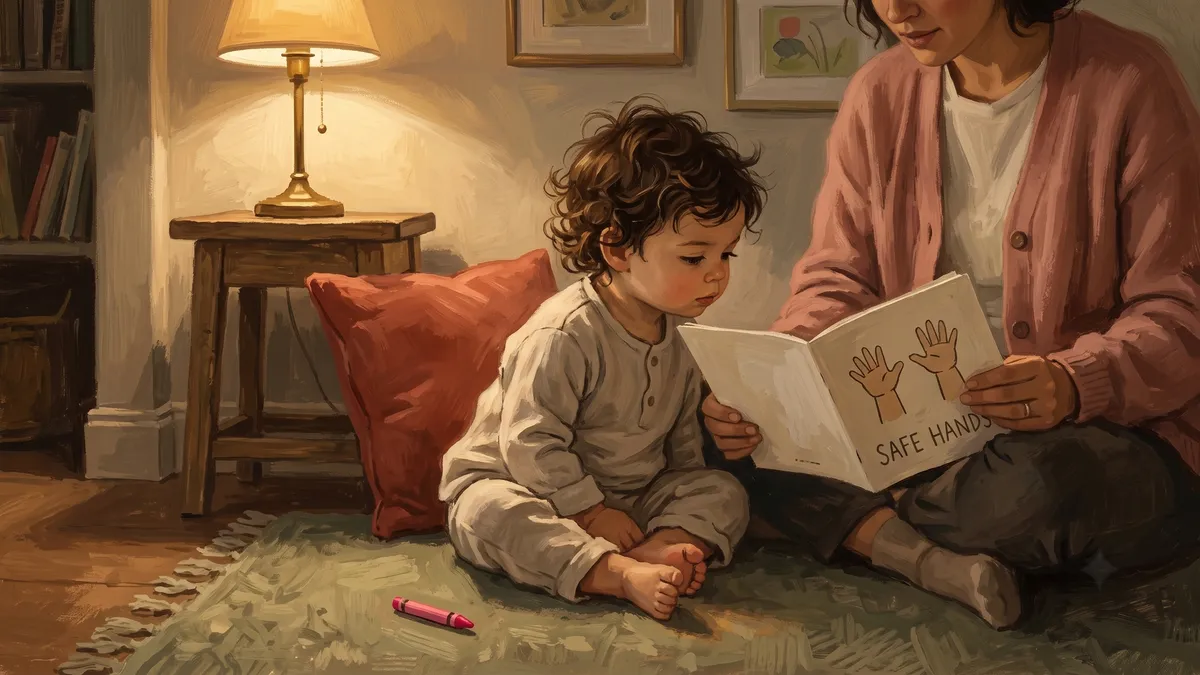
A no hitting social story is a short, personalized little book that shows your child what calm hands look like and gives them a do-this-instead for the moment the urge to hit, bite, or push takes over. It works because it teaches that swap in a quiet moment, not mid-meltdown, and the format goes back to Carol Gray, who first developed Social Stories in 1991 to walk autistic kids through tricky situations one plain sentence at a time.
I’m Nora Hayes, a former preschool aide raising an autistic seven-year-old, and below I’ll cover what one of these stories actually does, why little kids lash out, the safe swaps it teaches, how to read it so it sticks, and how to shape one to fit your own kid.
What a No Hitting Social Story Actually Does
A Short, First-Person Script That Names the Behavior
A hitting social story is a tiny book, told in your child’s own voice, that walks through one tricky moment and shows the safe move instead. A few pages. Plain words. “Sometimes I feel mad. Sometimes I want to hit. Hitting hurts my friend. I can squeeze my hands instead.”
It does three quiet things at once: it describes the situation, it names the behavior without scolding, and it points to what to do instead.
That structure isn’t random. Carol Gray’s research on how social stories support behavior lays out a format that mixes observable facts, other people’s feelings, and a gentle “I will” or “I may” line, and it asks the story to describe far more than it directs. The tone stays warm, never bossy.
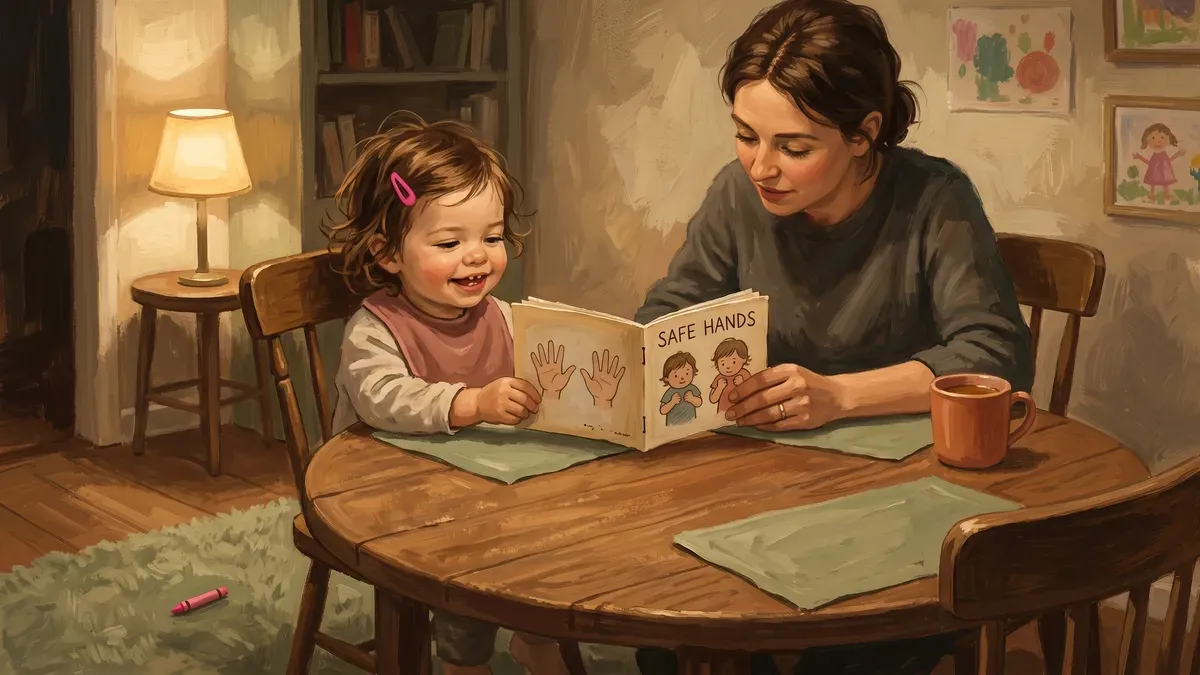
So your kid isn’t being told off. They’re being handed a script. The naming matters: a toddler who hears “hitting hurts” in a calm moment files it somewhere they can reach later. That’s the whole point of this kind of skill-building, the rehearsal of one small move through practice before it’s ever needed.
Why It Beats Telling a Child to Stop
“Stop hitting” lands in the worst possible second. The hand’s already swinging, the kid’s already flooded, and your words bounce off a brain that’s gone offline.
A story works the other way around. You read it when everyone’s calm, on the couch, at bedtime, ten times before the hard moment ever shows up. That repetition builds a picture your child can grab when the room gets loud.
That’s what a safe hands social story really is: a visual support that hands the prosocial behaviour over early, so gentle hands feel like the obvious choice and not a rule someone’s enforcing.
A command asks a melting-down kid to invent a better option on the spot. A story already gave them one. That’s the difference.
Why Kids Hit, Bite, and Push in the First Place
Before a story can help, you need to understand what the behavior is actually communicating. It’s not defiance, and it’s not a missing rule.
An Overwhelmed Body, Not a Bad Kid
Hitting, biting, pushing, spitting. To the adults in the room, it looks like aggression. What they actually are is a body doing the only thing it knows to do when big feelings have completely outrun the words available.
Toddlers and preschoolers are still building the language to name what’s happening inside them. When feelings outrun words, the body acts first.
- Frustration that has nowhere to go
- Overstimulation with no off-ramp
- Overwhelm that hits faster than language can catch up
For neurodivergent kids especially, emotional regulation is genuinely wired differently. The gap between the feeling and the word for it can be enormous.
NAEYC puts it directly: toddlers may bite to express anger or frustration because they lack the language skills to express their feelings. It’s a communication strategy when words aren’t available, not a sign of a bad kid.
The American Academy of Child and Adolescent Psychiatry notes that aggressive biting commonly begins between ages one and three, and that some of it is part of normal development. That doesn’t mean you ignore it. It means you stop treating it as a character flaw and start treating it as a skill gap.
Reading the Body Signals Before It Happens
Here’s where a biting social story (or a hitting one) can actually work, but only if you know what to watch for so you can use it at the right moment.
The escalation usually announces itself. The Crisis Prevention Institute identifies several early physical warning signs that tend to appear before a child hits or bites.
- Clenched fists or jaw
- Rigid posture
- Shallow or rapid breathing
- Hands pulling in, shoulders rising, or eyes going glassy
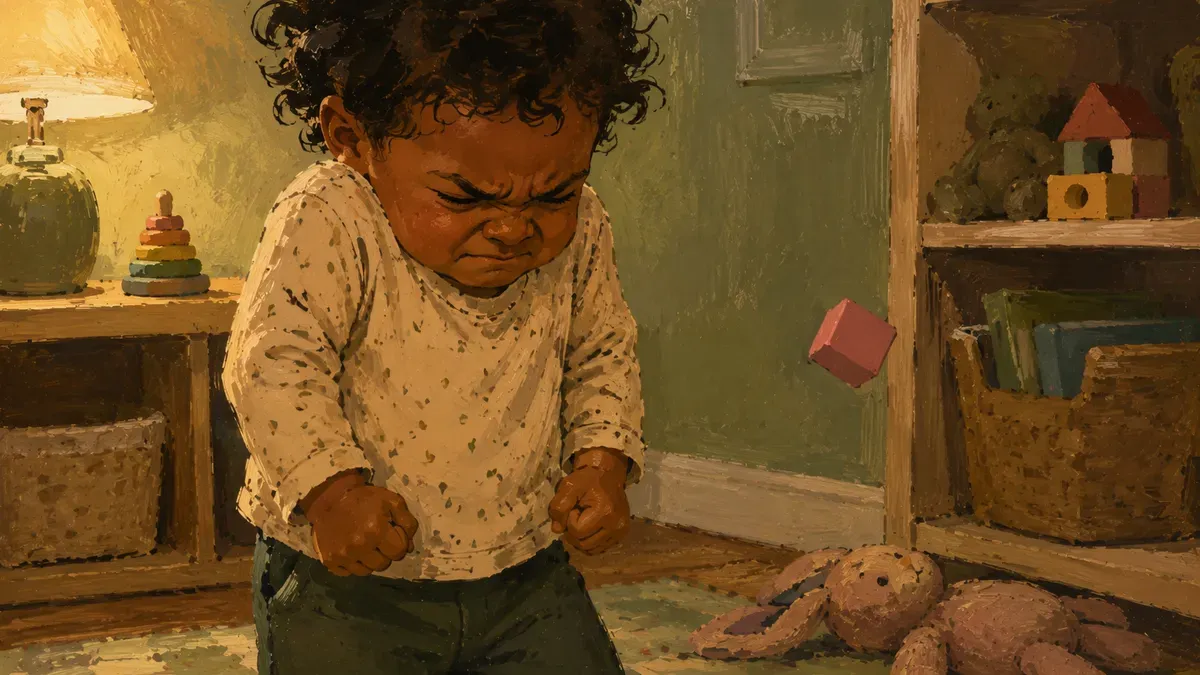
Those signals are the window. If you can name what you’re seeing out loud (“I see your hands are getting tight”) and offer the alternative the story already practiced, you’re stepping in before contact happens, not after.
For an elopement social story the same principle applies: spot the body cues early, and the story’s language is already there to meet them.
Safe Alternatives the Story Teaches Instead
Spotting the body cues is step one. The story’s real job is handing your child something to do with those hands before they make contact.
Calm-Down Moves That Give Hands a Job
A social story about keeping hands to self doesn’t just say “no hitting.” It offers a swap: here is what your hands can do right now.
The moves that work best give the body something physical to grab onto.
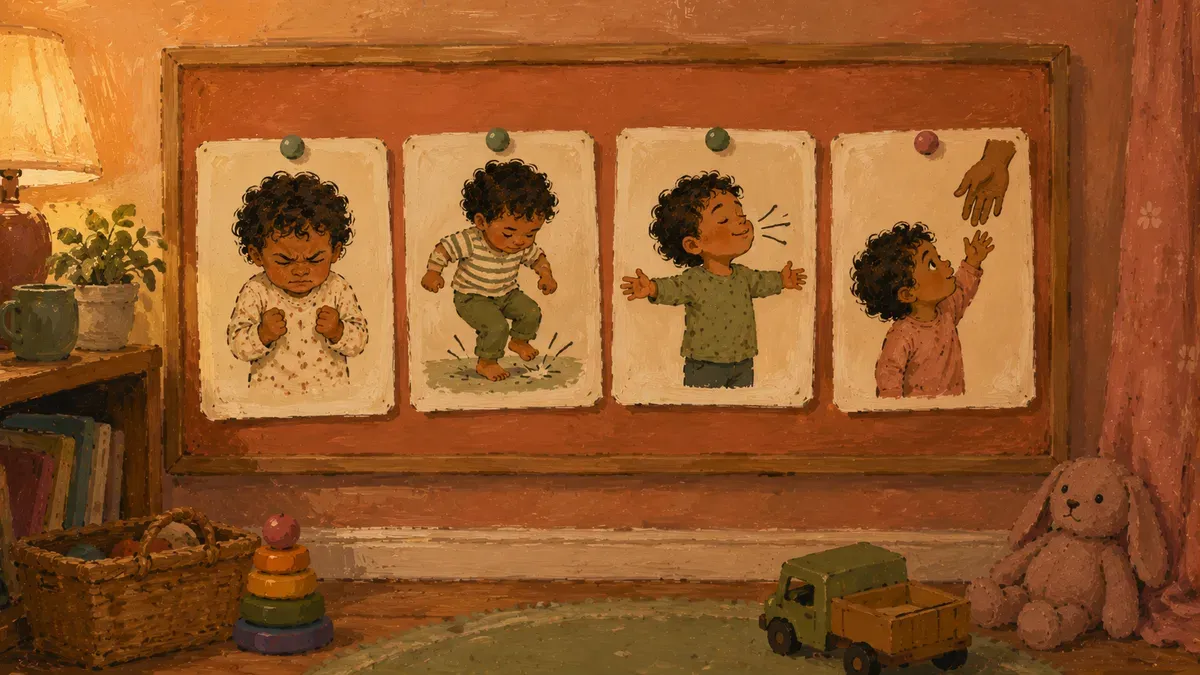
- Squeeze a fist: tight for three counts, then let go. Keeps hands busy and gives the pressure the body is actually after.
- Stomp your feet: big stomps release the same energy a shove would, without anyone getting hurt.
- Take a deep breath: Pathways.org notes that deep pressure and deep breathing both produce real physiological calming by activating the parasympathetic nervous system.
- Ask for help: the story scripts the words: “I need space” or “Can you help me?” so a child doesn’t hunt for language mid-meltdown.
For sensory-seekers, squeezing and stomping aren’t consolation prizes. The story names these moves in a calm moment so the body starts to recognize them as reachable. A personal space social story extends the same idea to situations where closeness itself is the trigger.
Linking the Story to PECS Cards and Visuals
For a child who isn’t talking yet, the story’s language is only half the tool. Pair it with visual supports and the calm-down choices become something they can point to in the moment.
An overview of PECS visual communication explains that PECS was designed for early nonverbal symbolic communication, where a child selects a picture and hands it to a partner. The Indiana Resource Center for Autism notes it was developed to reduce non-adaptive behaviors, which is exactly what spitting and hitting are.
Print a small card set alongside the story so the calm-down choices become something to point to, not just remember.
- Deep breath card
- Squeeze card
- “I need space” card
- No-spitting card with a PECS-style image
A spitting social story paired with picture cards closes the loop between what the story rehearses and what the child can communicate without words.
Reading the Story So It Actually Sticks
How and when you read the story matters just as much as what it says. Getting both right is what makes the words actually land.
Read It Calm, Read It Often
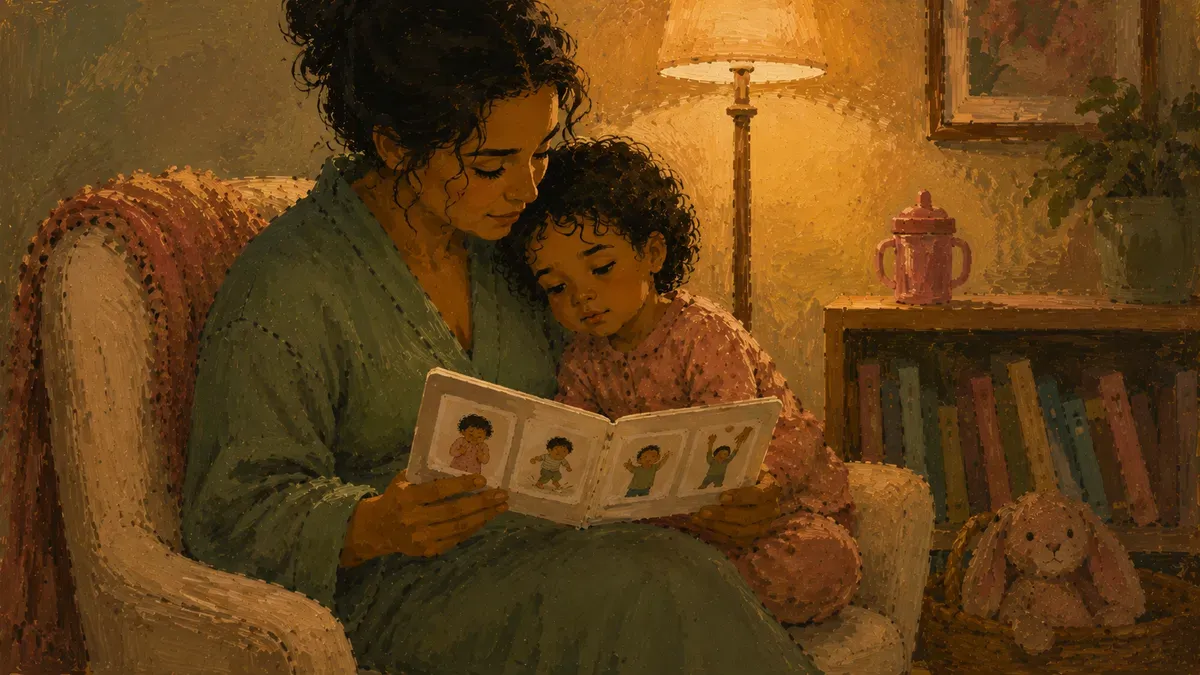
The biggest mistake is pulling out the story right after hitting happens. By then, your child’s nervous system is flooded, and no new script is going in. Read it when things are quiet: after breakfast, before bath, tucked into the bedtime routine. That’s when the words actually get filed away.
Repetition is what does the work. Sheffield Children’s NHS Foundation Trust guidance notes that parents typically see small behavioral shifts within 2-4 weeks of consistent reading, with larger changes often taking 6-8 weeks. That’s a lot of readings before anything looks different on the outside. Keep going anyway.
Read it in the same calm voice you’d use for any picture book. Don’t pause to explain, don’t reference yesterday’s incident. Just read it, let it settle, move on. The practice itself is the point.
Reading It With a Whole Class or Group
For educators, social stories work well as a shared classroom read, but the value multiplies when you pair the story with role-play. Research published in PMC found that combining modeling, behavior rehearsal, and peer feedback builds shared social language kids can actually use in the moment.
Here’s a simple group sequence:
- Read the story aloud once, normally.
- Ask two volunteers to act it out (one child feels the urge to hit, one shows what to do instead: stop, take a breath, use words or walk away).
- Let classmates give brief feedback on what looked kind.
This is how safe-hands choices become classroom vocabulary, not just a page on the wall. The same format works for any social story you’re running alongside it. Every child hears the same prosocial language and sees it modeled, including what accepting a redirect calmly looks like in practice. That shared emotional vocabulary is what makes it stick when the real moment comes and a child needs to recall what calm hands actually look like.
What to Do Right After Hitting Happens
The shared language built in a calm reading session is useful. The harder question is what to do in the thirty seconds after a hit lands. Two things matter: the reset in the room, and the story revisited later.
Stay Calm and Reset, Skip the Lecture
The hit happened. Your first job is not to teach. It is to stop anything worse.
Get between the kids if you need to, keep your voice flat, and move the hitter to somewhere quieter. Not as punishment. As a landing spot.
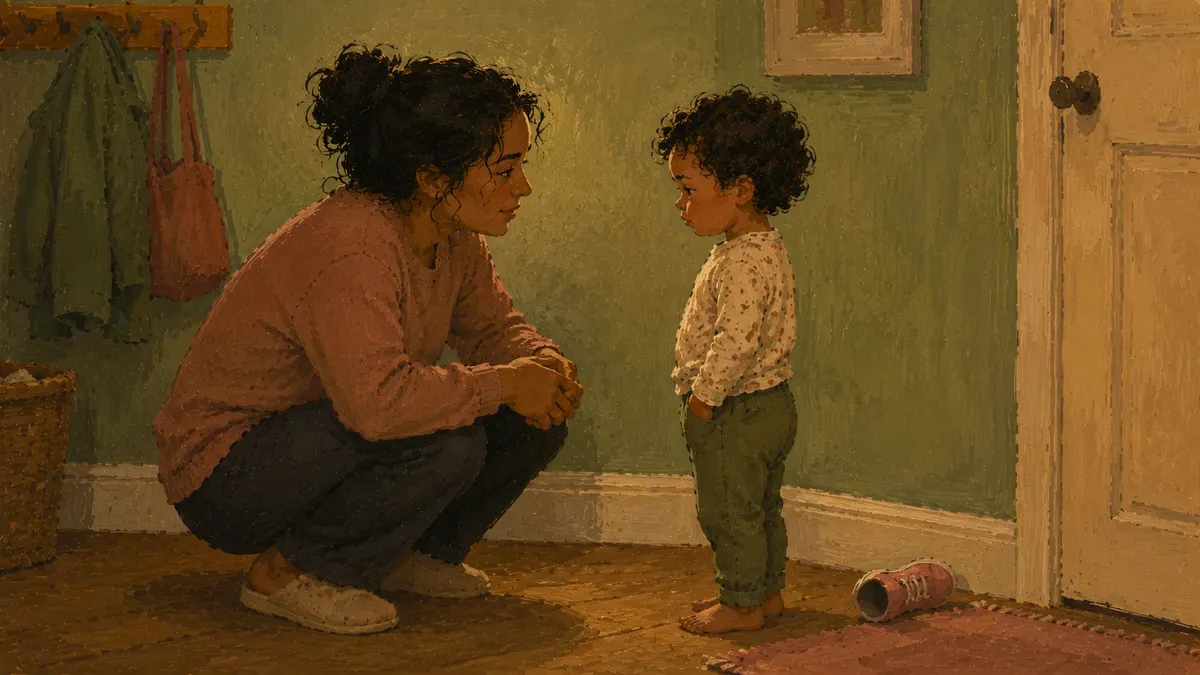
This is where a calm-down corner earns its place. Child Mind Institute draws a clear line between a punitive time-out, which isolates a dysregulated child at the exact moment they need co-regulation, and a calm-corner reset that invites the child to actively settle. One shuts them out. The other gives them a soft place to land.
The same reset works for a grabbing or stealing moment. A snatched toy, a stolen snack, a ripped-away crayon, the overwhelm underneath is the same. Lower your voice, move to the calm spot, skip the lecture. Shame does not reach a child who is flooded. It just makes the next meltdown start closer to the surface.
Re-Read the Story Later, Not in the Heat
Once you’re both regulated, that social story for hitting helps your child make sense of what just happened.
Pull it out in a quiet moment, not as a consequence. That separates it from a punitive time out, where the lesson lands before the child is ready. “Remember this book? Let’s read it together.” That move reconnects the child’s safe-hands memory to what just happened, without the story feeling like a scolding.
Timing the re-read right matters:
- Give it at least thirty minutes. Emotional vocabulary needs space before it can land.
- A child still raw from the incident reads the book as a scolding, not a support, and learns to resist it.
What happens tonight becomes practice for tomorrow, and practice is how it sticks. A sharing social story follows the same logic: it always lands better in calm than in chaos.
Make the Story Fit Your Child and Download It Free
The same story won’t land the same way for a two-year-old and a seven-year-old. Here’s how to adjust it by age, then where to grab a ready-made version.
Toddler, School-Age, or Older Child
Age shapes how you build it.
- Under 3: Four or five pages, one sentence each, big pictures over words. The concept is just “hands stay calm.” They need a picture of a deep breath and a picture of a hug, not backstory.
- Ages 4-7: A slightly longer story that explains why the behavior affects others. “When I push, my friend feels sad and doesn’t want to play” is a sentence a five-year-old can sit with. Add a few solution options so they start building a small menu of moves.
- 8 and up (especially neurodivergent kids): Involve them. Let them pick the character name, choose which calming moves go in the story, or draw one of the pictures. Ownership changes how a child reads the same book.
Build It Yourself in Five Minutes
You can browse our full library of social stories to find versions for hitting, biting, pushing, and more.
To make your own, open a blank document, a stack of index cards, or even a folded piece of paper. Write one sentence per page in first-person voice (“Sometimes I feel mad. I want to hit. Hitting hurts my friend. I can squeeze my hands instead.”). Add a simple drawing or a printed photo alongside each sentence. If your child’s triggers are specific, name them directly — “When the block tower falls down…” lands better than anything generic. Laminate it if you want it to survive a week.
Start with the plain four-page version. If it’s not landing after two weeks, sit down with your child and let them help rewrite it in their own words.
Found this useful? Save it for the next rough afternoon.
Questions parents ask me about this
Is there a social story I can use for kids who hit?
Yes. These stories are short, written in the first person, and built around the child's actual experience: what sets them off, what their body does right before the hit happens, and what they can do instead. You can write one yourself in a few minutes: a plain sentence or two per page, first-person voice, and a picture alongside each one. The body sections of this article walk you through the structure.
How often should I read a no hitting social story to my child?
Three to four times a week is a realistic target for most families. Read it during calm moments, never right after an incident when emotions are still running high. Small shifts tend to show up in the first couple of weeks; bigger changes usually take longer, so stick with it even when progress feels slow.
Do social stories work for biting and pushing too?
They do. Hitting, biting, and pushing all come from the same place: a body that is overwhelmed and out of language. A well-written story addresses the feeling first, then offers a safe alternative move, so the same structure works across all three behaviors. You can use one story that covers several behaviors, or keep separate short stories for each one if your child does better with a single focus.
At what age can a child understand a social story about hitting?
Simple picture-heavy stories can reach toddlers as young as two, though the understanding will be partial at that age. By three to four, most children can follow the sequence of "feeling, behavior, better choice" when it is paired with pictures. For older children and school-age kids, the story can include more about how the behavior affects other people, and some children do well helping to write their own version.
Should I use a time-out alongside a no hitting social story?
A brief move-away to get calm is fine, but a traditional punitive time-out is not the same thing. A flooded child cannot learn in the middle of the moment, so shame or isolation after a hit does not reach them. The story builds the skill during calm reading sessions; right after hitting happens, the goal is a quiet reset and a return to the story later, not a consequence that teaches nothing.
What if my child keeps hitting after reading the story?
Repetition is the whole point: the story is not a one-read fix, it is a skill your child builds up slowly over many calm readings. If hitting is still frequent after several weeks of consistent reading, look at the story itself: is the language too abstract, are the alternative moves genuinely available to the child, does it name their real triggers? Adjust what is not landing. If the behavior is intense or frequent and nothing is shifting, a conversation with an occupational therapist or behavioral support professional is a reasonable next step.
Can a teacher read a safe hands social story to the whole class?
Absolutely. Group reading builds a shared vocabulary so every child in the room knows what "safe hands" or "bodies to ourselves" means before a conflict happens. Pairing the read-aloud with a brief role-play or movement break makes the language stick. One classroom story benefits the whole group, and it reduces the chance that the child who struggles with hitting feels singled out.
Written by
Nora Hayes
Mom of two and a former preschool aide. I share the screen-free sensory play and calm-down ideas I test at my own kitchen table, plus what the moms in my little meet-up swear by. A parent passing on what works, not a doctor or a therapist.
More about NoraKeep going
All Social Stories-
 Social Stories
Social Stories for Kids With Autism: 20 Essentials
Social stories for kids with autism, made simple. Master the 6-step method and build the 20 essentials every autistic child needs.
-
 Social Stories
Social Story Templates: Edit Them to Truly Fit Your Kid
Free PDF social stories rarely fit your child. Learn to edit social story templates in minutes so every word, photo, and step is truly yours.
-
 Social Stories
Personal Space Social Story: Teach Hugs & Asking First
Hug by rule or by choice? This personal space social story teaches kids to ask first, say no, and read body bubbles. Start using it today.
-
 Social Stories
Potty Training Social Story: The Script That Worked
We read this potty training social story 40 times before it clicked. Get the full script, why it works, and make it yours. Grab it now.