Social Story Templates You Can Actually Edit and Make Yours


I am a parent sharing what worked at my house, not medical advice. For anything to do with your child's development or sensory needs, talk to your OT or doctor.
Editable social stories beat the free PDF because a generic story with a stranger’s name and someone else’s routine rarely sticks. I’m Nora Hayes, a former preschool aide and mom of an autistic sensory-seeker, and a story built around your child’s real name and their actual routine lands differently than one that doesn’t. Below I walk through the free editing tools, how to share one version so every caregiver stays consistent, and what to try when the story isn’t landing.
The plan in brief:
- Open a template in Canva, Google Slides, PowerPoint, or Word instead of printing a flat PDF.
- Swap in your child’s real name, your own photos, and the exact steps of their routine.
- Rewrite each line in first person using descriptive, perspective, and coaching sentences.
Editable Templates vs. the Free PDF Everyone Downloads
Start with the tools, sure, but first decide what you’re actually making, because a locked PDF and an editable file are not the same gift to a kid.
Where the One-Size PDF Falls Apart
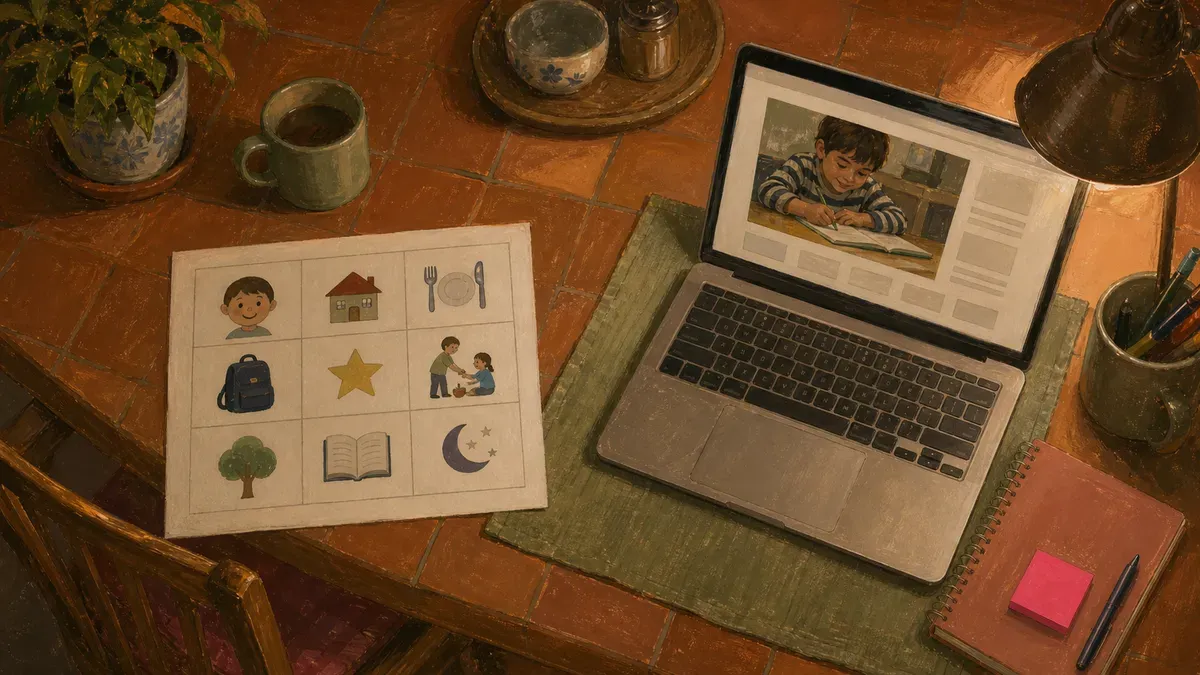
Most free social stories you download are flat printables: a stranger’s name, clip-art faces, a routine that almost never matches your house. June’s bedtime has three steps and a stuffed fox. The PDF’s version has five steps and a dog she’s never met. So she listens the way she’d listen to a story about a neighbor, polite, gone in a minute.
Generic visual supports ask a kid to imagine themselves into someone else’s day, the exact leap a lot of our group’s kids can’t make on a hard morning.
What You Gain by Editing Instead
Swap the name, add your own photos, and reorder the steps to match your actual routine. That’s what makes a child point at the page and say ‘that’s me.’ Autism Speaks openly notes that a generic story can feel like it’s about nobody. One study on social narratives built with a child’s real photos found they beat the generic version on target behaviors for all three kids tested.
Here is how they compare on what actually matters to a kid.
| Free static PDF | Editable template | |
|---|---|---|
| Child’s name | A stranger’s | Yours |
| Pictures | Clip art | Your own photos |
| Routine steps | Fixed | Reorder to match |
| Time to adapt | None possible | A few minutes |
Editable wins on fit; the free PDF wins on zero effort.
Want one your kid recognizes? Edit. For more on why these social stories land, recognition is the whole game.
How to Customize a Social Story Template Step by Step
Three passes get you from blank template to a story your kid recognizes: personalize first, balance the sentence types, then check the tone.
Fill In the Child’s Name, Photos, and Real Steps
Open the social story template and do the swaps before rewriting a word. Put your child’s real name in, replace every stock image with an actual photo of your bathroom or step stool, then reorder the routine steps to match your sequence. This comes first because it tells you what’s broken. Once your kid’s name is on the page, the lines that don’t fit your real routine jump out. Visual supports only work when a child sees their own world.

Rewrite the Lines With Carol Gray’s Sentence Types
The framework Carole Gray developed names five sentence types: descriptive (facts about the situation), perspective (how people feel), coaching (what the child can try), affirmative (shared values), and cooperative (what others will help with). Most lines in your social stories templates should land in the first two categories.
The original social story sentence-type guidelines specify five descriptive or perspective sentences for every directive. Scan your draft for lines starting with “I need to” and flip them into observations before adding a single instruction.
Keep It in First Person and Calm
Every line in your social story templates stays inside the child’s head: “I feel,” “I see,” “I can.” Carol Gray’s guidelines prohibit second-person phrasing because “you should” tips the story from descriptive to directive. At least half the lines should name something the child already does well. Emotional regulation improves when the story is empowering; a child who hears “I am good at waiting” handles anxiety differently than one corrected into compliance.
The Best Free Tools for Making Editable Social Stories
Once you know what a story needs to say, the only question left is where to build it. Two different tools fit two different households.

Canva and Google Slides for Drag-and-Drop Editing
Canva is the easiest place to start if you want something visual without a learning curve. Upload a photo of your child, drop it onto a slide, type in the name, and you have a personalized page in under two minutes. Backlinko reports Canva has 220 million monthly active users, which tells you how forgiving the interface is. The free plan covers everything you need here: photo uploads, text editing, and a shareable link.
Google Slides works exactly the same way and lives entirely in your browser. Build the story once, share it by link to every caregiver who reads it with your child. If you want to brush up on story social basics first, either tool works as a social story creator or maker from day one with no account fee and no download.
Word and PowerPoint When You Want It Printable
Some families want a physical booklet on the shelf, not a screen. Microsoft lets you use Word and PowerPoint free in any browser at Microsoft365.com with just a Microsoft account. Both work well as a social story generator: type the sentences, drop in a photo, print, laminate. PowerPoint’s slide layout gives you one page per scene almost automatically, so the booklet format requires almost no extra setup.
Sharing One Story So Every Caregiver Stays Consistent
The file is done. Now the part that actually determines whether the story works: getting everyone who cares for your child reading the same version.
A social story only works if everyone reads the same version, consistently, every time. If grandma skips the handwashing step and the babysitter changes the word “feels” to “is,” your kid is navigating three different stories in the same week. That inconsistency is what causes confusion, not the routine itself.
Print two or three copies. Keep one at home where the child can reach it for practice runs. Send one with the bag whenever they go somewhere else. For caregivers who need the “why,” a one-sentence note on the back is enough: “Read this before the activity, not during.”

If you saved the file digitally, you can share a view link so any caregiver can pull it up on their phone before drop-off, no printing required. Works well for a potty training social story when the grandparents have different bathrooms, or for a personal space social story that your child needs reinforced at school and at home.
The goal is one story, everywhere.
What to Do When a Social Story Isn’t Working
But even the best-personalized story sometimes stalls. Before you scrap it, check the implementation first.

Most of the time, the story itself isn’t the problem:
- Timing is off. Read it before the situation, not during one. Emotional regulation is already gone mid-meltdown. The story can’t do its job then.
- Not enough practice. One read-through rarely builds a routine. Aim for a few low-stakes run-throughs at home first, when nothing is on the line.
- Behavioral expectations are too big. If the story asks for five steps and your child can hold two, rewrite it around the two. Small wins build the bigger ones.
- No feedback after. Name what went well when you debrief. “You waited at the door. That was the plan.” That loop is what makes the story stick as a real tool.
If you’ve ticked all of those and it’s still not moving, the Indiana Resource Center for Autism recommends reassessing the child’s situation entirely and having someone monitor and revise the story as needed. A 2018 review at Autism Classroom Resources found social stories worked better for reducing challenging behaviors than for building social communication, which means pairing the story with other supports usually gets better results than the story alone.
Browse our full library of social stories if you need a fresh starting point.
Found this useful? Save it for the next rough afternoon.
Questions parents ask me about this
Where can I find editable social story templates to customize?
Look for editable templates in formats you can actually open and change, because the whole point is swapping in your child's name, real photos, and the actual steps of their routine. Many organizations that support autistic kids offer free downloadable templates built for personalization. Avoid locked PDFs that show a stranger's name and generic clip art, since those require a complete reprint every time anything changes.
Are free printable social stories as effective as editable ones?
A free printable works fine if your child's routine and the story details happen to match. The problem is that most free PDFs were written for a generic child, so the name, photos, and steps are off, and a story that feels like it's about someone else tends not to land the same way. An editable file you customize takes about the same time to set up, and you can update it whenever the routine shifts without starting from scratch.
How long should a social story template be for a young child?
For most toddlers and preschoolers, keep it to five to ten sentences across three to five pages. Shorter holds attention, gets read more often, and is easier to practice before the real situation. You can always split one long story into two shorter ones if the routine has a natural break in the middle.
Can I use real photos instead of clip art in a social story?
Yes, and real photos are almost always the better choice for young kids. A picture of your actual kitchen, your child's own backpack, or the specific classroom door they walk through every day makes the story concrete rather than abstract. Clip art can work when photos are not available, but the closer the images are to your child's real environment, the easier it is for them to connect the story to what actually happens.
How often should my child read their social story?
Read it daily in the days leading up to the situation, not just in the moment when things are already escalating. Once a day at a calm time (morning, after lunch, before bed) builds the familiarity that makes it useful. After the event, a quick read-back reinforces what went well and keeps the routine fresh for next time.
Do social story templates work for non-readers?
They work well for non-readers when an adult reads the story aloud together, turning each page as a shared activity. You can also record yourself reading it so your child can listen repeatedly without always needing another person there. Focus on real photos and simple sentence structure so the images carry most of the meaning, and keep the text short enough that one sentence per page is the norm.
Written by
Nora Hayes
Mom of two and a former preschool aide. I share the screen-free sensory play and calm-down ideas I test at my own kitchen table, plus what the moms in my little meet-up swear by. A parent passing on what works, not a doctor or a therapist.
More about NoraKeep going
All Social Stories-
 Social Stories
Social Stories for Kids With Autism: 20 Essentials
Social stories for kids with autism, made simple. Master the 6-step method and build the 20 essentials every autistic child needs.
-
 Social Stories
No Hitting Social Story for Hands That Won't Listen
Hands that hit, bite, and push aren't bad, they're overwhelmed. This no hitting social story teaches safe hands and what to do instead.
-
 Social Stories
Personal Space Social Story: Teach Hugs & Asking First
Hug by rule or by choice? This personal space social story teaches kids to ask first, say no, and read body bubbles. Start using it today.
-
 Social Stories
Potty Training Social Story: The Script That Worked
We read this potty training social story 40 times before it clicked. Get the full script, why it works, and make it yours. Grab it now.