Potty Training Social Story: The Script We Read 40 Times

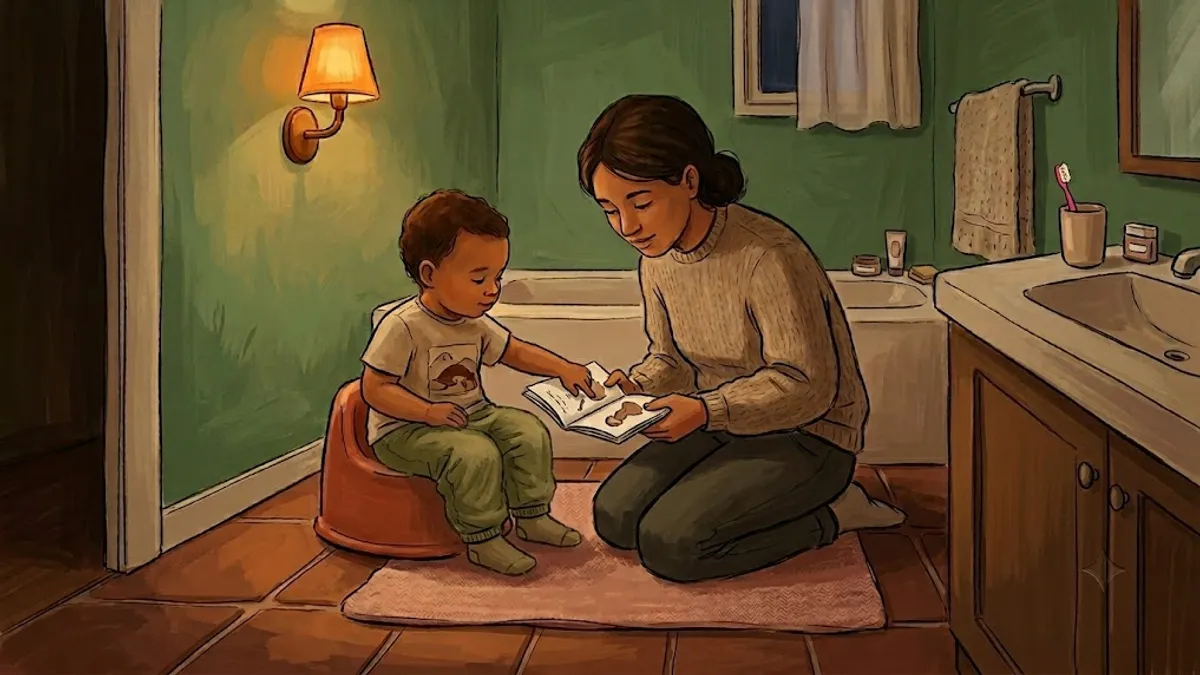
I am a parent sharing what worked at my house, not medical advice. For anything to do with your child's development or sensory needs, talk to your OT or doctor.
A potty training social story is a short, illustrated script that walks your child through the bathroom step by step, in plain words, before they ever have to do it for real. That rehearsal matters more for some kids than others: a 2022 study found 49% of autistic 4- and 5-year-olds weren’t toilet trained, against 8% of their typically developing peers, so the bathroom is genuinely confusing terrain and not a willpower problem.
I’m Nora Hayes, mom to Eli, my autistic 7-year-old, and what follows is the exact script we read until it stuck, along with how to read it, make it yours, and handle the days it all falls apart.
What a Potty Training Social Story Actually Does
A potty training social story does two things: it takes the fear out of the bathroom, and it leans on a method that’s been tested for decades.
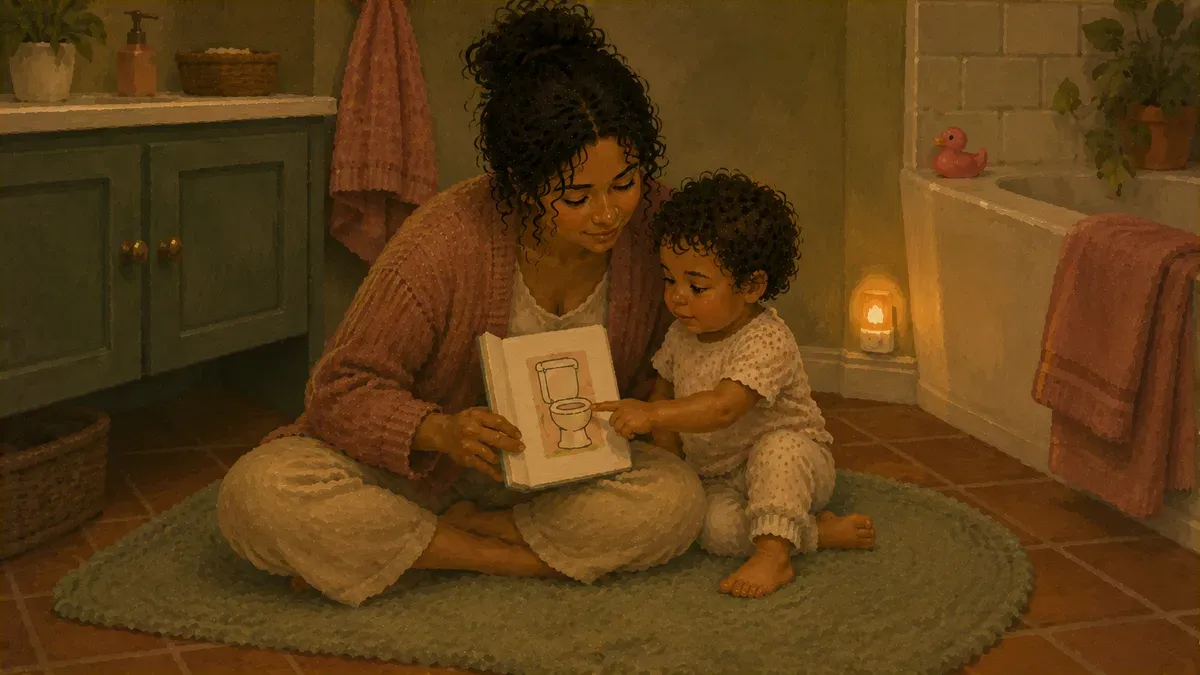
Why It Lowers Bathroom Anxiety for Autistic Kids
The bathroom is a sensory ambush. The fan roars, the flush is sudden and loud, the toilet is cold and tall, and nothing about it happens in an order your kid chose. For an autistic toddler who already reads the world as loud and unpredictable, that’s plenty of reason to plant their feet and say no.
A story rewrites the event into a sequence, and three things make that work:
- Same words, same pictures, same steps every single time
- That predictability is the whole mechanism
- The unknown becomes a routine your kid has already walked through on paper
Why that matters runs deeper than comfort. A 2012 study indexed on PubMed Central found that autistic children showed cortisol levels that stayed elevated forty minutes after a novel, unpredictable stressor, while other kids had already settled. Unpredictability hits harder and lingers longer. Take the surprise out, and you take a real chunk of the anxiety out with it.
Refusal usually isn’t defiance. It’s a nervous system bracing for something it can’t predict.
That’s the gap a story fills for a lot of neurodivergent kids: it turns a scary one-off into a sensory event they already know the shape of, which is exactly where anxiety reduction starts.
The Evidence Behind Carol Gray’s Method
This isn’t a Pinterest invention. The format comes from Carol Gray, who wrote the first social stories in 1990 for a student, then published the method shortly after. The recipe is deliberately plain:
- Short sentences
- First-person voice
- One small idea per page
“I sit on the potty. The flush is loud. That is okay.”
That simple language is exactly what a toilet training social story borrows. You’re not explaining plumbing. You’re narrating the steps in your kid’s own voice so the sequence, the social narrative of it, feels like theirs.
It holds up under scrutiny, too. The National Standards Project classified story-based interventions as an established, evidence-based practice for building social skills in autistic children. If you want the full backstory, here’s the social story method and its research base, and our breakdown of carole gray and why it works the way it does.
The Full Potty Training Social Story Script
Here are the exact pages we read with Eli, written so you can copy them straight onto cards or a slide.
Here is how to put the whole thing together:
- Copy each page below onto an index card or a slide.
- Snap a real photo of your bathroom for every step (your toilet, your sink).
- Read it in the same order, same wording, every time.
- Tape the finished strip at your child’s eye level.
The first part hands you the words; the second shows how to pin a picture to each page so the story works double-duty as a bathroom map.
The Word-for-Word Pages We Read
Predictability is the whole point, so the wording stays the same on Tuesday as it was on Monday.
One page, one step. That’s the rhythm of a good toileting social story.
- Page 1. “Sometimes my body tells me I need to pee or poop. My tummy feels full, or I feel a little wiggly.”
- Page 2. “When I feel that, I walk to the bathroom. The bathroom is where pee and poop go.”
- Page 3. “I pull my pants and underwear down.”
- Page 4. “I sit on the potty. I can hold the sides if I want. I stay until I am done.”
- Page 5. “Pee and poop come out into the potty. That feels okay.”
- Page 6. “I take toilet paper. I wipe until I am clean.”
- Page 7. “I pull my underwear and pants back up.”
- Page 8. “I flush. The water is loud for a second, then it stops. The loud part means it worked.”
- Page 9. “I wash my hands with soap and water. Now my hands are clean.”
- Page 10. “I did it. Using the potty is something I am learning to do.”
The flushing page earns its own line because the noise is what sends a lot of kids running. Naming it before it happens (“loud for a second, then it stops”) took the surprise out of it for Eli more than any reward sticker ever did. The wiping and handwashing steps are easy to rush past, but keep them in the sequence so the routine has a clear start and a clear end.
Pairing Each Page With a Visual
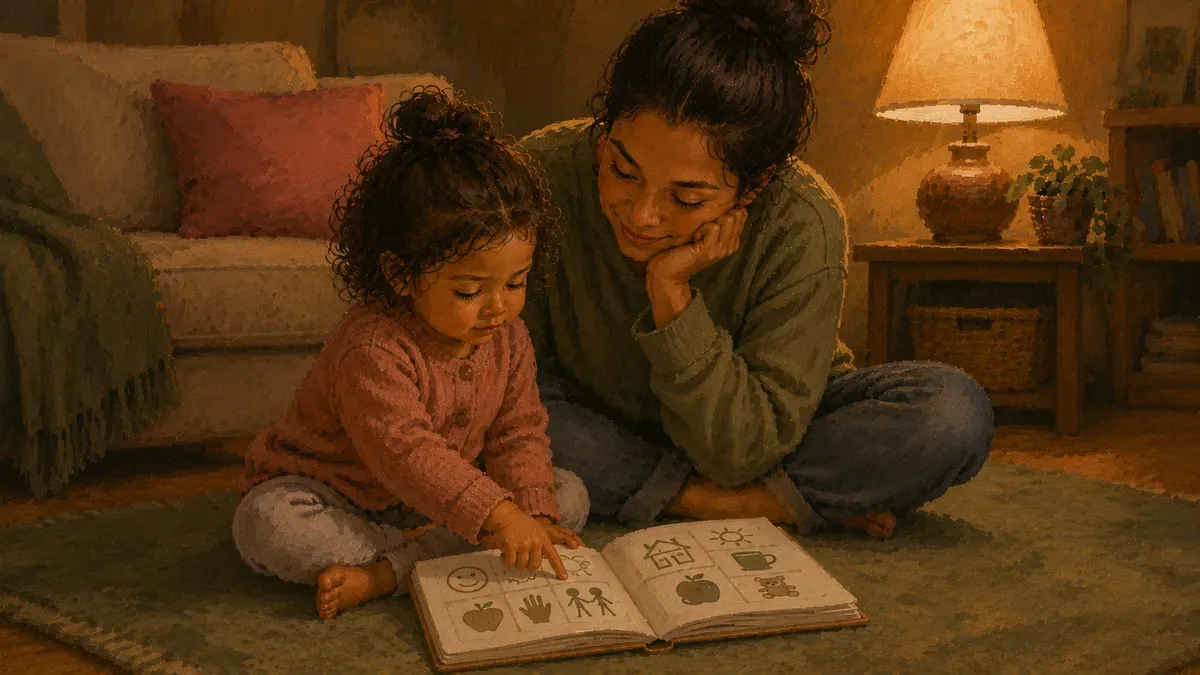
Now give every page a picture. One clear image per step, nothing busy, and the story quietly becomes a visual schedule your kid can follow even when you’re not reading aloud.
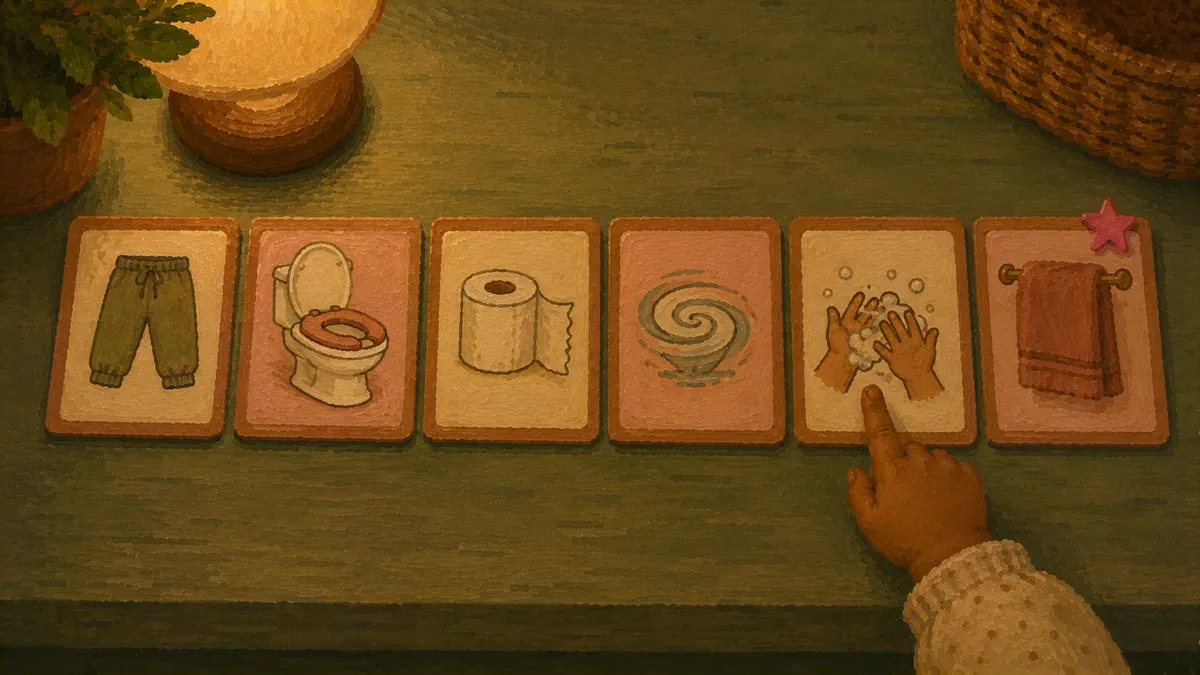
A real photo of your own bathroom usually beats a clip-art icon, because it’s the toilet they actually use.
This part isn’t just decoration. Visual supports earned their place in the research: the National Standards Project named visual schedules an established intervention that builds independence and the ability to plan for what’s coming next. Lean on that pairing, and you’re nudging real bathroom independence, not just narrating it.
Reading It So It Actually Sticks
A gorgeous story does nothing sitting in a drawer. How you read it, and how often, is what turns ten pages into a routine your kid actually trusts.
Why 40 Readings, Not 4
Here’s the part most of us get wrong. We read the story once, the kid still refuses the toilet, and we quietly shelve it. Repetition is the whole mechanism. In one randomized controlled trial, the gap between kids who got the story and kids who didn’t only showed up after reading a social story once a day for two straight weeks, and those gains were still holding at a six-week check-in.
So read it daily, at a calm, predictable time. Snuggled up before nap, or after breakfast, not mid-standoff at the bathroom door.
Read it when nothing is going wrong, never as a correction.
That last bit matters. The second the story becomes the thing you whip out after an accident, it turns into a lecture and motivation tanks. Keep it boring. Same couch, same calm voice, same time. By the tenth read, most kids can point to the picture before you turn the page.
If you want a deeper walkthrough on pacing and tone, here’s how to read social story sticks for the long haul.
Using a Special Interest Like The Loud House
Now for the lever that actually speeds up potty training. Autistic kids tend to run on whatever genuinely lights them up. A 2016 validation study of the Special Interest Motivation Scale found autistic people are more driven by deep interest and flow than neurotypical kids are.
So borrow that engine. If your kid is obsessed with a show, the story stops being a chore and becomes ten minutes about their favorite thing.
- Eli was deep in The Loud House, so we framed the toilet and potty steps as “what the kids in that house do too.”
- A train kid gets a story where the engine pulls into the bathroom station.
- A dinosaur kid? The T-rex flushes and washes those tiny arms.
Kids who read early and love words, the hyperlexic ones especially, will reread it on their own once their favorite characters are in it. That rereading is free repetition, and the motivation rides in with it. You’re not bribing. You’re meeting them where their brain already wants to be.
Making the Story Yours
A story about “a child” who uses “the potty” stays at arm’s length. The version that sticks stars your kid, in your bathroom, using the words your family actually says, so here’s what to swap and why the format you build it in matters.
Swapping Names, Photos, and Bathroom Words
Five things to swap before you print the first page:
- Your child’s name, on every single page
- A photo of their face on the cover
- Real photos of your toilet, your sink, your soap
- Your family’s words for pee and poop
- Any step they skip, dropped or simplified

Editable Template vs Free PDF
A locked free PDF looks like a bargain until you need to change one word and can’t. With toilet training, you will need to change things, constantly.
Your kid masters wiping but stalls on flushing. The handwashing page needs a new photo because you moved the step stool. None of that is possible on a flattened file you can only print.
That’s why editable social story templates you can actually customize earn their keep. You tweak as your child progresses, swap a photo in five minutes, and reprint. If you’re building a whole shelf of these, the same logic carries across social stories for kids with autism too, well past the bathroom.
When Things Go Sideways: Regression and Setbacks
So the story worked, and then one week it just stopped working. Before you panic or scrap the whole thing, here’s what’s actually happening and how to walk it back.
Handling Regression Without Restarting From Zero
A stomach bug, a week at grandma’s, a new daycare room, and suddenly the kid who had it down is having accidents again. That’s not failure. In a survey of 100 families, guidance on toilet training children with autism found that even into the teen years some toileting struggles persist, with the usual culprits being illness, medication changes, travel, and routine disruption. The skill isn’t gone. The routine got interrupted, and the predictability that held it together cracked.
Which is exactly why you don’t start over. Pull the same story back out and read it like you did at the beginning, calmly, at a set time. You’re not teaching a new skill. You’re rebuilding a familiar one, and a child who already knows the sequence usually snaps back faster than a child learning it cold.
Regression is the routine wobbling, not the skill disappearing, so rebuild with what already worked.
If the trigger was a big change like a move or a new sibling, it can help to pair the potty story with our social story about transitions so you’re calming the thing that actually rattled them, not just the bathroom part. Less anxiety, faster recovery.
Keeping the Story Consistent Across Home and School
A routine that’s rock-solid at home can fall apart the second your kid walks into a classroom. Autistic kids often don’t carry a bathroom routine from one place to the next on their own. Different toilet, different adult, different sequence, and the predictability they leaned on at home is gone.
The fix is boring and it works. Share the exact same story with the teacher, the aide, the babysitter, anyone who takes your child to the bathroom. Same words, same pages, same order. When the school reads the version your child already knows, they’re reinforcing one routine instead of asking the kid to relearn it from scratch in a strange room.
If you’re building a shelf of these for school and home, our full library of social stories keeps the format consistent so bathroom independence travels with your child wherever they go.
Found this useful? Save it for the next rough afternoon.
Questions parents ask me about this
What social story helps with potty training an autistic toddler?
A short, first-person social story that walks through each bathroom step in order works best: enter the bathroom, pull down pants, sit on the toilet, use the toilet, wipe, pull up pants, flush, wash hands, dry hands. Keep the language simple, one step per page, with a clear picture for each step. Reading it daily at a calm, predictable time helps it stick far more than reading it once right before a bathroom attempt.
At what age should I start a potty training social story?
Most families start when their child shows readiness signs, regardless of age, because autistic children often reach toileting readiness later than the typical window. The story itself does not require a minimum age; it just needs to match the child's communication level. If your child understands simple picture books and can follow a two-step direction, a social story is worth trying.
How long does it take for a toilet training social story to work?
Give it at least two weeks of daily reading before you judge results, because that consistent repetition is what builds the routine in the child's mind. Some kids show progress within a few days; others take longer depending on where they are in the readiness process. The story is one piece of the picture, not a standalone fix, and pairing it with a predictable bathroom schedule speeds things along.
What do I do about night-time potty training?
Night-time dryness is a separate developmental step from daytime toileting, and most children reach it well after they master daytime use. Focus the social story on daytime independence first. Once that is solid, you can add a separate night-time routine story if needed, but many families wait until daytime is consistent before tackling nights at all.
How do I handle wiping and handwashing in the story?
Include both as their own pages in the sequence so they register as non-negotiable steps, not optional add-ons. For wiping, break it into the specific motions your child needs using plain family language for the words they already know. Handwashing gets the same treatment, one step per page: water on, soap, scrub, rinse, dry. Naming each action separately prevents skipping and keeps the whole routine predictable.
Should I use real photos or drawings in the social story?
Real photos of your child in your actual bathroom work better than generic drawings or clip-art for most autistic children, because they show exactly what the child will see when the moment arrives. Drawings can work if real photos are not available, but they add a translation step the child has to do in the moment. A photo of your toilet, your sink, and your child performing each action removes any guesswork about whether the story applies to them.
Written by
Nora Hayes
Mom of two and a former preschool aide. I share the screen-free sensory play and calm-down ideas I test at my own kitchen table, plus what the moms in my little meet-up swear by. A parent passing on what works, not a doctor or a therapist.
More about NoraKeep going
All Social Stories-
 Social Stories
Social Stories for Kids With Autism: 20 Essentials
Social stories for kids with autism, made simple. Master the 6-step method and build the 20 essentials every autistic child needs.
-
 Social Stories
Social Story Templates: Edit Them to Truly Fit Your Kid
Free PDF social stories rarely fit your child. Learn to edit social story templates in minutes so every word, photo, and step is truly yours.
-
 Social Stories
No Hitting Social Story for Hands That Won't Listen
Hands that hit, bite, and push aren't bad, they're overwhelmed. This no hitting social story teaches safe hands and what to do instead.
-
 Social Stories
Personal Space Social Story: Teach Hugs & Asking First
Hug by rule or by choice? This personal space social story teaches kids to ask first, say no, and read body bubbles. Start using it today.