Fine Motor Skills Games for Preschoolers: 9 Busy Bags

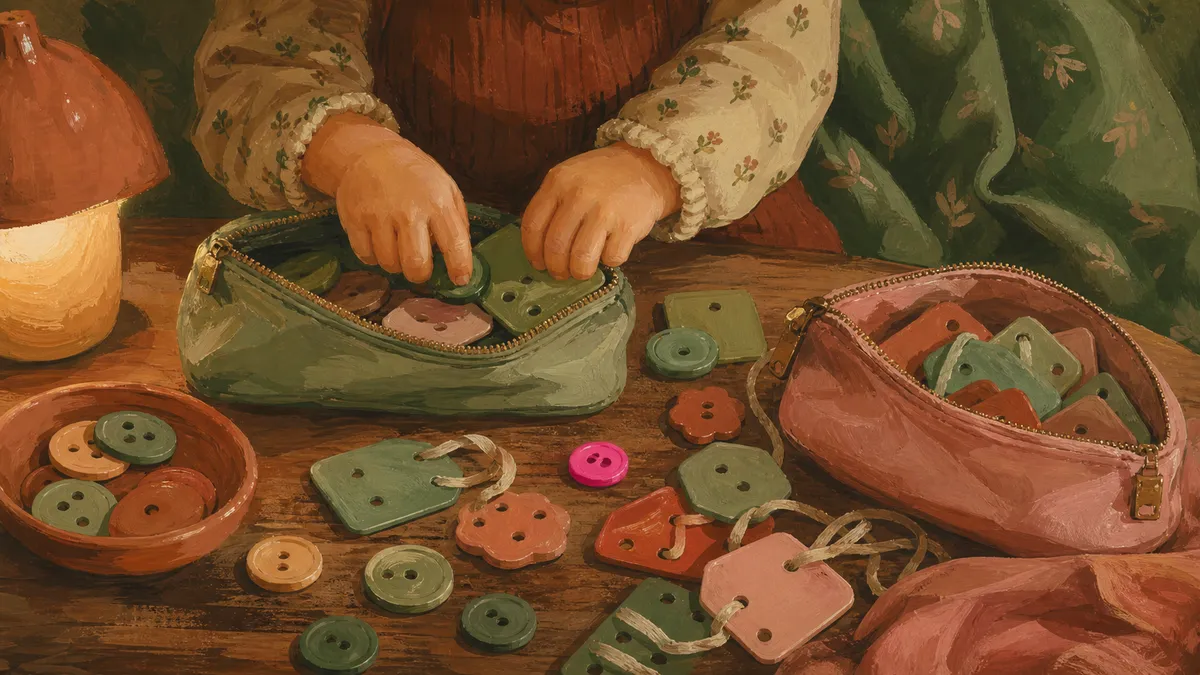
A busy bag builds fine motor skills when it makes those small hands pinch, twist, thread, or stack on purpose, not just shuffle pieces around to stay quiet. I’m Nora Hayes, a former preschool aide and mom of two, and I’ve run hundreds of these little setups at my kitchen table to learn which ones actually grow the pincer grip and which ones just buy a quiet ten minutes (both have their place, honestly).
All 9 games pack flat, survive the diaper bag, and keep a preschooler happily busy in a waiting room, a car seat, or wherever you end up far from home.
What Makes a Busy Bag Actually Build Fine Motor Skills
Not every quiet-time bag earns its spot. The ones that actually build little hands work three things at once, and they match what your kid can already do, so here’s what to look for before you waste an hour cutting felt.
The Pinch, Grip, and Coordination a Bag Should Train
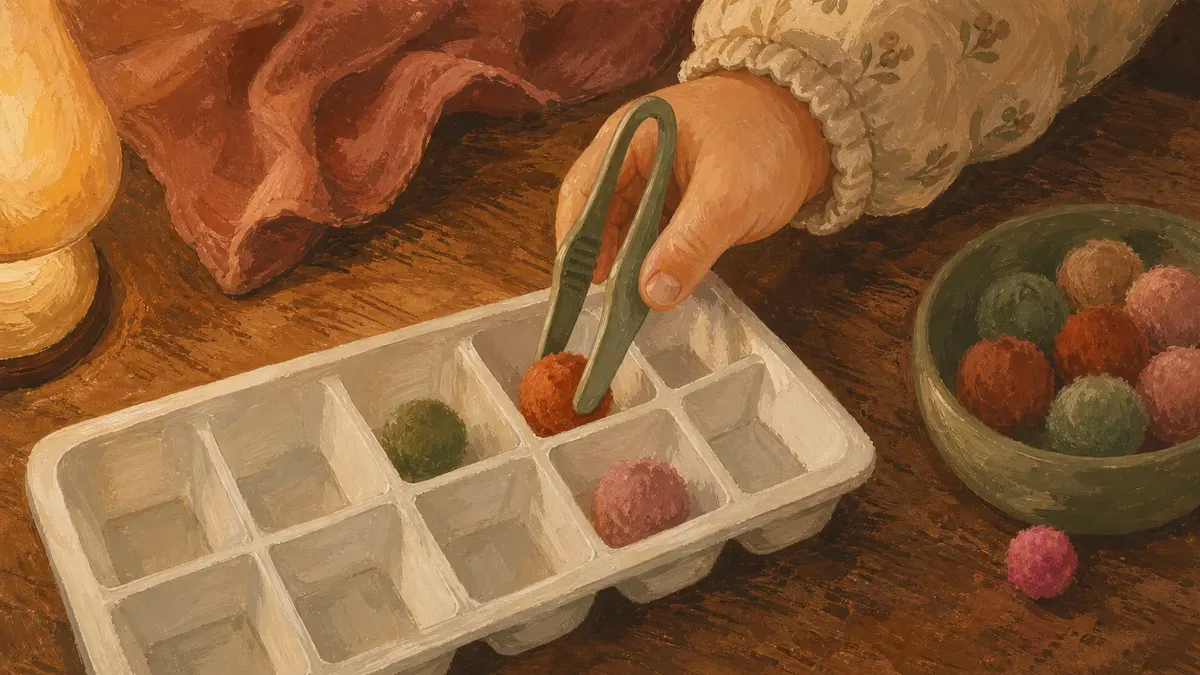
The magic isn’t the cute theme. It’s the pinch. A bag earns its keep when it makes your child work the pincer grasp, which is just thumb and index finger picking up something small. That tiny squeeze is the developmental precursor to holding a pencil and working zippers and buttons, per Cleveland Clinic, so a tweezer transferring pom-poms is doing real work, not just killing time.
The best fine motor games go further than one move, though. A bag worth keeping trains more than the pinch. You want hand strength and hand-eye coordination working in the same five minutes:
- Threading beads onto a pipe cleaner: one hand holds steady while the other guides the bead, which is bilateral coordination, both sides working together.
- The aim, the wiggle, the careful drop: that’s dexterity getting reps in.
A flimsy bag exercises none of it.
Matching the Setup to Your Child’s Age
The same bag can flop or shine depending on whose hands are in it. Scale it by two things: how big the pieces are, and how much precision the task demands.
- Age 2: fat pom-poms, big buttons, wide slots. The win is the grab, not the aim.
- Age 3: medium beads on a string, a fine motor milestone that arrives around this age, plus lacing cards with smaller holes.
- Age 5-6: tweezers, small beads, tracing, and tasks that need both hands.
If you want the full sequence behind these developmental milestones, here’s the real order fine motor activities develop in, and these travel-friendly development activities pair well with the fine motor tracing handwriting scissor skills you’ll work on once you’re back at the table. Match the setup to the kid, and quiet time does double duty as child development.
Packing a Busy Bag That Survives the Diaper Bag
The bag that looks great on your kitchen counter will fall apart by the second gas station stop. Before you pack anything, think containment first.
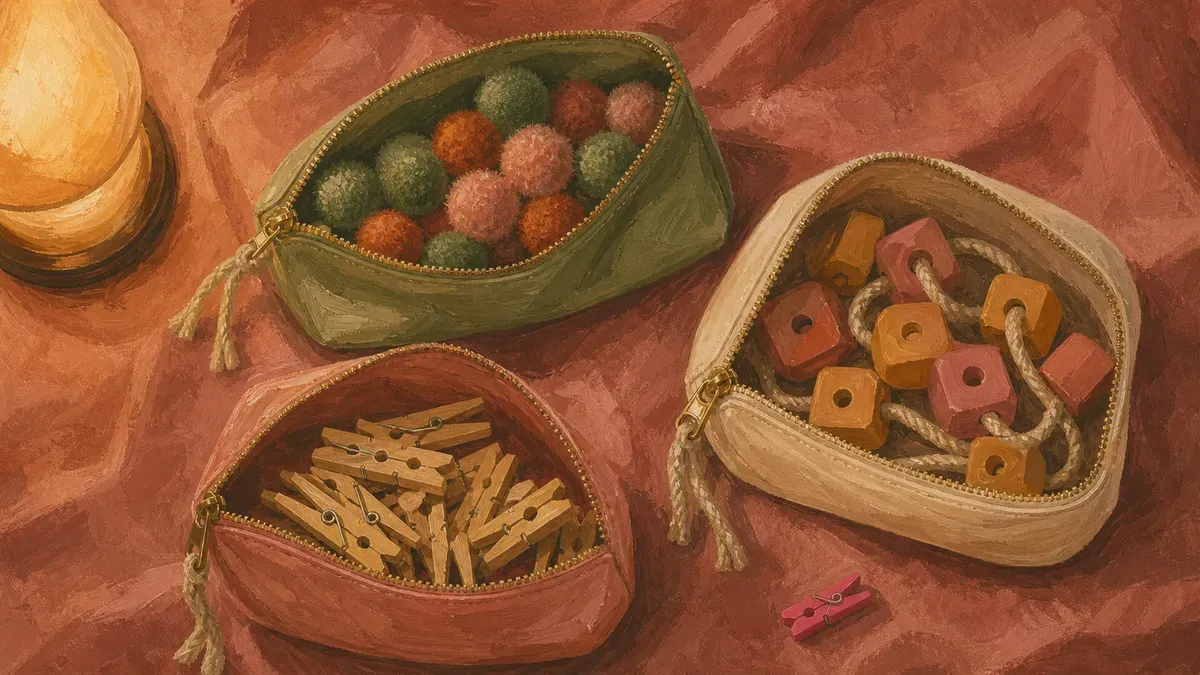
Quart-sized zip pouches are your friend. One activity per pouch, labeled with a marker. Pom-poms in one, mini clothespins in another, lacing beads in a third. Each pouch is self-contained, so when your three-year-old dumps it, you’re cleaning up one thing instead of everything.
- Containment by piece size. The age-appropriate rule from occupational therapy translates directly here: smaller pieces belong with older kids who have the pincer grasp to handle them. Under three, go bigger. A pom-pom beats a seed bead every time at that stage.
- Skip the fancy bins. Found materials pack better than purpose-built sensory kits. A cleaned-out spice jar holds exactly enough buttons or dried pasta for one sitting. A mint tin fits a row of mini pegs. Nothing rolls around.
- Weight check. A heavy bag means you won’t grab it. Keep each pouch light enough that the whole stack of three feels manageable in one hand.
- Reset in two minutes. This is the Montessori principle that actually matters on the road: each activity should be completable and re-packable without your help. If you have to reassemble it at a rest stop, it’s not a travel bag, it’s a project.
Start with three pouches. Rotate one new bag in each trip so the activities stay interesting without you having to prep something fresh every time. The bags that get used are the ones already in the diaper bag, not the ones you’re still planning to make.
9 Fine Motor Busy Bags That Travel Anywhere
Here are nine bags that actually earn their spot in the diaper bag, grouped by the skill they sneak in. Pick one from each group and you’ve got a rotation that keeps small hands working from the car to the waiting room.
- Pom-pom transfer
- Button drops
- Eyedropper color play
- Lacing beads
- Lacing cards
- Pipe cleaner threading
- Clothespin clip cards
- Coin sorting
- Small knobbed puzzles
Pinching and Transfer Bags
The whole job here is the pinch. Anything that makes your kid use thumb and finger to grab one thing and move it somewhere else is training the pincer grasp, and these three pack flat.
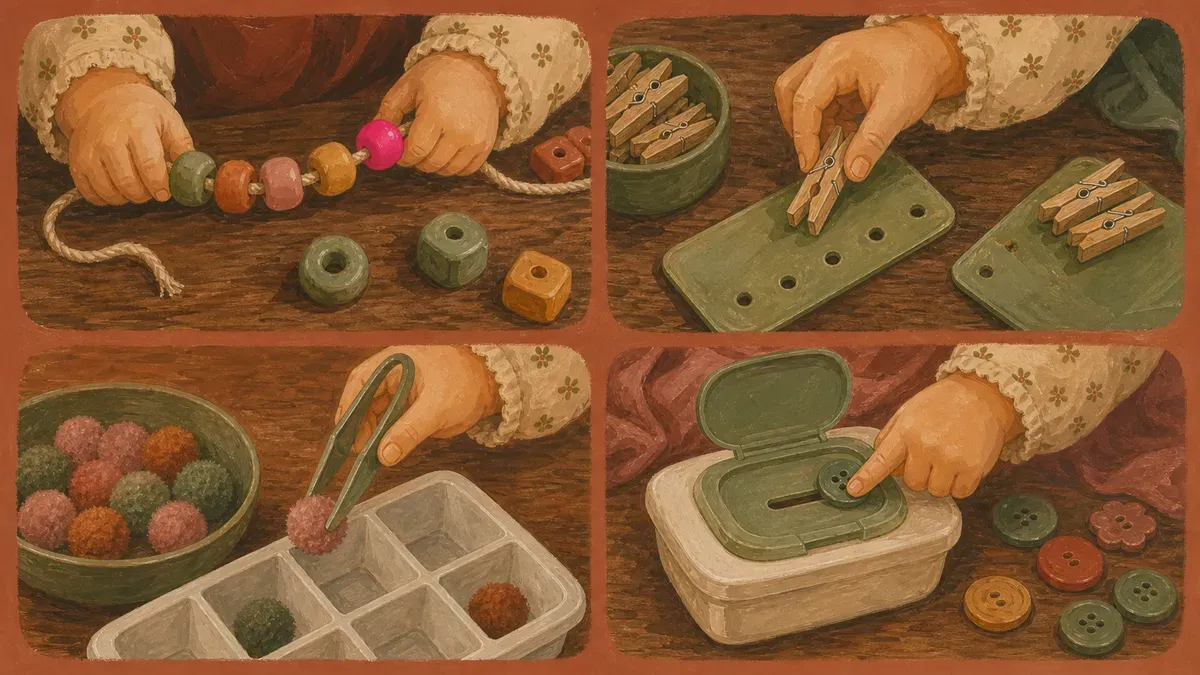
Start with the pom-pom transfer. A handful of craft pom poms, a set of kid tweezers, and two small cups or an ice tray. They pinch a pom pom, carry it across, drop it in the next slot. June will do this for a stretch I genuinely don’t understand, and the tweezers force the same grip a crayon needs.
- Button drops: Snap a slit-cut lid onto a wipes container and let them post buttons through one at a time. The narrow slot makes them align each button carefully, and that alignment is the real work.
- Eyedropper play: Pack a pipette and a few drops of food coloring. Squeezing drops into the wells of an empty egg carton turns into surprising focus.
Two cups, a handful of pom poms, and tweezers will out-last most battery-powered toys in your bag.
Keep pom poms and buttons for kids past the mouthing stage, and lean on these 20 pom pom activities quietly build more pinching practice at home.
Stringing, Lacing, and Threading Bags
Pinching is one hand. Stringing needs both, and that two-handed teamwork is exactly why these travel bags punch above their size.
Lacing beads come first. A shoelace with a knot at one end and a pouch of chunky beads, and they thread one bead after another. Stringing beads is a staple for occupational therapists working on bilateral hand coordination, dexterity, in-hand manipulation, and hand-eye coordination, according to NAPA Center. One hand holds the lace, the other feeds the bead. That’s the whole skill, and it travels in a sandwich bag.
- Lacing cards: Punch holes around a laminated shape and thread a shoelace in and out. This builds precursor skills for shoe tying and sewing, plus motor planning with every pass, per Your Therapy Source.
- Pipe cleaners: Thread through colander holes or string penne and pony beads onto a bent one. For older kids, write a letter on each bead and have them string a name. Letter recognition slips in quietly.
These threading setups are some of the most reliable fine motor games for kindergarten because the steady two-handed grip carries straight into pencil control.
Clipping, Sorting, and Puzzle Bags
This last group leans on hand strength and a bit of problem-solving, which makes it the sweet spot for older preschoolers and kindergartners who’ve outgrown the easy stuff.
Clothespin clip cards are the workhorse. Laminate a card with a number or picture and a row of dots, and they clip a clothespin onto the right answer. Clothespin clipping uses the same thumb-finger pinch as pencil grasp and buttoning, and occupational therapists reach for it to build pinch strength and finger isolation, as The OT Toolbox notes. That squeeze is harder than it looks, which is the point.
- Coin sorting: A handful of real coins or buttons and a few muffin-tin wells or a slotted bank. Picking up one piece at a time and dropping it through a snug slot works the pinch and the sort in one move.
Eli still likes this with a stack of pennies and a piggy bank when he needs a calm task.
Then the small puzzles. A few knobbed puzzles or peg boards pack flat and add a problem to solve, so they’re some of the better fine motor puzzles for a bag. Knobbed pieces force a real pinch to lift each one, and matching the shape to its hole is the thinking part.
- Skip the boxed jigsaws. Pack a four-piece knobbed board or a peg set in a zip pouch and you’ve got a problem-solving task that actually fits the bag.
These fine motor skills games for kindergarten do double duty: stronger hands for writing, and a quiet kid working a problem while you wait out a long line. That’s the win you’re packing for.
Picking the Right Bag for Your Child’s Age
The knobbed puzzle that keeps a five-year-old busy will frustrate a toddler and choke a one-year-old, so age drives the pick more than anything else. Here’s how I split the bags between the littlest hands and the bigger ones.
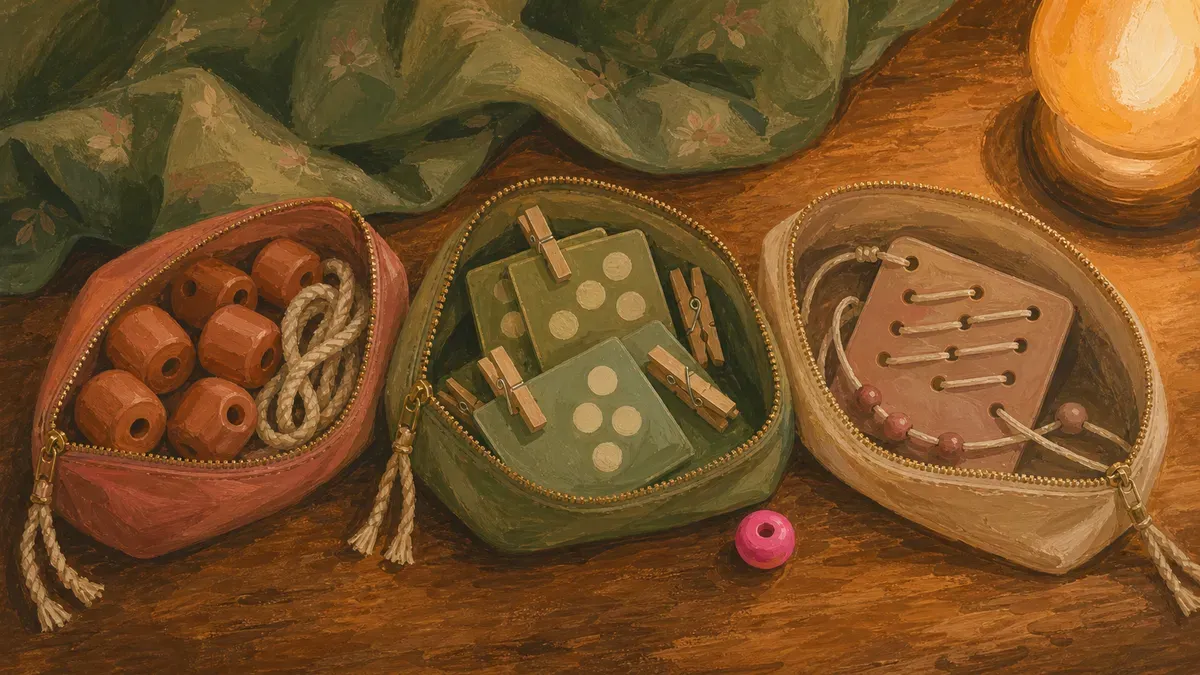
Toddlers and 2-Year-Olds: Big Pieces, Simple Wins
For the under-3 crowd, go big and go simple. One step, chunky pieces, instant payoff.
The safety rule isn’t optional at this age. Under federal law, any piece small enough to fit inside a cylinder 2.25 inches long and 1.25 inches wide counts as a small part and is banned from toys for kids under 3, per the CPSC’s choking-hazard guidance on age-appropriate play and safety. If a piece disappears into a toilet-paper tube, it stays out of a toddler’s bag.
The activities that actually build hand strength at this age are all about repetition with resistance.
- Snap large interlocking cubes apart and together
- Push fat blocks through a slot in a wipes-container lid
- Twist lids on and off containers
- Press pegs into a round hole
The right fine motor skill toys for 2 year olds give you real motor control practice and zero panic over what’s headed for the mouth.
Threes, Fours, and the Preschool Years
Around three, the bags get more interesting. Hands are steadier, the choke risk eases, and you can hand them real precision work. This is where threading, clipping, and play dough earn their pouch.
Fine motor toys for 3 year olds should ask for two hands at once.
- String medium beads onto a lace
- Clip clothespins onto a card
- Roll play dough into snakes and pinch off the ends
That pinch-and-roll is a quiet powerhouse for finger strength, and a handful of simple fine motor activities for preschoolers built around play dough will carry you through a lot of restaurant waits.
By four and five, dexterity has caught up enough for scissors and finer sorting. Fine motor skills toys for preschoolers work best when they have a clear finished result: a fully laced card, a row of pegs, a bead snake. A visible win keeps kids going, which is the whole point of fine motor toys for preschoolers. Match the developmental milestones, not the box’s suggested age, and the bag actually gets used.
Store-Bought Toys vs. DIY Busy Bags
The question I get most from the group: do you need to buy special toys for fine motor skills, or will a button and a piece of felt do the same job? Honest answer: both work. The difference is mostly about your time versus your budget.
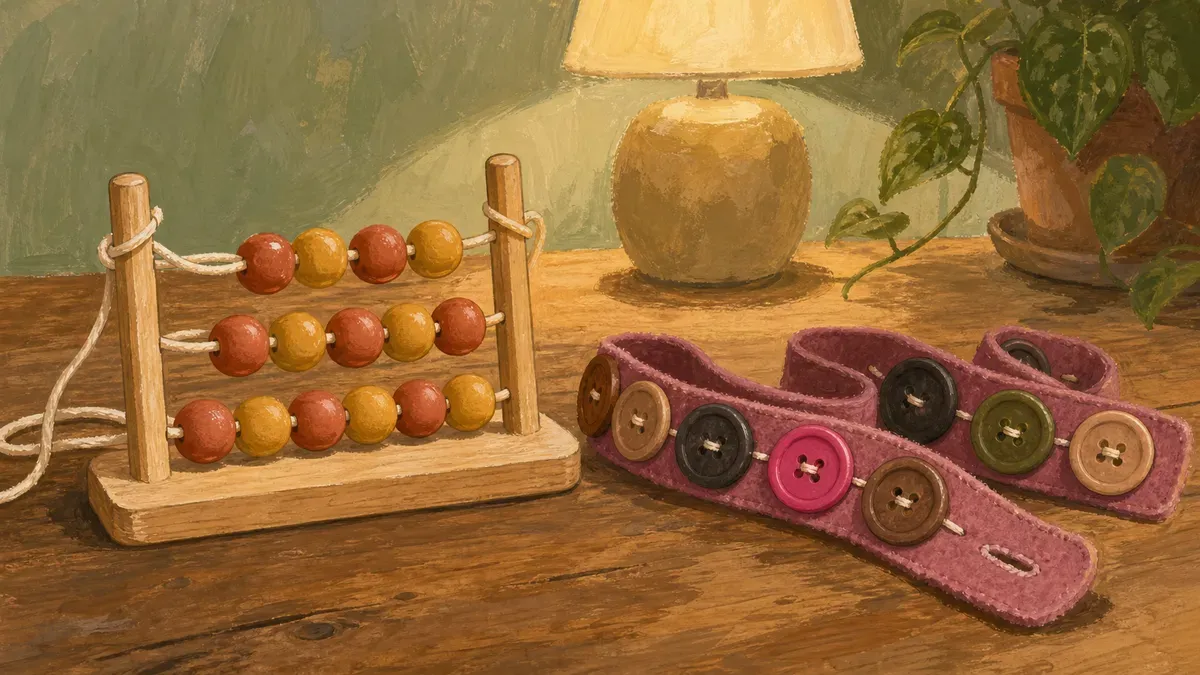
Store-bought toys to improve fine motor skills have two real advantages. They’re safety-tested, and the pieces stay together because that’s literally what they were designed for. A commercial lacing frame, a knob puzzle, a set of stacking rings: these hold up to a toddler’s particular brand of destruction in a way that a DIY version sometimes doesn’t. If your child sees an occupational therapist, your OT may already have favorites that double as therapeutic activities you can reinforce at home.
- Consistent piece size (important for safety checks)
- Durable enough to survive repeated bag in-and-out
- No prep time
Found materials win on cost and flexibility. A button snake costs under two dollars in supplies. A pipe-cleaner bead string is basically free. From a Montessori standpoint, real objects (actual coins, real buttons, genuine kitchen tools) carry more meaning than pastel plastic versions. Kids engage differently with things that belong to the adult world.
The honest trade-off: store-bought saves time; DIY saves money and often holds attention longer.
Neither is the better parent move. Swap between them. Start any session with a quick fine motor skills activity to warm up the hands before the bag comes out, and the source of the toy stops mattering almost entirely.
Keep the Fine Motor Practice Going at Home
The bags are for out-and-about. At home, you can go further.
Tracing and cutting practice are the natural next step once a child can handle the bag activities comfortably. Tracing builds pencil control without the pressure of writing actual letters, and it’s forgiving: if the line wanders, the world doesn’t end. Start with thick shapes on cardstock, then graduate to thinner lines as her hand steadies. A few minutes a day beats a long session once a week.
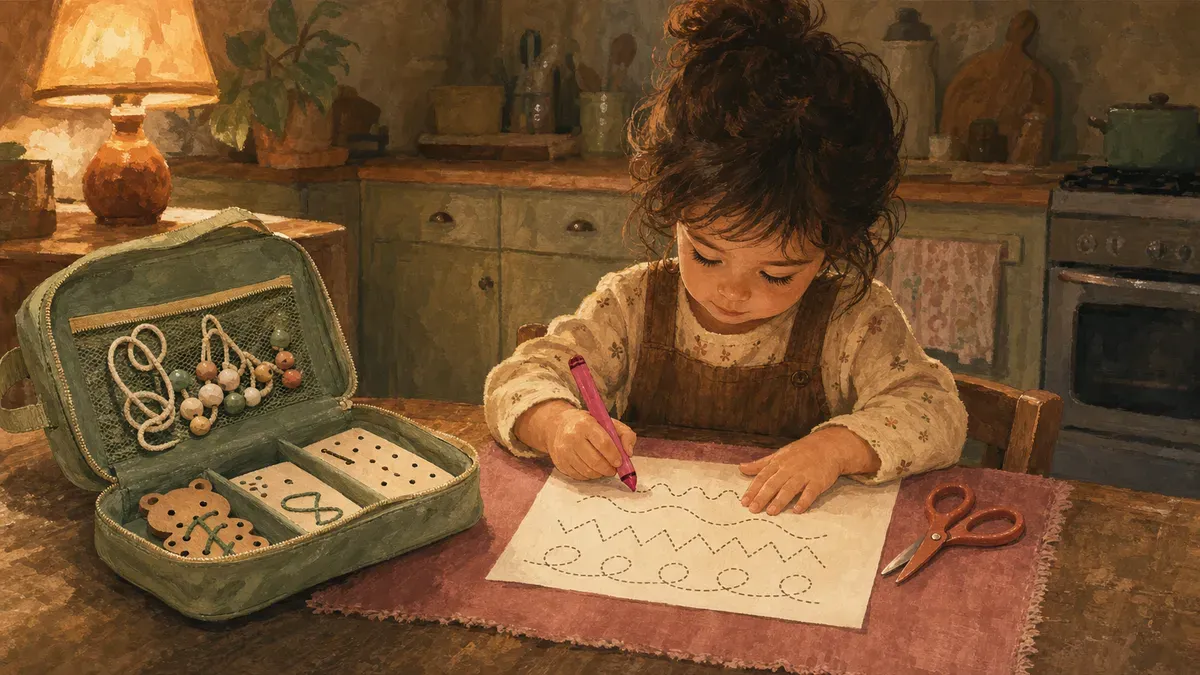
Scissor skills deserve their own mention. According to Your Therapy Source, cutting involves bilateral coordination, hand strength, eye-hand coordination, fine motor dexterity, postural stability, and sensory processing all at once. That’s a lot of systems working together, which is exactly why occupational therapy often uses cutting as a benchmark task. If your child struggles here, it’s rarely about effort. Check when to start scissor skills before pushing ahead.
At home, keep the tools accessible. A low shelf with a tray, some child scissors, and tracing sheets means the practice happens on her schedule, not yours. That low-effort availability does more than any structured lesson. For a fuller progression from pre-scissor work through cutting shapes and beyond, our full guide to building these skills at home lays it out step by step.
Found this useful? Save it for the next rough afternoon.
Questions parents ask me about this
What fine motor skills games work well for preschoolers on the go?
The best travel options combine a deliberate pinch or grip with a clear finished result: threading beads onto a pipe cleaner, clipping clothespins onto a card, or sliding coins into a slotted container. Rotating two or three pouches per trip keeps the novelty going longer than one big set of materials.
At what age can a child start using a busy bag independently?
Most kids manage a simple one-step busy bag on their own somewhere between two and three, once they can handle chunky pieces without mouthing everything. By three, many children can thread a medium-sized bead, clip a clothespin, and reset the activity themselves without help. Match the bag to what your child can already do rather than the box age. A bag that is slightly within reach feels satisfying, while one that is too hard just gets dumped.
How long should a preschooler stay busy with one fine motor bag?
For most preschoolers, ten to twenty minutes is realistic. Two minutes is still a win if it bridges a transition or holds attention through a checkout line. The skill repetition happens fast, and short sessions across many days add up more than one long sit.
Are busy bags safe for toddlers who still put things in their mouth?
Under three, assume anything small enough goes in the mouth. The Consumer Product Safety Commission bans small parts from toys marketed to children under three; check their small-parts guidance for what qualifies. For mouthing-age toddlers, keep busy bag pieces large: wooden drop blocks, play dough, chunky pegs. Save the beads and coins for when mouthing has stopped reliably.
What everyday household items make the best fine motor busy bags?
The pantry and junk drawer cover most of it. Dried pasta, large dried beans, measuring spoons, silicone muffin cups, craft sticks, and old muffin tins all pack flat or light. A set of clothespins and a piece of cardboard cut into a clip card costs almost nothing. Found materials often engage kids better than purpose-built kits because they feel like real-world objects rather than toys.
How do I keep busy bag pieces organized and clean while traveling?
Wipe pieces down with a damp cloth after each trip. Silicone, wood, and plastic all clean up easily. Keeping the pouches together in the outer pocket of the diaper bag means you can grab the whole rotation without repacking every time you leave the house.
Can busy bags help a child whose fine motor skills seem delayed?
Busy bags give a child with delayed fine motor skills extra low-pressure repetitions in a calm, self-paced setting, which is genuinely useful. They are not a substitute for evaluation or therapy. If you have real concerns about delays, an occupational therapist is the right starting point. What busy bags do well is fill the in-between moments with purposeful practice that does not feel like work to the child.
Written by
Nora Hayes
Mom of two and a former preschool aide. I share the screen-free sensory play and calm-down ideas I test at my own kitchen table, plus what the moms in my little meet-up swear by. A parent passing on what works, not a doctor or a therapist.
More about NoraKeep going
All Fine Motor-
 Fine Motor
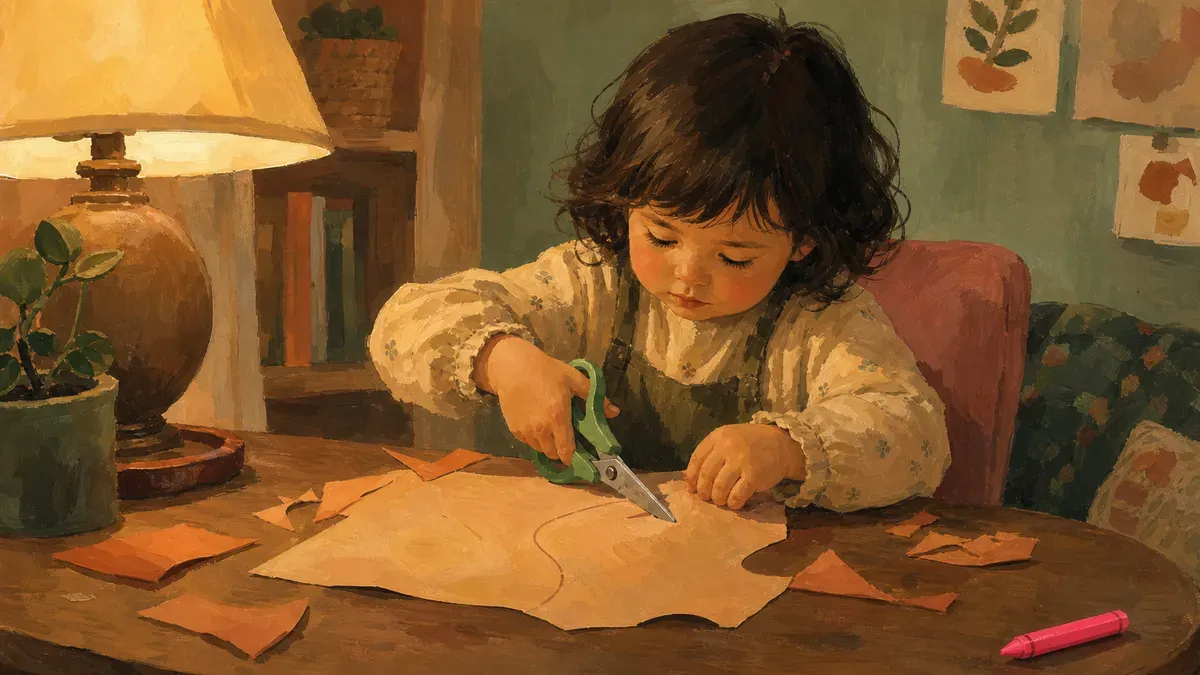
Cutting Worksheets: 15 Activities Beyond Straight Lines
Bored of straight lines? These cutting worksheets and 15 activities build scissor skills fast. Grab the free printables and start today.
-
 Fine Motor
Activities to Build Fine Motor Skills With Pom Poms
The hand strength behind neat handwriting starts with play. Try 20 pom pom activities to build fine motor skills your kid will actually beg to do.
-
 Fine Motor
Fine Motor Skills Activities for Preschoolers
Ready to write? Spot the 12 readiness signs and the fine motor skills activities for preschoolers that build the hand. Start now.
-
 Fine Motor
Fine Motor Skills Activities for 3-4 Year Olds
Worried your 4-year-old still scribbles? These fine motor skills activities for 3-4 year olds bridge scribbles to real letters. Start today.