Free Printable Shower Visual Schedule That Backs Up Therapy

Some links here are affiliate links. If you buy through one, I may earn a small commission at no extra cost to you. As an Amazon Associate I earn from qualifying purchases. I only point to things I'd actually use with my own two.
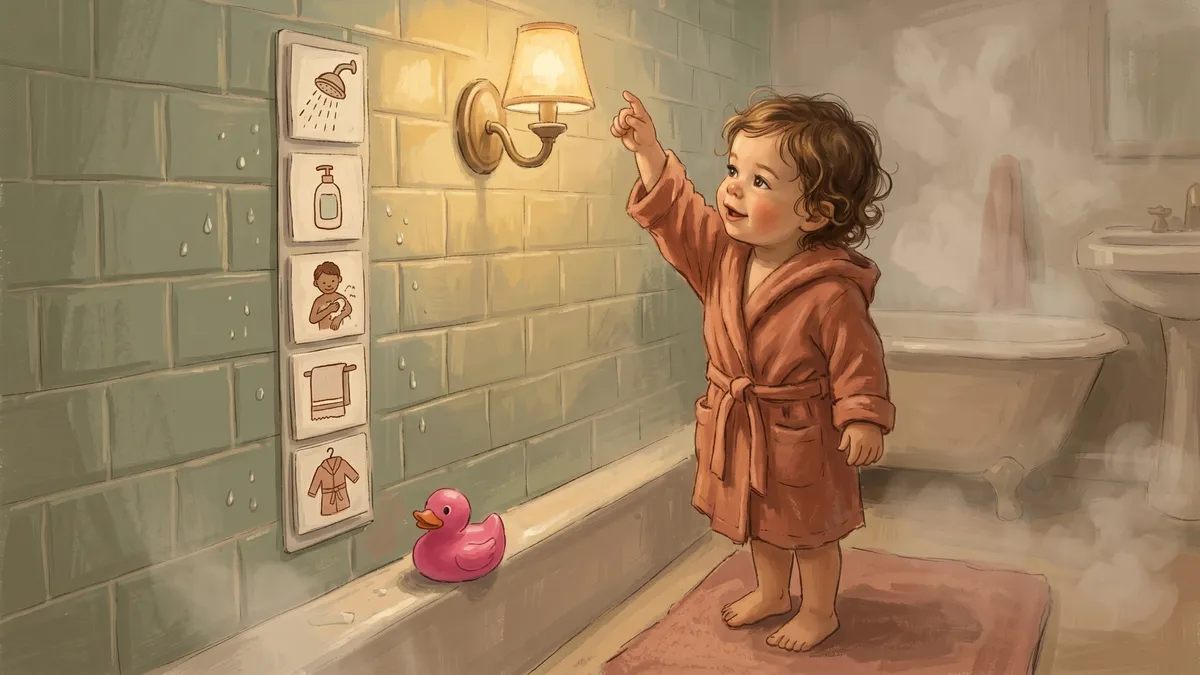
Yes, there’s a free printable shower routine visual schedule for kids, and you can have it taped to your tile tonight. I’m Nora Hayes, a former preschool aide and mom of an autistic 7-year-old, and a picture card for each shower step is how I stopped fighting Eli through bath time and started backing up what his speech and OT therapists were already teaching.
Grab the cards, build the set, mount it at eye level, and step back a little more each shower until they’ve got it.
The plan in brief:
- Print and laminate a 6-to-8 step shower card set, top to bottom.
- Velcro it to the bathroom tile at the child’s eye level.
- Run the same steps every shower, then fade one prompt each week.
Why a Shower Schedule Belongs in the Bathroom
Bathrooms stack a lot of sensory input into one short window.
- Exhaust fan noise and water pressure
- Temperature drop from warm room to cooler spray
- Water hitting the face and head
- Soap that stings eyes or feels wrong on skin
A laminated card set posted at eye level turns an unpredictable sequence into something your child can see coming. That predictability alone does real work: a neurophysiologic review of sensory processing in autism found that over 96% of children with ASD show hyper- or hypo-sensitivities across multiple sensory domains, which means the shower routine isn’t just uncomfortable. It can feel genuinely threatening.
Anxiety compounds that. A meta-analysis on anxiety in ASD estimated anxiety disorders in about 40% of youth with ASD, substantially higher than in typically developing peers. A visual schedule doesn’t treat anxiety, but it removes the “what comes next” dread that fans the flames.
The same logic applies to any kid who melts down at the transition. Children who struggle with visual schedules routines most are often the ones who need them most.
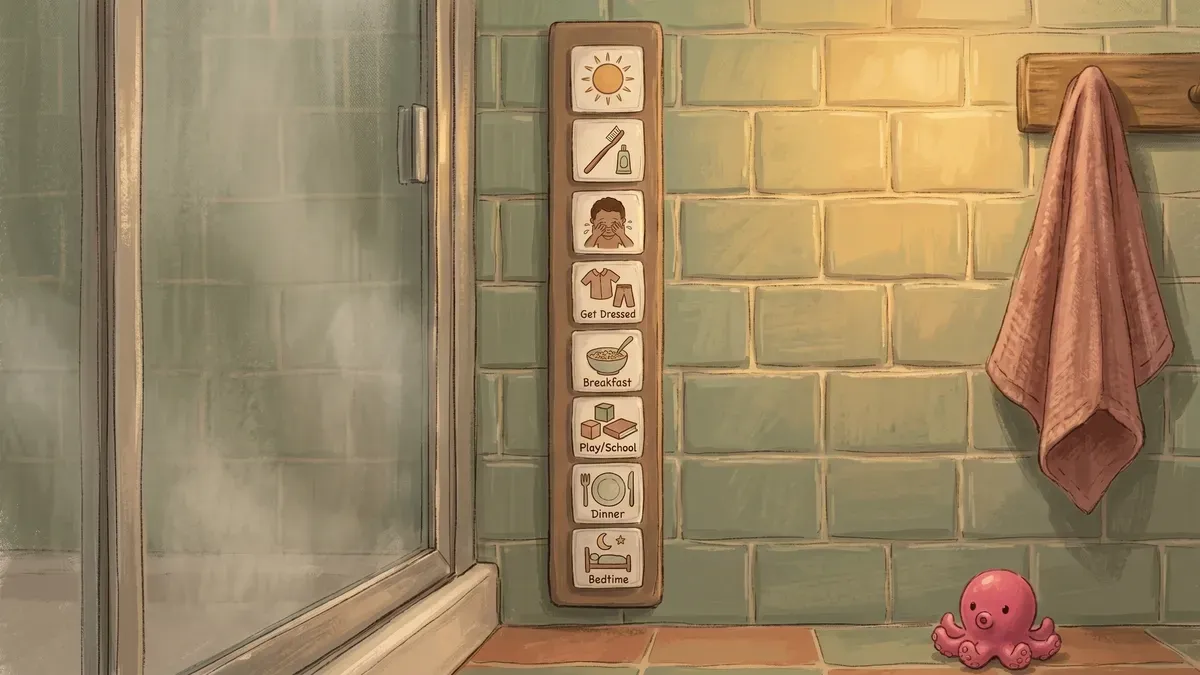
Put it where they can see it, not where you can. On the tile, at their eye level. That card set does the talking so you don’t have to.
Build the Shower Card Set Step by Step
Three steps get it built and running: print it, put it in order, and stick it where it counts.
Download and Print the Card Set
Grab the free printable and open it on whatever you’ve got, phone or laptop, then send it to the printer. You’ll see two versions in the download: real photos and simple illustrations.
Which one you pick depends on your kid, not on which looks cuter.
If your child is younger, or brand new to a picture schedule, start with photos. The Queensland autism education team recommends real photographs first for little ones, so snap your own bathtub if you can, and only move to the simpler line drawings once your kid can match an object to its picture on their own.
No printer? A drugstore photo kiosk prints them for pocket change.
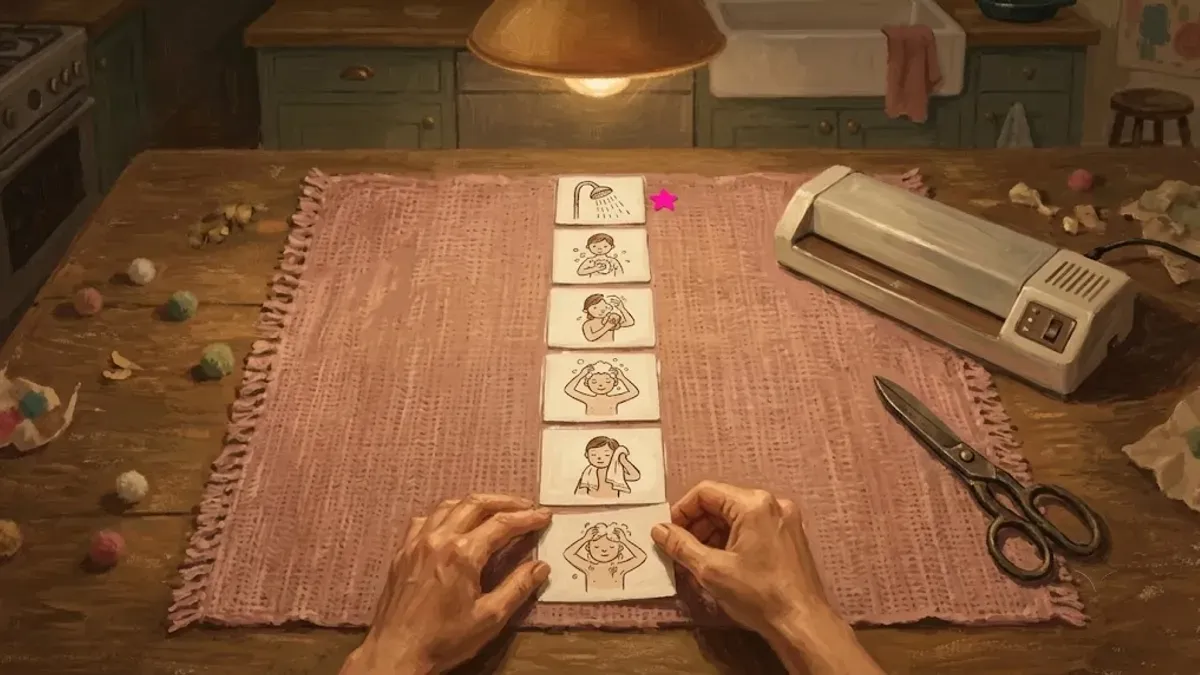
Once they’re printed, laminate them, or they’ll curl like a chip bag the first steamy shower. A cheap hot laminator earns its keep the second you’re making routine cards you want to last, and the Scotch one I’d point you to runs two rollers so the cards come out smooth, not bubbled. It’s an Amazon’s Choice sitting at 4.7 stars across more than 61,000 reviews, which is a lot of laminated flashcards and a fair sign it won’t jam on you halfway through. No laminator handy? Clear packing tape or a zip bag limps you through the first week.
If you want to test the waters with something smaller first, a printable first then board is the two-card baby version of this same idea.
Sequence the Steps Top to Bottom
Now the part that makes it actually work: order. A picture schedule only helps if the sequencing matches the real shower, so lay the cards out the way your kid actually moves through it.
Here’s the step-by-step run that works at our house, reading top to bottom:
- Undress
- Water on
- Wet hair
- Shampoo
- Body wash
- Rinse
- Water off
- Towel
Run it vertically, never side to side, so “done” always means moving down.
Vertical gives your kid structure they can feel: top is the start, bottom is the towel and freedom. Tweak the middle to match your own shower routine. Conditioner kid? Slot it after shampoo. The order is yours; the going-down direction stays.
Mount It Where Your Child Can See It
A gorgeous strip taped above the towel rack helps nobody. Mount it at your kid’s eye level, on the tile or the glass door, right where they’re standing when they need it.
The bathroom is the catch. Steam, splashes, and a daily routine that’s basically a sauna will wreck a flimsy strip fast.
Standard laminated paper can split or crease in that humidity, so either laminate yours well or skip the DIY entirely. The pre-made SchKIDules visual schedule set ships 93 laminated picture cards ready to hang, magnet- and Velcro-friendly, and built for exactly this kind of daily-routine wall. It’s an Amazon’s Choice at 4.6 stars from more than 1,100 parents and teachers, the kind of number that tells you it holds up in real bathrooms and classrooms, not just the listing photo.
For mounting, you’ve got two solid options:
- Velcro dots on the tile grout, peel-and-stick, cards come off to flip to “done”
- Suction cups on the glass door, no residue, easy to move. A two-pack of suction hooks rated 4.1 stars across 600-plus reviews grips glass, tile, or a mirror with no drilling and no tools.
Stick it up, step back, and let it run the show. The first few showers you’ll still be pointing at cards. That’s the job for now, and it’s exactly what we fade next.
How the Schedule Reinforces Speech and OT Goals
The cards aren’t just keeping the shower on track. Used right, they fold straight into the work your kid’s speech therapist and OT are already doing, and you don’t need a session plan to make it happen.
Carrying Over What the Therapist Started
Name every step out loud as you point to its card. “Wet hair. Now shampoo. Squeeze. Rub, rub, rub.” Boring to you, gold to a kid building language. Each card gives the word a picture to hang on, and saying it on cue, in the same order, every single night is repetition therapists would kill for.
Use the therapist’s exact words, not substitutes you make up on the fly.
- If she says “big breath, then go” before a hard sound, borrow that exact phrase.
- If the OT breaks rinsing into “tip head, count to five,” use her words, not your own.
That overlap matters more than it looks, because high-frequency practice is what moves the needle. One study of kids with apraxia, summarized in practice-production frequency research for apraxia, found that running 100 to 150 productions a session beat lighter practice, with one child’s consonant accuracy improving nearly 50% in 11 weeks.
Your shower routine won’t hit those numbers.
But naming eight steps, every night, is real sequencing and real motor-planning practice, the kind of executive functioning load a neurodivergent kid grows into one repetition at a time.
Handling Sensory and Water-Temperature Challenges
For a lot of kids, shower avoidance isn’t stubbornness. It’s the water hitting wrong. Too hot, too cold, too loud, all at once.
That’s not a behavior to push through. Sensory and anxiety run together more than people assume. A peer-reviewed study found that 60% of anxious youth had at least one sensory processing difficulty, versus 33% of kids without anxiety, and an overview of occupational therapy for sensory processing is exactly where those two threads get untangled.
So add a card for it. A “check the water” step, hand under the stream first, gives your kid a beat of control before the shower routine starts for real.
Add a temperature card with a thumbs-up: water gets checked and approved before anyone steps in.
Then ask the OT for the tactile tweaks. A softer stream setting, a handheld so the water never hits the face by surprise, warming the bathroom first. Small changes, fewer fights. For a deeper setup, our visual schedule autism home guide walks through the sensory side step by step.
Adding AAC and Spoken Cues
Not every kid can say the steps back to you, and that’s fine. Pair each card with a way to communicate it instead, based on where your kid is right now:
- Emerging language: you say the phrase and they echo what they can. “Shampoo.” Maybe you get “poo.” That counts. - Not using speech yet: set a single recordable AAC button or a tablet symbol beside each picture, so tapping it is how they request the next step. You record the word once (“rinse,” “all done”) and it plays back on every press, turning one cheap button into a voice for that step. It’s an Amazon’s Choice at 4.0 stars across 190-plus reviews, and I’d start with a single button for the step your kid fights hardest before buying a whole row.
This isn’t a nice extra. Roughly 25 to 35% of autistic children stay minimally verbal even after early intervention, per chla.org, which is why AAC sits right alongside the picture schedule rather than waiting behind it. Tapping “rinse” to make rinse happen teaches the same thing the cards do: I act, the world responds.
That back-and-forth, request then response, builds the independence a neurodivergent kid carries way past the bathroom. Our visual schedule nonverbal toddler walkthrough covers pairing AAC with cards if your kid isn’t talking yet.
Adapt the Schedule for Autism, ADHD, and the IEP
The shower schedule isn’t just a home tool. For a neurodivergent child on an IEP, it can be written in as a real support, and knowing that changes how you present it to a team.
Under IDEA, an IEP must include services based on peer-reviewed research to the extent practicable, per guidance on visual supports in the IEP from the U.S. Department of Education. Visual schedules clear that bar. If the team isn’t already using them, bring a laminated card set to the next meeting and ask.
The schedule looks a little different depending on the child:
- Autistic kids often need the predictability locked down tight. Same card order, every night. If something changes (new soap, new showerhead), give a verbal heads-up before the bath, not mid-step.
- Kids with ADHD struggle with sequencing more than motivation. The cards carry the sequence so the brain doesn’t have to hold it. Visual schedules for adhd work a bit differently here, with shorter windows and more movement breaks built in.
- Both profiles benefit from a first-then board when resistance spikes. “First rinse, then done” is faster than negotiating.
One note on the special ed side: if you want this written into a schedule goal on the IEP, ask the SLP or OT to draft the language. You bring the tool, they bring the paperwork.
Fade the Prompts as Independence Grows
Once the tool is in place, the job shifts: you want your kid moving through the shower without you beside them for every card. That does not happen by pulling support away all at once. Research published in the Journal of Applied Behavior Analysis found that effective fading procedures varied by individual learner and that withdrawing prompts abruptly undermined the gains. Gradual, monitored removal is what holds.
Here is how the sequence typically goes:
- Start fully prompted. Stand beside them, point to each card, name each step aloud.
- Drop the verbal cue. Point to the card, stay quiet, wait for them to act.
- Drop the point. Stay nearby but let them scan and move through the sequence on their own.
- Step back. Wait outside the door, available but not in the room.
- Check in at the end only. “Did you get through all your cards?” keeps the daily routine structure without hovering.
Monitor what breaks down. If your kid stalls at one card, add the prompt back at that step and fade from there again. One regression is not failure. It is data.
A solid visual schedule template can grow with your child as executive functioning builds. And if you want to apply the same idea across the whole day, our full library of home routine schedules has formats for morning, meals, and bedtime too.
Found this useful? Save it for the next rough afternoon.
Questions parents ask me about this
Is there a free printable shower routine visual schedule for kids?
Yes. You can download a free printable shower routine card set, print it at home, and laminate or sleeve the cards before hanging them in your bathroom. Look for sets that include the full undress-to-towel sequence, since having every step pictured is what makes the schedule work. Photo-based versions are easiest to find and tend to be the most useful for younger or newly schedule-using kids.
How many picture cards should a shower visual schedule have?
Six to eight cards covers the full routine without overwhelming most kids. That range gives you enough steps to be clear (undress, water on, wet hair, shampoo, body wash, rinse, water off, towel) without turning the wall into a poster. If your child is just starting out or pushes back on the full sequence, a first-then board with two cards is a fine place to begin.
How do I keep a paper shower schedule from getting wet?
Laminating the cards is the most reliable solution. A standard hot laminator costs very little and the pouches are inexpensive in bulk. If you want something more durable for high-steam bathrooms, slide the laminated cards into a waterproof plastic sleeve or use a page protector mounted with suction cups. Avoid regular tape on tile. It fails fast in humidity.
Should I use photos or illustrations on the shower cards?
Start with photos, especially for young children or any child who is new to picture schedules. Realistic photos are easier to connect to the actual task. Line drawings work well once your child has solid object-to-picture matching skills and can recognize what an illustration represents. If your child is already comfortable with picture books or illustrated schedules elsewhere in the house, illustrated cards are fine from the start.
What age should a child start using a shower visual schedule?
Most children can begin following a simple two- or three-step picture sequence by preschool age. A full six-to-eight step schedule is realistic for many kids around four or five, though the right time depends more on where your child is developmentally than on a number. Children who already follow a morning or bedtime picture schedule are usually ready to transfer the same skill to the shower routine.
Can a visual schedule help a child who refuses to shower?
Often, yes, but only when the refusal is rooted in not knowing what comes next or feeling overwhelmed by the sequence. Predictability lowers that threat response, and seeing every step laid out removes the guesswork that fuels resistance. If the refusal is primarily sensory (the water pressure, the temperature, the sound), pairing the schedule with sensory adjustments like a softer stream or a handheld showerhead tends to work better than the schedule alone.
Written by
Nora Hayes
Mom of two and a former preschool aide. I share the screen-free sensory play and calm-down ideas I test at my own kitchen table, plus what the moms in my little meet-up swear by. A parent passing on what works, not a doctor or a therapist.
More about NoraKeep going
All Visual Schedules-
 Visual Schedules
Visual Schedule Printable: 20 Picture Cards + Free PDF
Visual schedule printable with the 20 picture cards every toddler home needs. Free PDF to download, print, and start using tonight.
-
 Visual Schedules
Visual Schedules: A Beginner's Guide for Parents
Most visual schedules fail before day three. Learn how they work and build your first board in 5 steps your child will actually follow. Start today.
-
 Visual Schedules
Toddler Schedule: Build One With Picture Cards
Your 2-year-old can't read a clock yet. Build a toddler schedule with picture cards in 5 steps that stop nap fights and meltdowns. Start today.
-
 Visual Schedules
Free Printable Daily Routine Chart Kids Will Follow
Grab a free printable daily routine chart your child will actually follow, plus picture cards and tips to make any routine stick. Download now.